

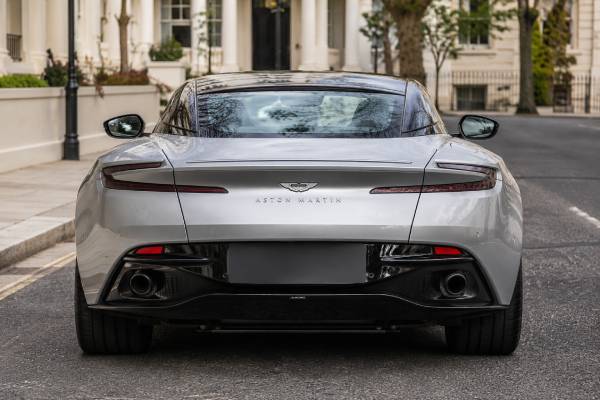
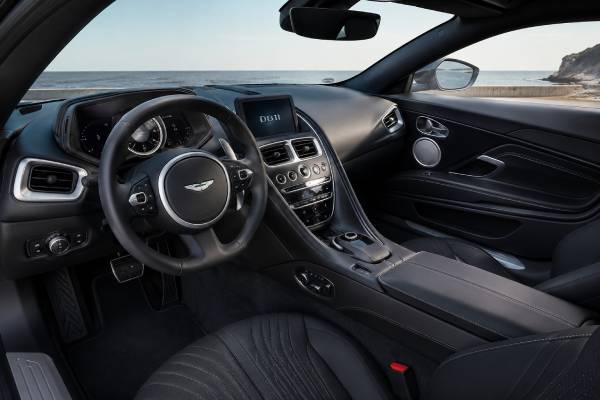
The 2022–2023 Aston Martin DB11 V8 Coupe is the final and most powerful factory version of the standard V8 coupe. For model year 2022, Aston Martin raised output from 503 to 528 bhp—535 PS—and increased the claimed maximum speed from 187 to 192 mph. The 4.0-litre twin-turbo engine still produces 675 Nm and drives the rear wheels through a rear-mounted eight-speed transaxle, preserving the lighter 49:51-balanced character that distinguishes the V8 from the V12. These late cars benefit from the developed AM5 platform and the youngest build dates, but they are not maintenance-light simply because they are newer. Battery condition, software, cooling-pack cleanliness, tire age, brake measurements, adaptive dampers, transaxle behaviour, camera systems, and hand-finished body condition still determine whether a car is ready to use. Buyers also need to verify the 528 bhp calibration rather than relying on a 2022 registration, since build and model-year dates can overlap. A well-documented example offers perhaps the clearest all-round DB11 formula: substantial performance, responsive steering, usable fuel economy, and final-production maturity.
Table of Contents
- What the 2022 power update changed
- The late M177 installation and rear-transaxle layout
- 2022–2023 V8 coupe specifications
- Performance, handling, and everyday range
- Late-production equipment and ownership usability
- Service, tires, brakes, cooling, and electronics
- Inspection and choosing a final-year V8 coupe
What the 2022 power update changed
The 2022 model-year update raised the V8’s peak output to 535 PS, equivalent to 528 bhp, and allowed the engine to sustain torque farther into the rev range. Aston Martin also raised the claimed top speed to 192 mph. The fundamental chassis and drivetrain layout remained familiar.
The change did not turn the DB11 into a different model. It remained a 2+2 grand tourer with adaptive damping, electric steering, a rear transaxle, mechanical limited-slip differential, brake-based torque vectoring, and the bonded-aluminium AM5 structure.
In normal driving, the extra output is most noticeable during sustained acceleration and at higher engine speeds rather than as a dramatic increase in low-speed torque. The 675 Nm figure stayed the same. A 503 bhp car can therefore feel very similar around town, while the 528 bhp version has greater performance headroom.
Model-year identification is essential. A car registered in 2022 may have been built to the earlier specification, and a late 2021 production car may be sold as a 2022 model depending on market conventions. Use the VIN, factory build sheet, production date, original invoice, and authorised diagnostic data.
The update also coincided with broader changes to Aston Martin’s model presentation and configurator. Equipment and option combinations can differ by market, so avoid assuming that every 528 bhp car has the same wheels, seats, audio, or driver-assistance features.
These cars represent the final standard DB11 V8 coupe before the DB12 replaced the model. Final-year status can support desirability, but condition remains decisive. A 2023 car with storage-related corrosion and repeated battery discharge may be less ready than a 2022 example driven and serviced regularly.
The strongest reason to choose the late V8 is balance. It delivers nearly the straight-line performance of the V12 in ordinary road conditions, carries less mass over the nose, returns better fuel economy, and avoids the extra thermal and service demands of the twelve-cylinder engine. It does not replace V12 character; it offers a different and often more usable solution.
The late M177 installation and rear-transaxle layout
The 4.0-litre twin-turbo V8 belongs to the Mercedes-AMG M177 family, but its DB11 installation is Aston Martin-specific. Aston developed the intake, exhaust, engine mounts, wet-sump arrangement, calibration, cooling integration, and relationship with the rear transaxle.
The two turbochargers sit inside the V of the engine, shortening exhaust paths and improving response. Heat concentration is significant, so sound oil, clean cooling systems, correct warm-up, and proper shutdown after hard use matter.
Peak torque of 675 Nm arrives from 2,000 rpm. A healthy engine should start promptly, idle evenly, and build boost without surging, hesitation, smoke, fuel smell, or repeated warnings. Turbo noise may be audible, but metallic contact or a siren-like tone requires investigation.
Power travels through a torque tube to the rear-mounted ZF eight-speed automatic. This arrangement moves gearbox mass rearward and contributes to the published 49:51 distribution. It also means driveline faults can involve front mounts, torque tube, rear gearbox, differential, shafts, or software.
Test the transaxle in every relevant condition. Selection into Drive and Reverse should be prompt, creep should be controlled, and light-throttle shifts should be smooth. Manual changes and kickdown should become quicker in sport modes without flare or harsh impact.
A speed-related whine, repeated thump, or delayed engagement should not be dismissed as adaptation. Record software status, but inspect fluid history, mounts, leaks, and mechanical behaviour. Relearning procedures are not a substitute for diagnosis.
Cooling capacity depends on several heat exchangers and fans. Debris can lodge between cores where it is invisible from the grille. Inspect the stack from accessible rear surfaces, look for stone damage and dried residue, verify reservoir levels and caps, and observe fan operation after heat soak.
The engine’s AMG family relationship can simplify some parts knowledge, but it can also invite incorrect assumptions. Service oil, filters, procedures, control software, and fault interpretation should follow Aston Martin information for the exact VIN. A technician familiar only with Mercedes applications may not understand the DB11’s transaxle and electrical architecture.
Modification history deserves attention. ECU and gearbox tunes, valve controllers, filters, downpipes, and exhaust changes can alter heat, emissions, sound, and insurance. Ask for the original calibration and parts, and verify whether the car can be returned to a documented factory baseline.
2022–2023 V8 coupe specifications
The late V8 coupe uses Aston Martin’s 528 bhp calibration of the M177-based engine with a rear-mounted ZF transaxle. Its 2022 update adds high-rev performance while retaining the lighter front axle and rear-biased balance of the earlier V8 chassis. The figures below apply to the 535 PS or 528 bhp model-year 2022 update. Earlier 503 bhp cars should not be relabelled using these values merely because they were first registered in 2022.
| Specification | Value |
|---|---|
| Engine | Mercedes-AMG M177-based 4.0-litre twin-turbocharged V8 with Aston Martin-specific installation and 22MY calibration |
| Displacement | 3,982 cc |
| Fuel | Premium unleaded gasoline |
| Maximum power | 528 bhp (535 PS / 393 kW) |
| Maximum torque | 675 Nm (498 lb-ft), sustained higher in the rev range than the earlier tune |
| Specification | Value |
|---|---|
| Transmission | Rear-mounted ZF eight-speed automatic transaxle |
| Drive and differential | Rear-wheel drive; mechanical limited-slip differential; brake-based torque vectoring |
| Front and rear suspension | Independent double wishbones front; multi-link rear; three-stage adaptive damping |
| Steering | Electric power-assisted rack-and-pinion |
| Brakes | Ventilated steel discs, six-piston front and four-piston rear calipers |
| Specification | Value | Standard or condition |
|---|---|---|
| 0–100 km/h (0–62 mph) | about 4.0 seconds, manufacturer 0–100 km/h (0–62 mph) | Manufacturer claim |
| Top speed | 309 km/h (192 mph) | Manufacturer claim |
| Fuel-tank capacity | 78 L (20.5 US gal) | Nominal capacity |
| U.S. fuel economy | 2022–2023 U.S. rating: 18 mpg city, 24 mpg highway, 20 mpg combined | EPA cycle; exact year and body style should be checked |
| Specification | Value |
|---|---|
| Length | about 4,750 mm (187.0 in) |
| Width | about 1,950 mm body; 2,060 mm including mirrors |
| Height | about 1,290 mm (50.8 in) |
| Wheelbase | 2,805 mm (110.4 in) |
| Kerb weight | about 1,760 kg (3,880 lb), published coupe kerb figure; equipment can alter mass |
| Weight distribution | 49:51 front/rear |
| Specification | Value |
|---|---|
| Body and seating | 2+2 coupe |
| Wheel format | 20-inch staggered wheels; design depended on specification |
| Typical factory tire sizes | 255/40 ZR20 front; 295/35 ZR20 rear |
| Luggage capacity | 270 L (about 9.5 cu ft) |
Performance, handling, and everyday range
The late V8 coupe is fast enough that its advantages are better measured in confidence and usability than in full-throttle tests. It combines a 192 mph claim with a chassis that remains approachable in GT mode and agile on smaller roads.
The 528 bhp tune carries more power at the upper end while maintaining strong low-speed torque. Overtaking can be completed with a modest downshift, and full acceleration should remain linear. Hesitation or sudden power reduction under load may indicate fuel, ignition, boost, temperature, or control issues.
GT mode should soften throttle and damper responses and encourage early shifts. Sport should hold gears and make the exhaust more present. Sport Plus should be immediate without becoming chaotic. If mode changes are barely perceptible, test damper commands, exhaust valves, steering settings, and software.
Reduced front mass remains the V8’s defining chassis quality. The coupe turns in readily and feels less nose-led than the V12, while the rear transaxle keeps the car stable under power. This does not make it small: width, long doors, and low bodywork still require care in urban use.
Tires determine whether the rear-drive balance feels progressive. Verify correct staggered sizes, matching high-performance construction, recent date codes, proper pressure, and even wear. A mixed or aged set can cause tramlining, intervention, and poor wet traction.
The large steel brakes should produce a firm pedal and repeatable stopping. Measure discs and pads, inspect inner faces, and test from several speeds. Cars stored in damp conditions can develop corrosion or pad deposits despite low mileage.
Fuel economy is unusually reasonable for the performance. U.S. EPA figures for 2022–2023 V8 cars are 18 mpg city, 24 highway, and 20 combined. Real use depends heavily on traffic, temperature, speed, trip length, fuel quality, and the frequency of boost.
Long-distance range benefits from the nominal 78-litre tank, but never plan to the last litre. Fuel availability, detours, and high-speed consumption can change the margin quickly. Use the required premium grade and avoid storing the car for months with degraded fuel.
Road-test at steady motorway speed, over broken surfaces, and through low-speed manoeuvres. Check wind noise, wheel balance, driveline vibration, steering centre, damper control, cameras, parking sensors, and climate performance. A strong DB11 should feel calmer as distance increases rather than revealing a growing list of irritations.
Late-production equipment and ownership usability
Late build does not mean modern infotainment by current standards. The DB11 retained its established digital cluster and Daimler-derived central interface, so buyers should judge reliability and equipment rather than expecting DB12-level connectivity.
Test every cluster layout, warning display, controller, touchpad where fitted, Bluetooth call, audio source, USB port, navigation function, camera view, parking sensor, and steering-wheel button. A stable older system is preferable to a poorly integrated aftermarket screen.
Phone-integration modules are common upgrades. Ask who installed the system, where the module sits, how it receives power, and whether wiring was cut. Check for battery drain, audio noise, lost camera functions, and delayed shutdown.
The front cabin is generous, while the rear seats remain occasional. They work best for children, short trips, coats, or extra bags. The 270-litre boot favours soft luggage. Inspect the boot floor and side cavities for moisture, damage, or non-standard wiring.
Seat options and trim vary. Check heating, ventilation, memory, lumbar support, full movement, and leather condition. Compare driver wear across bolster, wheel rim, pedals, door pull, controller, and key. Heavy restoration on one surface should have an explanation.
The long frameless doors use powered window indexing. Glass should drop when the handle is operated and seal after closing. Slow movement, scraping, wind whistle, or water tracks can point to voltage, regulator, alignment, or seal issues.
Surround-view cameras and parking sensors are practical necessities. Check image stitching, lens clarity, guidelines, audio alerts, and operation after the car is warm. A low bumper impact can damage cameras, sensors, splitter, undertray, and mounting brackets together.
Build specification affects value. Carbon exterior pieces, roof treatments, premium audio, rare paint, unusual leather, and Q content may be desirable, but replacement cost can be high. Confirm what was factory fitted and retain original parts after reversible changes.
Both keys, books, pouches, mobility equipment, tools, and battery-conditioning lead should be present. A complete handover package signals organised ownership and reduces avoidable replacement expense.
The most usable car is not necessarily the most heavily optioned. Prioritise comfortable seats, functioning climate control, good cameras, a quiet cabin, clean luggage space, and a colour combination that can be maintained. An impractical show specification may be less satisfying on the long journeys the DB11 was built to make.
Service, tires, brakes, cooling, and electronics
Annual service and active prevention remain the foundation of late DB11 ownership. Newer build dates reduce age but do not remove sensitivity to low voltage, heat, storage, and expensive wear items.
Use the exact Aston Martin schedule and fluid specifications for the VIN. Confirm engine oil, filters, plugs, coolant, brake fluid, transmission, differential, belts, and inspections. Keep itemised invoices rather than relying on a general “service completed” entry.
Battery care comes first because unstable voltage can affect drivetrain, roofless body electronics, cameras, handles, seats, and network communication. Use the recommended conditioner, test reserve capacity, and measure parasitic draw if discharge recurs.
Following a weak-voltage episode, restore a sound supply and capture a complete diagnostic report. Distinguish historic undervoltage codes from faults that return at normal voltage. Replacing a battery without documenting the before-and-after condition can hide a continuing problem.
Cooling maintenance includes cleaning between stacked heat exchangers, inspecting stone damage, checking reservoirs and hose joints, confirming fan stages, and watching temperature after slow traffic and heat soak. Record coolant additions and trace any recurring loss.
Oil or coolant on undertrays needs source tracing. Remove or lower panels as appropriate, clean the area, inspect hot and cold, and recheck after driving. Fluid can travel far from the original leak.
Tires should be replaced for age, condition, mismatch, or wear. Inspect inner shoulders and repaired punctures, confirm correct stagger, and align after replacement. Keep the before-and-after geometry report.
Brake service should use measured disc thickness, pad depth, fluid condition, caliper inspection, and both disc faces. Dry brakes after washing and avoid long damp storage. A low-mileage car can need brakes from corrosion before wear.
Adaptive dampers and links should be checked for seepage, play, damaged boots, and noise. A failed component can make the car ride poorly in every mode. Replace worn parts before alignment and verify that mode changes remain distinct afterward.
Campaign and software status should be checked by VIN through an authorised source. A skilled independent specialist may provide excellent routine service, but factory systems remain important for updates and records.
Maintain a financial reserve for tires, brakes, batteries, cameras, trim, low-volume body parts, and diagnostic time. Depreciation does not reduce replacement-part cost. A planned reserve protects both the car and the owner’s decisions.
Inspection and choosing a final-year V8 coupe
A pre-purchase inspection should verify the 528 bhp specification and establish condition before any premium is paid for a final-year car. The process needs a cold start, Aston-capable diagnostics, lift access, a full road test, and a hot recheck.
Match the VIN across the vehicle, build sheet, invoice, registration, service history, and diagnostic report. Confirm model year, output, market equipment, original wheels, options, and any Q content. Do not use registration date as the only proof.
Record battery voltage and scan every module before clearing faults. Observe cold cranking, smoke, idle, warning messages, fuel smell, and coolant smell. A pre-warmed car removes valuable evidence.
On the lift, inspect the cooling stack, engine and turbo areas, exhaust, torque tube, transaxle, differential, suspension, dampers, brakes, wheel barrels, tires, undertrays, jacking points, and signs of leaks or impact.
Road-test GT, Sport, and Sport Plus; automatic and manual shifts; low-speed manoeuvres; steady cruise; acceleration; braking; broken surfaces; cameras; climate control; windows; seats; and audio. Allow heat soak, inspect again, and repeat the scan.
Measure paint and examine bonded aluminium and composite bodywork. Check clamshell bonnet fit and catches, panel alignment, fasteners, adhesive seams where visible, AeroBlade paths, spoiler operation, wheel housings, and floor edges. High-quality documented paint is different from hidden structural work.
Review history chronologically. Annual service, battery, tires, brakes, alignment, campaigns, software, repairs, and ownership periods should agree with mileage and physical wear. A seller should explain gaps, repeated battery replacement, or recurring warnings.
Ask directly about ECU and transmission tunes, exhaust valve control, downpipes, filters, spacers, springs, wheel changes, wraps, coatings, trackers, and phone modules. Retained original parts and professional invoices reduce uncertainty.
Compare with earlier 503 bhp V8s, late 630 bhp V12s, and the DB12 according to intended use. The early V8 may offer better value; the V12 offers unique engine character; the DB12 has newer technology and a substantially reworked platform. The 2022–2023 V8 occupies a useful middle ground as the most developed standard DB11 V8.
Choose the example that needs the least explanation. A final-year badge is not a repair. Fresh matched tires, measured brakes, stable electronics, clean cooling, smooth shifts, documented paintwork, and complete history are the features that make the late 528 bhp coupe worth seeking. They also give the next workshop a truly dependable baseline for future service.
References
- Aston Martin launches new online configurator and reveals 22MY updates offering more power, and enhanced choice 2021 (22MY Update)
- SUBLIME CHOICES: DB11 NOW OFFERED WITH V8 ENGINE 2017 (V8 Engineering)
- Owner’s Guides | Aston Martin 2026 (Owner Documentation)
- Aston Martin Luxury Car Servicing | Aston Martin 2026 (Service Information)
- 2023 Aston Martin DB11 V8 2023 (EPA Fuel Economy)
Disclaimer
This guide is informational rather than a repair instruction or guarantee of condition. Verify the 528 bhp model-year specification, procedures, fluids, software, components, and campaigns through official records for the exact VIN, build date, and market.
A share on Facebook, X/Twitter, or another network is appreciated when the article helps someone choose a late V8 coupe responsibly.