

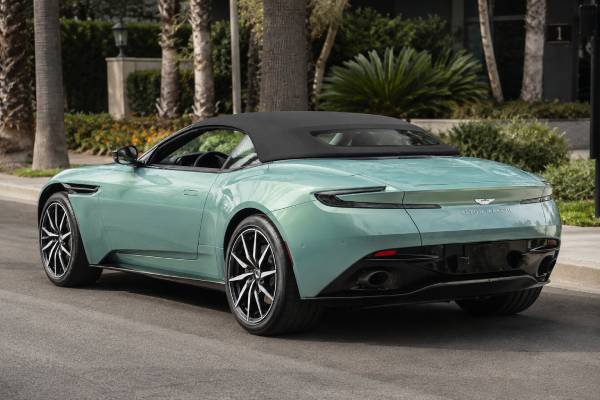
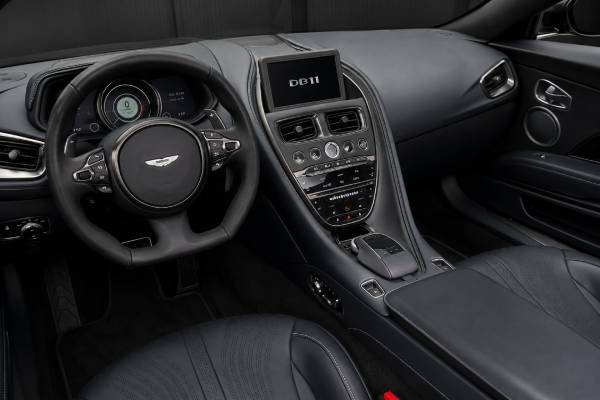
The 2022–2023 Aston Martin DB11 Volante is the final and most powerful factory version of the DB11 convertible. Aston Martin’s 2022 model-year update raised the 4.0-litre twin-turbo V8 to 528 bhp, or 535 PS, and increased the claimed top speed to 192 mph while retaining 675 Nm, rear-wheel drive, a rear-mounted eight-speed transaxle, adaptive damping, and the eight-layer folding fabric roof. The extra output gives the late Volante stronger high-rev performance, but the ownership essentials remain grounded in convertible engineering: stable battery voltage, smooth roof cycles, clean drains, correctly indexed windows, dry carpets and electronic spaces, healthy cooling, fresh tires, measured brakes, and complete service records. Because registration date and model year can overlap, buyers should verify the 528 bhp calibration from factory data rather than assuming every 2022-registered car received it. These final cars are attractive for their developed specification and younger age, yet low mileage can conceal storage-related deterioration. A well-kept example is a highly capable open grand tourer; an unresolved leak or electrical problem can make its final-year premium difficult to justify.
Table of Contents
- The final and fastest DB11 Volante
- Power update, transaxle, and convertible structure
- 2022–2023 Volante specifications
- Touring performance with 528 bhp
- Roof operation, drainage, and interior protection
- Late-model service and storage planning
- How to inspect and value the last DB11 convertible
The final and fastest DB11 Volante
The late Volante is the quickest standard open DB11 because the 2022 model-year V8 update raised output from 503 to 528 bhp and the top-speed claim from 187 to 192 mph. Torque remained at 675 Nm, so the change is strongest at higher engine speed rather than as a large increase in low-rev shove.
It also represents the end of the AM5-generation convertible. The DB12 Volante succeeded it with newer technology and a revised platform, making the 2022–2023 DB11 the mature closing version of the original turbocharged DB11 open car.
Final production can create false confidence. A car may be newer, but batteries still discharge, tires age, drains block, fabric marks, and brake discs corrode. A 2023 car stored damp or repeatedly started without driving may need more recommissioning than a higher-mileage 2022 example used regularly.
The model-year boundary requires documentation. Some cars first registered in 2022 may have the earlier 503 bhp tune, while a late build can be recorded differently across markets. Verify VIN, production date, factory specification, certificate of conformity, original invoice, and authorised diagnostic information.
There was no regular V12 DB11 Volante. The 528 bhp V8 is therefore the factory performance peak for this body. Advertisements mixing 630 bhp V12 data with a Volante are incorrect unless they describe a non-standard conversion, which would require extensive scrutiny.
The open car remains a 2+2. Front occupants receive the intended luxury experience; rear seats are occasional and can serve as luggage space. Roof packaging reduces boot flexibility compared with the coupe, so soft bags and disciplined loading are important.
A buyer should value the final Volante for integrated capability rather than top speed alone. Its useful qualities are roof-up refinement, roof-down airflow, immediate torque, long-distance stability, and the ability to change character through drive modes. Every one of those qualities depends on systems beyond the engine.
Power update, transaxle, and convertible structure
The M177-based V8 is Aston Martin-specific in installation. The company developed its intake, exhaust, mounts, wet-sump arrangement, calibration, cooling package, and connection to the rear-mounted ZF eight-speed transaxle. It should be serviced with DB11 data, not a generic AMG schedule.
Two turbochargers sit inside the engine’s V, improving response but concentrating heat. The late calibration sustains output higher in the rev range, which increases the importance of correct oil, clean heat exchangers, proper warm-up, and sensible cool-down after hard use.
The torque tube links the front-mid engine to the rear gearbox. Moving the transmission rearward helps the Volante achieve a published 47:53 balance despite reinforcement and roof mechanism mass. The layout makes the car feel more rear-led than its long bonnet suggests.
Transaxle behaviour should be consistent from cold to hot. Drive and Reverse selection should be prompt, low-speed creep controlled, and light-throttle changes smooth. Sport modes should quicken shifts without flare, repeated impact, or hesitation. A software reset cannot cure an active leak, worn mount, or mechanical whine.
The open structure uses additional reinforcement and its own damper calibration. The windscreen frame, steering column, doors, and dashboard should remain composed over diagonal bumps. Excessive shake may come from wheel balance, tires, suspension wear, poor body repair, or roof and seal movement rather than an unavoidable convertible trait.
The roof is an eight-layer fabric K-fold design. Its drive system coordinates header latch, bows, windows, deck movement, sensors, and control modules. Stable voltage and correct luggage-divider position are essential for reliable cycles.
Published cycle times are approximately 14 seconds down and 16 seconds up, with operation allowed at low speed under specified conditions. Use the exact owner’s guide limits. During inspection, start stationary on level ground and observe both sides.
Thermal and structural systems interact in real use. Slow scenic traffic can demand fans and air conditioning while the roof mechanism and cabin electronics remain active. A weak battery, marginal cooling component, or non-standard accessory can reveal itself only after a long summer drive.
2022–2023 Volante specifications
The final Volante mates the 528 bhp V8 to the DB11 rear transaxle, adaptive suspension, and reinforced convertible body. The eight-layer roof and its mechanism remain central to packaging, mass distribution, and ownership even after the 2022 power increase. These tables apply to the 535 PS or 528 bhp model-year 2022 update. Earlier 503 bhp Volantes should retain their original data even if first registered during 2022.
| Specification | Value |
|---|---|
| Engine | Mercedes-AMG M177-based 4.0-litre twin-turbocharged V8 with Aston Martin-specific installation and 22MY calibration |
| Displacement | 3,982 cc |
| Fuel | Premium unleaded gasoline |
| Maximum power | 528 bhp (535 PS / 393 kW) |
| Maximum torque | 675 Nm (498 lb-ft), sustained higher in the rev range than the earlier tune |
| Specification | Value |
|---|---|
| Transmission | Rear-mounted ZF eight-speed automatic transaxle |
| Drive and differential | Rear-wheel drive; mechanical limited-slip differential; brake-based torque vectoring |
| Front and rear suspension | Independent double wishbones front; multi-link rear; adaptive damping tuned for the open body |
| Steering | Electric power-assisted rack-and-pinion |
| Brakes | Ventilated steel discs, six-piston front and four-piston rear calipers |
| Specification | Value | Standard or condition |
|---|---|---|
| 0–100 km/h (0–62 mph) | about 4.1 seconds, manufacturer 0–100 km/h (0–62 mph) | Manufacturer claim |
| Top speed | 309 km/h (192 mph) | Manufacturer claim |
| Fuel-tank capacity | 78 L (20.5 US gal) | Nominal capacity |
| U.S. fuel economy | 2022–2023 U.S. V8 rating: 18 mpg city, 24 mpg highway, 20 mpg combined | EPA cycle; exact year and body style should be checked |
| Specification | Value |
|---|---|
| Length | about 4,750 mm (187.0 in) |
| Width | about 1,950 mm body; 2,060 mm including mirrors |
| Height | about 1,300 mm (51.2 in) |
| Wheelbase | 2,805 mm (110.4 in) |
| Kerb weight | about 1,870 kg (4,123 lb), EU kerb reference for Volante |
| Weight distribution | 47:53 front/rear |
| Specification | Value |
|---|---|
| Body and seating | 2+2 Volante |
| Wheel format | 20-inch staggered wheels; design depended on specification |
| Typical factory tire sizes | 255/40 ZR20 front; 295/35 ZR20 rear |
| Convertible roof | Eight-layer fabric K-fold roof; approximately 14 seconds to lower and 16 seconds to raise, operable at low road speed |
| Luggage capacity | Roof packaging reduces luggage space; use the exact market brochure when cargo volume is decisive |
Touring performance with 528 bhp
The late Volante delivers its extra power without losing the smooth low-speed character that makes an open GT usable. The 675 Nm torque figure still arrives early, while the 528 bhp tune adds strength as revs rise and supports the 192 mph claim.
Begin a road test roof-up in GT mode. The car should move away smoothly, shift early, absorb rough surfaces, and maintain a calm cabin. Listen at the header corners, side windows, rear glass, roof storage area, and seat mounts. Local whistles or ticks often point to adjustment or contamination.
Sport should increase response and exhaust presence, while Sport Plus should hold gears and tighten damping. A car that feels identical in all modes may have damper, valve, software, or communication issues. A car that is harsh in every mode may have old tires, excessive pressure, spacers, or suspension changes.
The extra top-end power is not a reason to test illegal speeds. Use legal acceleration to judge smooth boost, gear changes, cooling stability, and traction. Hesitation, power reduction, smoke, or warnings under load need diagnosis.
Lower the roof only after confirming normal voltage and mechanism operation. With the wind deflector and windows arranged correctly, buffeting should be manageable at touring speed. Severe turbulence may reflect missing equipment or glass position rather than a structural problem.
The exhaust is much more present roof-down. A standard system should remain tolerable at a steady motorway pace. Valve controllers, downpipes, catalyst changes, and rear sections can create drone and may affect emissions, insurance, and future sale.
Tires are crucial to confidence. Verify matching high-performance models, correct staggered sizes, date codes, pressure, and inner-shoulder wear. Old rubber can make the rear axle abrupt in rain while deep tread creates false reassurance.
Steel brakes should provide a firm, repeatable pedal. Test light and firm stops, inspect both disc faces, and measure remaining material. Storage corrosion and pad deposits are common low-mileage concerns; repeated hard touring can create different heat-related wear.
At the end of the drive, allow heat soak, raise the roof, inspect deck closure and seals, confirm fans, and scan the warm car. A complete cycle often reveals more than a short open-roof demonstration at the dealership.
Roof operation, drainage, and interior protection
Convertible reliability depends on keeping water on the intended path. Fabric, rear-glass bonding, seals, window indexing, roof channels, drains, boot cavities, and body outlets must all work together.
Inspect the hood dry before washing. Look for uneven colour, abrasion at folds, loose thread, pressure marks, bird deposits, tree sap, shrinking edges, and cloudy rear-glass bonds. Compare exposed fabric with protected folds to judge fading.
Operate the roof while watching both sides. It should move symmetrically, maintain a consistent motor sound, fold without catching, and finish with the deck flush and no warning. Stop if the mechanism strains or one side lags; repeated cycling can turn a small alignment issue into damage.
Clean roof fabric with low pressure, soft tools, and compatible products. Vacuum first, work in the weave direction, rinse thoroughly, and let it dry completely before folding. Automatic brushes and close pressure washing can damage fibres, seams, and bonds.
Water-repellent treatment can renew beading after cleaning, but it is not a leak repair. Mask paint and glass, follow cure conditions, and record the product. Uneven application may alter colour.
Inspect all seals for grit, cuts, flattening, sticky residue, and previous adhesive. Clean minimally and use only an approved conditioner. Excess product can stain fabric and collect abrasive dirt.
Frameless windows should drop when the door opens and rise into the seal when closed. Slow movement, scraping, wind whistle, or water tracks may involve battery voltage, regulator, calibration, alignment, or seal condition.
Clear drains with knowledge of their route. Rigid wire or high-pressure air can detach or puncture internal hoses. A controlled low-pressure water test with an observer inside is safer. Check header corners, side rails, rear quarters, roof storage, boot sides, carpet underlay, and electronic areas.
The open cabin receives more sunlight, dust, pollen, sunscreen, and occasional rain. Vacuum before wiping and use compatible low-gloss products. Pale leather shows dye transfer; dark leather shows polished friction areas. Avoid heavy recolouring that changes grain and buries stitching.
Keep the wind deflector, storage bag, luggage partitions, keys, books, tools, mobility kit, and battery-conditioning lead complete. Do not place luggage in the roof’s operating space or leave edition-specific accessories in a damp boot.
During storage, park dry with the roof raised, connect the conditioner, maintain ventilation, and use a clean breathable cover only in a dry garage. Folding damp fabric or covering a dirty car creates damage while appearing protective.
Late-model service and storage planning
A late DB11 Volante still needs annual service and a calendar-based plan. Mileage does not measure fluid age, battery health, tire hardness, roof-seal condition, or brake corrosion.
Use the VIN-specific Aston Martin schedule for engine oil, filters, plugs, coolant, brake fluid, transmission, differential, belts, and inspections. Retain itemised invoices showing materials and work rather than a generic annual-service description.
Battery support is especially important because roof, windows, latches, cameras, seats, and network modules depend on stable voltage. Use the recommended conditioner, record battery age, test capacity, and investigate parasitic drain from trackers or phone modules.
If the battery has dropped below a healthy state, correct the supply first and preserve a full-system scan before erasing anything. Historic undervoltage codes can be separated from faults that return at normal voltage. Do not clear the car before the initial report is saved.
Cooling care should include cleaning between stacked heat exchangers, inspecting impact damage, checking reservoirs and hose joints, confirming fans after heat soak, and evaluating air conditioning under real summer load. Record any coolant addition and trace recurring loss.
Inspect engine, turbo, transmission, and differential areas with undertrays removed as appropriate. Fluid can travel along panels and mislead diagnosis. Clean, run, and recheck rather than guessing.
Replace tires for age, mismatch, damage, or wear. Inspect inner shoulders and wheel barrels, use a complete suitable set, and align the car after replacement. Keep geometry and pressure records.
Brake service should include fluid condition, disc thickness, inner-face inspection, pads, calipers, hoses, and parking brake. Dry the brakes after washing and avoid storing them wet.
Roof maintenance belongs in the service file. Record water tests, drain cleaning, seal treatment, adjustments, rear-glass work, control faults, and mechanism repairs. A buyer should be able to see whether moisture concerns were solved or merely dried.
Seasonal storage should avoid brief stationary starts. Either store correctly or complete a full drive that warms engine, gearbox, differential, brakes, exhaust, and cabin systems. Short running adds condensation without exercising the complete vehicle.
Before recommissioning, inspect battery, fluids, tires, roof, drains, seals, brakes, underbody, and rodent evidence. Start cold, drive progressively, cycle the roof only after voltage is stable, and inspect again hot.
Check campaigns and software through an authorised Aston Martin source even when routine service is handled by a qualified independent. Preserve diagnostic scans, battery tests, alignment, tire records, roof history, and photographs of body or trim work.
How to inspect and value the last DB11 convertible
A final-year premium is justified only after the car’s 528 bhp identity, roof health, dry structure, and mechanical baseline are proven. A specialist inspection should begin cold and allow enough time for two roof cycles and a full heat cycle.
Match the VIN across the car, build sheet, invoice, registration, certificate of conformity, service history, and diagnostic report. Confirm model year, output, market equipment, roof colour, wheels, interior, and options. Registration date alone is insufficient.
Map the convertible’s weather system from the header rail to the lowest body outlets. Lift accessible trim and carpet edges, use moisture readings in the rear quarters and boot, and examine connectors for bloom or staining. A heavily scented cabin, unusually new underlay, or mismatched fasteners can indicate previous drying work even when the visible surfaces feel dry.
Record battery voltage and scan all control modules before cycling the roof. Observe the first start for cranking speed, smoke, idle, warnings, fuel smell, and coolant smell. A pre-warmed engine hides useful evidence.
Operate the roof stationary while watching both sides. Confirm coordinated glass, latch, fabric, bow, and deck movement. Inspect the folded and raised states, then repeat after the road test when the mechanism and body are warm.
Use a lift to inspect cooling cores, engine and turbo areas, exhaust, torque tube, transaxle, differential, suspension, dampers, brake inner faces, wheels, tires, undertrays, jacking points, and signs of impact or leakage.
Road-test roof-up and roof-down. Use every drive mode, automatic and manual shifts, steady cruise, controlled acceleration, braking, broken surfaces, cameras, climate control, windows, seats, handles, and audio. Allow heat soak and scan again.
Conduct a gentle zone-by-zone water test with permission. One person applies water while another checks inside. Moisture beneath dry-looking carpet is significant. Trace the route instead of accepting the claim that all convertibles leak.
Measure paint and assess the bonded-aluminium and composite body. Examine windscreen frame, clamshell bonnet, rear quarters, deck fit, panel fasteners, adhesive seams where visible, AeroBlade paths, wheel housings, and floor edges. Documented cosmetic work is different from uncertain structural repair.
Review modifications to ECU, gearbox, exhaust, suspension, wheels, wraps, coatings, trackers, audio, and phone integration. Reversible changes with original parts are easier to value. Cut wiring or unknown software can affect many roof and body systems.
Compare genuine 528 bhp Volantes with other late cars, then adjust for region, taxes, mileage, history, roof condition, dryness, service, tires, brakes, paint, and options. Earlier 503 bhp Volantes may offer better value; the late model offers the final power and production position.
The right car should be uneventful in the best sense. It should remain dry, start cleanly, stay cool, shift smoothly, change modes distinctly, complete roof cycles without strain, and stop without vibration. Those qualities—not a final registration date—make the 2022–2023 Volante worth owning.
References
- Aston Martin launches new online configurator and reveals 22MY updates offering more power, and enhanced choice 2021 (22MY Update)
- DB11 Volante: return of the ultimate convertible Sports GT 2017 (Roof and Structure)
- Owner’s Guides | Aston Martin 2026 (Owner Documentation)
- Aston Martin Luxury Car Servicing | Aston Martin 2026 (Service Information)
- 2023 Aston Martin DB11 V8 2023 (EPA Fuel Economy)
Disclaimer
This material is for general research and does not replace an Aston Martin specialist, convertible leak test, or official workshop information. Confirm the exact VIN’s output, roof limits, parts, software, and maintenance requirements for its market.
Please share the guide on Facebook, X/Twitter, or another platform if it helps another owner keep a final DB11 Volante dry and dependable.