


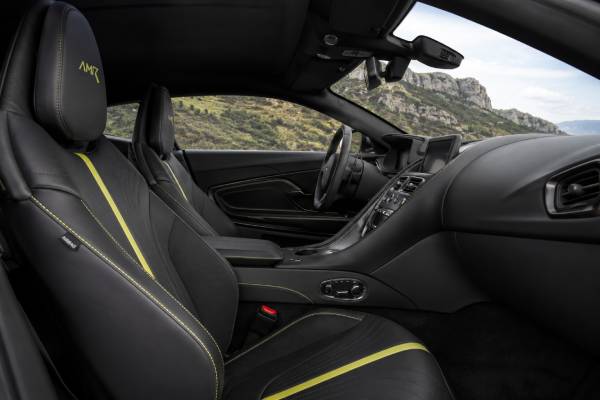
The 2018 Aston Martin DB11 AMR Signature Edition is the launch specification of the faster, sharper DB11 AMR and was limited to 100 cars worldwide. Its mechanical core is the 630 bhp version of Aston Martin’s 5.2-litre twin-turbo AE31 V12, paired with a revised eight-speed transaxle calibration and a 208 mph claimed maximum speed. What distinguishes the Signature Edition from an ordinary AMR is not extra engine output, but a tightly defined visual identity: Stirling Green paint, vivid lime accents, exposed carbon-fibre elements, dark cabin materials, and edition-specific detailing. That distinction is important because standard AMRs can be specified in similar colours or modified later. A prospective buyer therefore has two jobs: assess the health of a complex twelve-cylinder grand tourer and prove that the car retains its factory Signature Edition content. When both questions are answered well, this is one of the clearest collectible variants in the DB11 family—rare enough to feel special, but engineered to be driven rather than stored as an ornament.
Table of Contents
- Why the AMR Signature Edition matters
- Factory identity, colours, and numbered production
- AMR Signature Edition technical specifications
- How its 630 bhp chassis changes the DB11
- Preserving carbon, paint, leather, and lime details
- Mechanical service priorities for a collectible DB11
- Authentication and pre-purchase inspection
- Value, use, and long-term stewardship
Why the AMR Signature Edition matters
The Signature Edition is best understood as the ceremonial first chapter of the DB11 AMR, not as a separate performance tier above it. Every genuine example has the same 630 bhp and 700 Nm headline output as the regular production AMR, but only 100 received the launch colour and trim programme that Aston Martin used to signal the car’s more focused personality.
AMR replaced the original 600 bhp DB11 V12 as the flagship of the range. Aston Martin raised output by 30 bhp, recalibrated the transmission, retuned the suspension, revised the exhaust note, and increased the claimed maximum speed from 200 to 208 mph. The result was not a track special. It remained a 2+2 grand tourer with adaptive damping, a luxurious cabin, and enough compliance for long travel. The AMR badge indicated a more alert interpretation of the same mission.
The launch car’s appearance made that change instantly visible. Stirling Green had strong historical associations with British racing, while the lime stripe and brake details introduced the modern AMR colour language. Carbon-fibre pieces reduced visual mass around the lower body and engine cover. Inside, dark leather and Alcantara-like materials were punctuated by lime stitching and accents rather than traditional bright wood and polished metal.
Rarity alone should not dictate a purchase. The Signature Edition deserves a premium only when its provenance, specification, and condition remain persuasive. A regular AMR in exceptional mechanical health can be a better driver than a numbered car with neglected servicing, repaired carbon, old tires, and incomplete documentation. Conversely, a properly preserved Signature Edition offers something a standard car cannot: a finite, internationally recognised launch specification with a simple production story.
The model year is also unusually clean. Aston Martin announced the AMR in May 2018, and the Signature Edition belongs to that introduction. Later DB11 V12 cars retained the 630 bhp tune, and from the 2022 model year the AMR name was removed even though the power and dynamic attributes continued. That later naming change does not make a 2022–2023 V12 an AMR Signature Edition, nor does an aftermarket lime stripe turn a regular 2018 AMR into one.
Factory identity, colours, and numbered production
A correct Signature Edition should present as one coherent factory design. The exterior combines Stirling Green with lime detailing, gloss-black and carbon-fibre elements, dark wheels, and AMR identifiers. The cabin follows the same theme through Dark Knight leather, lime contrast work, carbon trim, and edition-specific presentation. Small deviations matter because replacement or refinishing can gradually erase what made the car identifiable.
The most useful evidence is documentary. Obtain the original sales invoice, build specification, factory or dealer order record, warranty-start information, and any certificate supplied with the car. The VIN establishes the individual vehicle, while the build record establishes how it left the factory. Numbered production claims should be supported by a plaque or factory paperwork rather than by an advertisement copied from another listing.
Inspect the lime graphic and accent lines in bright, diffuse light. Their edges should be consistent, their placement should agree from side to side, and the finish should not show lifting, overspray, knife marks, or a colour mismatch between repaired sections. Paint-protection film can alter gloss and colour slightly; identify where it is installed and whether it was placed over original paint or after refinishing.
Carbon-fibre inspection requires more than checking for obvious cracks. Look along the weave for distortion, cloudy lacquer, edge lifting, stone impact, previous sanding, resin bloom, and uneven clear-coat thickness. Lower splitters and diffusers are particularly exposed. A replacement genuine part may be entirely acceptable when documented, but an unbranded pattern part or a repaired piece concealed beneath dark film should affect valuation.
Inside, compare the condition of lime stitching, piping, embroidery, seat centres, steering wheel, and door inserts. Cleaning products can discolor vivid thread, while aggressive recolouring can bury the original contrast. Dark cabins also reveal abrasion through changes in sheen. Wear should correspond with mileage across the driver’s bolster, wheel rim, pedals, switchgear, and door pull.
Wheels and calipers are frequently refinished. Confirm the correct design, dimensions, surface treatment, centre caps, and lime caliper colour. A wheel can look attractive while having excessive material removed, a cracked inner barrel, or a poor repair beneath powder coat. Record part numbers when possible and compare them with the build specification.
The edition’s visual programme should never be used to excuse poor panel fit or inconsistent paint depth. The DB11 uses bonded aluminium and composite panels, and hand finishing creates some normal variation, but a specialist body inspection can distinguish factory character from collision repair. Pay particular attention to the clamshell bonnet, its vents and catches, the front corners, door apertures, rear quarters, deployable spoiler, and carbon lower parts.
AMR Signature Edition technical specifications
The Signature Edition shares the 630 bhp AMR mechanical package, placing its twin-turbo V12 forward of the cabin and the eight-speed transaxle at the rear. The edition’s limited status changes trim and provenance, not the underlying driveline specification. The figures below describe the factory AMR powertrain and coupe chassis shared by the Signature Edition. The edition’s exclusivity comes from its numbered launch specification; it did not receive a separate higher-output engine.
| Specification | Value |
|---|---|
| Engine | Aston Martin AE31, all-alloy 5.2-litre twin-turbocharged V12 |
| Displacement | 5,204 cc |
| Fuel | Premium unleaded gasoline |
| Maximum power | 630 bhp (639 PS / 470 kW) at 6,500 rpm |
| Maximum torque | 700 Nm (516 lb-ft) from 1,500 rpm |
| Specification | Value |
|---|---|
| Transmission | Rear-mounted ZF eight-speed automatic transaxle with revised calibration |
| Drive and differential | Rear-wheel drive; mechanical limited-slip differential; brake-based torque vectoring |
| Front and rear suspension | Independent double wishbones front; multi-link rear; adaptive damping with V12/AMR calibration |
| Steering | Electric power-assisted rack-and-pinion |
| Brakes | Ventilated steel discs, six-piston front and four-piston rear calipers |
| Specification | Value | Standard or condition |
|---|---|---|
| 0–100 km/h (0–62 mph) | 3.7 seconds, manufacturer 0–100 km/h (0–62 mph); 3.5 seconds to 60 mph | Manufacturer claim |
| Top speed | 334 km/h (208 mph) | Manufacturer claim |
| Fuel-tank capacity | 78 L (20.5 US gal) | Nominal capacity |
| U.S. fuel economy | 2022–2023 U.S. rating: 14 mpg city, 22 mpg highway, 17 mpg combined | EPA cycle; exact year and body style should be checked |
| Specification | Value |
|---|---|
| Length | about 4,750 mm (187.0 in) |
| Width | about 1,950 mm body; 2,060 mm including mirrors |
| Height | about 1,290 mm (50.8 in) |
| Wheelbase | 2,805 mm (110.4 in) |
| Kerb weight | 1,870 kg (4,123 lb), EU kerb; 1,765 kg published dry weight |
| Weight distribution | 51:49 front/rear |
| Specification | Value |
|---|---|
| Body and seating | 2+2 coupe |
| Wheel format | 20-inch forged staggered wheels on AMR; later cars offered several 20-inch designs |
| Typical factory tire sizes | 255/40 ZR20 front; 295/35 ZR20 rear |
| Luggage capacity | 270 L (about 9.5 cu ft) |
How its 630 bhp chassis changes the DB11
The AMR feels more urgent than the original V12 without abandoning the DB11’s grand-touring role. Its additional power is modest in percentage terms, but the revised gearbox strategy, firmer control, and more expressive exhaust make the car respond sooner and feel less insulated when the driver selects Sport or Sport Plus.
In GT mode, the car should still be civil. The transmission ought to move away smoothly, choose high gears without shunting, and respond cleanly to a moderate request for acceleration. The adaptive dampers should allow the body to breathe over long undulations while controlling a second movement. A car that is harsh in every mode may have incorrect tires, excessive pressure, damaged wheels, worn suspension joints, or a fault that has locked a system into a fallback condition.
The 700 Nm torque plateau begins at low engine speed, so full performance does not require constant high revs. This suits overtaking and fast touring, but it also places large loads on the rear tires. The stability system should intervene progressively rather than masking obvious axle hop, alignment problems, or mismatched rubber. Test the car on dry, clean roads with all assistance active; a pre-purchase drive is not the place to experiment with reduced stability control.
The steering is electric and relatively light, yet its accuracy depends on healthy front tires, correct geometry, sound wheel bearings, and intact suspension components. The AMR’s wider capability can make a small pull or vibration easy to dismiss at urban speed. Check straight-line behaviour on several road surfaces, then look for consistent loading through medium-speed bends.
Braking should be powerful and linear. The standard steel system is appropriate for road use, but the large discs and performance pads are not inexpensive. Feel for steering shake, pedal pulsation, scraping after storage, or a long pedal. Inspect both disc faces because the inner surfaces can corrode or crack without being obvious through the wheel spokes.
The exhaust is part of the AMR experience, but volume is not proof of authenticity. Aftermarket valve controllers, removed catalysts, non-original rear sections, or software changes can create a louder car while compromising legality, warranty history, refinement, and resale. A standard system should change character with the drive modes and complete a cold start without metallic rattles or persistent fumes.
A proper road test includes a full warm-up, repeated low-speed manoeuvres, a steady motorway phase, and a controlled period of stronger acceleration. Watch coolant and oil-related messages, listen after heat soak, confirm that the fans cycle normally, and recheck beneath the car. Many defects appear only when a tightly packaged V12 has reached operating temperature.
Preserving carbon, paint, leather, and lime details
Preservation should protect the original surfaces without making the car impossible to use. The right strategy is reversible, documented, and compatible with the material. Heavy cosmetic “improvement” can be more damaging to a limited edition than honest, carefully maintained wear.
Wash the exterior with methods that minimise contact and avoid staining matte or textured components. Carbon clear coat benefits from UV protection and prompt removal of insects, bird deposits, and road film. Paint-protection film is sensible on the nose and lower carbon, but only after paint condition has been recorded. Film edges should not cut across graphics awkwardly or trap moisture beside lifted lacquer.
Stirling Green can reveal machine-polishing trails under direct light. Before correction, measure paint, identify refinished panels, and agree on a conservative objective. Removing clear coat to chase every defect is a poor exchange on a collectible car. Keep photographs before and after significant detailing, together with the product and installer record.
The lime accents demand restraint. Solvents and aggressive adhesive removers can soften printed or painted edges. Mask them during machine work and test any chemical in an inconspicuous area. If a section is damaged, consult an Aston Martin body specialist and preserve a sample or photographic record before replacement.
Inside, vacuum first and use minimal moisture. Dark leather can develop polished high spots from friction; this does not always require recolouring. Clean gently, condition only with compatible products, and avoid glossy dressings that change the factory appearance. Bright thread should be cleaned along its direction rather than scrubbed across the seam.
Carbon interior panels scratch easily around the centre console and door pulls. Dust particles under a cloth can create fine marks, so use clean tools and little pressure. Inspect the lacquer at edges and mounting points for stress. Do not tighten loose trim blindly: a missing clip, warped substrate, or previous dismantling may be the real cause.
Storage environment matters. A dry, ventilated space, battery conditioner, tire-pressure management, and periodic full operating cycles are better than leaving the car untouched. Avoid plastic covers that hold moisture against paint. A breathable fitted cover should be perfectly clean and used only on a clean car.
Original removed parts should stay with the vehicle. If an owner installs reversible exhaust, wheel, or protection changes, label and store the factory components, fasteners, and paperwork. Future buyers value an unbroken chain of evidence more than a seller’s assurance that everything can be returned to standard.
Mechanical service priorities for a collectible DB11
Low mileage does not reduce the need for maintenance; it changes the maintenance pattern. Fluids age, batteries sulphate, seals sit in one position, tires harden, brakes corrode, and cooling passages collect debris even when the odometer advances slowly.
Use annual servicing as the minimum rhythm, then follow the VIN-specific schedule for plugs, filters, brake fluid, coolant, transmission, differential, and other time or distance items. The AE31 is an Aston Martin engine. Do not apply a generic V12 schedule or assume that the Mercedes-derived infotainment architecture makes the powertrain Mercedes-serviceable.
Battery voltage is a first-line health issue. Keep the car on the approved conditioner when parked, test the battery under load, and date every replacement. Multiple warnings after a weak start can be voltage related, but a technician should still scan each module and confirm what returns after stable power. Repeatedly clearing faults without diagnosis can erase useful evidence.
Cooling deserves an inspection from both sides of the heat exchangers. Leaves and road debris can lodge between stacked radiators where a quick view through the grille misses them. Check reservoirs, hose junctions, turbo-related plumbing, fan operation, and dried coolant traces. A stable temperature display is encouraging, not a substitute for pressure testing and inspection.
Oil leaks or consumption require context. Record level correctly, use the specified oil, and inspect after a full heat cycle. Undertrays can hide seepage or spread fluid away from its origin. Turbocharger feed and return areas, cam covers, sump regions, and the rear of the engine should be evaluated by someone familiar with the installation.
The transaxle and differential should be quiet and consistent at parking speed, under light throttle, and during overrun. Harsh engagement, delayed selection, repeated thumps, or a speed-related whine deserves investigation. Software updates may change shift quality, but software should not be used as a universal explanation for mechanical symptoms.
Tires must be matched in model, specification, age, and wear. The correct stagger and circumference relationship help the stability and traction systems. Alignment should be performed by a shop that can work with the car’s ride height and underbody safely. Retain the before-and-after measurements.
Finally, ask for campaign and software history from an authorised Aston Martin source. A complete independent-service record can be excellent, but factory campaigns and control-unit updates require separate verification. Combine both records rather than treating one as a replacement for the other.
Authentication and pre-purchase inspection
Authentication should happen before price negotiation, because the result determines what is being valued. Begin with the VIN and factory specification, then work outward to the numbered identity, exterior details, interior content, mechanical condition, and chain of ownership.
A disciplined inspection should include these steps:
- Match the VIN on the vehicle, registration, service records, build sheet, and diagnostic scan.
- Confirm that the factory record identifies the Signature Edition specification rather than a regular AMR in similar colours.
- Photograph plaques, badges, option labels, wheel markings, carbon components, paint details, keys, books, and supplied accessories.
- Measure paint and examine structural bonding, fasteners, panel dates, undertrays, jacking points, and carbon edges for repair evidence.
- Scan every control module before fault memory is cleared and preserve the report with mileage and voltage shown.
- Start the engine fully cold, complete a long road test, inspect it hot, and repeat the scan.
- Price all immediate and near-term work using current genuine-parts and specialist-labour estimates.
Do not rely on a generic inspection company that treats the car as an ordinary used coupe. The inspector should understand Aston Martin diagnostic systems, bonded aluminium construction, AE31 cooling, transaxle behaviour, adaptive damping, and the exact Signature Edition details.
Provenance gaps need explanations, not assumptions. A missing first invoice may be recoverable from a supplying dealer; a missing numbered item may not be. Imported cars require careful review of market specification, taxes, title history, odometer evidence, emissions equipment, lighting, warranty coverage, and software region.
Modification history should be explicit. Ask about engine software, exhaust valve control, downpipes, filters, suspension spacers, wheel refinishing, wraps, ceramic coatings, and audio or tracker installation. Reversible work is not automatically harmful, but hidden wiring cuts, altered emissions hardware, or an unknown tune introduce risk.
A clean inspection is not a guarantee of future perfection. It is a documented baseline that lets the buyer distinguish the cost of owning a rare AMR from the cost of correcting somebody else’s deferred work.
Value, use, and long-term stewardship
The strongest Signature Edition ownership case combines originality with regular, sympathetic use. Cars kept solely for mileage preservation can accumulate storage-related defects, while heavily used examples may lose delicate cosmetic details. A balanced car has exercised systems, current service, clean materials, and records that explain every change.
Market comparisons must be like-for-like. Separate genuine Signature Editions from standard AMRs, later 630 bhp V12s without the badge, and early 600 bhp cars carrying AMR-style additions. Then account for country, taxes, mileage, ownership history, accident record, paintwork, options, service status, tire age, and included accessories. Asking price is not transaction evidence.
A numbered car with an incomplete factory appearance should be valued as a restoration proposition. The cost is not only buying parts. Correct graphics, carbon finish, wheel treatment, cabin materials, and documentation may require specialist research and long lead times. Some cosmetic differences cannot be undone perfectly once original surfaces are removed.
Use the car for the journeys it was built to make. Bring temperatures up gradually, avoid repeated short cold starts, allow brakes to dry after washing, clean road debris promptly, and connect the conditioner after the car has cooled. Record fuel, oil, tire, and service observations. These habits produce both reliability and a credible history.
Insurance should reflect limited-edition replacement difficulty and agreed value where available. Confirm terms for mileage, storage, drivers, modifications, overseas travel, and choice of repairer. A standard market-value policy may not account for edition-specific carbon, paint, trim, or the time required to source correct parts.
The Signature Edition is unlikely to be the cheapest DB11 AMR to buy or repair, and it should not be. Its appeal rests on the union of the fastest DB11 specification of 2018 with a finite, memorable launch design. Pay for evidence, not merely rarity language. Maintain the mechanical car as rigorously as the collectible object, and it can remain both an important AMR artefact and a genuinely rewarding 208 mph grand tourer.
References
- DB11 AMR – NEW PERFORMANCE FLAGSHIP OF THE DB11 RANGE 2018 (Press Release)
- Aston Martin DB11: the latest in an illustrious bloodline 2017 (Engineering Background)
- Owner’s Guides | Aston Martin 2026 (Owner Documentation)
- Aston Martin Luxury Car Servicing | Aston Martin 2026 (Service Information)
- 2020 Aston Martin DB11 V12 2020 (EPA Fuel Economy)
Disclaimer
This article offers informational guidance only and cannot authenticate a car or replace professional diagnosis. Check every Signature Edition claim, service operation, part, torque value, and software requirement against factory records for the exact VIN and market.
Sharing the guide on Facebook, X/Twitter, or another channel can help other collectors approach these 100 cars carefully.