

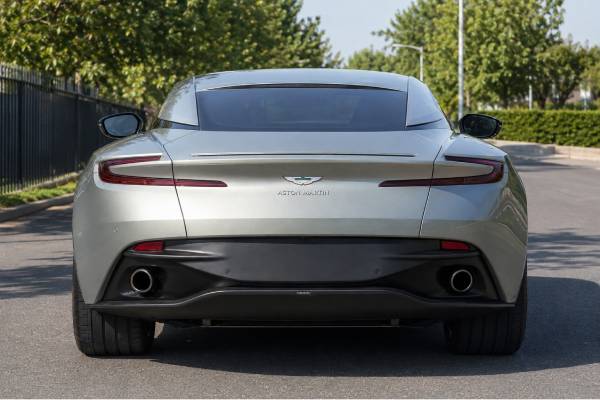
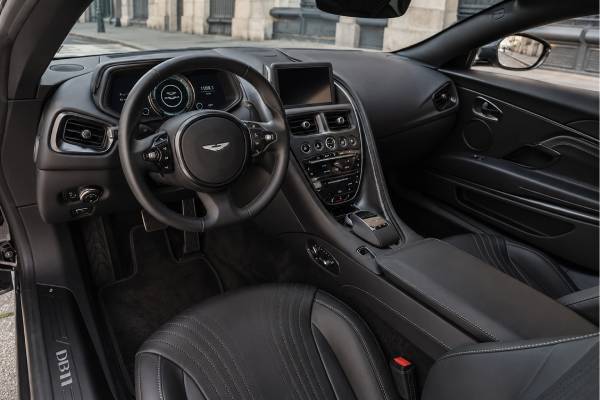
The 2016–2018 Aston Martin DB11 V12 Coupe is the original form of the AM5-generation grand tourer: 600 bhp, 700 Nm, rear-wheel drive, and a 200 mph top speed from Aston Martin’s new AE31 5.2-litre twin-turbo V12. Its production window was relatively brief because the 630 bhp DB11 AMR replaced it in 2018, yet that short run is precisely why the early car now has a distinct identity. It carries the clean launch specification, the first version of the DB11 chassis calibration, and the engine tune that introduced turbocharged series production to the marque. Buying one is not simply a choice between performance figures. The car’s value depends on service continuity, campaign completion, electrical health, cooling-system condition, tires and brakes, and the quality of any cosmetic work to its mixed-material body. A well-kept example remains a deeply capable long-distance car; a neglected one can turn its discounted purchase price into an expensive lesson.
Table of Contents
- The short-lived original V12 in context
- Inside the AE31 twin-turbo V12 and transaxle layout
- Original V12 coupe specifications
- What the DB11 V12 feels like on real roads
- Model-year detail, options, and cabin usability
- Ownership costs and preventive maintenance
- Fault-finding priorities before purchase
- Choosing between the 600 bhp V12, AMR, and V8
The short-lived original V12 in context
The 600 bhp DB11 V12 occupies a specific point in Aston Martin history: it launched the company’s “Second Century” product programme, replaced the DB9, and introduced the basic platform that later supported the V8 DB11, Vantage, DBS Superleggera, and DB12. It was therefore both a finished luxury car and the first public expression of a new technical family.
Compared with the DB9, the DB11 brought a longer wheelbase, more cabin space, a stiffer bonded-aluminium structure, electric steering, adaptive damping with broader mode control, a fully digital instrument display, modernised infotainment, and active airflow devices. Its design also changed the visual grammar of Aston Martin. The clamshell bonnet reduced visible shut lines, the roof strake separated the floating roof form, and the C-pillar ducts fed the AeroBlade system across the rear deck.
The original V12 lasted only until the AMR arrived. That does not make the 600 bhp car an unfinished prototype or an inferior AMR; it makes it the softer, more restrained interpretation. Its 200 mph top speed and 3.9-second 0–62 mph claim are already far beyond normal road requirements. The later car sharpened transmission, exhaust, and chassis responses, while the early V12 retained the most relaxed version of the concept.
Production-year labels can be confusing because launch, build, registration, and model-year dates overlap. A car unveiled in 2016 may be registered as a 2017 vehicle, and a late 2018 registration does not guarantee AMR specification. Confirm the VIN, power output, build sheet, badging, software status, and original invoice. Advertisements that use “AMR-style” wheels or an aftermarket tune should not be allowed to blur the distinction between a factory 600 bhp V12 and a genuine 630 bhp AMR.
Inside the AE31 twin-turbo V12 and transaxle layout
The AE31 is central to the original DB11’s appeal. It is an all-alloy, quad-cam, 48-valve V12 with two turbochargers, water-to-air charge cooling, variable cam timing, stop-start, and cylinder deactivation. Peak torque arrives from only 1,500 rpm, so the engine behaves less like a traditional high-revving exotic and more like an enormous reserve of thrust.
Cylinder deactivation closes one bank under suitable light-load conditions and alternates banks to manage temperatures. The transition should be unobtrusive. Hesitation, roughness, a persistent misfire, or warning messages are not normal characteristics to be dismissed as the system changing mode. Proper diagnosis requires an Aston-capable scan tool and a technician who can interpret stored faults, live data, fuel trims, boost control, and temperature information.
The gearbox is mounted at the rear and connected to the engine by a torque tube. This transaxle arrangement moves mass rearward and helps produce a near-even distribution. The ZF eight-speed automatic is familiar hardware in the wider industry, but its installation, control software, cooling, and differential relationship are specific to the DB11. Smooth operation at light throttle is as important as fast paddle shifts in Sport Plus.
The mechanical limited-slip differential works with Dynamic Torque Vectoring by braking. Rather than using an expensive active differential, the car can brake an inside wheel to influence rotation. The adaptive dampers, electric steering, powertrain mapping, exhaust valves, and stability control are coordinated through GT, Sport, and Sport Plus modes. A fault in one system can therefore change the behaviour of several others.
Thermal management deserves respect. The V12, turbochargers, charge coolers, catalytic converters, transmission, and tightly packaged nose all generate or reject significant heat. Clear radiators, correct coolant, sound hoses, healthy fans, and clean oil are not mundane details; they are what allow the powertrain to deliver repeated performance without distress.
Original V12 coupe specifications
The 2016–2018 V12 coupe combines Aston Martin’s 600 bhp AE31 engine with a rear-mounted eight-speed transaxle and mechanical limited-slip differential. The separated engine and gearbox masses help the long coupe turn and settle like a modern GT rather than a traditional front-heavy cruiser. These figures apply to the factory 600 bhp coupe, not the later 630 bhp AMR. Published dimensions and mass can differ slightly by market and measurement convention; retain the source definition rather than blending dry, EU kerb, and U.S. curb values.
| Specification | Value |
|---|---|
| Engine | Aston Martin AE31, all-alloy 5.2-litre twin-turbocharged V12 |
| Displacement | 5,204 cc |
| Fuel | Premium unleaded gasoline |
| Maximum power | 600 bhp (608 PS / 447 kW) at 6,500 rpm |
| Maximum torque | 700 Nm (516 lb-ft) from 1,500 rpm |
| Specification | Value |
|---|---|
| Transmission | Rear-mounted ZF eight-speed automatic transaxle |
| Drive and differential | Rear-wheel drive; mechanical limited-slip differential; brake-based torque vectoring |
| Front and rear suspension | Independent double wishbones front; multi-link rear; three-stage adaptive dampers |
| Steering | Electric power-assisted rack-and-pinion |
| Brakes | Ventilated steel discs, six-piston front and four-piston rear calipers |
| Specification | Value | Standard or condition |
|---|---|---|
| 0–100 km/h (0–62 mph) | 3.9 seconds, manufacturer 0–100 km/h (0–62 mph) | Manufacturer claim |
| Top speed | 322 km/h (200 mph) | Manufacturer claim |
| Fuel-tank capacity | 78 L (20.5 US gal) | Nominal capacity |
| U.S. fuel economy | 2017–2018 U.S. ratings commonly 15 mpg city, 21–22 mpg highway, 17–18 mpg combined | EPA cycle; exact year and body style should be checked |
| Specification | Value |
|---|---|
| Length | 4,739–4,750 mm (186.6–187.0 in), market/source rounding |
| Width | 1,940–1,950 mm body; about 2,060 mm including mirrors |
| Height | about 1,279–1,290 mm (50.4–50.8 in) |
| Wheelbase | 2,805 mm (110.4 in) |
| Kerb weight | 1,875 kg (4,134 lb), EU kerb definition |
| Weight distribution | 51:49 front/rear |
| Specification | Value |
|---|---|
| Body and seating | 2+2 coupe |
| Wheel format | 20-inch staggered wheels |
| Typical factory tire sizes | 255/40 ZR20 front; 295/35 ZR20 rear |
| Luggage capacity | 270 L (about 9.5 cu ft) |
What the DB11 V12 feels like on real roads
The original V12’s greatest strength is not a single acceleration number but the way it covers distance. In GT mode, the throttle is progressive, the gearbox seeks higher ratios, the dampers permit useful wheel travel, and the cabin remains calm enough for long days. The car feels substantial rather than delicate, yet the steering and rear transaxle keep it from behaving like a conventional front-heavy luxury coupe.
Acceleration is dominated by torque. A modest pedal movement at motorway speed can produce a rapid overtake without a dramatic downshift. Full throttle is much more intense, but the engine’s delivery remains smoother than many smaller turbo units. The exhaust is cultured in GT mode and more assertive in Sport, though an early V12 is not as deliberately vocal as the AMR.
On a test drive, begin with imperfect roads. Listen for damper knocks, loose trim, wheel impacts, and tire roar. Check whether the car settles after a crest rather than oscillating, whether the steering returns consistently, and whether the brakes remain smooth after several applications. A DB11 can mask speed so effectively that a short urban loop says little about its true condition.
The width matters. Parking cameras and sensors are useful, but their image quality and response are from an older generation. Confirm that the 360-degree view stitches correctly and that no camera is cloudy or intermittent. The front splitter, wheel rims, and long doors are vulnerable in tight spaces. Swan-hinged doors rise slightly as they open, helping with kerbs, but they still need considerable lateral room.
Cold, wet, or old tires change the car dramatically. Seven hundred newton-metres through the rear wheels can trigger intervention even in a straight line. Correct factory sizes, matching premium tire models, recent date codes, and proper pressures are essential. A cheap mixed set undermines the chassis calibration and is a strong clue that other maintenance may also have been done to price rather than standard.
Model-year detail, options, and cabin usability
Specification varied enough that two visually similar V12s can feel like different purchases. Paint, roof treatment, wheel design, carbon-fibre packages, seat type, leather pattern, veneer, audio, cameras, touchpad controller, headlining, and brake-caliper colour all influence desirability and replacement cost.
The cabin is a 2+2 rather than a true four-seat GT. Front occupants have generous room and a broad range of seat adjustment, while the rear seats suit children, occasional short trips, or luggage. ISOFIX points add practical value. The 270-litre boot works best with soft bags, and the rear seats can absorb overflow that would not fit through the boot opening.
The 12-inch instrument panel was advanced at launch, but buyers should inspect every display mode for dead pixels, flicker, warning messages, and delayed start-up. The central 8-inch screen and rotary controller are Daimler-derived and robust when healthy, though the interface lacks the speed and connectivity of newer cars. Test Bluetooth calls, audio, navigation, USB, radio reception, parking displays, and steering-wheel buttons. Confirm whether advertised premium audio is actually fitted.
Leather and veneer are hand-finished, which produces beauty but also variation. Look for bolster wear, dye transfer, stretched seat centres, shrinking leather around upper surfaces, loose stitching, lifting veneer, cloudy lacquer, and damage from suction-mounted accessories. A well-matched professional repair can be preferable to leaving damage, but undisclosed recolouring or poorly matched grain should affect price.
Early cars may have received software updates, revised parts, or campaign work over time. A later registration is not automatically a “better” build, and an early VIN is not automatically problematic. What matters is whether the car has been kept current. Obtain the authorised dealer campaign printout and compare it with invoices rather than relying on a seller’s statement that “all recalls were done.”
A useful way to judge cabin condition is to compare wear across contact points rather than focusing on a single scuff. The driver’s bolster, steering-wheel rim, metal door pulls, pedal faces, key, and rotary controller should tell a consistent mileage story. Heavy recolouring on one seat beside untouched controls deserves an explanation. Also inspect the long frameless window seals while someone operates each door: the glass should drop and reseal cleanly, without scraping, wind noise, or water marks. Climate control should cool both sides promptly and hold a stable fan speed, because a pleasant static display does not reveal weak refrigeration, blend-door faults, or a noisy blower. Finally, confirm that both keys are present and recognised reliably. Replacing or programming missing keys is not merely an inconvenience on a low-volume luxury car; it can require proof of ownership, specialist access, and more cost than buyers expect.
Ownership costs and preventive maintenance
The purchase price of an early DB11 can be surprisingly accessible; the operating standard should remain that of a hand-built 200 mph car. Budget for specialist labour, premium tires, large brakes, high-quality fluids, battery support, complex body repairs, and diagnostic time.
An annual service is a sensible baseline even for low-mileage cars. The precise oil specification, capacity, spark-plug interval, coolant, brake-fluid schedule, transmission and differential procedure, and filter requirements must come from VIN-appropriate documents. Do not substitute a Mercedes-AMG M177 schedule, a later AMR sheet, or a generic lubricant database for the AE31 instructions.
Battery care prevents a disproportionate number of frustrations. Use the correct conditioner, inspect the main battery’s age and test results, and investigate parasitic drain rather than repeatedly jump-starting the car. Low voltage can produce multiple unrelated warnings, but that does not mean every warning is “just the battery.” Clear evidence only after the root cause is understood and retain the scan report.
Cooling-system checks should include both visible condition and performance at temperature. Inspect radiators and condensers for impact damage or blockage, examine reservoirs and hose joints for dried residue, confirm fan operation, and look beneath undertrays for leaks. After a hard drive, allow the car to complete normal heat management rather than shutting it down immediately after repeated boost use.
Brakes and tires often dominate recommissioning cost. Measure disc thickness and runout, inspect both faces, verify pad condition, and check wheel inner barrels. Tire tread can look excellent while the rubber is old and hard. A car that has covered only a few thousand miles in several years may need more age-related work than one driven regularly and serviced on schedule.
Keep records detailed. Itemised invoices, diagnostic reports, battery tests, alignment sheets, tire dates, and photographs of major work create confidence. A stamped book without supporting detail is less useful for understanding how a complex car was actually maintained.
Fault-finding priorities before purchase
A serious inspection should be performed cold, on a lift, and with Aston-specific diagnostics. The goal is not to produce a frightening list of every possible failure; it is to separate normal wear, maintenance due, cosmetic choices, and active faults before price negotiation.
Key checks include:
- Observe the first start for battery speed, smoke, abnormal mechanical noise, fuel smell, unstable idle, or warning messages.
- Scan all modules before anyone clears history; record active, stored, and undervoltage-related faults.
- Road-test in GT first, then Sport, checking boost delivery, shift quality, paddle response, cooling stability, steering, damper changes, and brake smoothness.
- Inspect the engine, charge-cooling hardware, cooling pack, transaxle, differential, hoses, and undertrays for leaks or impact.
- Examine wheels inside and out, tire date codes, matching specifications, alignment wear, and evidence of repeated rim repair.
- Operate the AeroBlade-related openings visually, deployable spoiler, windows, handles, mirrors, cameras, parking sensors, seats, climate control, lamps, and boot release.
- Check carpets, boot cavities, seals, electronic compartments, and headlining edges for moisture or staining.
- Measure paint and inspect panel alignment with awareness that the body uses aluminium, composites, and hand finishing.
Ask why the car is being sold and how it was used. Long-term storage, repeated short trips, track activity, continental touring, urban use, and dealer display life create different wear patterns. Verify mileage through service records and inspection data, not merely a clean odometer screen.
A specialist’s estimate should categorise work as immediate safety, near-term preventive, cosmetic, optional, and investigatory. This keeps a worn tire from being treated like a mysterious engine fault and prevents a polished seller from minimising a cooling or electronic issue as “normal Aston character.”
Choosing between the 600 bhp V12, AMR, and V8
Choose the 600 bhp V12 when the original launch character matters more than having the final tune. It delivers the full twelve-cylinder experience, 200 mph capability, and the most relaxed calibration of the V12 DB11 line. The AMR is faster, louder, visually darker, and more focused; the V8 is lighter, more agile, less expensive to fuel, and often easier to use on tighter roads.
The differences are not only numerical. The V8 removes roughly 115 kg from the nose and shifts the balance rearward, making turn-in feel lighter. The AMR retains V12 mass but adds power, sharper shifts, a more expressive exhaust, and chassis revisions. The original V12 sits between them conceptually: more effortless and prestigious than the V8, less overtly sporting than the AMR.
Condition should override the hierarchy. A superb 600 bhp car with full history is a better purchase than a neglected AMR bought for the badge. Likewise, a V8 may suit an owner who values everyday agility and lower thermal load more than cylinder count. Test all three if possible on the same type of road.
For collectability, originality and specification matter. Launch colours, unusual Q commissions, carbon options, premium audio, and coherent interior choices can influence demand, but maintenance remains foundational. A rare colour cannot compensate for old tires, incomplete campaigns, repeated warning lights, or missing records.
The best original V12 is one that still performs its intended role: a beautiful, extremely fast grand tourer that can cross countries without exhausting its occupants. Preserve the mechanical baseline, keep the electronics healthy, use it often enough to avoid storage deterioration, and document every decision. The 600 bhp figure may no longer be the largest number in the DB11 family, but the car’s importance and breadth of ability have not diminished.
References
- Aston Martin DB11: the latest in an illustrious bloodline 2017 (Press Release)
- DB11 V12 Coupe « Aston Martins.com 2026 (Model Reference)
- Owner’s Guides | Aston Martin 2026 (Owner’s Guide Portal)
- Aston Martin Luxury Car Servicing | Aston Martin 2026 (Servicing)
- 2018 Aston Martin DB11 V12 Coupe Features and Specs 2018 (Specifications)
- 2017 Aston Martin DB11 Tested: The New Classic 2017 (Instrumented Test)
Disclaimer
This material is provided for general education. Exact procedures, intervals, capacities, software, and components may change with VIN, market, production date, and equipment; consult official Aston Martin information and a competent specialist before repair.
Please pass this guide along on Facebook, X/Twitter, or another platform if it supports your DB11 research.