


The Aston Martin DB11 V12 Coupe Launch Edition is more than an early DB11 with a plaque. It marks the point at which Aston Martin replaced the long-running VH-era formula with a new bonded-aluminium platform, its first series-production turbocharged V12, modern Daimler-derived electronics, and a radically different aerodynamic package. That historical importance makes a correct Launch Edition appealing, but it also makes careful identification essential: early cars were built in several curated colour and trim themes, while later DB11s can wear similar options without being true Launch Editions. Underneath the commissioning details is the original 600 bhp DB11 V12, a very fast 2+2 grand tourer capable of 200 mph yet designed for long-distance comfort. Buyers should therefore evaluate two things at once—the condition of a complex early-production performance car and the originality of a model whose value depends heavily on documentation, specification, and sympathetic maintenance.
Table of Contents
- What the Launch Edition actually represents
- How the first DB11 changed Aston Martin engineering
- V12 Launch Edition specifications and technical data
- Driving character: speed without losing the GT brief
- Cabin, equipment, and the six launch themes
- Maintenance priorities for an early-build DB11
- Known trouble areas and a serious pre-purchase inspection
- Authenticity, provenance, and value considerations
What the Launch Edition actually represents
The Launch Edition was the curated introduction to the DB11 range, not a separate high-output mechanical derivative. Its engine, transmission, brakes, suspension architecture, and headline performance match the original 600 bhp V12 coupe; the distinction lies in its launch-period specification, selected colour-and-trim combinations, and identifying sill plaques.
Aston Martin used the first DB11s to demonstrate how far its design and personalisation language had moved. Six named themes were publicised: New Heritage, Soft Tech, Shanghai Fashionista, Mysterious Sport, Intrepid Sport, and Iconic Craft. Each combined exterior paint, leather colours, stitching, veneer, metal finish, and decorative treatment into a coherent visual idea. These were not merely paint packages. A New Heritage car, for example, approached the DB11 as a modern continuation of traditional British GT materials, while Intrepid Sport used much sharper contrasts and technical finishes.
Production reality was less tidy than a modern online configurator might suggest. Other combinations appeared as the launch period progressed, market equipment differed, and Q by Aston Martin could alter an individual order. Consequently, authenticity cannot be established by colour alone. The strongest evidence is a complete build specification from Aston Martin, an original sales invoice or order form, the correct Launch Edition sill plaques, and a history that connects the car’s VIN to its delivered configuration.
That distinction matters because advertisements often use “Launch Edition” loosely to mean “early 2017 DB11.” A first-year car may be desirable, but it is not automatically the named edition. Conversely, a genuine example that has been retrimmed, wrapped, fitted with later wheels, or stripped of its original plaques may still be authentic by VIN, yet its collector appeal will depend on how confidently the original state can be reconstructed. Treat the title as a provenance claim to be proved, not a cosmetic description to be accepted.
How the first DB11 changed Aston Martin engineering
The first V12 DB11 is important because almost every major system represented a clean break from the DB9. The bonded-aluminium body architecture was lighter, stiffer, and more space-efficient, while the engine, electronic network, digital instruments, infotainment, steering, adaptive damping, and airflow management moved Aston Martin into a new technical generation.
The AE31 V12 is an in-house Aston Martin design with two turbochargers, water-to-air charge cooling, dual variable cam timing, direct electronic control, stop-start, and cylinder deactivation. At light load it can shut one cylinder bank, periodically alternating banks to manage catalyst temperature and wear. When full power is requested, all twelve cylinders return and 700 Nm is available from low engine speed. This gives the car a very different personality from the naturally aspirated DB9: less need to chase revs, much stronger mid-range acceleration, and an effortless surge suitable for passing at motorway speed.
The gearbox sits at the rear as a transaxle. Connecting the front-mid-mounted engine to the rear transmission helps centralise mass and contributes to the 51:49 front-to-rear distribution. A conventional mechanical limited-slip differential works with brake-based torque vectoring, while the eight-speed ZF automatic changes character through GT, Sport, and Sport Plus modes. The result is not a dual-clutch supercar response, but quick, smooth shifts that suit the DB11’s grand-touring role.
The body’s most visible engineering feature is the AeroBlade. Air enters ducts near the C-pillars, travels through the body, and exits across the rear deck to create a virtual-spoiler effect. A deployable rear spoiler supplements it when needed. At the front, the “Curlicue” extracts high-pressure air from the wheel arches to reduce lift. These devices allowed Marek Reichman’s design team to avoid a permanently raised wing while retaining high-speed stability.
Early ownership should account for the model’s newness. First-generation software, complex body sealing, retractable aerodynamic hardware, and an all-new turbocharged engine installation create more inspection points than on a simpler previous-generation Aston. That does not make every Launch Edition troublesome, but it rewards complete campaign history and technicians who understand the AM5 platform rather than learning on the car.
V12 Launch Edition specifications and technical data
The Launch Edition uses the first-production 600 bhp AE31 V12 behind the front axle line, with its eight-speed gearbox mounted at the rear. This front-mid-engine/transaxle arrangement distributes mass along the wheelbase and defines the original DB11 driving package. The Launch Edition did not receive a special engine tune, so the figures below are the original V12 coupe values. Market brochures sometimes round dimensions differently, and kerb, dry, EU, and U.S. weight definitions must not be mixed.
| Specification | Value |
|---|---|
| Engine | Aston Martin AE31, all-alloy 5.2-litre twin-turbocharged V12 |
| Displacement | 5,204 cc |
| Fuel | Premium unleaded gasoline |
| Maximum power | 600 bhp (608 PS / 447 kW) at 6,500 rpm |
| Maximum torque | 700 Nm (516 lb-ft) from 1,500 rpm |
| Specification | Value |
|---|---|
| Transmission | Rear-mounted ZF eight-speed automatic transaxle |
| Drive and differential | Rear-wheel drive; mechanical limited-slip differential; brake-based torque vectoring |
| Front and rear suspension | Independent double wishbones front; multi-link rear; three-stage adaptive dampers |
| Steering | Electric power-assisted rack-and-pinion |
| Brakes | Ventilated steel discs, six-piston front and four-piston rear calipers |
| Specification | Value | Standard or condition |
|---|---|---|
| 0–100 km/h (0–62 mph) | 3.9 seconds, manufacturer 0–100 km/h (0–62 mph) | Manufacturer claim |
| Top speed | 322 km/h (200 mph) | Manufacturer claim |
| Fuel-tank capacity | 78 L (20.5 US gal) | Nominal capacity |
| U.S. fuel economy | 2017–2018 U.S. ratings commonly 15 mpg city, 21–22 mpg highway, 17–18 mpg combined | EPA cycle; exact year and body style should be checked |
| Specification | Value |
|---|---|
| Length | 4,739–4,750 mm (186.6–187.0 in), market/source rounding |
| Width | 1,940–1,950 mm body; about 2,060 mm including mirrors |
| Height | about 1,279–1,290 mm (50.4–50.8 in) |
| Wheelbase | 2,805 mm (110.4 in) |
| Kerb weight | 1,875 kg (4,134 lb), EU kerb definition |
| Weight distribution | 51:49 front/rear |
| Specification | Value |
|---|---|
| Body and seating | 2+2 coupe |
| Wheel format | 20-inch staggered wheels |
| Typical factory tire sizes | 255/40 ZR20 front; 295/35 ZR20 rear |
| Luggage capacity | 270 L (about 9.5 cu ft) |
Driving character: speed without losing the GT brief
The Launch Edition is at its best as a very fast road car rather than a track-focused special. Its defining quality is range: it can settle into a quiet, compliant motorway rhythm, then deliver enormous mid-range thrust without the nervous ride or constant attention demanded by a harder-edged supercar.
GT mode softens the dampers, throttle mapping, transmission strategy, steering weight, and exhaust behaviour. This is the correct setting for assessing an unfamiliar car because it exposes low-speed driveline shunt, suspension knocks, wheel imbalance, wind noise, and brake judder that a more aggressive mode can disguise. A healthy DB11 should pull cleanly from low revs, shift without hesitation, track straight, and ride firmly but without sharp secondary bouncing.
Sport and Sport Plus progressively sharpen the car. The V12’s low-rpm torque can overwhelm cold or aged rear tires, so a test drive should not become a demonstration of stability control. Instead, pay attention to proportional throttle response, the consistency of boost delivery, and whether the gearbox follows paddle requests cleanly. Any warning message, reduced-power behaviour, misfire under load, or sudden temperature rise warrants diagnosis before purchase.
The steering is electrically assisted, a departure from the hydraulic feel of older Astons. It is accurate and reasonably quick, but the car communicates more through body response and front-tire load than through constant steering kickback. The long wheelbase gives stability, while the transaxle layout and adaptive damping prevent the nose from feeling as heavy as the engine count suggests. Nevertheless, this remains a broad, expensive GT on 20-inch tires. Narrow lanes, broken road edges, steep ramps, and kerbs demand patience.
Braking performance should feel strong and progressive. Surface corrosion after storage can produce temporary noise, but persistent vibration may indicate heat-spotted discs, uneven pad transfer, or wheel damage. The DB11’s performance allows speed to build deceptively, so tire age and correct load/speed ratings are safety items, not cosmetic bargaining points. A lightly used car on original-looking but old tires is not “preserved”; it is overdue for replacement.
Cabin, equipment, and the six launch themes
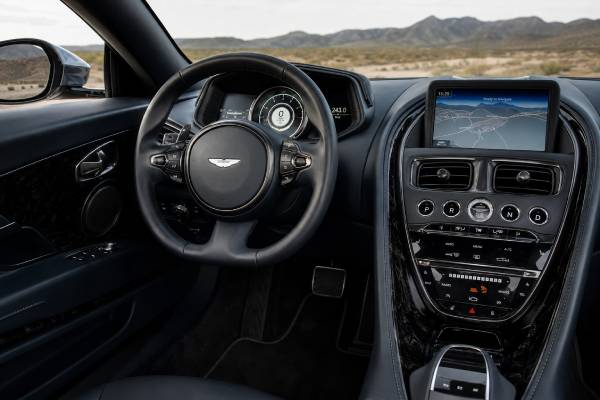
A Launch Edition should be judged as a complete design commission. The strongest cars retain the relationship among paint, leather, contrast colour, veneer, headlining, carpet, metal finish, wheel design, brake-caliper colour, and sill identification that made the launch themes distinctive.
The cabin introduced a 12-inch digital instrument panel and an 8-inch central display controlled by a rotary interface, with an optional touchpad on some specifications. The basic system came from Aston Martin’s Daimler partnership, but its software generation is now visibly older than current infotainment. Buyers should evaluate it for reliable operation rather than expect modern smartphone integration. Check navigation, audio sources, Bluetooth, cameras, parking sensors, seat memory, climate control, steering-wheel controls, and every display page. A weak 12-volt battery can create misleading faults, so testing should begin with a properly charged battery and known system voltage.
Materials require a different inspection approach from ordinary used cars. Leather stretching on heavily shaped seat bolsters can be normal, but colour transfer, shrinkage near glass, loose stitching, lifting veneer, cloudy lacquer, or damaged brogue perforations can be costly to correct. Ask whether any panel has been re-dyed. A skilful repair may be acceptable, but mismatched sheen or grain can reduce the visual coherence that gives a Launch Edition its appeal.
The rear seats are best viewed as occasional places or luggage platforms. ISOFIX mountings add genuine flexibility for small children, but adult access and legroom remain limited. The 270-litre coupe boot suits soft bags better than rigid cases. Original fitted luggage, if supplied with a particular car, can add interest, though its absence does not by itself disprove Launch Edition status unless the build documentation lists it.
Exterior presentation deserves close study in several lighting conditions. Large aluminium and composite panels can be expensive to refinish correctly, and the clamshell bonnet’s size makes panel alignment obvious. Inspect the edges around the bonnet, doors, roof strake, C-pillar intakes, boot lid, deployable spoiler, front splitter, and diffuser. Paint-depth readings should be interpreted by someone familiar with mixed construction and factory hand finishing; a single numerical threshold borrowed from mass-produced steel cars is unreliable.
Maintenance priorities for an early-build DB11
The safest maintenance strategy is time-based, documented, and proactive. Low annual mileage does not protect a DB11 from old tires, absorbed brake-fluid moisture, battery deterioration, hardened seals, stale fuel, corrosion on braking surfaces, or missed software and safety campaigns.
Annual servicing is a sensible minimum even where mileage remains low. The exact oil grade, quantity, filters, plug schedule, coolant requirements, and transmission procedures must be taken from the documentation for the VIN and market. Avoid generic internet fluid charts: the AE31 V12 has specific lubrication and cooling demands, and a technician should use Aston Martin-approved data for fill level and temperature conditions.
A battery conditioner is especially valuable. The DB11 contains many control modules and powered systems, and repeated low-voltage events can trigger warning messages, interrupted calibrations, or premature battery failure. Confirm the condition of the main battery, charging system, key batteries, and any fitted tracker backup battery. After battery replacement or disconnection, required initialization procedures should be performed rather than assuming every feature will relearn immediately.
Cooling-system inspection should include reservoirs, hose connections, radiator and charge-cooler circuits, undertrays, evidence of dried coolant, fan operation, and stable temperature under load. Turbocharged engines create substantial heat after a spirited drive; regular oil changes and correct warm-up and cool-down habits are inexpensive compared with investigating lubrication or turbocharger damage.
The transaxle, differential, adaptive dampers, suspension joints, and engine mounts should be checked for leaks, play, or deterioration. A service invoice that says only “oil and filter” is not the same as a thorough inspection. Ask for itemised records, campaign printouts, diagnostic scans, and measured brake/tire condition. On a collector-quality Launch Edition, preservation of original trim should never take priority over safe mechanical renewal.
Known trouble areas and a serious pre-purchase inspection
A pre-purchase inspection should combine Aston-specific diagnostics with a physical examination on a lift. A generic fault-code scan and a polished showroom presentation are not enough for a car with this level of electronic, aerodynamic, thermal, and trim complexity.
Concentrate on these areas:
- Electrical stability: look for low-voltage history, repeated warning messages, inoperative cameras or sensors, slow windows, seat-module faults, and infotainment resets.
- Cooling and fluid leaks: inspect the V12, charge-cooling system, hoses, radiators, undertrays, transaxle, and differential after the car has reached operating temperature.
- Engine behaviour: cold-start noise should settle promptly; investigate persistent ticking, smoke, fuel smell, misfires, uneven idle, or boost-related hesitation.
- Transmission and driveline: test reverse engagement, light-throttle shifts, manual paddle changes, full-lock manoeuvres, and low-speed take-up for delay or harshness.
- Suspension and wheels: examine forged or cast wheels for inner-rim bends, tires for age and uneven wear, dampers for seepage, and bushes or ball joints for play.
- Brakes: measure disc condition rather than judging through the wheel; check for lip, cracking, corrosion, vibration, and uneven pad contact.
- Body functions: operate the deployable spoiler, fuel flap, door handles, windows, mirrors, boot release, lamps, washer system, and parking equipment.
- Water management: inspect carpets, boot wells, headlining edges, seals, and electronic compartments for moisture or past water entry.
Request a diagnostic report before codes are cleared. Stored undervoltage events are different from recurring active faults, but both need context. Confirm that all safety campaigns and software updates applicable to the VIN have been completed. Because specifications varied widely, verify every advertised option physically; a listing copied from a decoder may include equipment not fitted to that market car.
Finally, inspect the car from cold. A seller who pre-warms the engine removes useful evidence about starting, exhaust smoke, battery strength, idle quality, and initial noises. There can be innocent reasons, but the inspection should be rescheduled so the car is genuinely cold.
Authenticity, provenance, and value considerations
Buy the best documented Launch Edition, not simply the lowest-mileage one. A correctly specified car with regular use, annual servicing, recent tires, completed campaigns, and transparent cosmetic history is usually a better ownership prospect than a static display car with gaps in its record.
Authentication should begin with the VIN and a factory or authorised-dealer build record. Compare that record with paint, interior colours, veneer, stitching, wheels, calipers, badges, plaques, audio system, cameras, seat functions, and optional carbon parts. Retain photographs of identifiers and copies of correspondence. If a component has been replaced, ask for the original part where practical and documentation explaining why.
Condition has several layers. Mechanical condition determines whether the car is safe and usable. Cosmetic condition affects immediate enjoyment and repair cost. Originality influences collector interest. Provenance establishes why the car can legitimately be described as a Launch Edition. These layers can conflict: a perfectly refinished bonnet may look better than an original stone-chipped one, while a collector may value the honest original paint more. Decide whether the goal is preservation, touring, or a blend of both before paying a premium.
The Launch Edition’s long-term appeal rests on its place in Aston Martin history. It introduced the DB11’s new platform and turbocharged V12 at the beginning of the “Second Century” programme. It is also visually linked to the moment when Aston moved from small variations on a familiar architecture to a thoroughly modern product family. That story is strongest when the car remains recognisably as delivered.
A rational purchase budget should include immediate baseline service, tires if age is uncertain, battery testing or replacement, paint-protection correction where needed, insurance, secure storage, and a contingency for specialist diagnosis. The DB11 became much more affordable on the used market than its original price suggests, but parts, labour, bodywork, and trim restoration still belong to a hand-built luxury performance car. Depreciation does not reduce the cost of doing the job properly.
References
- Aston Martin DB11: the latest in an illustrious bloodline 2017 (Press Release)
- DB11 V12 Coupe Launch Edition « Aston Martins.com 2026 (Model Reference)
- Owner’s Guides | Aston Martin 2026 (Owner’s Guide Portal)
- Aston Martin Luxury Car Servicing | Aston Martin 2026 (Servicing)
- Aston’s Twelve: 2017 Aston Martin DB11 Driven! 2016 (Independent Test)
- 2017 Aston Martin DB11 Tested: The New Classic 2017 (Instrumented Test)
Disclaimer
This guide is informational only. Launch Edition equipment and service requirements can differ by VIN, country, build date, and option content, so confirm repairs and specifications with the official documents for the individual car and a qualified Aston Martin technician.
Please share the article on Facebook, X/Twitter, or another network when it helps; that makes careful Launch Edition information easier for other owners to find.