


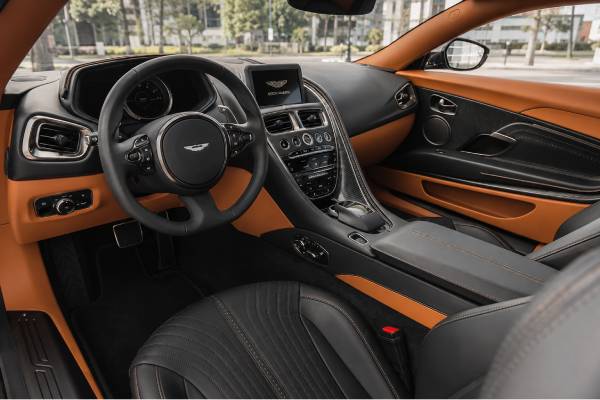
The 2017–2021 Aston Martin DB11 V8 Coupe is not simply the cheaper DB11. Its 4.0-litre twin-turbo engine removes roughly 115 kg from the front of the car, shifts the published weight distribution to 49:51, and gives the long grand tourer a more agile, rear-led balance. Output is still formidable at 503 bhp and 675 Nm, with a claimed 0–62 mph time of 4.0 seconds and a 187 mph maximum. The engine belongs to the Mercedes-AMG M177 family, but Aston Martin engineered its own intake, exhaust, calibration, mounts, cooling integration, wet-sump installation, and rear-transaxle relationship. That distinction matters for servicing and diagnosis. Across the 2017–2021 period, buyers will encounter different options, software states, market equipment, and histories, yet the essential purchase priorities remain consistent: stable electronics, clean cooling systems, smooth transaxle operation, healthy adaptive suspension, correct tires, sound brakes, and evidence of annual care. A strong example can be the most usable and balanced early DB11; deferred maintenance can erase its apparent value quickly.
Table of Contents
- Why the first V8 DB11 is more than a smaller-engine alternative
- Aston Martin’s version of the M177 powertrain
- 2017–2021 V8 coupe specifications
- Road behaviour, modes, brakes, and tires
- Year range, equipment, and everyday practicality
- A preventive maintenance plan that controls risk
- Common inspection findings and purchase decisions
Why the first V8 DB11 is more than a smaller-engine alternative
The V8 changes the character of the DB11 more than the 97 bhp power difference suggests. It trades the V12’s effortless prestige and straight-line surplus for a lighter nose, quicker response, lower fuel demand, and a chassis that feels more willing on compact roads.
Aston Martin introduced the V8 after the original V12, using the opportunity to retune springs, dampers, anti-roll bars, bushings, and steering. The compact engine sits farther back in the chassis, producing a slightly rear-biased balance. This makes the car easier to place at corner entry and reduces the sense of managing a large mass ahead of the driver.
The V8 remains a true DB11 rather than an entry-level imitation. It uses the same bonded-aluminium platform, rear-mounted eight-speed transaxle, mechanical limited-slip differential, adaptive damping, 2+2 cabin concept, AeroBlade rear airflow system, and extensive luxury options. Its performance exceeds what public roads can safely exploit.
For buyers, the main benefit is breadth. The car can commute, cross countries, and entertain on a winding route without requiring the fuel, heat, or front-axle load of the twelve-cylinder model. It also tends to offer a wider used-car selection, making it easier to prioritise condition and specification over scarcity.
The 2017–2021 scope includes early production and later cars built after the model had matured. Do not assume year alone predicts quality. An early car with complete campaigns, current software, annual servicing, and regular use can be a better purchase than a later example stored poorly or maintained only when a warning appeared.
In model-year 2022 the V8 received a power increase to 535 PS, or 528 bhp, and a 192 mph top-speed claim. That later tune falls outside this article. Advertisements often mix the figures, so verify the build date, model year, VIN specification, and engine output rather than accepting a seller’s generic DB11 description.
Aston Martin’s version of the M177 powertrain
The 4.0-litre V8 has AMG origins, but the installed system is an Aston Martin powertrain. Service decisions must follow the DB11’s VIN-specific data, because familiar engine architecture does not make oil procedures, cooling, software, emissions hardware, or diagnostics interchangeable with a Mercedes-AMG model.
The engine uses two turbochargers mounted inside the cylinder banks, shortening exhaust paths and helping response. Aston Martin developed its own air intake, exhaust, engine mounts, calibration, and packaging. The DB11 application also uses a wet-sump lubrication system and connects through a torque tube to the rear transaxle.
Peak torque of 675 Nm arrives from 2,000 rpm, allowing the car to accelerate strongly without chasing the upper rev range. A healthy engine should pull evenly, idle smoothly, and transition into boost without hesitation, surging, or repeated warning messages. Turbo whistle can be audible, but metallic contact, siren-like noise, smoke, or oil smell requires investigation.
The ZF eight-speed automatic is mounted at the rear. This arrangement supports weight distribution and gives the DB11 its long front-mid-engine proportions. Check selection from Park to Drive and Reverse, low-speed creep, light-throttle shifts, manual paddle response, full-load changes, and overrun. Delays, thumps, flares, or persistent vibration are not normal luxury-car character.
Thermal management links the engine, charge cooling, air conditioning, transmission, and tightly stacked front heat exchangers. Road debris between radiators can reduce capacity without being visible through the grille. Inspection should include the rear surfaces and spaces between cores, together with reservoirs, hoses, fans, and dried coolant traces.
Software is part of the powertrain. Campaigns and control-unit updates can affect drivability, fault strategy, battery management, displays, and shift quality. Obtain an authorised campaign printout and compare it with workshop invoices. A seller’s statement that the car was “always dealer serviced” does not show which updates were completed.
Modification deserves specific questions. ECU tunes, transmission software, valve controllers, filters, downpipes, and exhaust changes can alter heat, noise, emissions compliance, and warranty history. A standard-looking engine bay does not prove standard software. Ask who performed the work, what was changed, and whether the original calibration can be documented.
2017–2021 V8 coupe specifications
This 503 bhp coupe uses Aston Martin’s M177-based V8 installation, a torque tube, and a rear-mounted ZF eight-speed automatic. Moving the gearbox away from the engine and reducing front mass are the two technical choices that give the V8 DB11 its distinctive agility. These values apply to the original 503 bhp tune. The 2022 model-year increase to 528 bhp is a separate late-production specification and should not be applied to earlier cars.
| Specification | Value |
|---|---|
| Engine | Mercedes-AMG M177-based 4.0-litre twin-turbocharged V8, Aston Martin intake, exhaust, mounts, calibration and wet-sump installation |
| Displacement | 3,982 cc |
| Fuel | Premium unleaded gasoline |
| Maximum power | 503 bhp (510 PS / 375 kW) at 6,000 rpm |
| Maximum torque | 675 Nm (498 lb-ft) from 2,000 rpm |
| Specification | Value |
|---|---|
| Transmission | Rear-mounted ZF eight-speed automatic transaxle |
| Drive and differential | Rear-wheel drive; mechanical limited-slip differential; brake-based torque vectoring |
| Front and rear suspension | Independent double wishbones front; multi-link rear; V8-specific springs, anti-roll bars, bushings and adaptive damping |
| Steering | Electric power-assisted rack-and-pinion |
| Brakes | Ventilated steel discs, six-piston front and four-piston rear calipers |
| Specification | Value | Standard or condition |
|---|---|---|
| 0–100 km/h (0–62 mph) | 4.0 seconds, manufacturer 0–100 km/h (0–62 mph) | Manufacturer claim |
| Top speed | 301 km/h (187 mph) | Manufacturer claim |
| Fuel-tank capacity | 78 L (20.5 US gal) | Nominal capacity |
| U.S. fuel economy | U.S. rating: 18 mpg city, 24 mpg highway, 20 mpg combined for representative 2019–2021 cars | EPA cycle; exact year and body style should be checked |
| Specification | Value |
|---|---|
| Length | about 4,750 mm (187.0 in) |
| Width | about 1,950 mm body; 2,060 mm including mirrors |
| Height | about 1,290 mm (50.8 in) |
| Wheelbase | 2,805 mm (110.4 in) |
| Kerb weight | 1,760 kg (3,880 lb), published kerb weight |
| Weight distribution | 49:51 front/rear |
| Specification | Value |
|---|---|
| Body and seating | 2+2 coupe |
| Wheel format | 20-inch staggered wheels |
| Typical factory tire sizes | 255/40 ZR20 front; 295/35 ZR20 rear |
| Luggage capacity | 270 L (about 9.5 cu ft) |
Road behaviour, modes, brakes, and tires
The V8 coupe should feel light on its feet for a 1,760 kg grand tourer. Steering response is cleaner than in the early V12, the rear axle contributes naturally to rotation, and the car retains enough compliance to absorb rough touring roads in GT mode.
Test every dynamic mode separately. GT should deliver progressive throttle, early upshifts, restrained exhaust volume, and the softest damper setting. Sport should hold gears longer and add body control. Sport Plus should sharpen response without producing random harshness. If the settings make little difference, a damper, control, exhaust-valve, or software issue may be present.
The electric steering should track consistently and return smoothly. Road camber can influence a wide car, so compare several surfaces before judging a pull. Then inspect alignment values, front-tire shoulders, wheel condition, bearings, and suspension joints. A steering wheel that sits off-centre is evidence to investigate, not something to hide with a quick toe adjustment.
Tires are a primary chassis component. Correct staggered sizes, matched premium construction, suitable approval, recent date codes, and even wear are essential. Old rubber can retain deep tread while becoming hard and noisy. Mixed brands or different models front to rear can disturb wet balance and stability-control operation.
The steel brakes are strong and durable when used. Storage can leave corrosion, pad deposits, or an uneven transfer layer that causes vibration. Inspect both disc faces, measure thickness, examine pad wear, and test repeated stops from increasing speeds. Pedal travel should remain stable, and the car should stop straight.
At low speed, listen for suspension knocks, brake clicking, tire scrub beyond what steering lock explains, and noises from undertrays. At motorway speed, separate wheel imbalance from driveline vibration by changing throttle load and road speed independently. A vibration tied to speed but not engine load points toward wheels, tires, hubs, or shafts.
The mechanical limited-slip differential and brake-based torque vectoring help the rear-drive car deploy torque, but they cannot compensate for poor tires or careless inputs. Keep stability control active during a purchase test. Evidence of repeated track use—heat-marked brakes, heavily worn outer tire shoulders, unusual fluid changes, or tow-hook damage—should be discussed openly.
A good V8 DB11 does not need to feel dramatic all the time. Its strength is the transition from quiet, composed travel to decisive performance when asked. Abruptness, excessive noise, or constant stiffness often indicates modification or a problem rather than extra sporting authenticity.
Year range, equipment, and everyday practicality
Specification matters more than a simple year ranking. Across 2017–2021, cars can differ in paint, roof finish, wheels, carbon packages, seat design, leather, veneer, audio, cameras, blind-spot monitoring, parking assistance, and Q by Aston Martin content. Obtain the build sheet before deciding whether an absent feature is a fault or an unselected option.
The front seats and driving position suit long journeys, but the rear seats are occasional. They work for children, small passengers on short trips, or extra luggage. The 270-litre boot has a limited opening, so soft bags make better use of the volume. Check the boot floor, side cavities, seals, and electronic areas for moisture.
The digital instrument display should start promptly and show all layouts without dead pixels or flicker. The central infotainment uses a previous-generation Daimler interface. It lacks current touch-screen convenience, but healthy operation should be stable. Test Bluetooth, calls, audio sources, navigation, USB, controller, touchpad where fitted, steering-wheel buttons, and every camera view.
Parking technology is important because the body is wide and the bonnet is long. Confirm that the surround-view image is correctly stitched, lenses are clear, sensors detect consistently, and guidelines move as intended. A single failed camera can affect the complete view and may require calibration after replacement.
Frameless windows must index when the doors open and close. Slow operation, scraping, wind whistle, or water tracks can point to regulator, alignment, seal, or voltage issues. Check both keys and the flush door handles, mirrors, locks, boot release, fuel flap, and alarm.
Interior quality is high but hand-finished surfaces need scrutiny. Look for bolster abrasion, dye transfer, stretched perforation, loose stitching, leather shrinkage on upper panels, lifting veneer, cloudy lacquer, scratched carbon, and rattles from previous accessory installation. Repairs can be acceptable when colour, grain, sheen, and seam pattern are accurate.
A daily-used car may be healthier than a low-mileage garage car if it has been serviced and protected. Regular operation keeps seals exercised, battery charged, brakes clean, and fluids circulated. Judge mileage together with environment, journey type, records, and current condition.
A preventive maintenance plan that controls risk
The most economical way to own a DB11 is to prevent small faults from becoming system-wide problems. Annual servicing, battery care, cooling inspection, correct tires, and detailed records provide more value than waiting for a dashboard message.
Start with a baseline service after purchase unless recent work is fully documented. Verify the correct oil and filter, inspect all fluids, review plugs and filters by time and mileage, test brake fluid, assess coolant, and confirm transmission and differential history. Use the owner and service information for the exact VIN and market.
Battery health should be measured at rest, during cranking, and under load. Replace an aged battery before it causes repeated low-voltage events, register or configure it as required, and use the recommended conditioner. If discharge continues, measure parasitic draw rather than assuming another new battery will solve it.
Cooling-system prevention includes cleaning the heat-exchanger stack, inspecting stone damage, pressure testing when indicated, checking cap and reservoir condition, confirming fan stages, and looking for residue at hose joints. Monitor behaviour after slow traffic and a warm shutdown, when weak components may reveal themselves.
Oil or coolant on an undertray needs tracing. The tray can move fluid away from the source and hide the quantity. Clean the area, inspect hot and cold, and document consumption over distance. Avoid indiscriminate additive use or seal-swelling products in a high-performance engine.
Brake fluid absorbs moisture even when mileage is low. Steel discs can corrode during storage, and caliper pistons or sliders may not wear evenly. Measure rather than estimate remaining life. After washing, a short drying drive helps prevent pads from sitting against wet discs.
Alignment should follow tire or suspension work and whenever wear becomes uneven. Use a shop able to position the car correctly without damaging its low sills or underbody. Keep the alignment report and note fuel load, tire pressures, and any worn parts replaced before adjustment.
Software and campaigns belong in the service plan. Ask an authorised dealer to check the VIN periodically, even if an independent specialist performs routine work. Independent expertise and factory access complement each other.
Finally, budget a reserve. A DB11 purchased at a depreciated price still uses low-volume body parts, large brakes, complex electronics, and specialist labour. A planned reserve turns an unexpected sensor, tire set, or trim repair into ownership maintenance rather than a financial emergency.
Common inspection findings and purchase decisions
A pre-purchase inspection should classify findings by urgency and cause. The buyer needs to know which items affect safety, which are scheduled maintenance, which require diagnosis, and which are cosmetic choices.
Require a cold start. Watch cranking speed, smoke, idle quality, warning messages, exhaust condensation, and fuel or coolant smell. Scan all modules before clearing faults, record battery voltage, and distinguish historic undervoltage codes from active mechanical or communication problems.
On a lift, inspect the cooling pack, engine and turbo areas, exhaust, torque tube surroundings, transaxle, differential, suspension, brakes, wheel barrels, undertrays, floor edges, and jacking points. Look for missing fasteners, impact, fluid residue, heat damage, and non-standard wiring.
During the road test, evaluate low-speed manoeuvres, all drive modes, paddle shifts, steady cruise, acceleration under load, cooling stability, braking, steering, and noise over broken surfaces. Re-scan the car hot. Some faults appear only after boost, heat soak, or a complete control-unit wake cycle.
Body assessment should recognise bonded aluminium and composite panels. Paintwork is not automatically disqualifying, but the quality and reason matter. Check panel fit, bonnet latches, door apertures, adhesive seams where visible, lamp mounts, AeroBlade ducts, spoiler operation, and evidence of structural repair.
Price tires and brakes using measurements, not optimistic seller descriptions. A set of old premium tires with 6 mm of tread is still an immediate expense. Likewise, polished outer disc faces do not reveal inner corrosion. Wheel refinishing should be checked for cracks, bends, and correct dimensions.
Review history chronologically. Mileage, service dates, battery replacements, tire changes, campaigns, recurring warnings, accident repairs, and ownership periods should form a plausible sequence. A stamped book without invoices cannot explain what oil, parts, or diagnostic work was performed.
Choose the car with the clearest baseline, not the most exciting advertisement. A desirable colour and carbon options may enhance ownership, but they do not outweigh cooling faults, missing records, mismatched tires, or unresolved electrical warnings. The best 503 bhp V8 coupe is one that remains mechanically standard or transparently modified, drives consistently in every mode, and has been maintained as a 187 mph Aston Martin rather than merely valued as a used luxury car. A final overnight battery-voltage check and a second cold start after inspection can also expose intermittent drain or starting issues that a same-day viewing can very easily miss. It also confirms that the handles, windows, cameras, and control modules wake normally after a full sleep cycle.
References
- SUBLIME CHOICES: DB11 NOW OFFERED WITH V8 ENGINE 2017 (Technical Release)
- Aston Martin DB11: the latest in an illustrious bloodline 2017 (Platform Background)
- Owner’s Guides | Aston Martin 2026 (Owner Documentation)
- Aston Martin Luxury Car Servicing | Aston Martin 2026 (Service Information)
- Fuel Economy of the 2021 Aston Martin DB11 V8 2021 (EPA Fuel Economy)
Disclaimer
This article is for general information rather than professional repair direction. Specifications and maintenance requirements can differ by VIN, model year, country, software level, and installed options; use the official owner and service documents for the car being assessed.
Please share this V8 coupe guide on Facebook, X/Twitter, or another platform if it saves another buyer from an avoidable mistake.