

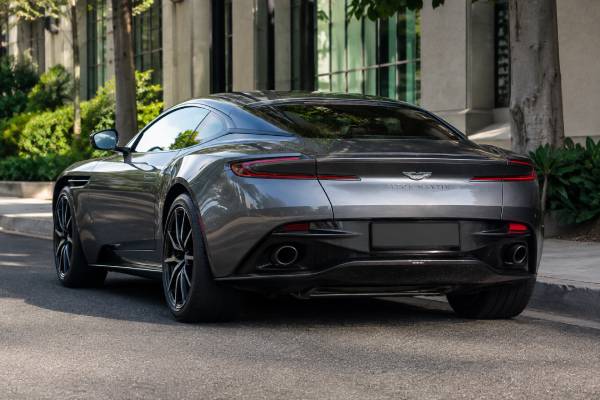
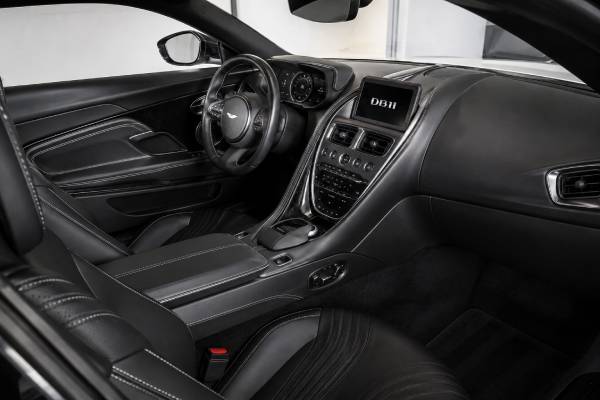
The 2022 Aston Martin DB11 W1 is a Japan-only Q by Aston Martin commission limited to 10 cars. Its name refers to W1, the central London postcode associated with Mayfair, and its specification translates that district’s architecture and luxury atmosphere into two exterior choices—Arizona Bronze and Lunar White—paired with a gloss-black roof, bronze pinstriping, Union Jack enamel wings, satin-black and bronze wheels, and a warm Bison Brown cabin theme. The assignment identifies the car with the 503 bhp version of the 4.0-litre twin-turbo V8, although the commission was announced near the transition to the 528 bhp 2022-model-year update. For any individual car, factory build data and Japanese homologation documents should settle the exact engine calibration rather than assumptions based on announcement date. W1 rarity is easy to state and harder to preserve. Buyers need proof that the VIN belongs to the ten-car commission, that its Q details remain correct, and that import, mileage, service, electronics, tires, brakes, and cooling have been assessed with the same care as the bespoke finish.
Table of Contents
- Why W1 was created for Japan
- Mayfair-inspired colours and Q details
- DB11 W1 technical specifications
- What to expect from the 503 bhp V8 coupe
- Japanese-market equipment, documents, and export issues
- Preserving bronze accents and bespoke cabin materials
- Mechanical care and pre-purchase authentication
Why W1 was created for Japan
W1 was created as a regional special commission rather than a global trim level. Q by Aston Martin developed ten cars specifically for Japan, drawing on the polished residential and commercial character of London’s Mayfair district. The model name comes from the W1 postcode at the centre of that area.
That origin gives the car a clear story but also creates room for inaccurate advertising. W1 is not shorthand for any white or bronze DB11, and it is not a dealer styling kit. A genuine example should have factory and Japanese-market records connecting its VIN to the ten-car Q commission.
The project was announced in Japan on December 20, 2021, and is commonly described as a 2022 special edition. Announcement, build, model-year, and first-registration dates can differ. Those dates also intersect with Aston Martin’s broader 2022 model-year V8 update, which increased standard DB11 V8 output to 535 PS or 528 bhp.
The assignment scope specifies 503 bhp. Because period W1 announcements concentrated on design rather than publishing a complete mechanical table, a buyer should not infer output from the year label alone. The factory build sheet, engine-control specification, certificate of conformity, Japanese registration data, and authorised diagnostic information should establish whether a particular W1 retains the earlier 503 bhp calibration or received the later output.
This is not merely a numerical detail. Insurers, import authorities, valuers, parts departments, and future buyers may all rely on the stated specification. A sales advertisement should explain the evidence rather than switching between 503 and 528 bhp according to whichever figure appears more attractive.
Regional rarity affects the ownership file. Japanese delivery records, dealer correspondence, inspection history, auction sheets where applicable, export documents, and translated service invoices may be essential to proving mileage and condition. Losing them can make an authentic ten-car commission appear less certain outside its home market.
W1 should be valued for coherent design and provenance, not for an assumed performance advantage. Its mechanical foundation is the V8 DB11 coupe, already a fast and balanced grand tourer. The limited story sits in the Q specification, market purpose, and surviving completeness.
Mayfair-inspired colours and Q details
The W1 design uses contrast rather than a single signature colour. Arizona Bronze evokes warm stone and metal tones associated with Mayfair buildings, while Lunar White provides a cooler alternative. Both were paired with a gloss-black roof and upper treatment that visually lowers the cabin.
Bronze pinstripes were applied to black exterior components, including areas such as the splitter, diffuser, side sills, side strakes, grille-vane edges, and related details described in Japanese launch material. Their narrow width makes condition and placement important. Uneven replacement tape or painted lines with poor edges can alter the car immediately.
The Aston Martin wings carry a Union Jack enamel treatment, and black enamel Q badges reinforce the commission identity. These small parts can be damaged by polishing, replaced with ordinary badges, or separated from the car. Photograph part markings and compare finish with factory images and the build record.
The 20-inch directional wheels combine satin black and bronze. Check that each wheel is on the intended side, because directional designs can be swapped during tire service. Inspect the bronze areas for colour match, clear-coat edge quality, and refinishing that has softened spoke details or buried markings.
Anodised brake-caliper presentation was part of the exterior composition. Confirm the precise factory finish for the VIN rather than assuming a repaint is original. Freshly painted calipers can conceal heat damage, corrosion, damaged seals, or over-sprayed hardware.
The standard cabin theme used Bison Brown semi-aniline leather with Ice Mocha contrast stitching and wing embroidery, together with warm trim such as dark open-pore ash and matching headlining or carpet details. An optional two-tone treatment combined a pale Glacier or Glacial White shade with Bison Brown, ivory stitching, Q quilting and perforation, Mocha carpet, and Ice Mocha belts.
Translations of colour names vary. Japanese and English sources may render Lunar, Platinum, Glacier, or Glacial terminology differently. The individual build sheet and paint or trim codes are the authority for the car in front of you. Do not reject a correct car because a translated advertisement uses a slightly different English name.
Open-pore wood should look tactile and low gloss. Heavy oil, furniture polish, or aggressive refinishing can darken pores and create an artificial sheen. Semi-aniline leather can show honest creasing; excessive recolouring may hide the original grain and bury contrast thread.
A complete W1 should also retain keys, books, Japanese delivery materials, Q documentation, tools, mobility equipment, battery-conditioning lead, and any special accessories listed on the invoice. Ten-car provenance is strongest when the small objects and paperwork remain with the physical specification.
DB11 W1 technical specifications
The W1 is built on the V8 coupe’s front-mid-engine and rear-transaxle architecture, with the assignment classified at 503 bhp. Because its announcement sits near a model-year power transition, the individual VIN and Japanese homologation record remain the final authority. The tables follow the assignment’s 503 bhp classification for this commission. Because W1 was announced near the 2022 model-year power change, confirm the exact calibration and homologated output for each VIN before publication, registration, or purchase.
| Specification | Value |
|---|---|
| Engine | Mercedes-AMG M177-based 4.0-litre twin-turbocharged V8, Aston Martin intake, exhaust, mounts, calibration and wet-sump installation |
| Displacement | 3,982 cc |
| Fuel | Premium unleaded gasoline |
| Maximum power | 503 bhp (510 PS / 375 kW) at 6,000 rpm |
| Maximum torque | 675 Nm (498 lb-ft) from 2,000 rpm |
| Specification | Value |
|---|---|
| Transmission | Rear-mounted ZF eight-speed automatic transaxle |
| Drive and differential | Rear-wheel drive; mechanical limited-slip differential; brake-based torque vectoring |
| Front and rear suspension | Independent double wishbones front; multi-link rear; V8-specific springs, anti-roll bars, bushings and adaptive damping |
| Steering | Electric power-assisted rack-and-pinion |
| Brakes | Ventilated steel discs, six-piston front and four-piston rear calipers |
| Specification | Value | Standard or condition |
|---|---|---|
| 0–100 km/h (0–62 mph) | 4.0 seconds, manufacturer 0–100 km/h (0–62 mph) | Manufacturer claim |
| Top speed | 301 km/h (187 mph) | Manufacturer claim |
| Fuel-tank capacity | 78 L (20.5 US gal) | Nominal capacity |
| U.S. fuel economy | U.S. rating: 18 mpg city, 24 mpg highway, 20 mpg combined for representative 2019–2021 cars | EPA cycle; exact year and body style should be checked |
| Specification | Value |
|---|---|
| Length | about 4,750 mm (187.0 in) |
| Width | about 1,950 mm body; 2,060 mm including mirrors |
| Height | about 1,290 mm (50.8 in) |
| Wheelbase | 2,805 mm (110.4 in) |
| Kerb weight | 1,760 kg (3,880 lb), published kerb weight |
| Weight distribution | 49:51 front/rear |
| Specification | Value |
|---|---|
| Body and seating | 2+2 coupe |
| Wheel format | 20-inch staggered wheels |
| Typical factory tire sizes | 255/40 ZR20 front; 295/35 ZR20 rear |
| Luggage capacity | 270 L (about 9.5 cu ft) |
What to expect from the 503 bhp V8 coupe
A W1 should drive like a standard, healthy 503 bhp DB11 V8 coupe. Q by Aston Martin changed colours, materials, and details; it did not announce a W1-specific chassis or performance calibration.
The compact V8 removes substantial front mass compared with the original V12 and contributes to a 49:51 published balance. The long coupe therefore turns more readily than its proportions suggest, while the rear transaxle keeps power delivery stable and the cabin remains suited to long journeys.
The engine provides 675 Nm from 2,000 rpm. In GT mode, it should pull smoothly with early shifts and restrained exhaust volume. Sport adds urgency and holds gears longer, while Sport Plus provides the most immediate settings. A permanent harsh ride or excessive drone is not proof of W1 character.
The 503 bhp factory claim corresponds to a 4.0-second 0–62 mph time and 187 mph top speed in the standard V8 coupe. If factory records establish the later 528 bhp calibration for an individual car, the performance reference changes. Keep that question documentary rather than attempting to judge power by sensation.
Road-test the car from cold through full temperature. Check cranking speed, idle, boost response, automatic and manual shifts, steady cruise, cooling stability, fan operation after heat soak, and any warning messages. The car should not surge, smoke, hesitate, or smell strongly of fuel or coolant.
Steering accuracy depends on the correct directional wheels, matched tires, pressure, and alignment. Inspect inner shoulders and date codes. A low-mileage Japanese car may have original-looking tires that are old enough to compromise wet grip and braking.
The large steel brakes should stop the car straight with a firm pedal. Storage corrosion can affect inner faces even when outer surfaces look polished. Measure disc thickness and pad life, and inspect wheel barrels for brake dust hiding cracks or repairs.
Ride quality should change clearly between damper settings but remain grand-touring in GT. Knocks over small impacts, repeated float after crests, or vibration at speed require diagnosis of links, dampers, wheels, tires, bearings, and undertrays.
A modified exhaust is especially relevant on an imported limited edition. Japan-market sound and emissions rules, export compliance, insurance, and future registration can be affected by valve controllers, downpipes, catalysts, or software. Ask for original parts and calibration evidence.
Japanese-market equipment, documents, and export issues
The paper trail is part of W1 authenticity. A buyer outside Japan should expect to work with translated documents and should preserve both the original-language records and any certified translations.
Useful records include the Japanese registration certificate, first delivery invoice, Q or dealer specification, maintenance book, inspection history, warranty-start data, recall and campaign evidence, auction condition sheet if the car passed through auction, export certificate, customs documents, and odometer declarations.
Mileage verification should use several independent points. Service dates, annual inspection records, auction sheets, diagnostic mileage, tire dates, brake wear, cabin condition, and registration history should form a consistent sequence. A converted instrument display does not itself prove that kilometres were recorded correctly after export.
Market equipment can differ in navigation maps, radio frequencies, connected services, telematics, alarm or tracker, lighting, emissions labels, and software region. Determine which functions can be updated officially in the destination country and which may remain Japan-specific.
Right- or left-hand-drive configuration must match the build record and intended market. Do not assume that a Japan-delivered luxury car is necessarily right-hand drive; special orders can vary. Lighting conversion should be documented and reversible where possible.
Import compliance can involve emissions testing, noise rules, immobiliser requirements, taxes, title classification, and parts labelling. A car legally exported from Japan is not automatically registrable everywhere. Consult the destination authority and a qualified importer before purchase.
Warranty and service support may change after export. Ask whether local Aston Martin dealers can access the VIN, order W1-specific parts, perform software updates, and record service in the relevant systems. Regional limited editions can require communication with the original Japanese dealer or Aston Martin regional office.
Japanese maintenance invoices often contain useful detail even when the buyer cannot read them. Translate line items, part numbers, advisories, and customer-declined work rather than relying on a one-line summary. Photographs and date-stamped inspection sheets can explain cosmetic repairs or recurring concerns.
If the car remains in Japan, verify shaken inspection status, taxes, parking documentation, and any dealer warranty. If it has already moved abroad, preserve the entire export chain. Provenance becomes harder to reconstruct each time documents are discarded after a registration change.
A complete file does more than support value. It helps technicians identify market-specific software and equipment, allows insurers to understand the ten-car specification, and prevents the car from being described incorrectly years later.
Preserving bronze accents and bespoke cabin materials
W1 preservation requires material-specific care because its identity is concentrated in narrow bronze details, enamel badges, satin wheel finishes, semi-aniline leather, contrast stitching, and open-pore wood.
Wash the bronze pinstripes by hand with low pressure and soft media. Avoid dragging a polishing pad across their edges or using solvent to remove nearby adhesive. Photograph their original placement before applying paint-protection film or undertaking front-end refinishing.
Gloss-black roof and upper trim show fine scratches quickly. Clean them with separate, uncontaminated tools and dry gently. Paint correction should follow thickness measurement and a conservative plan; removing clear coat to chase every mark is a poor trade on a ten-car commission.
Union Jack enamel wings should be cleaned without metal polish or abrasive compounds. Inspect enamel for chips, lifting, and chemical clouding. If replacement becomes necessary, retain the damaged original part with its invoice and photograph the installation.
Satin-black and bronze wheels need pH-compatible cleaners and soft brushes. Gloss enhancers can change the intended satin appearance. After tire work, confirm direction, wheel location, balance weights, centre caps, and that tools have not chipped bolt recesses.
Semi-aniline leather is softer and less heavily coated than conventional automotive leather. Vacuum grit first, use minimal compatible cleaner, and test in a hidden area. Sunscreen, denim dye, hand sanitiser, and dark clothing can transfer to pale two-tone seats.
Ice Mocha or ivory stitching should be cleaned along the seam with little moisture. Aggressive scrubbing can fray thread or spread dye from adjacent leather. A specialist repair should match thread diameter, colour, stitch length, and perforation pattern.
Open-pore ash should remain low gloss. Avoid oil-rich furniture products, steam, and abrasive pads. Dust with a clean soft tool and address liquid spills promptly. A darkened or polished patch can be harder to reverse than a small scratch.
Store the car in stable, dry conditions with a battery conditioner and enough ventilation to prevent condensation. Use a spotless breathable cover only after the paint is clean. Do not leave bespoke luggage or paper records in a damp boot.
Keep a cosmetic ledger. Record film, coating, paint repair, wheel refinishing, badge replacement, leather treatment, and wood work with photographs and product names. Future owners need to distinguish preserved original material from well-executed restoration.
Mechanical care and pre-purchase authentication
A W1 inspection must prove commission identity and establish the mechanical baseline independently. The rarity story cannot compensate for an unresolved cooling fault, poor tires, weak voltage, or uncertain output specification.
Start with factory evidence. Match VIN across the car, build sheet, Q documents, Japanese registration, export records, service history, and diagnostic scan. Confirm W1 designation, exterior choice, roof and upper package, wheels, badges, cabin theme, options, and homologated engine output.
Perform a fully cold start. Record battery voltage, cranking, smoke, idle, warning messages, and smells. Scan all modules before clearing faults. Low voltage can generate many codes, but faults that return after stable power must be diagnosed normally.
On a lift, inspect the heat-exchanger stack, engine and turbo areas, exhaust and catalysts, torque tube, rear transaxle, differential, suspension, adaptive dampers, brakes, wheel barrels, tire inner shoulders, undertrays, floor edges, and jacking points.
Cooling prevention is crucial. Debris can sit between stacked cores, and Japan’s urban use may involve long periods of low-speed heat. Check reservoirs, hose joints, fan operation, dried residue, and temperature behaviour after a warm drive and heat soak.
The transaxle should select promptly and shift consistently cold and hot. Test creep, light throttle, paddles, kickdown, overrun, and tight manoeuvres. Software status should be recorded, but repeated thumps or delays need more than an adaptation reset.
Body inspection should account for bonded aluminium, composites, gloss-black areas, and narrow pinstripes. Measure paint, examine panel fit and fasteners, inspect the clamshell bonnet and AeroBlade paths, and identify replacement carbon or black components.
Price missing W1 parts before negotiating. Ten-car-specific wheels, badges, pinstripe details, trim, or paperwork may not be readily available. A general Aston Martin part that fits physically may not restore authenticity.
Review service by date and item. Annual care, oil specification, plugs, fluids, battery, tires, brakes, alignment, campaigns, software, and any accident repair should form a credible chronology. Translate Japanese invoices where necessary.
Finally, compare the car only with genuine W1 examples or with standard V8 coupes adjusted carefully for the commission premium. Region, taxes, export cost, mileage, output evidence, condition, originality, and document completeness all matter.
The right W1 is not merely one of ten on paper. It is a correctly specified, well-documented Japan commission whose bronze and brown design remains intact and whose V8 coupe beneath it has been maintained without shortcuts. That combination makes the Mayfair idea durable beyond its launch moment.
References
- アストンマーティン、日本限定10台の「DB11 W1」 ロンドンメイフェアの贅沢なライフスタイルを反映 2021 (Japanese Launch Report)
- 英国の真髄 – アストンマーティンDB11 ‘W1’ 2021 (Authorised Dealer Overview)
- SUBLIME CHOICES: DB11 NOW OFFERED WITH V8 ENGINE 2017 (V8 Engineering)
- Owner’s Guides | Aston Martin 2026 (Owner Documentation)
- Aston Martin Luxury Car Servicing | Aston Martin 2026 (Service Information)
Disclaimer
This is an informational guide, not an official W1 certificate, import opinion, or repair manual. Confirm output, Japanese-market specification, Q content, registration requirements, parts, and service procedures from the exact VIN and authoritative documents.
Please share it on Facebook, X/Twitter, or another network when it helps preserve accurate knowledge about the ten-car W1 commission.