

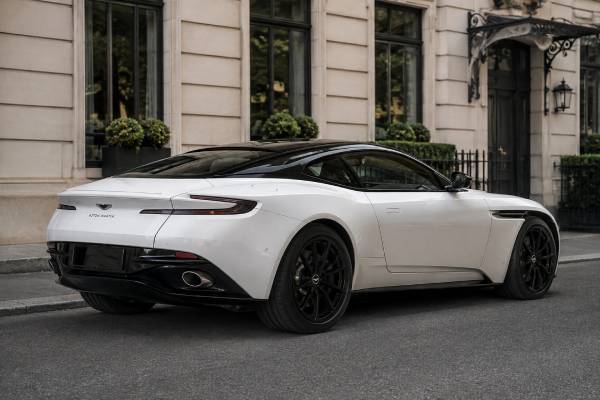
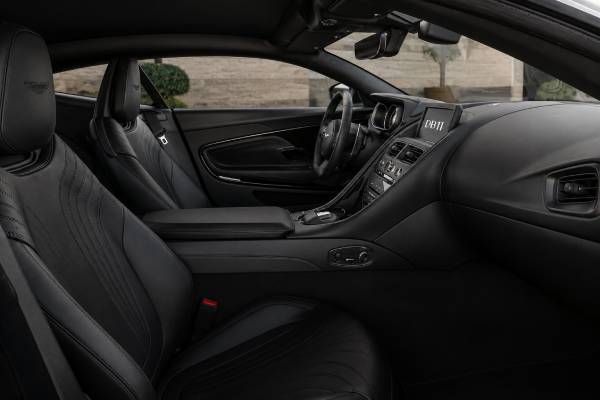
The 2021 Aston Martin DB11 V8 Coupe Shadow Edition is a factory appearance package limited to 300 DB11 V8 cars worldwide across the coupe and Volante body styles. It did not receive extra power, revised acceleration, or a unique chassis tune: the coupe retains the 503 bhp, 675 Nm 4.0-litre twin-turbo V8, rear transaxle, and 187 mph claim of the standard model. Its identity comes from a coordinated dark treatment that includes gloss-black exterior details, black chrome badging, 20-inch gloss-black directional wheels, Shadow Edition sill plaques, and a deliberately subdued cabin theme. That makes authentication more nuanced than checking an engine code. Many ordinary DB11s have been blacked out by owners, while genuine Shadow cars may have lost original wheels or trim through damage and refinishing. A strong purchase combines a VIN-linked factory build record with careful inspection of every edition component, plus the normal DB11 checks for battery voltage, software status, cooling, tires, brakes, transaxle behaviour, adaptive suspension, and body repair. Rarity adds interest, but condition and completeness determine whether that interest deserves a premium.
Table of Contents
- The Shadow Edition in one clear definition
- Exterior and cabin details that establish identity
- Shadow Edition coupe specifications
- Performance unchanged, character transformed
- Caring for black trim, wheels, paint, and carbon
- Service and fault prevention for the 2021 V8
- Authentication, inspection, and realistic valuation
The Shadow Edition in one clear definition
The Shadow Edition is a visual limited edition, not a hidden performance derivative. Aston Martin announced it for the 2021 model year and capped combined coupe and Volante production at 300 cars worldwide. The drivetrain remained the then-current 503 bhp V8 specification.
This distinction prevents three common errors. First, the 300 figure is not 300 coupes plus 300 Volantes. Second, a Shadow Edition does not have the later 528 bhp model-year 2022 tune unless factory records establish that unusual overlap for a specific car. Third, a standard DB11 fitted with black wheels and badges is not converted into a numbered factory edition.
The package worked by reducing bright visual interruptions. Gloss-black bonnet blades, dark exterior trim, black chrome wings and script, directional black wheels, and Shadow identifiers gave the DB11 a more architectural appearance. Depending on market and individual order, body colour and cabin details could vary within the edition theme, so a single press photograph is not a complete build guide.
The coupe suits the treatment because its fixed roof and continuous fastback form create long dark surfaces. Unlike a carbon-heavy motorsport package, the Shadow theme relies on finish and contrast. Poor wheel refinishing, cloudy black chrome, scratched gloss trim, or inconsistent paint can therefore damage the design more than a conventional colour specification.
The package was offered late in the 503 bhp period. Registration and model-year language can overlap, especially across markets. Use the VIN, factory build sheet, production date, warranty start, and original invoice to establish exactly what the car is. An advertisement that calls any black 2021 DB11 a “Shadow” is not evidence.
Rarity should be considered in context. Three hundred cars across two body styles is meaningfully limited, but not so scarce that a buyer should accept unresolved faults. The edition carries the same mechanical needs as every contemporary V8 coupe and the same potential cost when those needs are ignored.
The most desirable examples remain visually complete, mechanically standard or transparently modified, and supported by delivery documentation. A car missing one edition plaque or the correct wheels may still be genuine, but the cost and feasibility of restoration should be reflected before purchase.
Exterior and cabin details that establish identity
Identity should be built from several matching sources: VIN-linked factory specification, original sales documents, physical edition components, and a coherent finish. No single black part or badge is conclusive because all can be replaced.
Begin with the build sheet. It should describe the Shadow Edition or its package code and list exterior colour, roof treatment, wheels, brake-caliper finish, interior palette, veneer or carbon, audio, cameras, and other options. Compare the invoice and first registration to the same VIN.
Inspect the gloss-black bonnet blades from low angles. Fine washing scratches, stone marks, polish residue at edges, or lifting film are common. Confirm that both sides have matching sheen and fit. Replacement pieces should have correct part markings and documented installation.
Black chrome badges are visually distinct from painted or wrapped standard badges. Look for pitting, cloudy plating, bent wings, adhesive residue, and inconsistent finish between the nose, rear script, and side identifiers. Fresh ordinary badges sprayed black may lack the depth and edge quality of factory pieces.
The 20-inch directional wheels should be checked side by side. Directional designs can be installed on the wrong side after tire work, undermining the intended visual flow. Verify part numbers, dimensions, orientation, centre caps, inner-barrel condition, and the accuracy of any refinishing.
Gloss black reveals sanding and powder-coat defects more readily than silver. Inspect spoke edges for excessive material, bolt-seat damage, cracks, welds, and a finish that buries markings. A cosmetically perfect wheel can still be structurally compromised.
Shadow Edition sill plaques are important, but they should be treated as one element in the complete file. Photograph their wording and condition, and compare both sides. Scratched or missing plates may be replaceable only with proof of ownership and may have long lead times.
Cabin specification can be dark without being identical on every car. Check leather colour, stitching, headlining, trim, seat type, and optional carbon against the build record. Wear shows as a change in sheen on black surfaces, so inspect under diffuse light rather than using showroom reflections.
Body paint should be assessed independently of the dark package. Measure panel depths, examine the clamshell bonnet and rear quarters, inspect fasteners and apertures, and identify paint-protection film. A black roof or upper package can make mismatched repairs difficult to see until the car is outdoors.
Keep all original parts. If a prior owner fitted silver wheels, bright badges, or a different exhaust for personal taste, the correct Shadow components should accompany the car. Completeness is easier to preserve than to reconstruct from discontinued pieces.
Shadow Edition coupe specifications
The Shadow coupe is mechanically the regular 2021 V8 DB11: 503 bhp, rear-wheel drive, and a rear-mounted eight-speed transaxle. The limited package changes visual surfaces and identifiers, so the technical table should not imply a separate power or chassis tune. The Shadow package did not alter the homologated V8 output, acceleration, or chassis hardware. These figures are the standard 2021 V8 coupe values beneath the limited-edition finish.
| Specification | Value |
|---|---|
| Engine | Mercedes-AMG M177-based 4.0-litre twin-turbocharged V8, Aston Martin intake, exhaust, mounts, calibration and wet-sump installation |
| Displacement | 3,982 cc |
| Fuel | Premium unleaded gasoline |
| Maximum power | 503 bhp (510 PS / 375 kW) at 6,000 rpm |
| Maximum torque | 675 Nm (498 lb-ft) from 2,000 rpm |
| Specification | Value |
|---|---|
| Transmission | Rear-mounted ZF eight-speed automatic transaxle |
| Drive and differential | Rear-wheel drive; mechanical limited-slip differential; brake-based torque vectoring |
| Front and rear suspension | Independent double wishbones front; multi-link rear; V8-specific springs, anti-roll bars, bushings and adaptive damping |
| Steering | Electric power-assisted rack-and-pinion |
| Brakes | Ventilated steel discs, six-piston front and four-piston rear calipers |
| Specification | Value | Standard or condition |
|---|---|---|
| 0–100 km/h (0–62 mph) | 4.0 seconds, manufacturer 0–100 km/h (0–62 mph) | Manufacturer claim |
| Top speed | 301 km/h (187 mph) | Manufacturer claim |
| Fuel-tank capacity | 78 L (20.5 US gal) | Nominal capacity |
| U.S. fuel economy | U.S. rating: 18 mpg city, 24 mpg highway, 20 mpg combined for representative 2019–2021 cars | EPA cycle; exact year and body style should be checked |
| Specification | Value |
|---|---|
| Length | about 4,750 mm (187.0 in) |
| Width | about 1,950 mm body; 2,060 mm including mirrors |
| Height | about 1,290 mm (50.8 in) |
| Wheelbase | 2,805 mm (110.4 in) |
| Kerb weight | 1,760 kg (3,880 lb), published kerb weight |
| Weight distribution | 49:51 front/rear |
| Specification | Value |
|---|---|
| Body and seating | 2+2 coupe |
| Wheel format | 20-inch staggered wheels |
| Typical factory tire sizes | 255/40 ZR20 front; 295/35 ZR20 rear |
| Luggage capacity | 270 L (about 9.5 cu ft) |
Performance unchanged, character transformed
Mechanically, the Shadow Edition should drive exactly like a healthy 503 bhp DB11 V8 coupe. The dark visual treatment may make the car appear more aggressive, but it does not justify a louder exhaust, harsher ride, or faster claimed acceleration.
The V8’s major dynamic advantage over the V12 is reduced front mass. Aston Martin published a 1,760 kg kerb figure and 49:51 balance, allowing the nose to respond cleanly while the rear transaxle gives the car stable traction. The result is agile for its size rather than nervous.
GT mode should deliver soft throttle response, smooth early shifts, and useful suspension travel. Sport should hold gears and add exhaust presence. Sport Plus should tighten the responses further. A car that crashes over small bumps or drones constantly may have incorrect tire pressures, aged tires, spacers, modified suspension, or an altered exhaust.
The engine produces 675 Nm from 2,000 rpm, so overtaking rarely requires high revs. Boost should build evenly without hesitation, smoke, metallic turbo noise, or warning messages. The compact hot-V layout generates substantial local heat; full power should be used only after proper warm-up.
Steering accuracy depends on tire quality and alignment. Dark wheels can hide inner-barrel damage and brake dust, so do not let the appearance package distract from measurement. Check date codes, matching tire model, inner-shoulder wear, repaired punctures, and correct stagger.
The brakes use large ventilated steel discs. Test light applications for smoothness and firmer stops for stability. Storage can corrode inner faces, while repeated hard use can create heat checking or pad deposits. Measure discs and pads rather than estimating through black spokes.
At motorway speed, distinguish wind noise, tire roar, wheel imbalance, and driveline vibration. Change throttle load at a steady speed and change speed at a steady load. A vibration that follows road speed has a different diagnostic path from one that follows engine torque.
The coupe’s closed body should remain quiet over diagonal surfaces. Creaks around the rear trim, roof, frameless glass, or seats should be localised. Hand-built character is not permission for every rattle, especially if recent audio, tracker, camera, or trim work has disturbed clips and wiring.
A standard powertrain preserves the edition’s logic. ECU tunes and exhaust modifications may add speed or sound, but they separate the car from the stated factory package and can complicate emissions, insurance, heat management, and resale. Documentation and retained original parts are essential if changes have been made.
Caring for black trim, wheels, paint, and carbon
Dark finishes show poor technique quickly. The safest preservation plan uses clean tools, minimal abrasion, measured correction, and documentation of every film, coating, or refinished part.
Gloss-black exterior pieces scratch from ordinary washing. Rinse loose grit, use separate clean media for lower areas, and dry without dragging contaminated towels across long surfaces. Automatic brushes can create a grey haze that is especially visible on bonnet blades and roof trim.
Before polishing, identify whether a part is painted, plated, wrapped, carbon-fibre, or protected by film. Each surface has different heat and abrasion limits. A machine pass that improves body clear coat may damage black chrome, thin edge paint, or film.
Paint correction should follow thickness measurement and repair history. Deep scratches cannot always be removed safely. On a limited edition, retaining clear coat is more valuable than achieving a temporary defect-free reflection. Photograph the car before and after substantial correction.
Black chrome requires gentle, non-abrasive cleaning. Metal polish can remove or cloud the plated appearance. Bird deposits, insect residue, and road salt should be removed promptly with compatible products. Damaged badges are usually better replaced with the correct part than aggressively restored.
Wheel care should avoid acidic cleaners and stiff brushes that attack finish or leave bright marks at edges. Clean inner barrels so cracks, bends, and adhesive-weight residue remain visible. After tire service, confirm correct orientation and use tools that do not chip the bolt recesses.
If carbon-fibre options are fitted, inspect the clear coat for UV clouding and stone impact. Lower pieces benefit from professionally applied film, but film should not conceal existing cracks or repaired weave. Record part numbers before replacement.
The interior’s dark leather and trim can look clean while holding abrasive dust. Vacuum seams and perforations first. Use low-gloss, compatible cleaners and avoid oily dressing. Compare wear across the seat bolster, wheel rim, door pulls, pedals, and controller to preserve an honest mileage story.
Storage should be dry, ventilated, and supported by a battery conditioner. A clean breathable cover can protect against dust, but a dirty or damp cover will abrade black paint. Keep the car and cover separately clean.
Cosmetic work belongs in the history file. Retain invoices for wheel refinishing, paint repair, film, coatings, badge replacement, leather work, and detailing. Future buyers need to know which dark surfaces are factory, repaired, or protected.
Service and fault prevention for the 2021 V8
The Shadow Edition follows the normal 503 bhp V8 service needs. Its limited status does not change fluid intervals, but it raises the value of careful, itemised records and reversible repairs.
Service annually and use the exact Aston Martin requirements for oil, filters, plugs, coolant, brake fluid, transmission, differential, and inspections. The engine is M177-based, yet the DB11 installation differs from Mercedes-AMG applications in calibration, cooling, intake, exhaust, mounts, and rear-transaxle integration.
Keep the battery on the recommended conditioner during storage. Test capacity before it becomes weak enough to trigger module faults. When multiple warnings appear, restore stable voltage, scan every system, and verify what returns. Do not erase the evidence first.
Cooling maintenance is preventive. Clean the spaces between stacked heat exchangers, inspect stone damage, look for dried residue at reservoirs and joints, and confirm fan operation after a warm drive. A car used mostly in urban traffic can accumulate heat without high road speed.
Inspect engine and transmission undertrays for leaks and impact. Fluid can travel along a panel and drip far from its source. Clean, trace, and recheck after heat cycling rather than guessing from one stain.
The rear transaxle should engage promptly and shift smoothly. Evaluate cold and hot, including parking manoeuvres, light throttle, paddle shifts, kickdown, and overrun. A software update can refine calibration; it cannot repair worn hardware or an active leak.
Tires age even when mileage is low. The Shadow’s dark wheels can make sidewall cracking and inner wear less obvious, so use good lighting and measure. Replace with a matched set of the correct size and performance level, then align the car.
Brake fluid, disc condition, pads, calipers, and hoses should be checked by time and measurement. Dry the brakes after washing and avoid long damp storage with wet pads against the discs. Retain thickness readings and photographs when major work is postponed.
Campaign and software status should be checked by VIN through an authorised Aston Martin source. Routine work may be performed by a qualified independent specialist, but factory access remains useful for updates and campaign confirmation.
A maintenance reserve should cover more than oil changes. Tires, brakes, batteries, cameras, trim, low-volume body parts, and diagnostic hours can arrive together. Buying a limited edition at the edge of the budget encourages exactly the deferred care that harms its future value.
Authentication, inspection, and realistic valuation
Value begins with proving the factory edition, then subtracting the cost of bringing the individual car to a known baseline. Rarity cannot be priced independently of correctness and condition.
Ask for the build sheet, original invoice, warranty-start record, service history, campaign printout, both keys, books, and delivery photographs. Match every VIN and compare the listed Shadow components with the car. Record absent or substituted parts.
A specialist inspection should include a cold start, complete module scan, lift examination, long road test, hot reinspection, and second scan. Check cooling, leaks, turbo and exhaust areas, transaxle, differential, adaptive dampers, suspension, brakes, wheels, tires, undertrays, electronics, cameras, climate control, and every door and window function.
Measure paint and inspect the bonded-aluminium and composite body with appropriate knowledge. Examine bonnet latches, panel fit, adhesive seams where visible, fasteners, jacking points, wheel housings, AeroBlade ducts, and spoiler operation. High-quality documented paintwork is different from hidden structural repair.
For edition authentication, photograph bonnet blades, badges, wheels, plaques, interior details, and build codes. Compare wheel orientation and finish with factory material. Check whether replacement dark parts are genuine and whether original removed items remain with the car.
Review modifications explicitly: engine and gearbox software, exhaust valves, downpipes, filters, suspension, spacers, wheels, wraps, coatings, audio, trackers, and phone integration. Ask for installers, dates, invoices, and the original parts.
Market comparison should use other genuine Shadow Edition coupes where available, then adjust for region, taxes, mileage, ownership, service, body repair, specification, tires, brakes, and completeness. A standard black DB11 is not a valid limited-edition comparable; neither is a Shadow Volante without allowance for body style.
Do not pay a premium merely because a plaque is present. Pay for a consistent evidence chain and a car that still embodies the factory package. A correct Shadow Edition with current maintenance can offer modest collectability without sacrificing use. An incomplete one may be no more valuable than an equivalent standard V8 once restoration costs are included.
The best purchase is visually disciplined and mechanically uneventful. It starts cleanly, holds temperature, shifts smoothly, changes mode distinctly, stops without vibration, and retains its dark details without cosmetic shortcuts. That is what turns the Shadow Edition from an appearance package into a credible limited-production Aston Martin.
References
- DB11 V8 Coupe Shadow Edition « Aston Martins.com 2021 (Edition Reference)
- 2021 Aston Martin DB11 V8 Shadow Edition Debuts, Limited To 300 Units 2020 (Announcement)
- SUBLIME CHOICES: DB11 NOW OFFERED WITH V8 ENGINE 2017 (V8 Engineering)
- Owner’s Guides | Aston Martin 2026 (Owner Documentation)
- Fuel Economy of the 2021 Aston Martin DB11 V8 2021 (EPA Fuel Economy)
Disclaimer
This article is informational and does not certify Shadow Edition authenticity or mechanical condition. Verify package content, powertrain data, service steps, software, and replacement parts through the exact VIN, factory build record, market documents, and a qualified inspector.
Please share the guide on Facebook, X/Twitter, or elsewhere when it assists your research into the Shadow coupe.