

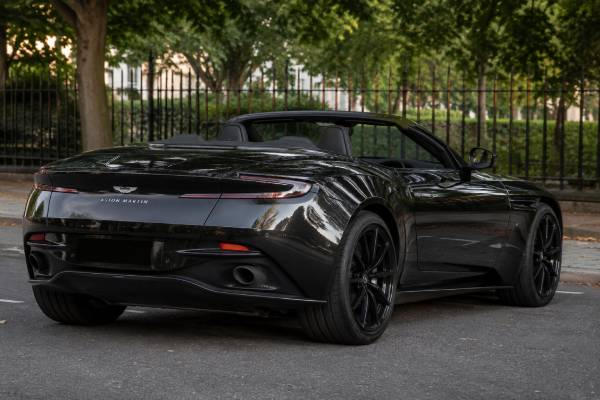
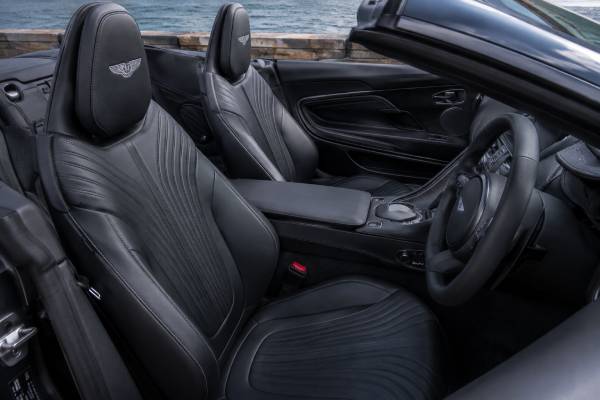
The 2021 Aston Martin DB11 V8 Volante Shadow Edition applies the factory’s dark 2021 visual package to the open DB11. Combined production for Shadow Edition coupes and Volantes was limited to 300 cars worldwide; the figure does not represent 300 of each body style. The Volante retains the standard 503 bhp and 675 Nm V8, rear-mounted eight-speed transaxle, adaptive chassis, and 187 mph claim. Its special content is visual: gloss-black exterior pieces, black chrome badging, directional black wheels, Shadow sill plaques, and a darker cabin presentation. On the convertible, those details must work with an eight-layer fabric roof, exposed rear-deck surfaces, and an interior that receives more sun, dust, and occasional rain than the coupe. A buyer therefore needs to confirm both edition identity and convertible health. Factory build documentation, correct wheels and trim, roof operation, drainage, window indexing, battery stability, cooling, tires, brakes, and evidence of water ingress all deserve attention. A complete dry car can be an unusually cohesive late 503 bhp Volante; a merely black DB11 with missing Shadow parts should not command the same premium.
Table of Contents
- A dark-theme Volante limited across two body styles
- Edition details visible with the roof up and down
- Shadow Edition Volante specifications
- The V8 convertible driving experience
- Roof fabric, black surfaces, seals, and water paths
- Maintenance for a low-mileage special edition
- How to authenticate and inspect before buying
A dark-theme Volante limited across two body styles
The Shadow Edition was a styling programme designed to make the DB11 look more technical and discreet without changing its powertrain. Aston Martin announced a global total of 300 V8 coupes and Volantes for the 2021 model year, giving the package scarcity while allowing buyers to choose fixed-roof or open-air form.
That combined figure should appear consistently in sales descriptions. Claims of “one of 300 Volantes” are not supported by the public production statement unless the seller has separate factory evidence for the final body-style count. The distinction affects both accuracy and valuation.
The Volante brings additional visual surfaces into play. With the roof raised, the fabric colour and texture become part of the dark composition. With the roof lowered, the rear deck, headrests, seat shoulders, door tops, and tonneau area are exposed. The condition of those parts matters as much as the black badges seen in a photograph.
Mechanical output remained at 503 bhp. The 528 bhp update arrived for model year 2022, together with a 192 mph maximum. A 2021 registration can occasionally overlap with production or market conventions, so the VIN-linked build data must settle which calibration applies.
The Shadow theme can be imitated easily. Black wheels, wraps, badges, and trim are widely available. What cannot be recreated easily is the complete factory evidence chain: order code, build specification, original invoice, delivery photographs, correct sill identifiers, and a consistent set of parts.
The edition should not be treated as too precious to operate. Roof systems, seals, brakes, battery, dampers, and climate control benefit from regular full use. Long storage may protect mileage while creating flat-spotted tires, damp brake surfaces, weak voltage, stiff seals, and mechanism faults.
Buyers should decide whether they want a collectible specification or simply a dark-coloured Volante. A standard car may offer more choice and a lower price. The Shadow Edition earns its place only when completeness, condition, and provenance are all stronger than the ordinary alternative.
Edition details visible with the roof up and down
Authenticate the package by comparing the physical car with its build record in both roof positions. The VIN should connect the exterior colour, roof, wheels, black chrome, interior, sill plaques, and options to one original factory specification.
Start with gloss-black bonnet blades and upper or lower trim. Examine them under diffuse and direct light for washing haze, polish burn, stone impact, lifted film, edge chipping, and mismatched replacement pieces. Gloss-black parts can appear perfect indoors and reveal severe micro-scratching outdoors.
Black chrome badges are plated or finished components, not ordinary bright badges sprayed with black paint. Check their depth, edge quality, mounting, and consistency around the car. Abrasive metal polish can permanently cloud them, so a freshly “restored” badge deserves close inspection.
The directional wheels must be the correct design, size, orientation, and finish. Tire shops can swap side-specific wheels or refinish them without reproducing the original gloss and edge definition. Inspect part numbers, inner barrels, spoke roots, bolt seats, centre caps, repairs, and tire-pressure sensors.
Raise the roof and assess fabric colour against the body and black trim. Look for uneven fading, detergent marks, abrasion at folds, seam damage, rear-glass bonding, and areas polished by a cover. A replacement roof may be mechanically sound yet alter the factory appearance if colour or weave differs.
Lower the roof and inspect the storage cover, rear-deck surfaces, mechanism apertures, headrest backs, and exposed stitching. Scratches or chips here often come from luggage, jewellery, improper cleaning, or roof service. Check that no loose trim or wiring is visible.
The interior may include dark leather, contrast stitching, carbon or other trim, and specific Shadow presentation. Confirm details against the build sheet rather than assuming one press-car specification. Compare wear across seat bolsters, steering wheel, pedals, door pulls, switches, and roof controls.
Sill plaques provide a useful check but are not sufficient alone. Photograph both, inspect fastening and condition, and verify that their wording matches factory material. Replacement plaques should be supported by an authorised parts record.
Paintwork and body repair remain separate questions. Measure panels, inspect bonnet alignment and catches, check windscreen frame and rear quarters, and examine jacking points and bonded structure. Dark colours and black trim can hide repair boundaries until viewed from several angles.
List all included items: keys, books, wind deflector, storage bag, mobility kit, battery-conditioning lead, tools, and removed original parts. A limited-edition convertible loses credibility when its defining components have been separated from it.
Shadow Edition Volante specifications
The Shadow Volante combines the standard 503 bhp V8 driveline with the DB11’s reinforced open structure and eight-layer fabric roof. Its dark-edition content is cosmetic; the rear transaxle, adaptive chassis, and convertible mechanisms follow normal 2021 Volante specification. No special engine or suspension tune was added for the Shadow package. The tables describe the standard 2021 503 bhp Volante beneath its limited dark-finish specification.
| Specification | Value |
|---|---|
| Engine | Mercedes-AMG M177-based 4.0-litre twin-turbocharged V8 with Aston Martin-specific hardware and calibration |
| Displacement | 3,982 cc |
| Fuel | Premium unleaded gasoline |
| Maximum power | 503 bhp (510 PS / 375 kW) at 6,000 rpm |
| Maximum torque | 675 Nm (498 lb-ft) from 2,000 rpm |
| Specification | Value |
|---|---|
| Transmission | Rear-mounted ZF eight-speed automatic transaxle |
| Drive and differential | Rear-wheel drive; mechanical limited-slip differential; brake-based torque vectoring |
| Front and rear suspension | Independent double wishbones front; multi-link rear; adaptive damping tuned for the open body |
| Steering | Electric power-assisted rack-and-pinion |
| Brakes | Ventilated steel discs, six-piston front and four-piston rear calipers |
| Specification | Value | Standard or condition |
|---|---|---|
| 0–100 km/h (0–62 mph) | 4.1 seconds, manufacturer 0–100 km/h (0–62 mph) | Manufacturer claim |
| Top speed | 301 km/h (187 mph) | Manufacturer claim |
| Fuel-tank capacity | 78 L (20.5 US gal) | Nominal capacity |
| U.S. fuel economy | Representative U.S. V8 rating: 18 mpg city, 24 mpg highway, 20 mpg combined | EPA cycle; exact year and body style should be checked |
| Specification | Value |
|---|---|
| Length | about 4,750 mm (187.0 in) |
| Width | about 1,950 mm body; 2,060 mm including mirrors |
| Height | about 1,300 mm (51.2 in) |
| Wheelbase | 2,805 mm (110.4 in) |
| Kerb weight | 1,870 kg (4,123 lb), EU kerb definition |
| Weight distribution | 47:53 front/rear |
| Specification | Value |
|---|---|
| Body and seating | 2+2 Volante |
| Wheel format | 20-inch staggered wheels |
| Typical factory tire sizes | 255/40 ZR20 front; 295/35 ZR20 rear |
| Convertible roof | Eight-layer fabric K-fold roof; approximately 14 seconds to lower and 16 seconds to raise, operable at low road speed |
| Luggage capacity | Convertible luggage capacity is reduced from the coupe; verify the market brochure for the exact measurement method |
The V8 convertible driving experience
The Shadow Volante should drive like any correctly maintained 503 bhp DB11 Volante: fast, composed, and distinctly different with the roof raised or folded. Its appearance does not alter the performance baseline.
The V8 delivers 675 Nm from low engine speed, so ordinary acceleration feels effortless. GT mode should be smooth, with early shifts and compliant damping. Sport and Sport Plus add urgency and exhaust volume. A permanent drone or an abrupt low-speed gearbox may indicate modification or a fault, not edition character.
At about 1,870 kg on the published EU basis, the Volante carries more mass than the coupe and has a 47:53 distribution. The rearward balance helps it turn naturally, while the open-body calibration should control movement without creating a brittle ride.
Test first with the hood raised. Listen at the header corners, side glass, rear quarters, and roof storage area. The frameless windows should index and seal cleanly. A local whistle, water mark, or ticking noise can often be traced to adjustment, contamination, or previous roof work.
Cycle the roof stationary and watch each side. The header, windows, fabric, bows, deck, and final confirmation should move in a coordinated sequence. A change in motor speed, asymmetric fold, scrape, or repeated warning deserves diagnosis before another cycle.
With the roof down, assess buffeting with and without the wind deflector and side windows. Climate control should maintain comfort, and the exhaust should remain enjoyable at steady speed. Aftermarket valve controllers are particularly obvious in an open car and can make touring tiring.
Steering shake is not an accepted convertible trait. Test smooth and diagonal bumps, then investigate wheel balance, tire age, pressure, alignment, suspension joints, and structural repair if movement is excessive. The windscreen frame and column should feel stable.
Brake performance must remain repeatable. Inspect the hidden inner disc faces and measure wear. Dark wheels can obscure corrosion and dust. Old tires can also degrade braking and wet stability despite deep tread.
Finish the drive with a warm roof cycle and a second diagnostic scan. Heat and body movement can expose sensor, latch, voltage, or alignment issues that are absent during a cold showroom demonstration.
Roof fabric, black surfaces, seals, and water paths
Care must address two vulnerable groups at once: convertible weather systems and dark cosmetic surfaces. The safest methods use low pressure, compatible products, and little abrasion.
Vacuum the hood gently before washing. Use a soft brush in the weave direction, rinse without driving water into seams, and allow complete drying before lowering. Pressure washers held close, automatic brushes, and household chemicals can damage fibres, stitching, or rear-glass bonds.
Reproofing should follow cleaning and leak diagnosis. A water-repellent coating can improve beading but cannot fix a torn seal or blocked drain. Mask black chrome, paint, glass, and trim to prevent overspray marks, and record the product and date.
Inspect header, side, rear, and storage-area seals for cuts, flattening, dirt, and previous adhesive. Clean minimally and apply only a compatible treatment. Too much dressing collects grit and can stain the dark roof fabric.
Window indexing is part of weatherproofing. Each glass panel should drop slightly when the door opens and rise into the seal after closing. Scraping, slow movement, or wind noise may reflect regulator, alignment, voltage, or seal problems.
Drainage should be checked by route, not attacked blindly. High-pressure air or rigid wire can disconnect a hose inside the body. A controlled water test with an observer inside is safer. Check carpet underlay, boot side cavities, roof storage, rear quarters, and electronic compartments for moisture.
Gloss-black trim should be washed with clean dedicated media. Fine scratches show quickly, and aggressive polishing can thin edges or change the sheen. Identify whether each surface is paint, film, plating, or carbon before correction.
Black chrome needs non-abrasive products. Wheel cleaners should be compatible with gloss paint and should not be allowed to dry in bolt recesses or around centre caps. Clean inner barrels so bends, cracks, and repaired areas remain visible.
Open cabins collect sunscreen, hand sanitiser, pollen, grit, and occasional rain. Vacuum before wiping, use low-gloss leather products, and clean contrast stitching carefully. Do not hide honest light wear under heavy dye that changes grain and buries thread.
Storage combines all these concerns. Park dry with the roof raised, connect the conditioner, maintain ventilation, and use a spotless breathable cover only in a clean garage. Never cover damp fabric or lower it for a long storage period without checking official guidance.
Maintenance for a low-mileage special edition
Low annual mileage does not justify delayed service. Time-sensitive fluids, battery capacity, tire age, seal condition, and brake corrosion can deteriorate while the odometer barely moves.
Service at least annually and follow VIN-specific Aston Martin information for oil, filters, plugs, coolant, brake fluid, transmission, differential, and inspections. The M177-based engine has Aston-specific intake, exhaust, mounts, calibration, cooling, and a rear-transaxle installation.
Keep a battery conditioner connected when the car is parked. Test the battery before touring season and investigate repeated discharge. When voltage has fallen, support the electrical system correctly before reading every control unit. Roof, windows, cameras, seats, and drivetrain systems can all show secondary faults.
Cooling-system care should include access to the spaces between heat exchangers. Remove leaves and insects, inspect impact damage, check reservoirs and hose joints, and confirm fan operation after slow hot running. Air-conditioning performance is also important in an open car used in summer.
Inspect for oil and coolant residue with undertrays removed as appropriate. Fluid can spread along panels, so locate the source and recheck after cleaning. Do not accept repeated top-ups without a diagnosis.
The transaxle should engage cleanly and shift consistently from cold to hot. Test manual paddles, steady cruise, kickdown, parking manoeuvres, and overrun. Record software updates, but do not use adaptation language to dismiss recurring impacts or delays.
Tires should be replaced by age and condition as well as tread. Verify correct sizes and matching models, then align the car and retain measurements. The black finish makes wheel damage harder to see, so inspect inner barrels under strong light.
Brake fluid and disc condition are time-sensitive. Dry brakes after washing, inspect both disc faces, and measure thickness. A low-mileage car stored damp can need discs sooner than a regularly driven example.
Exercise the roof through complete cycles at appropriate intervals, only with stable voltage and dry fabric. Record adjustments, seal work, water tests, and any control repairs. Roof history is as important to a Volante buyer as engine-service history.
Keep campaign and software checks current through an authorised source. Independent specialists can handle much routine and diagnostic work, but factory campaign status must still be verified by VIN.
A detailed file protects value: invoices, scans, battery tests, tire dates, alignment, roof work, water tests, paint and wheel records, and photographs. A stamp alone cannot explain the care of a limited open car.
How to authenticate and inspect before buying
The inspection must prove three things: the car is a factory Shadow Edition, the convertible body is dry and functional, and the V8 drivetrain has a sound maintenance baseline.
Collect documents before viewing. Match VIN, build sheet, invoice, registration, service records, campaign printout, and diagnostic history. Confirm the Shadow package, model year, 503 bhp specification, body style, market, roof colour, wheels, interior, and options.
Inspect the car dry and cold. Photograph edition parts, measure paint, examine bonnet and body alignment, look at the underbody and jacking points, check tires and wheels, and scan all modules before operating the roof. Record voltage and fault status.
Cycle the hood only if the first inspection reveals no obstruction or damage. Watch both sides, verify window movement, inspect fabric folds and rear glass, and check deck closure. Repeat after the road test.
Conduct a long drive roof-up and roof-down. Assess cold start, boost delivery, transaxle, steering, suspension modes, brakes, wind noise, body shake, exhaust drone, climate control, cameras, sensors, windows, seats, and audio. Re-scan the warm car.
A lift inspection should cover the cooling stack, engine and turbo areas, exhaust, torque tube, transaxle, differential, dampers, suspension links, brake inner faces, wheel barrels, undertrays, floor edges, and signs of water or impact.
Perform a controlled low-pressure water test with permission. Start at individual zones and inspect hidden areas immediately. Damp carpet, odour, corrosion, or evidence of repeated drying should be traced rather than attributed to normal convertible use.
For edition identity, compare bonnet blades, black chrome, wheel finish and orientation, sill plaques, interior details, and roof specification with factory records. Price missing or non-original parts using current availability; some may be difficult to source.
Review every modification. A tune, exhaust, lowering part, spacer, wrap, coating, tracker, or phone module should have an invoice and a clear route back to standard. Hidden wiring changes are especially concerning in a roof-equipped car with multiple control modules.
Value the car against genuine Shadow Volantes when possible, then adjust for local market, taxes, mileage, history, roof condition, water evidence, service, tires, brakes, paint, and completeness. Do not use a standard black Volante as an equal comparable.
A well-bought example should need no excuses. It should be dry, electrically stable, mechanically smooth, visually complete, and honest about any work. That combination—not darkness alone—is what makes the Shadow Edition Volante special.
References
- DB11 V8 Coupe Shadow Edition « Aston Martins.com 2021 (Edition Reference)
- 2021 Aston Martin DB11 V8 Shadow Edition Debuts, Limited To 300 Units 2020 (Announcement)
- DB11 Volante: return of the ultimate convertible Sports GT 2017 (Volante Engineering)
- Owner’s Guides | Aston Martin 2026 (Owner Documentation)
- Fuel Economy of the 2021 Aston Martin DB11 V8 2021 (EPA Fuel Economy)
Disclaimer
Use this content for general research only. A professional inspection and the VIN-specific owner, roof, and service information take priority for authentication, leak diagnosis, repair procedures, software, and parts in every market.
A share on Facebook, X/Twitter, or another platform is welcome if the guide helps another Shadow Volante buyer avoid incomplete evidence.