

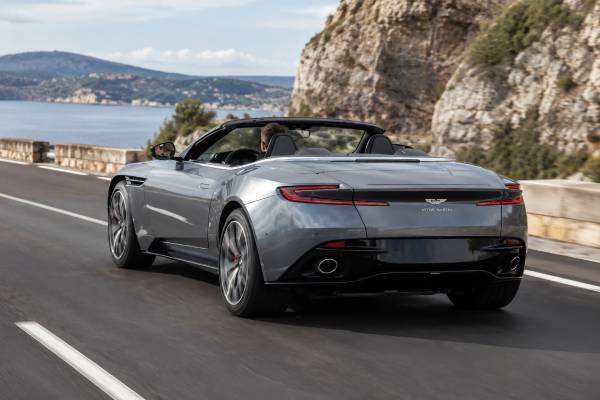
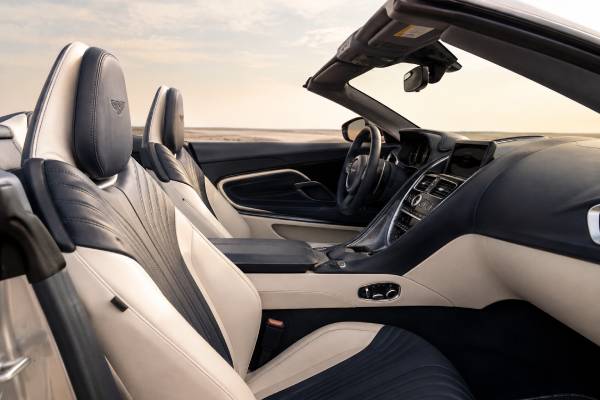
The 2018–2021 Aston Martin DB11 Volante is the original 503 bhp open version of the AM5-generation DB11. It combines a 4.0-litre twin-turbo V8 with a rear-mounted eight-speed transaxle, adaptive damping, rear-wheel drive, and an eight-layer fabric roof that folds beneath a clean rear deck. Aston Martin chose the V8 rather than the heavier V12 for this body, helping the convertible retain responsive steering and a rear-biased published weight distribution despite reinforcement and roof hardware. Performance remains serious: 675 Nm, a claimed 0–62 mph time of 4.1 seconds, and a 187 mph maximum. Ownership, however, is defined as much by water management as by speed. Roof fabric, rear-glass bonding, window indexing, seals, drainage routes, storage cavities, battery health, and interior exposure all need deliberate inspection. Buyers should also distinguish these cars from the 2022–2023 Volante, which received 528 bhp and a 192 mph claim. A sound early Volante is a refined all-weather grand tourer; a neglected roof or low-voltage electrical system can turn apparently minor symptoms into expensive dismantling.
Table of Contents
- What the first DB11 Volante was designed to do
- The eight-layer roof and open-body engineering
- 2018–2021 Volante specifications
- Driving character with the roof raised and lowered
- Weatherproofing, drains, trim, and daily usability
- Service schedule, storage, and seasonal preparation
- Pre-purchase checks for a dry, healthy convertible
What the first DB11 Volante was designed to do
The DB11 Volante was designed as a complete open grand tourer rather than a coupe with its roof removed. Aston Martin developed the structure, suspension, roof package, rear deck, luggage area, and cabin airflow around convertible use. The result prioritises refinement and distance over minimal mass.
It arrived with the 503 bhp V8 only. The compact engine reduced load ahead of the cabin and helped offset the mass added by reinforcement and the folding hood. At approximately 1,870 kg on the published EU basis, the Volante is not light, but 675 Nm from 2,000 rpm gives it effortless pace.
The car’s mission is broad. With the roof raised, it should provide secure weather protection and enough isolation for long motorway travel. With the roof lowered, it should manage wind and retain climate comfort without making conversation impossible. It also needs to carry two adults, occasional rear passengers or bags, and touring luggage within the limits of the roof packaging.
The 2018–2021 range uses the original V8 output. For model year 2022, Aston Martin increased the V8 to 535 PS, or 528 bhp, and raised the claimed top speed to 192 mph. The visual differences can be subtle, so verify model year and build data instead of relying on registration date.
A convertible’s condition is cumulative. A single storm rarely ruins a car when seals and drains work, but years of blocked channels, damp storage, lowered wet fabric, or untreated leaks can affect carpets, trim, connectors, modules, and odour. Roof history deserves the same seriousness as engine history.
The strongest used examples have been exercised throughout the year, dried properly, kept on a battery conditioner, and serviced annually. Cars stored for long periods may show low mileage while suffering hard tires, corroded brake surfaces, weak batteries, flattened seals, or mechanism stiffness.
Choice of colour and roof fabric influences ownership more than in the coupe. A pale interior looks dramatic with the top down but reveals dye transfer and water marks. A dark hood hides some staining yet may show dust and abrasion. Buy the specification you will care for rather than the one that photographs best under showroom lights.
The eight-layer roof and open-body engineering
The roof is a multi-layer K-fold fabric system designed to combine a low folded stack with acoustic and thermal insulation. Its operation involves the header latch, bows, linkages, drive components, windows, deck movement, sensors, and control logic. Smooth coordination is more important than raw cycle speed.
Published operation is approximately 14 seconds to lower and 16 seconds to raise, with low-speed operation permitted under specified conditions. Use the owner’s guide for the exact speed, incline, voltage, luggage-divider, and temperature restrictions. During inspection, operate it stationary on level ground first.
Watch both sides throughout the cycle. The fabric should fold predictably without catching, the windows should move at the correct time, and the deck should close flush. Listen for a motor that slows, clicks, strains, or changes pitch. Stop if movement becomes asymmetric rather than forcing another cycle.
The rear glass and surrounding fabric deserve close examination. Look for edge lifting, cloudy adhesive, creases pressing against the glass, abrasion, and water tracks. Inspect the headlining and frame from inside with the roof partway open only when the safe service position is understood.
The open body uses structural reinforcement and a suspension calibration matched to its mass distribution. Aston Martin cited improvements over the preceding DB9 Volante, including a stiffer structure and a lighter roof system. On the road, the steering column, windscreen frame, and dashboard should remain composed over diagonal bumps.
Some noise is inevitable with a fabric roof, but local whistles or ticking often point to seal contamination, glass indexing, latch adjustment, trim contact, or previous repair. Diagnosis should reproduce the condition with roof up, roof down, windows raised, and windows lowered.
The roof control system depends on stable battery voltage. Slow cranking, repeated low-voltage events, or an aged battery can interrupt a cycle or create confusing warnings. Test the battery and charging system before assuming the mechanism itself has failed.
Never use the roof storage area as casual luggage space. A misplaced item can obstruct movement, damage trim, or prevent a divider or sensor from confirming the correct position. Check that all cargo separators, covers, warning labels, and retaining parts are present.
2018–2021 Volante specifications
The early Volante packages the 503 bhp V8 ahead of the passenger cell and the eight-speed transaxle behind it, then adds an eight-layer folding roof and body reinforcement. Its rearward weight bias reflects the open-body hardware as well as the DB11 transaxle concept. The data below describe the original 503 bhp Volante, not the 528 bhp 2022 model-year update. Roof and luggage figures should always be read with the source’s measurement method and operating conditions.
| Specification | Value |
|---|---|
| Engine | Mercedes-AMG M177-based 4.0-litre twin-turbocharged V8 with Aston Martin-specific hardware and calibration |
| Displacement | 3,982 cc |
| Fuel | Premium unleaded gasoline |
| Maximum power | 503 bhp (510 PS / 375 kW) at 6,000 rpm |
| Maximum torque | 675 Nm (498 lb-ft) from 2,000 rpm |
| Specification | Value |
|---|---|
| Transmission | Rear-mounted ZF eight-speed automatic transaxle |
| Drive and differential | Rear-wheel drive; mechanical limited-slip differential; brake-based torque vectoring |
| Front and rear suspension | Independent double wishbones front; multi-link rear; adaptive damping tuned for the open body |
| Steering | Electric power-assisted rack-and-pinion |
| Brakes | Ventilated steel discs, six-piston front and four-piston rear calipers |
| Specification | Value | Standard or condition |
|---|---|---|
| 0–100 km/h (0–62 mph) | 4.1 seconds, manufacturer 0–100 km/h (0–62 mph) | Manufacturer claim |
| Top speed | 301 km/h (187 mph) | Manufacturer claim |
| Fuel-tank capacity | 78 L (20.5 US gal) | Nominal capacity |
| U.S. fuel economy | Representative U.S. V8 rating: 18 mpg city, 24 mpg highway, 20 mpg combined | EPA cycle; exact year and body style should be checked |
| Specification | Value |
|---|---|
| Length | about 4,750 mm (187.0 in) |
| Width | about 1,950 mm body; 2,060 mm including mirrors |
| Height | about 1,300 mm (51.2 in) |
| Wheelbase | 2,805 mm (110.4 in) |
| Kerb weight | 1,870 kg (4,123 lb), EU kerb definition |
| Weight distribution | 47:53 front/rear |
| Specification | Value |
|---|---|
| Body and seating | 2+2 Volante |
| Wheel format | 20-inch staggered wheels |
| Typical factory tire sizes | 255/40 ZR20 front; 295/35 ZR20 rear |
| Convertible roof | Eight-layer fabric K-fold roof; approximately 14 seconds to lower and 16 seconds to raise, operable at low road speed |
| Luggage capacity | Convertible luggage capacity is reduced from the coupe; verify the market brochure for the exact measurement method |
Driving character with the roof raised and lowered
A healthy Volante should be enjoyable in both configurations. Roof-up assessment reveals sealing, structural noise, and long-distance refinement; roof-down driving reveals airflow, cabin exposure, exhaust drone, and the smoothness of the mechanism’s final stowage.
Start in GT mode with the roof raised. Throttle response should be progressive, the gearbox should move away cleanly, and the dampers should absorb small sharp impacts without allowing repeated body movement. Listen around the header rail, side windows, rear quarters, and roof storage area.
The V8’s 675 Nm makes overtaking easy without constant downshifts. Sport adds response and sound; Sport Plus holds gears and tightens control. The car should not become unstable, excessively harsh, or jerky. If modes feel indistinguishable, investigate dampers, control software, exhaust valves, or previous modification.
Lower the roof after confirming normal operation. Check that no warning remains and that the deck is fully seated. At moderate speed, airflow should be manageable with the side windows and wind deflector used appropriately. Severe buffeting can result from missing equipment or glass position rather than a structural fault.
The exhaust is more prominent with the roof down. A factory system should offer character without an unavoidable motorway drone. Valve controllers, non-original rear sections, removed catalysts, and ECU changes can make a car entertaining for ten minutes and tiring over a day. Ask for evidence of any exhaust work.
Steering should remain accurate and largely free of shake. Test on smooth and broken surfaces, then distinguish body tremor from wheel imbalance or tire defects. Correct staggered tires, pressures, date codes, alignment, and wheel condition matter greatly in a heavy rear-drive convertible.
Brake testing should include light, medium, and firm applications. The pedal should remain consistent, and the car should stop straight. Storage corrosion often affects the inner disc faces first. Measure condition rather than accepting visible tread or polished outer faces as proof of life remaining.
At the end of the drive, raise the roof again while systems are warm. Some alignment or sensor issues appear after body and mechanism temperatures change. Recheck for warnings, inspect the header seal, and look for new marks where fabric has folded.
Weatherproofing, drains, trim, and daily usability
Keeping the Volante dry requires clean drainage routes, healthy seals, correctly indexed windows, intact fabric, and prompt attention to moisture. Waterproofing is not one replaceable part; it is the performance of the complete system.
Clean the hood with products intended for automotive fabric. Vacuum and brush loose dirt gently before using liquid, rinse with low pressure, and allow complete drying. Automatic brushes, close pressure washing, harsh household cleaners, and folding the hood while damp can accelerate wear.
Water-repellent treatment can restore beading after cleaning, but it does not repair a leak. Mask paint and glass carefully, follow curing conditions, and keep a record of the product. Uneven darkening or overspray is difficult to correct on a high-value car.
Seals should be free of grit, tears, flattening, and sticky contamination. Use only compatible care products in small amounts. Excess dressing can attract dirt or migrate onto the headlining and roof fabric. Check the glass drop when each door opens and the final contact when it closes.
Drain cleaning should follow the known route. Rigid rods or high-pressure air can disconnect or puncture hoses. If water exits slowly, a DB11-experienced specialist should access the channels and verify the outlet rather than simply forcing the blockage farther into the body.
A controlled water test starts gently at lower seams and progresses upward. One person applies water while another checks header corners, side rails, rear-glass edges, quarter areas, roof storage, boot sides, carpet underlay, and nearby electrical spaces. Moisture beneath dry-looking carpet is significant.
Convertible cabins receive more ultraviolet light and airborne contamination. Sunscreen, cosmetics, denim, rain, and grit can mark leather and trim. Clean spills promptly with compatible methods, avoid glossy dressings, and compare exposed surfaces with shaded areas before deciding on restoration.
The rear seats remain occasional and the roof packaging reduces luggage flexibility. Use soft bags, keep cargo clear of roof partitions, and secure loose items. Confirm that the wind deflector, its storage bag, books, keys, tire-mobility equipment, and battery-conditioning lead are present.
Parking equipment deserves full testing. The long, wide body relies on cameras and sensors in tight spaces. Check every view with roof up and down, because a folded roof or open deck can change what the driver sees and because low voltage can create intermittent faults.
Service schedule, storage, and seasonal preparation
Annual service remains appropriate even when the car is driven only in summer. Fluids age, batteries lose capacity, tires harden, seals dry, and brake surfaces corrode independently of mileage.
Use the VIN-specific Aston Martin schedule for engine oil, filters, plugs, brake fluid, coolant, transmission, differential, belts, and inspections. The M177 family origin does not make a Mercedes service schedule sufficient; Aston Martin’s installation, calibration, cooling, exhaust, and transaxle arrangement differ.
Maintain the main battery with the recommended conditioner during parking periods. Record installation date and test reserve capacity. If discharge recurs, measure parasitic draw and examine aftermarket trackers, phone modules, chargers, and audio equipment.
Before winter storage, clean and fully dry the roof, body, wheel arches, and brakes. Store with the hood raised unless official guidance for the exact situation says otherwise, because long folding can set creases and hide moisture. Use a clean, breathable fitted cover only in a dry environment.
Do not start the engine briefly every few weeks without driving. Short running adds fuel dilution and condensation while failing to warm the transmission, differential, brakes, and exhaust. Either leave the car correctly stored or complete a meaningful drive when conditions permit.
Spring recommissioning should include battery test, tire pressure and date review, fluid inspection, roof and drain check, cold start, brake-surface assessment, and a progressive road test. Cycle the roof only after voltage and visible mechanism condition are satisfactory.
Cooling-system care is essential before hot-weather touring. Clean the heat-exchanger stack, inspect impact damage, confirm fans and climate performance, and examine reservoirs and joints for residue. A convertible used in slow scenic traffic may demand cooling airflow even without high road speed.
Tires and brakes need measurements, not visual optimism. Replace aged tires as a complete compatible set and inspect inner shoulders. Check both faces of each disc, pad thickness, hoses, calipers, and parking-brake operation. Dry the brakes after washing.
Keep campaign status current through an authorised Aston Martin check, even when routine service is entrusted to an independent specialist. Retain diagnostic reports, roof work, water tests, battery records, alignment, and photos of any body repair. A convertible’s history should explain both mechanical and weather-related care.
Pre-purchase checks for a dry, healthy convertible
A good inspection begins with the car cold, the roof raised, and the interior dry. The specialist should have Aston-capable diagnostics, lift access, moisture-testing tools, and enough time for roof cycles and a long road test.
Verify VIN, build specification, model year, market equipment, service chronology, campaign status, keys, and accessories. Registration date alone does not distinguish a 503 bhp car from a later 528 bhp model-year vehicle. Confirm the powertrain specification in factory records.
Scan before operating the roof. Record battery voltage and all active, stored, communication, and undervoltage faults. If voltage is weak, stabilise power according to approved procedure before cycling a complex mechanism.
Inspect fabric, seams, rear glass, header, bows, seals, headlining, storage cover, partitions, drains, boot cavities, carpet underlay, and electrical areas. Smell for damp or cleaning products used to conceal it. Look for water tide lines, corroded fasteners, mould, or recently replaced carpet.
Cycle the roof while watching both sides. Confirm smooth speed, correct window movement, clean latching, flush deck closure, and no persistent warning. Repeat after the road test when the car is warm.
The lift inspection should cover cooling, leaks, exhaust, transaxle, differential, suspension, dampers, brakes, tires, wheels, undertrays, floor edges, and jacking points. Convertibles may be lifted incorrectly by shops unfamiliar with the low structure, leaving crushed or scraped areas.
Road-test with roof up and down. Assess cold start, idle, boost, shifts, steering, braking, damper modes, wind noise, body shake, climate control, cameras, sensors, windows, seats, and audio. Re-scan after heat soak.
Conduct a gentle water test only with the seller’s agreement and a method that can locate individual leak paths. Inspect hidden areas immediately. A claim that “all convertibles leak a little” is unacceptable; occasional water exposure and an active ingress route are different conditions.
Price findings in separate groups: safety, due service, roof and water repairs, electrical diagnosis, tires and brakes, cosmetic work, and optional upgrades. A car with a clear dry history, complete records, and fresh maintenance is usually worth more than a cheaper example whose first-year needs remain unknown.
The best early DB11 Volante should feel like one car in both roof positions. It should start cleanly, stay cool, shift smoothly, remain dry, and complete every roof cycle without drama. That baseline matters far more than a low odometer or a photogenic colour combination.
References
- DB11 Volante: return of the ultimate convertible Sports GT 2017 (Official Launch)
- SUBLIME CHOICES: DB11 NOW OFFERED WITH V8 ENGINE 2017 (V8 Engineering)
- Owner’s Guides | Aston Martin 2026 (Owner Documentation)
- Aston Martin Luxury Car Servicing | Aston Martin 2026 (Service Information)
- Fuel Economy of the 2021 Aston Martin DB11 V8 2021 (EPA Fuel Economy)
Disclaimer
This guide provides general ownership information and is not a substitute for professional roof, body, or mechanical diagnosis. Confirm all specifications, operating limits, service procedures, and parts with VIN-specific Aston Martin documents for the applicable market.
Sharing it on Facebook, X/Twitter, or another platform can help more Volante owners find careful water-management advice.