


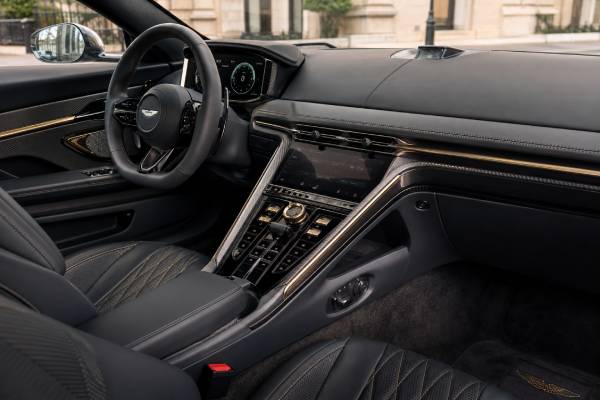
The Aston Martin DB12 Goldfinger Edition is a 60-car Q by Aston Martin commission built around the 671 hp DB12 coupe. It is mechanically familiar but materially distinctive: Silver Birch paint, gold-plated controls, special carbon fiber, DB5-inspired seat fluting, and a carefully documented owner package connect it to the 1964 film Goldfinger. That makes this car more than a color-and-trim exercise, yet it does not become a different performance derivative. Its appeal rests on the combination of a modern Super Tourer, unusually detailed factory personalization, and an official production limit small enough to make provenance important from day one. This guide separates the edition-specific content from the standard DB12 engineering beneath it, explains how the car performs and lives as a road car, and shows what to inspect before buying. It also covers preservation decisions that matter when delicate finishes, numbered accessories, and complete documentation can influence both enjoyment and long-term collectibility.
Table of Contents
- What makes the Goldfinger Edition different
- DB12 Goldfinger Edition technical data
- Bond design and commissioned details
- Performance and road character
- Maintenance and preservation
- Authenticity and pre-purchase checks
- Ownership value and buying verdict
What makes the Goldfinger Edition different
The Goldfinger Edition is a factory-built, 60-example special edition of the DB12 coupe, not a power upgrade or a dealer-applied appearance package. Its significance comes from Q by Aston Martin craftsmanship, an unusually coherent James Bond theme, and the completeness of the delivery set that accompanied each car.
Aston Martin announced the edition in October 2024 to mark 60 years since Goldfinger reached cinemas. The connection is precise: the film introduced the silver Aston Martin DB5 as a screen icon, while the DB12 edition uses Silver Birch paint and numerous references to the story without attempting to recreate a 1960s car. It remains a current-generation AM5 DB12 with modern structure, electronics, safety systems, and twin-turbo performance.
That distinction matters for buyers. There is no special engine tune beyond the regular 680 PS, or 671 bhp, specification. Acceleration, top speed, transmission hardware, adaptive suspension, and electronic differential are fundamentally those of the standard DB12. The added value is in the specification and scarcity, not a hidden mechanical package. A seller describing it as a higher-output model should be challenged to provide factory documentation.
The edition is also different from a privately commissioned DB12 with similar colors. Q by Aston Martin can produce highly individualized cars, but a one-off Silver Birch DB12 with gold details is not one of the 60 Goldfinger Editions unless its build records, edition identifiers, and original delivery material establish that identity. For a collector, authenticity is therefore a chain of evidence rather than a visual impression.
The best way to think about the car is as three layers:
- the DB12 coupe provides the powertrain, chassis, dimensions, infotainment, and basic service requirements;
- the Goldfinger specification adds factory-selected exterior, interior, and material details;
- the numbered owner package completes the edition and can materially affect desirability when the car changes hands.
This layered view prevents two common mistakes. The first is paying for supposed performance exclusivity that does not exist. The second is undervaluing small original components because they do not change how the car drives. On a 60-car edition, a missing attaché case, model, magazine, or film-related item may be harder to replace correctly than a normal service part.
DB12 Goldfinger Edition technical data
The Goldfinger Edition uses the regular DB12 coupe’s 4.0-liter twin-turbocharged V8, rear-mounted eight-speed automatic transmission, rear-wheel drive, and adaptive chassis. Its edition-specific specification changes presentation and equipment, while the underlying 671 hp performance package remains unchanged.
The M177 designation commonly used for this engine identifies its Mercedes-AMG-derived V8 family. In DB12 form, Aston Martin specifies its own output, cooling, intake, exhaust, software, and vehicle integration, so specifications from unrelated AMG applications should not be substituted.
| Parameter | Specification |
|---|---|
| Powertrain type | Internal-combustion engine |
| Engine | 4.0 L all-alloy twin-turbocharged V8 |
| Valve gear | Quad overhead camshafts |
| Fuel system | Direct sequential electronic fuel injection |
| Lubrication | Wet sump |
| Compression ratio | 8.6:1 |
| Maximum power | 680 PS / 671 bhp / 500 kW at 6,000 rpm |
| Maximum torque | 800 Nm / 590 lb-ft at 2,750–6,000 rpm |
| Engine stop-start | Standard |
| Parameter | Specification |
|---|---|
| Transmission | ZF 8-speed automatic, rear mid-mounted |
| Drive | Rear-wheel drive |
| Propeller shaft | Carbon fiber |
| Rear differential | Electronic limited-slip differential |
| Final-drive ratio | 3.083:1 |
| 0–60 mph | 3.5 seconds |
| 0–100 km/h | 3.6 seconds |
| Maximum speed | 325 km/h / 202 mph |
| Parameter | Specification |
|---|---|
| Body structure | Bonded aluminum structure with composite body panels |
| Front suspension | Independent double wishbones |
| Rear suspension | Independent multi-link |
| Dampers | Adaptive DTX dampers |
| Steering | Electric power-assisted rack and pinion; 2.375 turns lock-to-lock |
| Front brakes | 400 × 36 mm steel discs; 6-piston calipers |
| Rear brakes | 360 × 32 mm steel discs; 4-piston calipers |
| Front tires | 275/35 ZR21 |
| Rear tires | 325/30 ZR21 |
| Factory tire type | Michelin Pilot Sport 5 S developed for Aston Martin |
Carbon-ceramic brakes were available on the DB12 platform. When fitted, they use 410 mm front and 360 mm rear discs and reduce unsprung mass by approximately 27 kg compared with the standard steel system. A buyer should verify the individual Goldfinger Edition’s build sheet rather than assume every example received the same brake option.
| Parameter | Specification |
|---|---|
| Body style | 2-door coupe, 2+2 seating |
| Length | 4,725 mm / 186.0 in |
| Width including mirrors | 2,135 mm / 84.1 in |
| Maximum body width excluding mirrors | 1,980 mm / 78.0 in |
| Height | 1,295 mm / 51.0 in |
| Wheelbase | 2,805 mm / 110.4 in |
| Fuel-tank capacity | 78 L / 20.6 US gal |
| Luggage capacity | 262 L / 9.3 cu ft |
| EU kerb weight | 1,788 kg / 3,942 lb with lightweight options |
| Weight distribution | 48% front / 52% rear |
The published EU kerb-weight figure is the manufacturer’s value for a DB12 configured with lightweight options; it is not a guaranteed measured weight for every Goldfinger Edition. Edition equipment, brake choice, seats, and other configuration details can alter the finished car’s mass.
| Parameter | Specification |
|---|---|
| Urban fuel consumption | 17.5 L/100 km / 16.1 mpg imperial |
| Extra-urban fuel consumption | 9.1 L/100 km / 31.0 mpg imperial |
| Combined fuel consumption | 12.2 L/100 km / 23.2 mpg imperial |
| Combined CO2 emissions | 278 g/km |
These are homologated manufacturer figures rather than a promise of real-world economy. Short journeys, cold starts, heavy traffic, tire condition, and frequent use of the car’s performance can increase consumption substantially. Market labeling and test-cycle presentation may also differ, so registration documents remain the correct source for a specific car.
Bond design and commissioned details
The Goldfinger Edition succeeds because its references are integrated into materials and controls instead of relying on large graphics or costume-like decoration. The result can look restrained at a distance, while revealing its identity through close inspection.
Silver Birch paint supplies the most immediate link to the film DB5. The 21-inch multi-spoke wheels have a special silver finish with diamond-treated detailing, and black brake calipers keep the wheel area visually controlled. Gold side strakes and a silver-and-black enamel Aston Martin badge add contrast, while Q identification confirms the car’s factory-special status.
Inside, the Sports Plus seats use fluting inspired by the DB5. A Prince of Wales check pattern appears through perforation and detailing across the seats, door inserts, headliner, and treadplates. This is an effective modern interpretation because it refers to classic tailoring rather than copying a period cabin literally.
The most delicate details are also the most memorable. Selected rotary and roller controls receive 18-karat gold plating, including the central drive-mode control and notched gear selector. The latter refers to the tracking device used in the film. Gold metal fibers are woven into gloss 2×2 twill carbon fiber, producing a material that cannot be replicated convincingly with ordinary gold-colored vinyl or aftermarket trim. An embroidered eight of hearts on the driver’s sun visor provides a deliberately discreet story detail.
The edition also included a Bowers & Wilkins audio system and a delivery collection assembled to feel like part of the commission. The package comprised a custom car cover, a luxury key presentation box, a Silver Birch model, a piece of 35 mm film associated with the Furka Pass scene, an individually numbered magazine, a Globe-Trotter attaché case, and a Bollinger presentation set with a magnum and glasses.
These items are not equivalent to ordinary dealer merchandise. Their numbers, condition, packaging, and relationship to the car should be recorded. Owners who intend to use the attaché case or glassware may reasonably do so, but they should understand that wear, missing inserts, or replacement packaging can affect how a later collector judges completeness.
Performance and road character
The Goldfinger Edition drives like a well-specified DB12: extremely fast, rear-driven, and more usable over distance than its output suggests. Its identity changes the sense of occasion, but the dynamic strengths come from the standard car’s broad torque, rear-mounted transmission, adaptive damping, and electronic differential.
Eight hundred newton-meters is available across a wide plateau, so the V8 does not need constant high-rpm operation to make progress. In ordinary traffic, the transmission can use the engine’s midrange and keep the car calm. A deeper accelerator input brings rapid downshifts and a much harder response, while manual paddle control lets the driver hold a gear for a corner sequence or overtaking maneuver.
The rear-mounted gearbox contributes to the 48:52 published weight distribution. It does not make a large grand tourer feel tiny, but it helps the nose respond cleanly and gives the rear axle useful traction. The electronic differential can vary locking behavior more rapidly than a passive unit, supporting stability under power while still allowing the car to rotate when the selected drive mode and available grip permit it.
The adaptive dampers are central to the DB12’s dual-purpose character. Their wide control range allows the car to settle into long, fast journeys without becoming disconnected, then tighten body control when the road turns technical. Owners should still select modes for conditions rather than treating the most aggressive setting as automatically best. On broken pavement, a more compliant damper setting can keep the tires in better contact with the surface and make the car both quicker and more comfortable.
Twenty-one-inch wheels and very wide, low-profile tires create real tradeoffs. Steering response and dry grip are strong, but pothole impacts are less forgiving and standing water demands judgment. The 325-section rear tires are costly, sensitive to alignment, and capable of hiding wear on their inner shoulders. Cold-weather performance also depends on compound temperature. The car’s electronics cannot create grip that the tires do not have.
Steel brakes are appropriate for road use and generally simpler to evaluate and replace. Carbon-ceramic brakes reduce unsprung mass and resist repeated high-temperature use, but their replacement cost makes inspection essential. A glossy rotor is not automatically healthy, and a superficial visual check is insufficient. A qualified Aston Martin technician should assess disc condition, wear data where available, pad thickness, surface damage, and any history of track use or improper cleaning chemicals.
Despite its speed, the DB12 is not a spacious four-seat alternative to a sedan. The rear seats are best treated as occasional accommodation or extra luggage space. The 262-liter trunk suits soft bags better than rigid cases, and the special owner package will require separate storage rather than traveling in the car routinely. The Goldfinger Edition is therefore strongest as a two-person long-distance car with dramatic performance and a ceremonial layer absent from the standard model.
Maintenance and preservation
The safest ownership strategy is to maintain the Goldfinger Edition as a current high-performance DB12 while preserving its Q-specific finishes as irreplaceable original material. Mechanical neglect will hurt the car more than sensible mileage, but careless detailing can damage the very features that distinguish it.
Use the service schedule and fluid requirements assigned to the individual VIN and market. Online summaries are not a substitute for the owner information and workshop documentation that apply to the car. Software revisions, campaign work, service intervals, and approved materials can change, and a 2024-delivered car may not share every requirement with a later registration.
A practical maintenance routine includes the following priorities:
- Check engine-oil level and warning messages according to the official procedure, especially before a long journey or spirited use.
- Keep the cooling system, underbody, and front heat exchangers free from impact damage and accumulated debris.
- Inspect tire pressures cold, record tread depth across each tire, and investigate uneven inner-edge wear rather than merely replacing the pair.
- Measure battery condition if the car is stored, use an approved maintainer, and avoid repeated short starts that never restore charge.
- Preserve a complete digital and paper service history, including software updates, campaign completion, tire changes, alignment reports, and brake measurements.
- Allow the powertrain and tires to reach suitable operating condition before demanding maximum performance.
United States buyers should verify recall completion by VIN. DB12 campaigns have included an oil-cooler hose concern that could allow oil loss and an infotainment issue that could obstruct the rearview-camera image when reverse is selected. A clean-looking car is not evidence that either action was completed; the repair record or current VIN check is what matters.
The special surfaces need a different approach from ordinary trim. Gold-plated controls should be cleaned with a soft, clean microfiber cloth and a product explicitly approved for the finish. Abrasive metal polish can thin or alter plating. Aggressive interior cleaners may discolor leather, attack printed markings, or lodge residue in the Prince of Wales perforation. The gold-thread carbon fiber should not be machine-polished casually because an edge burn-through or damaged clear coat may require specialist refinishing.
Silver Birch paint benefits from careful decontamination and measured paint-depth records before correction. Paint-protection film can reduce stone damage, but installation should be done by a specialist familiar with complex edges, badges, strakes, and high-value factory paint. Film should not be cut directly against delicate Q components. Keep installation invoices, product details, photographs, and removal history with the car.
Wheel refinishing is another risk. The edition’s diamond-treated silver finish should not be replaced with a generic bright silver or incorrectly recut surface. Before authorizing repair, photograph the undamaged wheels in consistent light, obtain the factory finish code or approved repair specification, and ask whether the shop can preserve spoke shape and machining depth. Over-machining a diamond-cut wheel can permanently change it.
Store the owner package in a stable, dry environment away from direct light and wide humidity swings. Do not leave the 35 mm film item, magazine, leather goods, or presentation materials in a damp garage or hot trunk. Keep beverages separate from paper and leather pieces. The car cover should be clean before use; trapped grit can mark paint, and a cover over a wet car can hold moisture against surfaces.
Authenticity and pre-purchase checks
A pre-purchase inspection must verify two things independently: that the car is a genuine Goldfinger Edition and that it is a sound DB12. A beautiful appearance, low odometer reading, or dealer description cannot replace build evidence and a diagnostic inspection.
Start with the VIN, original sales invoice, factory build specification, Q documentation, registration history, and service record. Names and dates should form a plausible timeline. Confirm that the edition identifiers match the vehicle and that no paperwork appears to have been assembled from unrelated sources. An Aston Martin retailer can help determine what information can be verified through factory systems, subject to privacy and market rules.
Then inventory the edition content. Compare the exterior color, wheel design and finish, badges, strakes, interior colors, seat pattern, headliner, treadplates, gold-plated controls, carbon trim, visor embroidery, audio equipment, and sill markings with official edition imagery. Look for mismatched aging: a heavily worn steering wheel beside supposedly unused seats, a newly plated control beside aged neighboring hardware, or one fresh wheel among three older finishes may indicate repair or replacement. Repair is not automatically disqualifying, but it should be disclosed and documented.
The delivery set deserves its own checklist. Record each item, its serial or edition number where present, condition, packaging, and storage case. Check that the numbered magazine corresponds appropriately and that the model, film presentation, key box, attaché case, car cover, and beverage set are present. Do not assume a seller can source missing pieces after completion; factory replacements for limited-edition material may not exist.
Mechanical inspection should include a cold start, full diagnostic scan, software and campaign status, leak check, cooling-system condition, engine mounts, transmission behavior, differential operation, adaptive dampers, steering, suspension joints, wheel damage, tire age and wear, alignment clues, brake condition, underbody impacts, and operation of all driver-assistance and infotainment functions. Test every key, camera, display, seat function, audio channel, climate-control outlet, and exterior light.
Road testing should begin gently. Listen for trim movement and suspension noise over varied surfaces, verify smooth low-speed transmission behavior, check straight-line tracking, and confirm that the brakes stop cleanly without vibration. Only after temperature, tires, road, legality, and insurance permit should stronger acceleration be sampled. Paint and body inspection requires sensitivity to the bonded aluminum structure and composite panels. Measure paint consistently, examine panel edges and fasteners, inspect undertrays, and look for overspray or film-cut marks. A repaired bumper is a different concern from structural damage, but both should be understood. Ask for invoices and photographs rather than accepting vague statements such as “minor cosmetic work.”
Finally, confirm insurance valuation, approved repair access, secure storage, tire availability, and transport arrangements before purchase. The time to discover that a local body shop cannot reproduce a Q finish is before damage occurs, not after.
Ownership value and buying verdict
The Goldfinger Edition is most compelling for a buyer who wants a usable modern Aston Martin and values official Bond provenance enough to preserve the complete commission. It is less rational for someone seeking the fastest DB12 derivative or a low-attention daily driver.
Scarcity alone does not guarantee appreciation. Sixty examples worldwide is a meaningful limit, but future value will depend on demand for the DB12 generation, the durability of its electronics and materials, the cultural strength of the Bond association, market conditions, and the quality of individual cars. Mileage matters, but condition, originality, service history, accident history, and package completeness can matter more than a small odometer difference.
The best examples will likely be easy to explain. They will have continuous ownership records, timely servicing, completed campaigns, matching edition material, original finishes where practical, and high-quality documentation for any repair. Modifications should be approached cautiously. Exhaust, suspension, software, wheel, audio, or trim changes may be reversible, but the original parts and calibration records should remain with the car. Permanent changes to numbered or Q-specific components are difficult to justify.
A buyer should also decide how the car will be used. Treating it as static art can create battery, seal, tire, fluid, and corrosion problems while denying the owner the qualities that make the DB12 worthwhile. Using it without restraint can expose irreplaceable surfaces and accessories to avoidable wear. A balanced plan—regular temperature-cycling drives, controlled mileage, careful storage, and professional maintenance—usually protects both function and enjoyment better than indefinite inactivity.
Price comparisons must be like-for-like. A normal DB12, a heavily personalized Q car, another Bond edition, and a complete Goldfinger Edition occupy different markets even if their mechanical specifications overlap. Compare total condition and provenance, not merely advertised mileage. For the right owner, the edition delivers something rare: the speed and usability of the DB12 with a factory narrative that rewards close attention. Its strongest features are not louder exhaust or quicker acceleration, but carefully made details that connect contemporary engineering to one of Aston Martin’s defining cultural moments. Buy the car for that combination, verify every element, and maintain it as both a complex modern grand tourer and a limited Q commission.
References
- Q by Aston Martin celebrates 60 years of iconic James Bond partnership with DB12 Goldfinger Edition 2024
- DB12 | Super GT | Aston Martin 2026
- DB12 Brochure | Aston Martin 2026
- Introducing the Aston Martin DB12: The world’s first Super Tourer 2023
- DB12 Quick Start Guide | Aston Martin 2026
- Vehicle Detail Search – 2024 ASTON MARTIN DB12 | NHTSA 2026
Disclaimer
This article is for general information and is not professional diagnosis, repair, legal, financial, or valuation advice. Specifications, torque values, service intervals, software, campaigns, and procedures can vary by VIN, market, model year, and equipment; verify all work and decisions against the car’s official service documentation and current manufacturer information. Please share this guide with other Aston Martin enthusiasts on Facebook, X/Twitter, or your preferred owners’ community if it helped.