
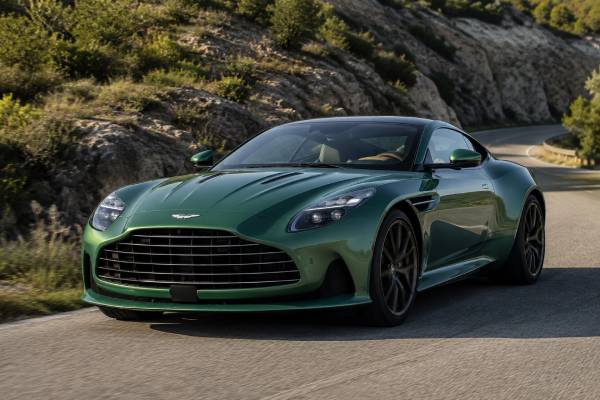
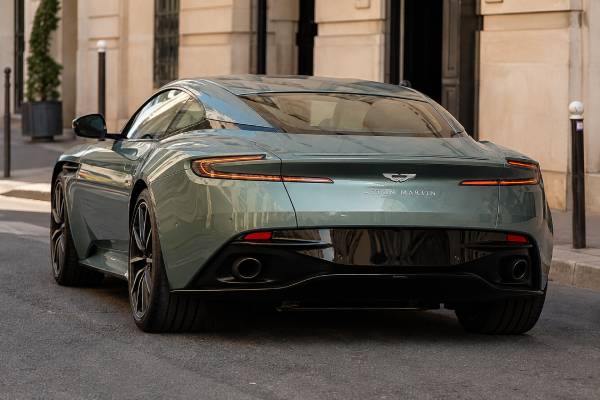
The Aston Martin DB12 S is the sharper 690 hp evolution of the DB12 coupe, introduced in October 2025 with first deliveries scheduled for early 2026. Its extra 19 hp is the least important part of the transformation. Faster transmission responses, revised launch control, firmer rear roll control, new suspension geometry, retuned steering and electronic differential software, standard carbon-ceramic brakes, added downforce, and a quad-outlet exhaust give the S a more urgent and disciplined character. It remains a front-engine, rear-wheel-drive 2+2 Super Tourer rather than a stripped track special, but it shifts the balance noticeably toward precision and repeated high-load performance. That makes specification choices and condition especially important: an S used hard on poor tires or neglected carbon ceramics can be a worse purchase than a carefully maintained standard DB12. This guide explains what changed, presents the coupe’s official technical data, interprets the engineering, and outlines the maintenance and inspection work needed before treating the fastest regular-production DB12 coupe as a serious ownership proposition.
Table of Contents
- DB12 S purpose and key changes
- DB12 S coupe technical specifications
- Power delivery, shift speed, and launch control
- S chassis, carbon ceramics, and aerodynamics
- Interior equipment and option decisions
- Hard-use maintenance and consumables
- DB12 S buying strategy
DB12 S purpose and key changes
The DB12 S is designed to feel more responsive and controlled everywhere, not merely to produce a higher number on a dyno sheet. Its upgrades target the complete path from accelerator input to tire load: engine calibration, gearbox timing, differential behavior, damping, geometry, roll stiffness, braking, steering, exhaust, and aero balance.
Aston Martin raises the twin-turbo V8 from 680 PS to 700 PS, equivalent to 690 bhp, while retaining the 800 Nm peak. The official 0–60 mph time falls from 3.5 to 3.4 seconds and 0–100 km/h from 3.6 to 3.5 seconds. Maximum speed remains 202 mph. Those changes show that the S is not chasing a different top-speed category; it is intended to respond more quickly and repeatably in the speeds and transitions a driver uses most.
The eight-speed rear transaxle receives a revised strategy capable of shifts in approximately 120 milliseconds. Launch-control changes reduce shift time by more than 50 percent during a maximum-acceleration start, while a more progressive throttle map helps the driver meter the same 800 Nm with greater accuracy. The electronic limited-slip differential is recalibrated to support the revised chassis.
Suspension changes include new damper software, revised camber, toe, and caster settings, and a rear anti-roll bar that is seven percent stiffer. Steering calibration is modified to increase connection and precision. Standard carbon-ceramic brakes remove about 27 kg of unsprung mass compared with the steel system, improving heat capacity and helping the dampers control the wheels.
Aerodynamic and visual changes are functional as well as identifying. A fixed rear spoiler, dual-element front splitter, bonnet louvres, and revised lower body treatment increase high-speed stability and cooling. The four-tailpipe exhaust gives the S a distinct rear view. An optional titanium system saves 11.7 kg and increases sound level by 1.5 dB, according to Aston Martin.
None of this turns the S into a racing car. It retains climate control, advanced driver assistance, a 2+2 cabin, adaptive damping, and long-distance ability. The relevant comparison is not “road car versus track car,” but standard DB12 breadth versus an S calibration that prioritizes sharper reactions and more thermal margin.
DB12 S coupe technical specifications
The DB12 S coupe uses a 700 PS version of the 4.0-liter twin-turbo V8, standard carbon-ceramic brakes, rear-wheel drive, and a 1,820 kg published EU kerb weight. Official combined fuel consumption is 11.9 L/100 km with CO2 emissions of 269 g/km under the stated homologation method.
| Parameter | Specification |
|---|---|
| Powertrain type | Internal-combustion engine |
| Engine configuration | 4.0 L all-alloy twin-turbocharged V8 |
| Valve gear | Quad overhead camshafts |
| Fuel delivery | Direct sequential electronic fuel injection |
| Compression ratio | 8.6:1 |
| Maximum power | 700 PS / 690 bhp / 515 kW at 6,000 rpm |
| Maximum torque | 800 Nm / 590 lb-ft at 2,750–6,000 rpm |
| Lubrication | Wet sump |
| Engine stop-start | Standard |
| Parameter | Specification |
|---|---|
| Transmission | Rear mid-mounted ZF 8-speed automatic |
| Fastest stated shift time | Approximately 120 milliseconds |
| Driven wheels | Rear |
| Differential | Electronic limited-slip differential with S calibration |
| Final-drive ratio | 3.083:1 |
| 0–60 mph | 3.4 seconds |
| 0–100 km/h | 3.5 seconds |
| Maximum speed | 325 km/h / 202 mph |
| Parameter | Specification |
|---|---|
| Front suspension | Independent double wishbone |
| Rear suspension | Independent multi-link |
| Dampers | Adaptive DTX with S-specific calibration |
| Rear anti-roll bar | 7% stiffer than standard DB12 |
| Steering | Electric power-assisted rack and pinion with S calibration |
| Front brakes | 410 × 38 mm carbon-ceramic discs; 6-piston calipers |
| Rear brakes | 360 × 38 mm carbon-ceramic discs; 4-piston calipers |
| Front tires | 275/35 ZR21 |
| Rear tires | 325/30 ZR21 |
| Wheel size | 21-inch forged alloy |
| Parameter | Specification |
|---|---|
| Body and seating | 2-door coupe; 2+2 |
| Length | 4,725 mm / 186.0 in |
| Width including mirrors | 2,135 mm / 84.1 in |
| Maximum width excluding mirrors | 1,980 mm / 78.0 in |
| Height | 1,290 mm / 50.8 in |
| Wheelbase | 2,805 mm / 110.4 in |
| Ground clearance | 120 mm / 4.7 in |
| Turning circle | 12.4 m / 40.7 ft |
| Fuel capacity | 78 L / 20.6 US gal |
| EU kerb weight | 1,820 kg / 4,012 lb |
| Weight distribution | 48% front / 52% rear |
| Parameter | Specification |
|---|---|
| Combined fuel consumption | 11.9 L/100 km / 23.7 mpg imperial |
| Combined CO2 emissions | 269 g/km |
The published weight and homologation values are defined by the manufacturer and relevant test procedure. Actual vehicle mass and real fuel use depend on options, market equipment, load, temperature, route, and driving style. The titanium exhaust’s stated 11.7 kg saving should not be subtracted from another configuration without confirming how that vehicle was weighed.
Power delivery, shift speed, and launch control
The S feels faster mainly because the car answers the driver sooner. A 20 PS increase matters at high load, but sharper throttle response, quicker ratio changes, and revised differential control reduce delay throughout a corner or overtaking sequence.
Peak torque remains 800 Nm, so the engine does not need a different personality to produce the result. It still delivers a broad midrange rather than demanding constant operation near the 6,000 rpm power peak. The S calibration makes small pedal movements more informative without turning the accelerator into an on-off switch. That is useful on a wet road, where precision is more valuable than maximum response.
The 120-millisecond shift claim describes the quickest operating condition, not every automatic change. In a relaxed mode, the gearbox can still prioritize smoothness. In an aggressive mode or under manual paddle control, clutch and torque-management strategies shorten the interruption. The advantage is most obvious when the car is already loaded laterally or accelerating hard, because the next gear arrives with less disturbance to balance.
Launch control combines engine torque, transmission engagement, tire slip, differential locking, and stability logic. Aston Martin’s greater-than-50-percent reduction in shift time during a launch helps explain the improved 0–60 mph figure even though maximum torque does not increase. It does not mean every road surface will reproduce 3.4 seconds. Tire temperature, tread, pressure, gradient, grip, load, fuel, ambient conditions, and powertrain temperature all matter.
Repeated starts impose heat and load on the tires and driveline. They should never be used casually during a pre-purchase test, and an owner who uses launch control frequently should shorten inspection intervals according to official guidance and professional advice. The relevant questions are whether the system operates without warnings, whether transmission behavior remains clean when hot, and whether the tires and differential show signs of abuse.
The optional titanium exhaust changes more than appearance. Its 11.7 kg reduction is located low and toward the rear, while the reported 1.5 dB increase gives the S a stronger acoustic distinction. Titanium also responds differently to heat and cleaning chemicals than stainless steel. Bluing can be normal, but dents, cracked brackets, contact marks, or poor alignment are not. Confirm whether the system is factory fitted and retain its build documentation.
Fuel quality should follow the exact market handbook. High-output turbocharged engines depend on knock control and correct octane, and repeated operation on unsuitable fuel can reduce performance even when the electronics protect the engine. Do not add aftermarket tuning to “unlock” assumed unused capacity without considering cooling, transmission torque management, emissions law, warranty, and resale.
S chassis, carbon ceramics, and aerodynamics
The S chassis is not simply stiffer; it is rebalanced to support faster direction changes while keeping the adaptive range needed for touring. The seven-percent-stiffer rear anti-roll bar, new geometry, damper calibration, and steering software work together, so changing one component in isolation can undo the intended balance.
More rear roll stiffness generally helps the car rotate by changing how lateral load is distributed between the axles. Aston Martin pairs that hardware with revised camber, toe, and caster settings to improve tire contact and steering response. The electronic differential and stability systems are then calibrated around the new mechanical behavior. This is why fitting S parts to a regular DB12 is not equivalent to owning a factory S.
Adaptive damping remains important because the car has not abandoned grand-touring use. On smooth pavement, a firmer mode can reduce heave and make steering inputs feel immediate. On a broken road, a more compliant setting may generate more grip by allowing wheel movement. A driver should judge the car by tire contact and confidence, not by how much vertical motion is felt in the seat.
Carbon-ceramic brakes are standard, giving the S a 410 mm front and 360 mm rear system. Their lower unsprung mass benefits steering and damper response, while high-temperature resistance supports repeated deceleration. Road drivers may also appreciate reduced brake dust. The tradeoff is high replacement cost and a condition-assessment process more specialized than measuring an iron disc with a basic tool.
A carbon-ceramic inspection should consider rotor surface condition, edge damage, oxidation or wear indicators specified by the manufacturer, pad material and thickness, heat history, caliper condition, and contamination. Chips from wheel removal, careless storage, impact, or gravel can be serious. A seller’s claim that ceramics “last forever” is a warning sign, not reassurance.
Aston Martin also introduced next-generation corner-braking control. The system coordinates braking and vehicle dynamics to improve stability when deceleration occurs during a turn. It cannot defeat physics or compensate for an old tire, wet paint line, unsuitable pressure, or poor judgment. Its presence makes correct sensor calibration, wheel-speed signals, alignment, and software status more—not less—important.
The front splitter, bonnet louvres, fixed spoiler, and rear treatment are designed as an aero package. The splitter manages front airflow, the louvres relieve under-bonnet pressure and heat, and the rear spoiler contributes balance. Damage or an aftermarket replacement may affect more than appearance. Check underside abrasion, mounting points, panel alignment, and repair quality, especially because the S has only 120 mm of published ground clearance.
The fixed rear spoiler should not be confused with the deployable solution used elsewhere in the DB12 range. Its benefit is immediate and consistent, with no actuator required, but it changes cleaning and luggage-opening access. Water and debris can collect around mounting areas, so careful hand cleaning and inspection are preferable to forcing automated brushes around it.
Interior equipment and option decisions
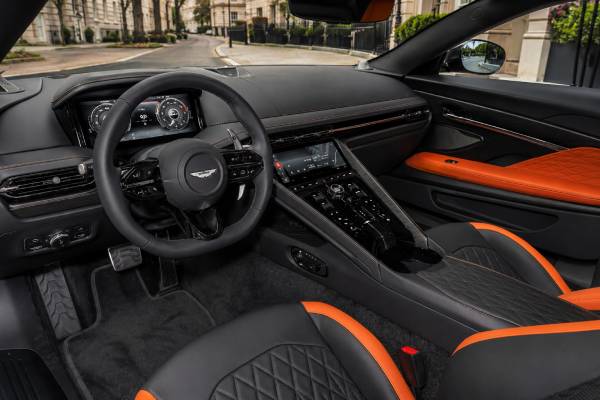
The DB12 S cabin signals its performance focus through seats, trim, and graphics rather than deleting comfort equipment. Standard Sport Plus seating and S-specific herringbone detailing preserve the model’s luxury role, while optional carbon performance seats can change both support and everyday usability.
The standard 16-way Sport Plus seats are the sensible choice for many owners. They combine adjustment, long-distance comfort, and lateral support, and their powered range makes it easier to accommodate different drivers. Test every movement, memory function, heating or ventilation where fitted, and the passenger controls. A seat that twists or stops under load needs diagnosis rather than force.
Carbon performance seats reduce visual and physical bulk and can hold the torso more firmly. Their suitability depends on body shape, mobility, journey length, and frequency of entry. Sit in the exact car for more than a showroom minute. Check helmet clearance only if relevant, but also test normal tasks: reaching the belt, turning to reverse, entering a tight garage, and getting out without dragging clothing across the bolster.
The DB12 interface combines 10.25-inch driver and central displays with physical controls for major vehicle functions. In the S, the ability to separate powertrain aggression from damper firmness is especially useful. A driver may want immediate shifts and exhaust response on a bumpy road without the firmest suspension setting. Learn the configuration logic before concluding that one default mode represents the car.
Audio choice remains between the standard system and the 1,170-watt, 15-speaker Bowers & Wilkins option in markets where offered. The premium system adds weight and cost but can matter in a car used for long journeys. Verify operation channel by channel. Rattles blamed on speakers can originate in trim, while distortion in only one source may be software or signal related.
Exterior options deserve a repair-cost lens. Exposed carbon, satin finishes, elaborate wheels, contrast stitching, and light leather can make an S exceptional, yet each asks for specific care. A front-end paint-protection film installation should account for the dual splitter and bonnet vents. Wheel refinishing must preserve original geometry and finish. Matte or satin paint cannot be spot-polished like gloss.
The titanium exhaust is the option most directly tied to performance identity, but it is not automatically essential. The standard quad system already distinguishes the S. Choose titanium for its sound, mass saving, and material appeal; do not pay a premium based on a seller’s vague claim that it is present. The build sheet, part appearance, and factory records should agree.
Hard-use maintenance and consumables
An S that uses its performance regularly needs condition-based inspection in addition to scheduled service. Carbon-ceramic brakes, wide tires, low aero components, high thermal loads, and rapid shifting can remain durable, but only when wear is measured and warnings are acted upon early.
Begin with the official schedule assigned to the VIN. Service timing, fluids, campaign work, and procedures can differ by market and build date. Keep itemized records, not just a stamp. A useful history includes oil and filter service, brake assessments, tire dates and tread maps, alignment settings, battery tests, software versions or updates, campaign completion, and any over-temperature or warning investigation.
After sustained high-load use, allow the car to cool through normal operation rather than stopping immediately after the hardest section where safe and lawful. Inspect tires for pickup, cuts, shoulder wear, and pressure change. Look under the front splitter and along the floor for contact. Check brake surfaces and wheels only after temperatures are safe; spraying cold chemicals or water on very hot components is poor practice.
Track use, where permitted and supported, requires more than selecting a mode. Drivers need correct tire pressures for the conditions, adequate pad and rotor state, suitable fluid, secure wheel fasteners checked to official procedure, no loose cabin items, and an understanding of noise and insurance rules. A road service schedule may not address repeated track temperatures. Obtain written specialist guidance for the exact use.
Tires are the car’s most important consumable. The 275/35 ZR21 front and 325/30 ZR21 rear sizes leave little tolerance for incorrect pressure, misalignment, or impact. Replace with the approved specification and preserve matched axle pairs. A different high-performance tire may fit physically while changing steering response, wet grip, noise, or electronic behavior.
Battery care remains fundamental. Low voltage can trigger drivetrain, suspension, camera, and infotainment messages that obscure the real issue. Use compatible maintenance equipment during storage, but do not assume every warning is voltage-related. Scan the car and preserve fault data before clearing it.
Cooling performance deserves a clean front air path. Inspect radiators, condensers, ducts, and grilles for debris or damage, particularly after fast driving or following other vehicles on loose surfaces. Oil, coolant, or fuel odor requires investigation. The S’s 20 PS increase is modest, but the car’s intended operating intensity places a premium on healthy thermal systems.
Cleaning procedures should protect carbon ceramics and aero parts. Avoid products that can contaminate rotors, and never allow a wheel to rest against a ceramic disc during removal. Lift only at approved points, because 120 mm ground clearance and composite lower pieces make improvised jacking risky. Choose workshops that understand the model before an emergency forces the decision.
DB12 S buying strategy
Buy the DB12 S when its sharper response, standard carbon ceramics, fixed aero, and distinct specification justify the additional cost and maintenance exposure. A standard DB12 is the better value for drivers who mainly want the 671 hp grand-touring experience and prefer steel brakes or a less assertive setup.
Because the S reached customers later than the original DB12, early used examples may be demonstrators, press-related cars, dealer stock, or rapidly resold private vehicles. Usage context matters. Ask who drove the car, where, whether it attended track or launch events, and what inspections followed. Low mileage can include a high proportion of demanding operation.
Verify identity through VIN, build sheet, and factory records. Check for the 700 PS specification, standard carbon-ceramic system, S aero, quad exhaust, correct wheels, interior identifiers, and options. Cosmetic conversion of a standard DB12 cannot reproduce the full engine, transmission, geometry, differential, damper, brake, steering, and software package.
Commission a cold-start inspection and complete diagnostic scan. Evaluate transmission engagement, differential behavior, steering, adaptive damping, cameras, driver assistance, displays, seats, climate, and audio. Measure tires across the tread, inspect inner wheel barrels, assess every ceramic disc properly, and look beneath the splitter. Paint and structural checks should be performed by someone familiar with bonded aluminum and composite panels.
On the road, judge finesse before force. The throttle should be progressive, the gearbox smooth at low speed and quick when requested, and the brakes controllable rather than abrupt. The car should track accurately without steering correction, yet it will follow cambers and road texture more than a soft luxury coupe. Compare behavior across damper and powertrain settings to separate calibration from a fault.
Calculate ownership cost using the exact car. Insurance, ceramic brake exposure, 21-inch tires, alignment, low-front-end repair, premium fuel, servicing, warranty, and transport to a qualified center may outweigh small differences in purchase price. Ask whether the warranty covers track-related faults, consumables, carbon ceramics, trim, software, and consequential damage; exclusions matter more than marketing language.
The strongest S is not necessarily the rarest color or most heavily optioned. It is the car whose condition supports the engineering promise: correct tires, undamaged ceramics, straight geometry, current software, clean cooling, fault-free diagnostics, and a transparent history. In that state, the DB12 S offers a meaningful upgrade over the standard coupe—less because it is 19 hp stronger than because every major control system has been tuned to react with greater discipline.
References
- DB12 S | Class-Leading Super Tourer | Aston Martin 2026
- Aston Martin DB12 S: The new pinnacle of performance and style 2025
- DB12 | Super GT | Aston Martin 2026
- DB12 Quick Start Guide | Aston Martin 2026
- Aston Martin Luxury Car Servicing | Aston Martin 2026
- Safety Campaign Checker | Aston Martin 2026
Disclaimer
This article is general information, not professional diagnosis, repair, legal, financial, performance-driving, or purchase advice. Specifications, torque values, intervals, procedures, software, and campaign status vary by VIN, market, model year, and equipment; verify them against the vehicle’s official service documentation before work or high-load use. Please share the guide on Facebook, X/Twitter, or an Aston Martin community when it helps another DB12 S owner.