

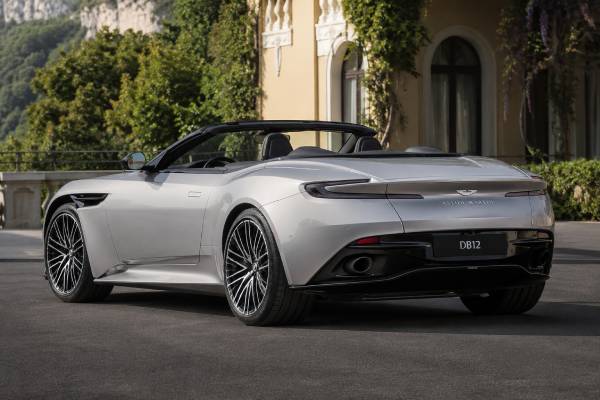
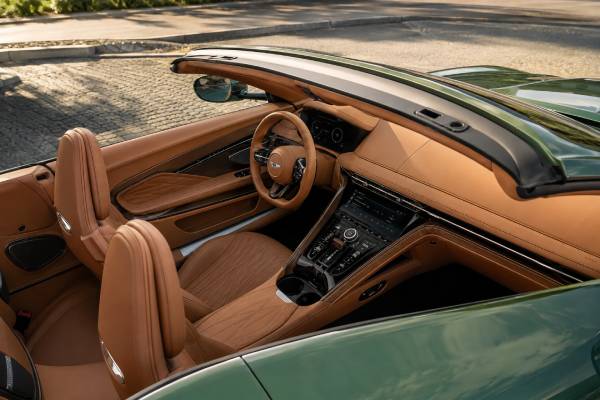
The Aston Martin DB12 Volante is the open-roof counterpart to the DB12 coupe, retaining its 671 hp twin-turbo V8 and 202 mph maximum speed while adding an eight-layer folding fabric roof. It is not simply a coupe with the top removed. The body receives dedicated reinforcement, the rear suspension has its own tuning, luggage capacity changes with roof position, and the published EU kerb weight rises to 1,898 kg with lightweight options. Those differences shape how the car rides, steers, stores luggage, and ages. They also make roof condition and water management central to any purchase inspection. The Volante is at its best as a very fast two-person touring car that can transform its atmosphere in 14 seconds, rather than as a substitute for a practical four-seat convertible. This guide examines its exact technical specification, roof system, structural engineering, everyday usability, maintenance priorities, and used-car risks, with particular attention to the details that separate a healthy open-top DB12 from one likely to generate expensive trim, electronic, or weather-sealing work.
Table of Contents
- Why the Volante is a distinct DB12
- DB12 Volante numbers and specifications
- Roof, structure, and chassis behavior
- Open-air performance and long-distance use
- Roof care, drainage, and seasonal storage
- Volante pre-purchase inspection
- Choosing the Volante over the coupe
Why the Volante is a distinct DB12
The Volante shares the coupe’s engine, transmission, rear-wheel drive, electronic differential, and core interior, but its folding roof changes the engineering and ownership equation. Buyers should treat it as a separate model rather than assume every DB12 coupe figure or recommendation carries over unchanged.
Aston Martin revealed the DB12 Volante in August 2023, with first deliveries planned for the fourth quarter. The design uses a fabric K-fold roof rather than a retractable hardtop. That choice preserves a low, elegant rear profile, limits the folded stack to approximately 260 mm, and avoids the mass and packaging demands of multiple rigid roof panels. It also introduces fabric, tensioning elements, seals, linkages, hydraulic or electro-mechanical actuation components, drainage paths, and a rear storage arrangement that need their own care.
The roof comprises eight insulation layers. It can open in 14 seconds and close in 16 seconds, and the official launch specification permits operation at speeds up to 31 mph. Remote operation may be available through the key within the prescribed range and conditions. These capabilities are useful when weather changes suddenly, but they are not an invitation to operate the mechanism over rough surfaces or while obstacles, ice, luggage, or debris interfere with its travel.
Removing a fixed roof from a high-performance structure normally reduces rigidity, so Aston Martin added reinforcement and revised mounting points. The company reported a 3.7 percent increase in global torsional stiffness compared with the preceding DB11 Volante and a 140 percent increase in front-axle mounting stiffness. The rear suspension receives dedicated spring and damper calibration to manage the additional mass and altered load path.
The practical consequences are clear. The Volante weighs more than the coupe, accelerates fractionally more slowly to 60 and 100 km/h, and has less cargo volume. In return, it offers an experience the coupe cannot: direct exposure to the engine note, weather, scenery, and speed. The value of that trade depends less on headline performance than on how often the owner will actually lower the roof.
DB12 Volante numbers and specifications
The DB12 Volante uses the same 680 PS and 800 Nm V8 calibration as the standard coupe, but its official 0–100 km/h time is 3.7 seconds and its published EU kerb weight is 1,898 kg with lightweight options. Its dimensions remain compact enough for grand touring, though the 2,135 mm mirror width deserves attention in garages and narrow streets.
| Parameter | Specification |
|---|---|
| Powertrain category | Internal-combustion engine |
| Engine | 4.0 L all-alloy twin-turbocharged V8 |
| Valve gear | Quad overhead camshafts |
| Fuel system | Direct sequential electronic fuel injection |
| Compression ratio | 8.6:1 |
| Maximum output | 680 PS / 671 bhp / 500 kW at 6,000 rpm |
| Peak torque | 800 Nm / 590 lb-ft at 2,750–6,000 rpm |
| Lubrication | Wet sump |
| Stop-start | Standard |
| Parameter | Specification |
|---|---|
| Transmission | Rear mid-mounted ZF 8-speed automatic |
| Drive layout | Rear-wheel drive |
| Differential | Electronic limited-slip differential |
| Propeller shaft | Carbon fiber |
| Final-drive ratio | 3.083:1 |
| 0–60 mph | 3.6 seconds |
| 0–100 km/h | 3.7 seconds |
| Maximum speed | 325 km/h / 202 mph |
| Parameter | Specification |
|---|---|
| Roof type | Eight-layer fabric K-fold roof |
| Opening time | 14 seconds |
| Closing time | 16 seconds |
| Permitted operating speed | Up to 50 km/h / 31 mph in official launch specification |
| Folded stack height | Approximately 260 mm / 10.2 in |
| Trunk volume, roof raised | 206 L / 7.3 cu ft |
| Trunk volume, roof lowered | 169 L / 6.0 cu ft |
| Parameter | Specification |
|---|---|
| Structure | Bonded aluminum with composite body panels |
| Front suspension | Independent double wishbone |
| Rear suspension | Independent multi-link with Volante-specific tuning |
| Dampers | Adaptive DTX system |
| Steering | Electric power-assisted rack and pinion; 2.375 turns lock-to-lock |
| Front brakes | 400 × 36 mm steel discs; 6-piston calipers |
| Rear brakes | 360 × 32 mm steel discs; 4-piston calipers |
| Front tires | 275/35 ZR21 |
| Rear tires | 325/30 ZR21 |
| Factory tire type | Michelin Pilot Sport 5 S developed for Aston Martin |
| Parameter | Specification |
|---|---|
| Body and seating | 2-door convertible; 2+2 |
| Length | 4,725 mm / 186.0 in |
| Width including mirrors | 2,135 mm / 84.1 in |
| Maximum width excluding mirrors | 1,980 mm / 78.0 in |
| Height | 1,295 mm / 51.0 in |
| Wheelbase | 2,805 mm / 110.4 in |
| Fuel-tank capacity | 78 L / 20.6 US gal |
| EU kerb weight | 1,898 kg / 4,184 lb with lightweight options |
| Weight distribution | 47% front / 53% rear |
The EU weight is a manufacturer-defined value for a lightweight-option configuration, not a scale ticket for every Volante. Options such as carbon-ceramic brakes, seats, audio, exterior trim, and market equipment can change actual mass.
Roof, structure, and chassis behavior
The Volante’s engineering challenge is to preserve steering precision and suspension control without a fixed roof tying the upper body together. Aston Martin addresses this through structural reinforcement and dedicated calibration, accepting a weight increase rather than pretending the convertible can be identical to the coupe.
The bonded-aluminum platform uses adhesive joints and mechanical fastening to create a rigid base from multiple extrusions, castings, and panels. In the Volante, strengthening around the underbody, suspension mounts, sills, and rear structure helps carry loads that would otherwise pass through a fixed roof. The result is not only about reducing visible shake; it gives the adaptive dampers and alignment a more stable foundation.
On a smooth road, the extra mass is less obvious than the numbers suggest. The rear-mounted gearbox and rear-biased 47:53 distribution help the car feel planted, while the electronic differential meters lock according to steering, throttle, wheel speed, and stability-control demands. The steering remains quick enough for confident placement, and the body does not need to be harsh to respond accurately.
Rough surfaces reveal more of the convertible compromise. A driver may notice a little more movement through the structure, mirror, steering column, or seat than in the coupe, particularly with the roof lowered. This is not automatically a defect. Repeated clunks, sharp scuttle shake, one-sided creaks, changing panel gaps, or noises that appeared after a wheel impact are different and should be investigated.
The rear springs and damper software are calibrated for the Volante’s mass distribution. Replacing components with coupe parts or fitting lowering hardware without understanding the adaptive system can upset ride height, alignment, electronic control, and tire clearance. Any modified example needs documentation that identifies parts, installer, geometry, software implications, and whether original components remain available.
Optional carbon-ceramic brakes can improve wheel control because their lighter discs reduce unsprung mass. That effect may be especially noticeable in a heavier convertible, but it does not erase the mass difference. For road touring, the standard steel brakes are highly capable and easier to budget for. Carbon ceramics make more sense when their response, heat resistance, cleanliness, or option value is worth the inspection and replacement risk to the owner.
The roof itself contributes to refinement when raised. Eight layers provide acoustic and thermal insulation, and the K-fold arrangement preserves a smooth exterior silhouette. Wind noise should be present but controlled, without a concentrated whistle from one corner or water entering around glass. Door-glass indexing and seal compression are part of the system; a window that does not drop and reseal correctly can create noise and weather problems even when the fabric roof is healthy.
Open-air performance and long-distance use
With the roof down, the Volante’s greatest feature is sensory access rather than additional speed. The V8 sounds more immediate, sightlines open upward, and an ordinary road can feel more memorable, while the car still has the torque reserve and stability expected of a 202 mph grand tourer.
The official 0–60 mph time is one tenth slower than the coupe’s, a difference few owners will identify without instruments. At road speeds, the 800 Nm plateau dominates. The car accelerates hard from the midrange, and the eight-speed transmission can remain unobtrusive during cruising before responding rapidly to a paddle or throttle request.
Top-down comfort depends on speed, wind direction, seat position, temperature, and use of the wind deflector if equipped. Windows raised can reduce cabin turbulence substantially. Heating, seat ventilation or heating where fitted, and climate control extend the useful season, but a convertible is never isolated from dust, pollen, exhaust, and sudden weather. Carrying suitable clothing and checking the forecast remain more effective than relying on equipment alone.
The Volante is best packed with flexible luggage. With 206 liters available when the roof is up and 169 liters when folded, rigid suitcases can restrict the mechanism or consume the useful shape quickly. Never force bags above the load separator or into the roof’s movement space. A test pack before a long journey prevents the awkward discovery that lowering the roof requires leaving luggage behind.
Rear seats have limited adult usefulness and become even less practical when the front occupants need comfortable touring positions. They can hold small bags, but unsecured objects may be exposed to wind or become dangerous under braking. Use approved restraint points and keep anything that could strike trim, controls, or occupants secured.
The wide tires generate strong dry grip, yet open-air driving can encourage an exaggerated sense of speed and occasion. Rain can arrive quickly, low temperatures reduce tire performance, and standing water challenges 325-section rear tires. Select stability settings conservatively on public roads and remember that 671 hp can overwhelm available grip well below the car’s maximum speed.
Long-distance evaluation should include roof-up and roof-down running. Check buffeting, seat comfort, climate performance, audio audibility, navigation, adaptive cruise, camera views, storage access, and refueling range. A car that is thrilling for 20 minutes may still be tiring over four hours because of seat fit, tire noise, a persistent roof whistle, or the owner’s luggage needs.
Roof care, drainage, and seasonal storage
A Volante roof lasts best when it is kept clean, allowed to dry fully, and exercised according to the official procedure. The most damaging habits are forcing movement against an obstruction, folding contaminated fabric, ignoring blocked drainage, and storing the car damp.
Begin with inspection rather than chemicals. Vacuum loose dust gently, remove bird contamination promptly, and use products approved for the specific fabric and water-repellent treatment. Household detergent, stiff brushes, pressure washers, and aggressive waterproofing can fade color, disturb fibers, damage stitching, or push water past seals. Clean the roof in shade and allow it to dry completely before prolonged folding or covering.
Operate the mechanism on level ground when practical, with adequate overhead and rear clearance. Confirm that the luggage separator is correctly positioned and that no straps, clothing, leaves, ice, or cleaning towels are near the hinges and storage bay. Hold the control through the full cycle as instructed and watch for asymmetry. If movement slows, stops, or produces a warning, do not keep cycling it in the hope that the fault clears.
Drainage paths carry water away from seals and roof storage areas. Their exact access and service procedure should come from official information, but owners can watch for warning signs: damp carpet, condensation, musty odor, water marks, sloshing, repeated window fogging, or moisture around the trunk and rear cabin. Water intrusion can affect modules and connectors before it becomes visible on the upper trim.
Rubber seals should be cleaned with approved materials and inspected for twisting, cuts, flattening, or contamination. Door glass must index properly when the door opens and reseat against the roof. Misalignment can result from calibration, regulator, hinge, seal, or body issues. Smearing silicone or universal conditioner over the area may temporarily change noise while making correct diagnosis harder.
A storage plan should protect both the roof and the car’s electronics. Park the car dry, normally with the roof raised unless official guidance specifies otherwise, and use a breathable indoor cover on clean paint. Maintain appropriate battery voltage with compatible equipment, preserve tire pressures, avoid handbrake or brake-pad adhesion where the official storage procedure offers an alternative, and move or exercise the vehicle at suitable intervals.
Seasonal return to use should include a full visual inspection. Look for tire flat spots or cracking, animal damage, fluid leaks, corrosion on brake surfaces, blocked grilles, stale odor, roof staining, and warning messages. Let systems initialize before immediately cycling the roof. A careful first drive with gradual braking and temperature buildup is safer than treating the end of storage as an event launch.
Mechanical maintenance remains just as important as roof care. Follow the VIN-specific schedule, keep software and safety campaigns current, inspect cooling and oil systems, test battery health, and document tire, alignment, brake, and suspension measurements. The convertible’s extra systems add responsibilities; they do not replace the basic needs of the high-output V8 platform.
Volante pre-purchase inspection
A proper Volante inspection must take place both dry and wet, with the roof cycled repeatedly and the car scanned electronically. A conventional coupe inspection will miss some of the most expensive convertible risks.
Request the VIN, build sheet, service invoices, warranty history, campaign status, both keys, and any records of roof adjustment, water leaks, glass calibration, battery replacement, body repair, or software work. Ask how the car was stored and whether it spent long periods with the roof folded. Vague claims that convertibles “all make that noise” should be tested rather than accepted.
Examine the fabric in diffuse daylight. Look for color variation, abrasion at fold lines, lifting edges, loose stitching, tension differences, stains, pinching, and evidence of harsh cleaning. Check the rear glass and surrounding bond or seam. Inspect the headliner for marks that could indicate contact or moisture. Compare left and right mechanism areas for missing fasteners, disturbed trim, or lubricants applied indiscriminately.
Cycle the roof from fully closed to fully open and back more than once, following the official conditions. Time need not match a stopwatch exactly, but motion should be coordinated and confident. Watch the tonneau area, side flaps, glass, headliner, latches, and final seal. Confirm that the instrument display reports the correct status and that windows index and close properly. Repeat after a road drive, because temperature and body movement can expose intermittent faults.
A controlled water test is valuable when performed by a knowledgeable technician. It should reproduce rain without directing high-pressure water into seals. Immediately inspect the headliner, A-pillars, door openings, rear storage area, carpets, trunk, module locations, and drain exits. Moisture meters and removal of selected trim may be justified if odor or history raises concern.
The mechanical inspection should cover cold start, oil and coolant leaks, cooling pack, transmission, differential, adaptive dampers, steering, suspension joints, wheels, tire age and inner-edge wear, brakes, underbody, exhaust, cameras, driver assistance, climate control, displays, audio, and fault memory. United States cars should receive a current VIN recall check, including relevant oil-cooler hose and rearview-camera campaigns.
Test drive with the roof in both positions. Roof-up evaluation should focus on whistles, glass sealing, rattles, temperature control, and water evidence. Roof-down evaluation should note mechanism noises, body movement, wind management, and loose objects. Drive over a range of surfaces at sensible speeds and brake progressively. A loud exhaust should not be allowed to mask suspension or trim sounds.
Finally, verify cargo needs and garage clearance in person. Measure the opening available with the roof partition in place, place the intended bags inside, and ensure the roof can operate without contact. Check mirror width against the actual parking space. These simple tests prevent a technically excellent car from becoming a poor fit for its owner.
Choosing the Volante over the coupe
Choose the Volante when open-air driving will be a regular part of ownership and its extra weight, smaller trunk, roof maintenance, and potential weather-sealing work are acceptable. Choose the coupe when maximum structural purity, lower mass, greater luggage volume, and simpler long-term care matter more than the convertible experience.
On paper, the coupe’s advantages are easy to quantify: a 1,788 kg published EU kerb figure with lightweight options instead of 1,898 kg, a 262-liter trunk instead of 206 or 169 liters, and a 3.5-second 0–60 mph claim rather than 3.6. The fixed roof also removes a complex system and provides a quieter, more consistent enclosure.
The Volante’s advantage cannot be reduced to a table. Lowering the roof changes the relationship between driver, road, engine, and surroundings. For some owners, that is the reason to buy an Aston Martin at all. The small performance penalty becomes irrelevant because the experience is richer at normal road speeds.
Specification should support intended use. A light interior can emphasize the open cabin but may demand more cleaning. Carbon-ceramic brakes can reduce unsprung mass but add replacement exposure. The premium audio system may matter more roof-up than roof-down. Dark roof colors may hide some contamination, while distinctive colors can increase personal appeal but narrow the resale audience. There is no universally correct build.
Do not buy solely by mileage. A frequently used, garaged, correctly maintained Volante with a dry roof system can be a better prospect than a low-mile example that sat with a depleted battery and damp seals. Conversely, high mileage without tire, brake, alignment, and roof-service records may hide expensive needs. History must explain how the car reached its current condition.
A sensible purchase includes an independent specialist report, a current VIN campaign check, verified option list, roof and water test, diagnostic scan, insurance quotation, and realistic reserve for consumables. Warranty coverage is valuable only when its roof, electronics, seals, trim, and consequential-damage terms are understood.
The DB12 Volante is not the objectively purest DB12, and it does not need to be. It trades a measure of speed, stiffness, cargo capacity, and simplicity for a transformation no drive mode can reproduce. Buyers who will use that transformation, protect the mechanism, and accept the maintenance obligations receive one of the most complete expressions of the DB12’s grand-touring purpose.
References
- DB12 Volante | Luxurious Top-Down Car 2026
- Introducing DB12 Volante: The ultimate open-top Super Tourer 2023
- DB12 Volante Brochure | Aston Martin 2026
- DB12 Quick Start Guide | Aston Martin 2026
- Aston Martin Luxury Car Servicing | Aston Martin 2026
- Safety Campaign Checker | Aston Martin 2026
Disclaimer
This guide is informational and does not replace professional diagnosis, repair, legal, financial, or purchase advice. Specifications, torque values, service intervals, roof procedures, campaign status, and approved materials vary by VIN, market, model year, and equipment; verify them in the car’s official service documentation before acting. Share this guide on Facebook, X/Twitter, or an Aston Martin owners’ forum when another Volante buyer could benefit from it.