


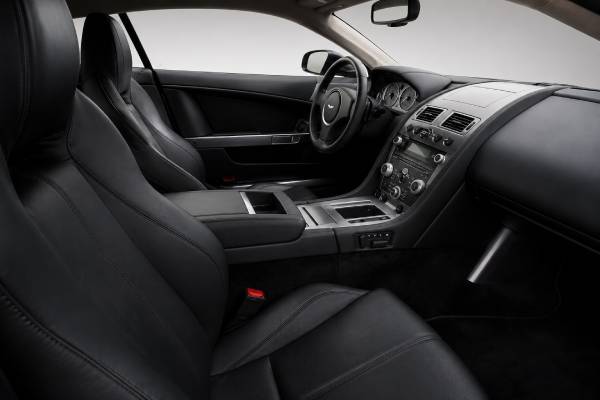
The 470 hp Aston Martin DB9 is the important middle chapter of the AM802 story. It keeps the original car’s graceful shape and choice of manual or Touchtronic 2 transmission, but adds the AM09 V12, more torque, revised chassis tuning, and a series of detail improvements that make it a more mature grand tourer. For many buyers, it is the sweet spot: more developed than the 450 bhp launch car, less complex and less visually altered than the 2013 AM11 redesign, and still available with three pedals.
This article covers the coupe produced from the 2008 update through 2012. The changeover is not perfectly described by registration year, so a 2008 car must be identified by its build information and engine specification. The newest examples are now old enough that condition eclipses published performance. Service continuity, battery health, cooling-system condition, suspension wear, transmission behaviour, body repairs, and recall completion all matter. A strong AM09 DB9 still feels fast, balanced, and unusually refined; a neglected one can consume its purchase-price advantage quickly.
Table of Contents
- The 470 hp DB9 in Context
- AM09 Technical Data
- What the 2008 Update Changed
- Manual Versus Touchtronic
- Living With the Chassis and V12
- Reliability, Service, and Recalls
- Inspection and Purchase Strategy
The 470 hp DB9 in Context
The AM09 car is the facelift-era DB9 with 470 bhp and 600 Nm, not an early 450 bhp car merely registered late. It retains the basic VH aluminium architecture and rear-transaxle layout while refining the engine, damping, steering, braking feel, cabin details, and exterior finish.
Aston Martin’s first DB9 had already established the essential formula: a naturally aspirated V12 mounted behind the front axle, a carbon-fibre propeller shaft inside a torque tube, and a six-speed transaxle placed near the rear axle. That arrangement keeps the heaviest components within the wheelbase and gives the car close to even weight distribution. The 2008 update did not abandon the formula because it did not need to. Instead, Aston Martin concentrated on response, refinement, and quality.
The AM09 engine raised output from 450 to 470 bhp and torque from 570 to 600 Nm. The gains came with a higher compression ratio and revised internal and breathing details rather than turbocharging. The result is not a dramatic change in low-speed character; it is a stronger, cleaner pull through the middle and upper rev range. The factory 0–60 mph claim improved to 4.6 seconds, and maximum speed rose to 190 mph.
Externally, these cars can look deceptively similar to earlier DB9s. Changes included a revised grille treatment, altered mirrors, updated wheel designs, and detail revisions that varied through the production run. The interior evolved as well, notably with Aston Martin’s Emotion Control Unit key arrangement on later specifications and incremental changes to switchgear and trim. Because owners frequently retrofit wheels, lamps, grilles, and badges, visual cues should support—not replace—VIN, engine, and build-data checks.
The coupe remains a 2+2, but its rear seats are best viewed as occasional accommodation or luggage platforms. Its real purpose is two-person touring. The boot is useful for soft bags, the cabin is quieter than the Volante, and the fixed roof gives the chassis a more settled response over broken surfaces. It is neither a lightweight sports car nor a luxury saloon. It occupies the ground between them, prioritising composure, steering accuracy, and the sense of a large engine working without forced induction.
Model-year equipment can differ across markets. Options and running changes included wheel styles, seat specifications, audio systems, navigation updates, trim materials, sport packages, and special editions. Buyers should assess the individual car rather than assume that every 2010 or 2012 example carries an identical specification.
AM09 Technical Data
The AM09 DB9 coupe is a naturally aspirated internal-combustion car with rear-wheel drive and a rear-mounted six-speed transaxle. Manual and automatic versions share the same engine output, while gearing, operation, and official consumption differ.
| Item | Specification |
|---|---|
| Engine | 5,935 cc all-alloy naturally aspirated V12 |
| Engine code | AM09 |
| Valvetrain | Four overhead camshafts, 48 valves |
| Compression ratio | 10.9:1 |
| Maximum power | 470 bhp (350 kW; 477 PS) at 6,000 rpm |
| Maximum torque | 600 Nm (443 lb-ft) at 5,000 rpm |
| Fuel delivery | Electronic sequential multi-point injection |
| Drive layout | Front-mid engine, rear-wheel drive |
| Item | Manual | Touchtronic 2 automatic |
|---|---|---|
| Gearbox | Six-speed rear transaxle | Six-speed rear transaxle |
| Final drive | 3.54:1 | 3.154:1 |
| Differential | Limited-slip | Limited-slip |
| 0–60 mph | 4.6 seconds | 4.6 seconds |
| 0–100 km/h | 4.8 seconds | 4.8 seconds |
| Maximum speed | 306 km/h (190 mph) | 306 km/h (190 mph) |
| Item | Manual | Touchtronic 2 automatic |
|---|---|---|
| Official combined consumption | 16.4 L/100 km | 14.6 L/100 km |
| Official CO₂ emissions | 389 g/km | 345 g/km |
| Fuel tank | 80 litres | 80 litres |
| Fuel requirement | Premium unleaded | Premium unleaded |
| Item | Specification |
|---|---|
| Body | Bonded and riveted aluminium VH structure |
| Suspension | Independent double wishbones front and rear |
| Damping | Adaptive damping system |
| Front brakes | 355 mm ventilated steel discs, four-piston calipers |
| Rear brakes | 330 mm ventilated steel discs, four-piston calipers |
| Front wheels and tyres | 8.5J × 19; 235/40 ZR19 |
| Rear wheels and tyres | 9.5J × 19; 275/35 ZR19 |
| Measurement | Value |
|---|---|
| Length | 4,710 mm |
| Width excluding mirrors | 1,875 mm |
| Height | 1,270 mm |
| Wheelbase | 2,745 mm |
| Kerb weight | 1,760 kg |
| Seating | 2+2 |
The official figures describe a fast car, but they do not capture its defining quality: accessible, progressive performance. The V12 does not need to be kept on boost, and the chassis is designed to communicate its load rather than surprise the driver with an abrupt transition.
What the 2008 Update Changed
The 2008 revision improved the DB9 by sharpening response without turning it into a hard-edged derivative. The engine is stronger, the chassis uses adaptive damping, and many small refinements make the car feel more consistent than the launch version.
The higher-output V12 is the headline change. Its 600 Nm torque peak gives the car greater authority when overtaking, while the extra power is most apparent as speed builds. Throttle calibration and breathing changes help it feel more alert. It remains smooth enough to pull from low engine speeds, but its best character appears when the driver lets it rev.
Adaptive dampers broaden the chassis operating window. Their purpose is not to make the DB9 behave like a track car; it is to control body movement more precisely while preserving the compliant primary ride expected of a grand tourer. A sound car should feel tied down through long bends yet absorb isolated bumps without crashing. Damping faults can upset this balance, so a warning-free dashboard alone is insufficient—physical leakage and road behaviour still matter.
Aston Martin also worked through many production details during the model’s life. Later cars can show improved trim execution, revised electrical components, different infotainment generations, and options unavailable at launch. None transforms the underlying architecture, but together they affect daily usability. A buyer who values Bluetooth integration, a particular console design, or a specific seat may prefer a late car even when the mechanical condition is similar.
The update did not solve the limitations of age or low-volume manufacture. Navigation now looks dated, some switches have a borrowed origin, rear-seat space remains minimal, and parts can be expensive despite the car’s used-market price. The correct perspective is that this is a hand-finished exotic GT whose depreciation has made it accessible, not an ordinary coupe whose maintenance has become cheap.
When comparing individual years, prioritise documented running changes over internet shorthand. A late car may have newer infotainment or trim, but an early AM09 example with rebuilt suspension, fresh tyres, current fluids, and a clean diagnostic record can drive better. The update’s value lies in the complete condition of the engine, damping, brakes, and cabin rather than in registration age alone.
Do not confuse the 470 bhp car with the substantially revised 2013 model. The AM11 version has 510 bhp, enlarged body details, 20-inch wheels, carbon-ceramic brakes, three-stage adaptive damping, and automatic transmission only. An advertisement describing a 2012 registration as the “new-shape 510” or a 2013 registration as the “470” needs build-level verification.
Manual Versus Touchtronic
Choose between the transmissions according to use and condition, not internet hierarchy. The rare manual is more interactive and may command a premium, while the automatic is better suited to traffic and is easier to find with complete history.
The manual gearbox uses a conventional clutch and a rear transaxle. Its lever movement is mechanical and deliberate, particularly when cold. A good example rewards accurate timing and makes the driver more involved in the V12’s delivery. It also introduces an expensive wear item. Clutch life depends heavily on use, gradients, manoeuvring, and driver technique; mileage by itself cannot predict remaining life.
During inspection, note the bite point, pedal feel, take-up smoothness, and any smell after low-speed manoeuvres. Apply full throttle in a high gear once the car is warm and conditions are safe. Engine speed should rise in step with road speed. Difficulty selecting gears may reflect clutch drag, linkage adjustment, transaxle wear, or old lubricant, so diagnosis should precede negotiation.
The Touchtronic 2 is a conventional torque-converter automatic rather than a single-clutch automated manual. That makes it smooth at parking speed and relaxed on a long journey. Column-mounted paddles give manual selection, and the transmission generally suits the engine’s broad torque curve. Its six ratios are fewer than in modern automatics, but that is not automatically a defect; the V12 can cover a wide speed range in each gear.
Test the automatic cold and fully hot. Selection of Drive and Reverse should be prompt, creep should be predictable, and shifts should not flare or slam. Use gentle throttle, full-throttle kickdown, paddles, and repeated manoeuvres. Check Park on level ground with the parking brake applied and verify that no transmission warning appears after stopping and restarting.
A wider DB9 recall addressed software associated with Park engagement on certain automatic cars, while a separate recall concerned a transmission switch printed-circuit board on specified later builds. Applicability is VIN-specific. Completion should be verified with an official source rather than assumed because a dealer once serviced the car.
The best buying rule is simple: a documented automatic with smooth operation is preferable to a manual with a slipping clutch and uncertain history. Conversely, a properly maintained manual offers a connection absent from every 2013-on DB9, because the later AM11 cars were automatic only.
Living With the Chassis and V12
The AM09 coupe is most satisfying when used regularly and allowed to complete proper journeys. Repeated short starts, long storage with a weak battery, and deferred fluid changes create more trouble than sensible mileage accumulated by a careful owner.
On the road, steering should be fluid and naturally weighted. The nose responds without the hyperactive turn-in of a small sports car, and the rear follows progressively. The transaxle layout gives the driver confidence to place the car, especially in long, medium-speed bends. Worn front bushes, tired dampers, poor geometry, or mismatched tyres can make the same model feel heavy and vague, which is why a test drive should not be dismissed as merely subjective.
The steel brakes are easier to understand and often less intimidating to replace than the carbon-ceramic system fitted to the 2013 redesign. They still require inspection of both disc faces, measured thickness, pad condition, hoses, fluid, and caliper operation. A lip on the outer edge tells only part of the story. Cars stored in damp conditions may corrode on the inner faces or develop sticking components.
Nineteen-inch tyres are central to ride, steering, and safety. Use matching premium tyres in the correct sizes and inspect production dates. A car can have legal tread while riding poorly because its tyres are old and hardened. Inner-edge wear points toward geometry or suspension issues. Vibration may come from flat spotting, wheel damage, poor balancing, or worn driveline parts.
The engine should be warmed by driving gently rather than idling for an extended period. Monitor fluid levels according to the owner’s guide, and investigate any persistent smell of coolant, fuel, or hot oil. A V12 has more ignition components, injectors, gaskets, and exhaust hardware than a simpler engine; small faults therefore deserve prompt attention before they damage catalysts or create secondary problems.
Fuel consumption is substantial and sensitive to use. The official combined figures are not realistic predictions for every owner, especially in short urban journeys. Range can be reasonable on a steady tour because of the 80-litre tank, but premium fuel cost is part of the car’s operating budget. The same applies to insurance, specialist labour, and parts that retain luxury-car pricing even after depreciation.
Cabin care is not trivial. Leather shrinks and creases when neglected, headlining can sag, piano-black and metal finishes mark, and obsolete infotainment components may be costly to replace. Climate control should cool promptly and maintain temperature. Test seat motors, memory, heated functions, mirrors, windows, locks, parking aids, audio, navigation, lamps, and both keys.
Reliability, Service, and Recalls
The AM09 powertrain can cover meaningful mileage, but reliable ownership depends on disciplined annual care and early response to leaks, warnings, vibration, or low voltage. “Only driven in summer” is not a service record.
Aston Martin’s period schedule uses 10,000 miles or 16,000 kilometres and 12 months as the recurring service interval after the initial visit. Brake fluid is time-sensitive, coolant has a multi-year interval, and gearbox or differential oils and spark plugs have mileage-based requirements. Market schedules can differ, so the exact operations should be checked for the VIN and transmission.
Annual inspection should include fluid leaks, coolant condition, hoses, belts, engine mounts, exhaust, suspension joints, dampers, brakes, tyres, wheel condition, steering, battery, charging output, and a complete diagnostic scan. Stored codes matter even when no warning is illuminated. Ask the specialist to distinguish historic low-voltage entries from active faults rather than simply erasing everything.
Battery condition is one of the most practical ownership issues. The car has multiple control modules and does not tolerate prolonged low voltage gracefully. A maintenance charger is advisable for occasional use, but it cannot revive a failing battery indefinitely. Load-test the battery, inspect terminals and grounds, and confirm charging voltage before replacing expensive modules.
Oil seepage can arise at several joints and may be hidden by undertrays. Identify the source and rate rather than accepting “they all do that.” A light mist and an active leak requiring repeated top-ups are different conditions. Coolant residue, unstable temperature, fan faults, or pressure loss should be resolved before high-load driving.
Suspension wear often arrives gradually. Bushes, ball joints, anti-roll-bar links, and dampers can deteriorate without a dramatic failure, leaving the car less precise and wearing tyres. Replacing one obviously failed part may not restore the intended behaviour if the rest of the axle is similarly aged. A specialist should inspect the system as a whole and align the car after relevant work.
Recall history varies by build date and market. The 2007–2008 front lower control-arm cam-bolt campaign can overlap the earliest update cars. A throttle-pedal lever recall covered a broad production period beginning in late 2007. Certain automatic DB9s were later included in a Park-pawl software campaign. Obtain a VIN-specific record from an Aston Martin dealer and check the relevant national safety authority.
Inspection and Purchase Strategy
A good AM09 DB9 should be bought on evidence: correct identity, invoices, a clean diagnostic picture, a specialist inspection, and a long test drive. Colour, mileage, and a polished showroom presentation come after those fundamentals.
First establish what the car is. Compare the VIN, build plate, registration documents, engine information, option record, and seller’s description. Pay special attention to 2008 and 2012/2013 registrations because transition cars are often advertised under the wrong output. Confirm whether wheels, grilles, lamps, exhaust parts, or badges are original, factory options, or later additions.
Study the history chronologically. Look for annual attention even during low-mileage periods, and identify gaps rather than counting stamps. Invoices should reveal brake fluid, coolant, plugs, transaxle or differential oil, batteries, tyres, brakes, suspension work, air-conditioning repairs, and recall actions. Repeated replacement of the same component may indicate that the root cause was never found.
Inspect paint under natural light. Aluminium panels can corrode where coatings are damaged, and poor repairs may show as ripples, thick edges, overspray, mismatched metallic flake, or uneven gaps. Check the long doors for drop and clean latching. Examine the underside for impact, crushed lift points, missing fasteners, scraped undertrays, and fluid staining.
The specialist pre-purchase inspection should include a full module scan, battery and alternator test, cold start, cooling-system assessment, leak inspection with undertrays considered, suspension play, damper condition, brake measurements, tyre dates, wheel runout where necessary, and transmission testing. Ask for estimated costs, not only a list of observations.
During the drive, start with the car cold and finish with it fully heat-soaked. Listen for abnormal start-up noise and confirm a stable idle. Test progressive and heavy throttle after warm-up, every gear or automatic mode, firm braking, rough roads, tight turns, parking manoeuvres, climate control, and a hot restart. Recheck for smells, leaks, warnings, or a change in transmission behaviour.
Set aside a reserve for the first year. Even an excellent car may need preventative work, new tyres due to age, fluids not supported by invoices, cosmetic correction, or an upgraded battery-maintenance arrangement. The cheapest purchase can become the most expensive ownership experience when several deferred jobs converge.
The 470 hp coupe rewards careful selection. It retains the elegant early silhouette, offers the final broad period in which a manual was available, and adds enough engine and chassis development to feel convincingly resolved. Bought with patience and maintained by someone who understands the platform, it remains one of the most usable ways to own a naturally aspirated V12 grand tourer.
References
- Aston Martin DB9 | Past Models | Aston Martin (UK) | Aston Martin UK 2026
- DB9 – 2026 (Historic Model)
- THE ASTON MARTIN DB9 IS THE 2011 (Factory Brochure)
- Owner’s Guides | Car Ownership | Aston Martin (UK) | Aston Martin UK 2026
- SAFETY RECALL ACTION 2014 (Recall Documentation)
- Park Pawl may not Engage, Allowing Vehicle to Move 2017 (Recall Database)
Disclaimer
This article provides general educational information and cannot establish the condition, safety, authenticity, or value of a particular vehicle. Specifications, service requirements, equipment, and recall coverage can vary by VIN, build date, gearbox, and country; verify them through official documentation and an experienced Aston Martin specialist.
Share this guide on Facebook, X/Twitter, or another social platform when it helps your search or ownership planning. Doing so supports more detailed independent vehicle guides.