
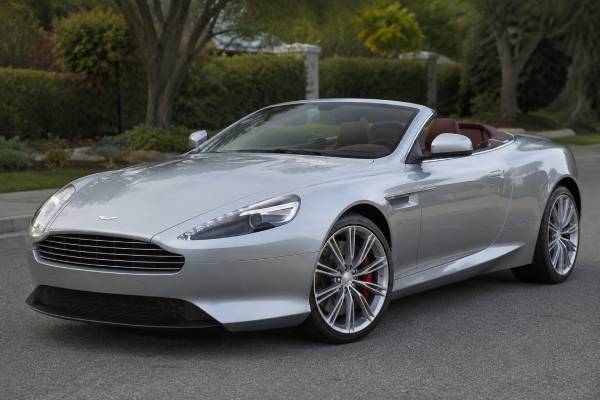
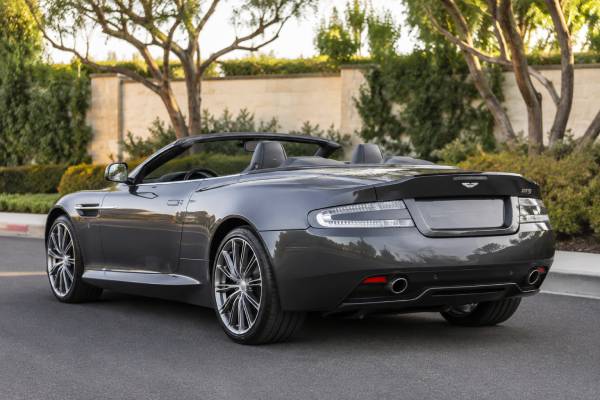
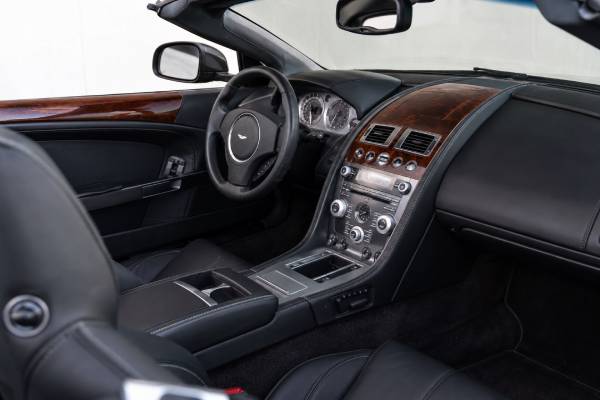
The 510 hp Aston Martin DB9 Volante is the most extensively developed standard open DB9. Its 2013-model-year redesign brought the AM11 V12, standard carbon-ceramic brakes, three-stage adaptive damping, wider 20-inch wheels, fresh bodywork, and a much stiffer open structure. Aston Martin claimed a 30 percent improvement in Volante body rigidity over the preceding version, a change that matters more on a convertible than a modest acceleration gain.
This article covers the AM11 Volante from its late-2012 introduction until the 540 bhp DB9 GT took over the final production phase in 2015. It is automatic only, using the six-speed Touchtronic 2 rear transaxle. A prospective owner needs to evaluate two expensive machines at once: a high-performance V12 GT and a power-roof convertible. Carbon-ceramic disc condition, adaptive dampers, roof geometry, drains, frameless windows, battery voltage, electronics, cooling, tyres, and body repairs must all pass inspection. When those systems are healthy, the car offers rare breadth—quiet roof-up travel, open-air V12 theatre, and chassis control far beyond the early Volante.
Table of Contents
- What Makes the AM11 Volante Different
- Exact Specifications for the 510 hp Convertible
- Stiffness, Roof Operation, and Weather Sealing
- V12 Performance and Open-Top Road Manners
- Caring for Carbon Ceramics, Dampers, and Tyres
- Electrical, Cooling, and Age-Related Trouble
- Pre-Purchase Checks for an AM11 Volante
What Makes the AM11 Volante Different
The AM11 Volante is not the earlier body with an engine tune. It is a structural, powertrain, brake, suspension, and styling revision that moves the open DB9 much closer to the capability of the contemporary coupe.
The central VH platform still consists largely of bonded and riveted aluminium sections, but Aston Martin changed key structural areas and quoted a 30 percent increase in rigidity for the Volante. This gives the suspension more consistent mounting points and reduces the extra body movement that accompanies an open roof. The improvement is especially noticeable on diagonal bumps, through fast direction changes, and when the car brakes hard on an uneven surface.
Exterior changes included a deeper front grille, reshaped lower intake, revised bonnet and wings, stronger side strakes, a more integrated rear spoiler form, and diffuser-led rear styling. The result is visually closer to the DBS and Virage than the delicate 2005 Volante, yet it retains the low waistline and clean fabric-roof profile that define a DB9.
The AM11 V12 produces 510 bhp at 6,500 rpm and 620 Nm at 5,500 rpm. Dual variable camshaft timing, larger throttle bodies, revised cylinder-head and block details, an uprated fuel system, and freer breathing make it more eager above the mid-range. It is still naturally aspirated, so power builds in proportion to engine speed rather than arriving as a turbocharged step.
Only the Touchtronic 2 six-speed automatic was offered. It remains mounted at the rear, linked to the engine by a torque tube and carbon-fibre shaft. This positioning helps keep weight distribution balanced despite reinforcement and roof hardware. The automatic’s smooth low-speed behaviour also suits the car’s intended use better than a single-clutch automated transmission would.
Standard carbon-ceramic brakes reduce unsprung weight compared with similarly sized iron discs and cope with repeated high-energy stops. Three-stage adaptive damping gives Normal, Sport, and Track modes. Together, these changes allow the AM11 Volante to remain comfortable on a tour while feeling substantially more controlled than its predecessor.
The rear seats and boot are still compromised. Roof stowage consumes space behind the cabin, and adults will struggle in the second row. The car works best as a two-person grand tourer with soft luggage and the wind deflector fitted. That practical limitation should be tested before purchase rather than discovered on departure day.
Exact Specifications for the 510 hp Convertible
This model is a rear-wheel-drive, naturally aspirated petrol convertible with a front-mid V12 and rear automatic transaxle. It shares its 510 hp powertrain with the coupe but carries additional body and roof mass, reflected in its kerb weight.
| Item | Value |
|---|---|
| Engine | 5,935 cc all-alloy naturally aspirated V12 |
| Engine designation | AM11 |
| Valvetrain | 48 valves, four overhead camshafts, dual variable camshaft timing |
| Maximum power | 510 bhp (380 kW; 517 PS) at 6,500 rpm |
| Maximum torque | 620 Nm (457 lb-ft) at 5,500 rpm |
| Fuel system | Electronic sequential multi-point injection |
| Drive | Rear-wheel drive |
| Item | Factory figure |
|---|---|
| Transmission | Touchtronic 2 six-speed automatic rear transaxle |
| Final-drive ratio | 3.46:1 |
| Differential | Limited-slip |
| 0–100 km/h (0–62 mph) | 4.6 seconds |
| Maximum speed | 295 km/h (183 mph) |
| Official combined consumption | 14.3 L/100 km |
| Official CO₂ emissions | 333 g/km |
| Item | Specification |
|---|---|
| Front suspension | Independent double wishbones with anti-dive geometry |
| Rear suspension | Independent double wishbones with anti-squat and anti-lift geometry |
| Damping | Adaptive system with Normal, Sport, and Track modes |
| Front brakes | 398 mm carbon-ceramic discs; six-piston calipers |
| Rear brakes | 360 mm carbon-ceramic discs; four-piston calipers |
| Steering | Hydraulically assisted rack and pinion |
| Item | Value |
|---|---|
| Front wheels and tyres | 8.5J × 20; 245/35 ZR20 Pirelli P Zero |
| Rear wheels and tyres | 11J × 20; 295/30 ZR20 Pirelli P Zero |
| Length | 4,720 mm |
| Width including mirrors | 2,061 mm |
| Height | 1,282 mm |
| Wheelbase | 2,740 mm |
| Kerb weight | 1,890 kg |
| Fuel capacity | 78 litres |
| Item | Specification |
|---|---|
| Roof | Power-operated multi-layer fabric hood with hard tonneau |
| Roof cycle | 17 seconds |
| Side glass | Frameless with automatic indexing |
| Rollover protection | Strengthened windscreen surround and deployable rear hoops |
| Seating | 2+2 |
Factory data can vary slightly by market and test method. The key ownership distinction is the combination of 1,890 kg kerb weight, high-value ceramic brakes, wide tyres, and a complex roof: each affects the inspection and running budget.
Stiffness, Roof Operation, and Weather Sealing
A healthy AM11 Volante should feel notably tighter than an early car, and its roof should complete every movement without hesitation or asymmetry. Excessive scuttle shake or unreliable operation is not something to accept simply because the vehicle is a convertible.
The stronger structure allows the suspension to respond more accurately because its mounting points move less relative to one another. On a rough road, some tremor may still pass through the windscreen frame, but the body should not feel as though the front and rear are taking separate paths. Listen for creaks that change when crossing an angled entrance, and watch whether the doors remain stable in their openings.
The hood mechanism relies on coordinated frame motion, hydraulic or powered actuation, control logic, and several position inputs. The hard tonneau opens, the fabric folds into its well, and the cover closes over it. Correct voltage is essential. Cycling a roof repeatedly from a weak battery can trigger faults or stop the sequence in a vulnerable position.
Before operation, inspect the roof for debris, damaged stitching, abrasion, incorrect folds, and separation around the heated rear glass. Observe from both sides as it moves. The front bow should meet the windscreen header evenly, and the tonneau gaps should be consistent. A mechanism that needs a hand on one side may already be out of adjustment.
Frameless windows lower briefly when the doors open and rise into their seals after closing. Test this repeatedly with each door and key. Slow or incomplete indexing can allow glass to strike the roof seal, increase wind noise, and admit water. The cause may be a regulator, latch signal, calibration issue, wiring fault, module problem, or low voltage.
Weatherproofing depends on clean seals and open drains, not on applying large amounts of silicone. Water around the hood well must travel through designed channels and exits. Dirt and leaf fragments can block them; previous trim work can displace a tube. Cleaning should be gentle because high-pressure air or rigid tools can create the very leak an owner is trying to prevent.
A controlled hose test should proceed one area at a time, beginning with low flow. Check the front header, side windows, rear quarters, tonneau, and boot independently. Afterwards, inspect under carpets and around electronic modules, not only visible trim. Sound insulation can conceal moisture, and water may travel away from its entry point.
The roof fabric benefits from careful washing with a dedicated product and soft brush. Pressure washers can force water past seams. Reproofing can restore water beading after correct cleaning, but it will not repair stretched tension straps, split seals, poor glass adjustment, delaminated fabric, or a failed rear-window bond.
V12 Performance and Open-Top Road Manners
The AM11 Volante feels faster through response and control rather than through a dramatic change in the 0–62 mph figure. Its engine pulls harder at high revs, and the stiffer body lets the adaptive suspension manage nearly two tonnes with greater precision.
In Normal mode, the car should breathe with the road while controlling large movements cleanly. Sport reduces roll and pitch and suits a smooth, fast road. Track is firmer again and can make poor surfaces less comfortable without necessarily making the car quicker on them. A buyer should test all three settings rather than assume that an illuminated button confirms correct damper operation.
Hydraulic steering provides useful texture and a stable centre. The wide front tyres add authority, but the wheel should not tug or follow cambers excessively. Pulling, inconsistent effort, vibration, or an off-centre position may indicate tyre wear, alignment, wheel damage, bushes, or previous impact.
The V12 begins with smooth low-speed torque and becomes more urgent beyond the mid-range. Roof down, its induction and exhaust notes arrive with less filtering, making moderate acceleration more rewarding than the raw figures suggest. The car gathers speed quickly and quietly enough that the driver must monitor road speed closely.
Touchtronic 2 is smooth during manoeuvres and relaxed in Drive. Paddle shifts allow the driver to hold a ratio through a series of bends or use engine braking on descents. The gearbox has only six speeds and should not be evaluated against current transmissions. It should, however, select Drive and Reverse promptly, shift consistently at full temperature, and avoid flare, shunt, or warnings.
The carbon-ceramic brakes deliver large reserves when warm and healthy. Pedal effort may feel different from an iron-disc system at very low temperature, but operation should remain consistent. Repeated stops should not produce vibration or a change in travel. Chipped discs, incorrect pads, sticking calipers, or old fluid can turn an impressive specification into poor real-world braking.
With the roof raised, the cabin should remain suitable for long motorway travel. A localised whistle often points to glass or seal adjustment; widespread buffeting may indicate poor roof tension. With the hood down, the wind deflector reduces turbulence significantly for two occupants. Confirm that it is supplied, fits securely, and has intact mesh.
The Volante is not a track car despite having a Track damper setting. Its strength is breadth: enough composure for a fast mountain road, enough compliance for distance, and an open cabin that makes the engine engaging without forcing the driver to explore the maximum speed.
Caring for Carbon Ceramics, Dampers, and Tyres
The brake, damper, wheel, and tyre system deserves its own maintenance plan because one weak component can make the others appear faulty. Correct inspection prevents both unsafe use and unnecessary replacement.
Carbon-ceramic discs are expensive and need more than a glance through the wheel spokes. Inspect outer and inner faces, edges, and mounting areas for chips, impact damage, scoring, unusual surface change, or contamination. An experienced specialist may use disc mass, wear indicators, service information, and operating history to judge remaining life. Ordinary steel-disc thickness assumptions are not sufficient.
Ask which pads were fitted and by whom. The correct compound and bedding procedure protect feel and disc condition. Wheel-cleaning chemicals should be compatible with the braking system. A car prepared for sale with aggressive acid can have bright wheels and compromised surfaces. After washing, gentle braking helps dry the system before storage.
Brake fluid still ages. Moisture lowers its boiling point and can corrode internal components, regardless of disc material. Verify time-based replacement through invoices. Inspect flexible hoses, caliper seals, parking-brake function, and electronic warnings as part of the complete system.
Adaptive dampers can leak or lose effectiveness without immediately setting a warning. Compare all four corners for rebound, noise, and body control. A car that hops over a bump in Sport but floats in Normal may have a mode-control issue, a failed damper, or tyre-related behaviour. Diagnostic data and a physical inspection should support the road test.
Bushes, links, and ball joints carry significant loads from wide tyres and vehicle mass. Wear may show as inner-edge tyre loss, clunks, vague steering, brake instability, or an inability to hold alignment. Replacing only one noisy link can leave the underlying axle imbalance unresolved. Assess both sides and align after repair.
Twenty-inch tyres should be a matching approved-quality set in the correct 245/35 front and 295/30 rear sizes. Check date codes as well as tread. A low-mileage Volante often retains old rubber because it appears unused. Hardened tyres reduce wet grip, increase noise, and can make the adaptive damping seem excessively harsh.
Inspect wheels inside and out for cracks, buckles, poor welds, and excessive refinishing. Low-profile tyres offer limited protection from potholes. Persistent vibration after balancing justifies runout measurement rather than repeated weight changes. Correct cold pressures and a specialist geometry setup are final steps, not optional details.
Electrical, Cooling, and Age-Related Trouble
The most effective preventive measures are stable voltage, annual diagnostics, a dry cabin, and immediate investigation of heat or fluid warnings. These cars rarely improve when intermittent faults are ignored.
A maintenance charger is sensible for an occasionally used Volante, but the battery should still be load-tested. Slow cranking, roof refusal, forgotten window indexing, multiple warnings, and strange locking behaviour can share a low-voltage cause. Inspect connections and grounds and test alternator output before replacing control units.
Moisture raises the stakes. Water can corrode connectors and modules long after a visible leak is dried. Look for damp underlay, green or white deposits, musty odour, fogging, swollen trim boards, and previous dehumidifier use. A scan that shows communication faults across several modules may support the physical evidence.
The V12 cooling system must keep temperature stable in traffic and after high load. Confirm fan operation, inspect radiator faces for blockage, look for dried residue at joints, and assess hose condition. Pressure testing may be justified when the level drops without an obvious leak. Do not accept repeated topping-up as normal.
Oil residue around the engine or transaxle should be traced. Undertrays can catch fluid and hide the source. Determine whether the leak is active, whether it reaches hot exhaust components, and whether repair requires extensive access. A recently steam-cleaned engine bay makes a post-drive inspection particularly important.
Misfire, rough idle, or catalyst warnings need prompt diagnosis. Ignition components, injectors, air leaks, sensors, or fuel quality can be involved. Driving a misfiring V12 can overheat and damage catalysts, adding cost. Stored codes and live data are more useful than speculative parts replacement.
Specified cars from the wider production period were included in recalls involving a transmission switch printed-circuit board, throttle-pedal components, and automatic Park-pawl software. Recall status cannot be established by year alone. Ask an Aston Martin dealer or the relevant safety authority to search the VIN and provide proof of completion.
Interior and exterior ageing also have financial weight. Dashboard leather can shrink, headlining can sag, seat bolsters wear, lamps haze, aluminium paint can bubble at damaged areas, and carbon or gloss trim can mark. These issues may not prevent use, but correcting several at Aston Martin standards can equal a major mechanical invoice.
Pre-Purchase Checks for an AM11 Volante
A purchase decision should be based on repeatable operation and measurable condition. The right car completes every roof cycle, remains dry, shows healthy brake life, controls its body in all damper modes, and has invoices that explain how it reached that state.
Confirm the model identity through VIN, build date, engine data, and factory specification. The boundary between late 470 bhp cars, 510 bhp cars, and 540 bhp GTs is easily blurred in advertisements. Cosmetic GT-style parts do not change the underlying model. Check original colours, options, and special-edition claims when they influence price.
Examine the history as a timeline. Annual service should be visible even in years with little mileage. Identify brake-fluid changes, coolant, spark plugs, gearbox or differential work, batteries, tyres, roof repairs, drain maintenance, suspension, carbon-ceramic measurements, air conditioning, and recall completion. A missing interval should be costed rather than explained away.
Inspect in dry daylight before any water test. Look down every panel for waviness and paint mismatch. Open the long doors on level ground, check for drop, and compare their operation with the roof raised and lowered. Examine the nose, undertrays, sills, lifting points, wheel arches, and fastener areas for impact or corrosion.
Operate the roof multiple times with suitable voltage support. Stand outside and watch both sides, then sit inside and listen. Test both windows, locks, handles, boot, fuel flap, seats, mirrors, climate, audio, navigation, parking sensors, lamps, heated glass, and both keys. Repeat selected functions after the test drive and hot restart.
A controlled low-pressure water test should be agreed with the seller. Apply water in sections, allow time for drainage, then inspect under carpets and in the boot. Do not flood the car in an attempt to force a result. The goal is to see whether designed routes work under normal rainfall conditions.
Use an independent Aston Martin specialist for the pre-purchase inspection. The written report should cover diagnostic codes, battery and charging output, cold start, cooling, leaks, transmission, dampers in all modes, suspension play, carbon-ceramic disc condition, tyre age, wheel damage, roof and drain function, moisture, body repairs, and VIN recall status. Ask for current and near-term cost estimates.
Drive until the entire car is warm. Include slow manoeuvres, uneven roads, open bends, steady cruise, safe acceleration, repeated braking, paddle shifts, and a hot restart. The vehicle should settle after one movement, maintain straight braking, and remain free of new warnings. Recheck for smells or drops after parking.
Keep a reserve after purchase. A specialist may find the car safe and still recommend old tyres, unsupported fluids, a battery, geometry, seal adjustment, or preventive cooling work. That reserve protects the ownership experience from becoming a sequence of deferred decisions.
The AM11 Volante is for a buyer who values capability without giving up theatre. It is heavier than the coupe and more complex than an early DB9, but its stronger structure, advanced brakes, and broader damping make it the most resolved standard open model. Choose by evidence and it can deliver the rare combination its specification promises: a refined convertible, a serious high-speed GT, and a naturally aspirated V12 car usable at everyday pace.
References
- DB9 VOLANTE – 2026 (Historic Model)
- Aston Martin DB9 | Past Models | Aston Martin (UK) | Aston Martin UK 2026
- 2013 DB9 Brochure 2013 (Factory Brochure)
- Owner’s Guides | Car Ownership | Aston Martin (UK) | Aston Martin UK 2026
- Defect Information Report 2014 (Recall Documentation)
- Park Pawl may not Engage, Allowing Vehicle to Move 2017 (Recall Database)
Disclaimer
This is an informational model guide, not a vehicle-specific diagnosis, safety certification, or repair manual. Figures, equipment, maintenance procedures, and recall applicability may differ by VIN, production date, options, and country. Verify them with official information and a qualified specialist before acting.
Please share the guide through Facebook, X/Twitter, or another suitable channel if it assisted your research; sharing helps other DB9 buyers locate detailed information.