


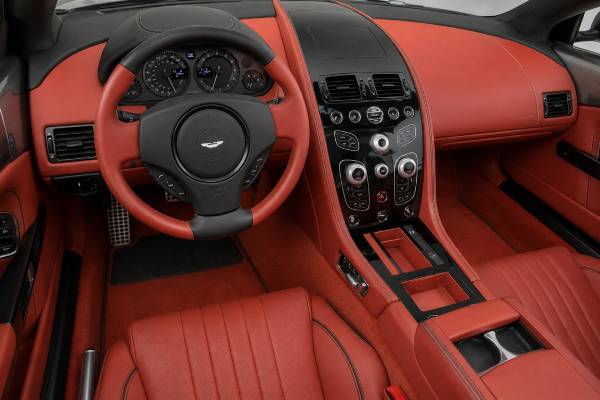
The Aston Martin DB9 GT is the final and most powerful production coupe in the DB9 line. Its 5.9-litre AM11 V12 develops 540 bhp, the exterior carries model-specific black details and GT badging, the cabin gains dedicated trim, and the sports exhaust gives the last car a more assertive voice. Underneath, it uses the mature 2013-on package of a bonded-aluminium structure, six-speed Touchtronic 2 rear transaxle, carbon-ceramic brakes, and three-stage adaptive damping.
Built for the 2015–2016 closing phase, the GT is desirable because it represents the end of a 12-year model story rather than because it is a completely different platform. That makes authenticity and condition especially important. Ordinary DB9s can be dressed with GT wheels, badges, lamps, or black trim, while a genuine GT can still be a poor purchase if its ceramic discs, dampers, tyres, battery, cooling system, or body repairs have been neglected. This guide explains what is truly GT-specific, how it should drive, what ownership demands, and how to verify a car before paying a final-edition premium.
Table of Contents
- The DB9 GT as the Final Coupe
- GT Specifications in Detail
- Where the Extra 30 hp Comes From
- GT Chassis, Brakes, and Road Behaviour
- Identifying an Authentic DB9 GT
- Maintaining the Last-Generation Hardware
- Collectability, Inspection, and Purchase
The DB9 GT as the Final Coupe
The DB9 GT is best understood as a factory-developed send-off for the existing AM11 car, not as a separate successor. It adds power, sound, identifying details, and late-production equipment while retaining the core six-speed transaxle and VH platform.
By the time the GT appeared, the DB9 architecture had undergone continual refinement since 2004. The 2013 redesign had already introduced the stronger body, AM11 engine, carbon-ceramic brakes, 20-inch wheel package, and three-stage adaptive damping. The GT builds on that mature base and raises maximum output from 510 to 540 bhp. Torque remains 620 Nm, and the power peak moves to 6,750 rpm.
Aston Martin positioned the car as the most potent standard DB9, quoting 0–60 mph in 4.4 seconds and 0–100 km/h in 4.5 seconds. Maximum speed remains 183 mph. Those figures place it above the regular AM11 car, but the appeal is not a transformative straight-line difference. The GT feels like a sharper final calibration of a familiar grand tourer: stronger at the top end, louder through its sports exhaust, and more distinctive in presentation.
Exterior identifiers include a gloss-black front splitter and rear diffuser, black-edged or darkened rear lamps, graphitic exhaust tailpipes, V12 badges on the front wings, a GT badge on the rear deck, and unique 20-inch wheels. Colour and option choices could alter the visual effect, and some markets received special packages. Genuine identity should therefore come from the VIN and factory build record, not from a checklist of parts that can be purchased separately.
Inside, the GT carries embroidered badging, model-specific seat treatment, and an engraved fuel-filler cap. A coupe commonly has an Alcantara-trimmed steering wheel, while specification can vary with options and market. The later AMi II infotainment system offers a more developed interface than earlier DB9 installations, but it still belongs to a car conceived before modern touchscreen dashboards.
The GT remains a 2+2 with token rear accommodation. Its strengths are front-seat comfort, a useful coupe boot, long-distance stability, and the sense of occasion created by the naturally aspirated V12. It is more luxurious and substantial than a lightweight sports car and should be assessed against that brief.
Production rarity can support desirability, but numbers quoted by sellers are often market-specific, confused with special editions, or unsupported. What matters first is whether the vehicle is a genuine factory GT, then whether its condition and history justify a premium over a standard 510 bhp DB9.
GT Specifications in Detail
The GT is a naturally aspirated, rear-wheel-drive coupe using the AM11 V12 and six-speed Touchtronic 2 automatic transaxle. Its power calibration and GT equipment are unique, while its brakes, damping layout, dimensions, and basic driveline closely follow the 2013-on DB9.
| Specification | Value |
|---|---|
| Engine | AM11 5,935 cc all-alloy naturally aspirated V12 |
| Valvetrain | Four overhead camshafts, 48 valves, dual variable camshaft timing |
| Maximum power | 540 bhp (403 kW; 547 PS) at 6,750 rpm |
| Maximum torque | 620 Nm (457 lb-ft) at 5,500 rpm |
| Fuel delivery | Electronic sequential multi-point injection |
| Engine layout | Longitudinal front-mid-mounted |
| Drive | Rear-wheel drive |
| Specification | Factory figure |
|---|---|
| Transmission | Touchtronic 2 six-speed automatic rear transaxle |
| Final-drive ratio | 3.46:1 |
| Differential | Limited-slip |
| Propeller shaft | Carbon fibre in aluminium torque tube |
| 0–60 mph | 4.4 seconds |
| 0–100 km/h | 4.5 seconds |
| Maximum speed | 295 km/h (183 mph) |
| Specification | Value |
|---|---|
| Structure | Bonded and riveted aluminium VH architecture |
| Suspension | Independent double wishbones front and rear |
| Damping | Adaptive system with Normal, Sport, and Track modes |
| Front brakes | 398 mm carbon-ceramic discs; six-piston calipers |
| Rear brakes | 360 mm carbon-ceramic discs; four-piston calipers |
| Front wheels and tyres | 8.5J × 20; 245/35 ZR20 |
| Rear wheels and tyres | 11J × 20; 295/30 ZR20 |
| Measurement | Value |
|---|---|
| Length | 4,720 mm |
| Width including mirrors | 2,061 mm |
| Height | 1,282 mm |
| Wheelbase | 2,740 mm |
| Kerb weight | 1,785 kg |
| Fuel capacity | 78 litres |
| Seating | 2+2 |
| Measurement | Published figure |
|---|---|
| Combined consumption | 14.0 L/100 km |
| CO₂ emissions | 325 g/km |
| North American estimate | 12 mpg city / 18 mpg highway |
| Fuel requirement | Premium unleaded |
The GT did not adopt the later eight-speed automatic used by the second-generation Vanquish. That distinction matters because advertisements sometimes imply that every final Aston V12 used the same transmission.
Where the Extra 30 hp Comes From
The GT’s extra output comes from factory calibration and breathing development of the AM11 V12, with peak power delivered at a higher engine speed. Torque is unchanged, so the car’s clearest advantage appears when the driver uses the upper rev range.
The AM11 already included dual variable camshaft timing, revised cylinder heads, larger throttle bodies, improved intake flow, and an uprated fuel system. In GT form, Aston Martin extracted 540 bhp at 6,750 rpm while retaining 620 Nm at 5,500 rpm. This shifts the emphasis toward sustained acceleration rather than a larger low-speed shove.
From idle through ordinary traffic, a well-maintained GT should be smooth and tractable. It does not need constant revs to move cleanly. As the tachometer climbs, throttle response remains direct and the sports exhaust gives the final car a more pronounced voice. The effect is progressive, allowing the driver to sense the engine’s effort rather than waiting for boost.
The six-speed automatic can leave the V12 in its broad mid-range in Drive. For the full GT character, the paddles are more useful: select a lower ratio before turn-in, hold it through the bend, and let the engine reach its higher power peak. The fixed column paddles remain in the same place as the steering wheel turns, which some drivers prefer and others need time to learn.
Gearbox behaviour should be judged by consistency. Selection from Park to Drive or Reverse should be prompt, parking-speed creep should be controlled, and shifts should not flare or strike. Test the car cold and hot because fluid temperature can expose issues absent at the beginning of a demonstration. A slower shift than a modern dual-clutch transmission is normal; a warning, loss of drive, or changing behaviour is not.
The sports exhaust should sound even from both sides and remain free of metallic rattles. Check valves, actuators, hangers, heat shields, joints, and tailpipe condition. Aftermarket exhaust changes can be enjoyable, but they affect originality and may create drone or warning issues. A seller claiming a factory system should be able to support it through the build specification and recognizable components.
Engine inspection starts cold. Listen for persistent mechanical noise, watch for smoke, and confirm a stable idle. Once fully warm, use progressive load and a safe high-rpm pull, then perform a hot restart. Scan for misfire counts and stored faults. Ignoring a misfire risks catalyst damage, and the GT’s badge does not make ordinary ignition or fuel-system maintenance optional.
GT Chassis, Brakes, and Road Behaviour
The GT remains a grand tourer first: stable, communicative, and capable of carrying speed without the nervousness of a lightweight track car. Its best chassis setting depends on the road, and the hardest mode is not automatically the fastest.
Normal mode should provide controlled compliance. The body may move over a long crest, but it should settle once. Sport adds support for faster direction changes and braking. Track is firmest and works best on smooth surfaces; on a broken road it can reduce tyre contact and comfort. During a test, each mode should create a noticeable, coherent change without warnings or one corner behaving differently.
Hydraulic steering gives the GT a natural build-up of effort. Wide tyres and the long wheelbase make it stable at speed, yet it should still turn accurately. Tramlining, steering-wheel vibration, pull under braking, or an inability to hold a straight path suggests tyre, wheel, geometry, bush, or damage issues.
The carbon-ceramic brakes are a key part of the car’s performance and value. Their large front discs and six-piston calipers provide repeated stopping capacity while reducing rotating and unsprung mass. On the road, the pedal should be firm and deceleration easy to meter. Low-speed noise can occur, but vibration, grinding, or a pedal that changes after several stops needs investigation.
Disc assessment should be performed by someone familiar with carbon-ceramic systems. Inspect both faces and edges for chips, deep scoring, heat damage, or contamination. Use the manufacturer’s approved wear criteria, which may include mass or indicators rather than ordinary thickness measurement alone. Request a written estimate of remaining life because replacement cost materially affects the car’s value.
The 20-inch wheels are vulnerable to pothole damage. Inspect inner barrels for cracks, repairs, and buckling. Tyres should match, carry the correct ratings, and be recent enough to retain grip. Deep tread on old rubber is not a benefit. Inner-shoulder wear can expose geometry or suspension deterioration that is invisible from beside the car.
Bushes, ball joints, links, and adaptive dampers operate under significant load. Gradual wear makes the car feel less special long before it becomes undriveable. The correct GT should feel cohesive: steering response, body control, braking, and rear-axle traction should happen as one sequence. A loose or unsettled example needs mechanical investigation, not a claim that all DB9s feel heavy.
Identifying an Authentic DB9 GT
The VIN and factory build record are the decisive evidence of GT identity. Badges, wheels, black trim, clear or darkened lamps, exhaust tips, and embroidered seats can all be installed after production.
Begin with the chassis number and obtain a build specification from an Aston Martin dealer or recognised heritage source. It should identify the model as a DB9 GT and list exterior colour, interior scheme, options, market, and production details. Compare that record with the car rather than asking the car to prove the paperwork.
Factory exterior cues generally include a gloss-black splitter and diffuser, black-bordered rear lamps, graphitic tailpipes, front-wing V12 badges, GT rear badging, and dedicated wheels. Examine the quality and positioning. Poor adhesive, incorrect fonts, drilled panels, mismatched finishes, or recently replaced parts may indicate conversion or repair. Legitimate factory parts can also have been renewed after damage, so invoices are valuable.
Inside, look for GT embroidery, the correct seat and trim treatment, model-specific sill or plaque details where fitted, and the engraved fuel cap. The coupe’s Alcantara steering wheel is a useful cue, but options, retrimming, and market specification can complicate it. A worn original wheel may have been replaced with leather; that does not erase the car’s identity but should be documented.
AMi II infotainment is associated with the final cars. Confirm that menus, audio, navigation, Bluetooth-related functions, and controls operate. An earlier centre stack does not automatically prove fraud if parts were replaced, but it warrants explanation. Likewise, aftermarket smartphone integration should be inspected for clean installation and retention of factory functions.
Check the engine designation and output through records rather than attempting to infer power from sound. Software tunes on a 510 bhp DB9 do not create a factory GT. Conversely, a genuine GT returned to standard after an aftermarket calibration may still require evidence that the engine management, exhaust, and emissions equipment are correct.
Special colours or limited packages can add another layer. Seller claims about “one of one” status should be supported by a factory record that defines the market and combination. Rarity alone does not guarantee desirability; unusual colours, non-original retrimming, or missing special components can narrow the buyer pool.
Authenticity also includes continuity. Original books, both glass keys, service invoices, factory accessories, windscreen labels, tools, and sales documents contribute to confidence. None should outweigh mechanical condition, but together they make a final-edition car easier to understand and resell.
Maintaining the Last-Generation Hardware
The GT needs annual service even when it is preserved as a low-mileage car. Time affects fluids, tyres, batteries, seals, and electrical contacts, while infrequent short journeys can be harder on the V12 than regular long-distance use.
Confirm the official schedule for the VIN and market. Oil and filter service, broad visual inspection, and diagnostic scanning form the yearly baseline. Brake fluid, coolant, filters, spark plugs, transaxle and differential lubricants, and auxiliary items should appear at the required time or mileage. Itemised invoices are more useful than a stamp because they reveal what was actually completed.
Battery care is one of the cheapest forms of prevention. Use an approved maintainer during storage, then periodically load-test the battery and verify charging output. Repeated low voltage can generate unrelated warnings, upset window or lock calibration, and complicate diagnosis. Check grounds and connections before replacing an expensive control module.
Cooling performance should be observed in traffic, not only during a quick road test. Inspect radiator faces, fan operation, coolant condition, hoses, joints, and any history of topping up. Oil seepage should be traced with attention to the undertrays, which can conceal evidence. A clean engine bay directly before sale deserves a second look after heat soak.
Carbon-ceramic brake care includes correct pads, compatible cleaning products, fresh fluid, and protection from impact during wheel service. Ask workshops to use suitable lift points and torque procedures. Wheel removal by an inexperienced tyre shop can damage discs, calipers, wheels, or fasteners before the car even returns to the road.
Adaptive damper faults can be electronic, hydraulic, or mechanical. A scan should be combined with leakage inspection and a drive in each mode. Suspension joints and alignment must be assessed with the tyres because one can mask the other. Replacing old tyres without correcting worn bushes leads to rapid repeat wear.
The interior needs protection from heat and sunlight. Alcantara becomes polished when handled with oils or harsh cleaners, leather can shrink, and gloss trim scratches easily. Use correct materials and avoid over-restoration that removes original texture. Store both keys safely and operate all electrical systems during routine exercise.
Recall status remains VIN-specific. The wider automatic DB9 population was involved in campaigns concerning Park-pawl software, and earlier production periods included other actions. A late production date makes some earlier recalls unlikely, but only an official check establishes that no campaign is outstanding.
Collectability, Inspection, and Purchase
Treat collectability as a reason for stricter due diligence, not as permission to overlook use and maintenance. The best long-term GT is authentic, mechanically ready, cosmetically honest, and supported by records that another buyer can understand later.
Start by confirming factory identity and specification. Compare VIN, build sheet, colour, trim, badges, wheels, lighting, exhaust, interior details, and infotainment. Resolve inconsistencies before negotiating. A genuine but modified GT may still be desirable, but value it as the car it is rather than as an untouched reference example.
Build a service timeline. Look for annual oil service, brake-fluid replacement, coolant, plugs, battery history, tyre dates, carbon-ceramic assessments, damper or bush work, transmission care, air conditioning, and recall checks. Long storage should be accompanied by evidence of battery support, dry conditions, and recommissioning—not merely low mileage.
Inspect paint in direct and reflected light. Aluminium-panel repairs can show waves, metallic mismatch, edge build-up, or bubbling. Check the underside for front-splitter damage, crushed lift points, scraping, missing fasteners, and repairs around wheel arches. A professional paint-depth survey can help, but material differences and factory hand finishing require informed interpretation.
A specialist pre-purchase inspection should include a cold start, module scan, charging test, fluid-leak review, cooling assessment, transmission operation, damper modes, suspension play, wheel condition, tyre age, brake-disc life, body and underbody inspection, and recall status. Ask the inspector to separate immediate safety work, near-term maintenance, and optional cosmetic correction.
Drive the car for enough time to reveal heat-related problems. Use parking manoeuvres, urban shifts, uneven roads, open acceleration, repeated braking, and a hot restart. Operate every cabin function after the drive. The car should not develop warnings, smells, coolant movement, transmission changes, or a rough idle.
Decide whether the car will be used, displayed, or both. A delivery-mileage example may command a particular premium but can need recommissioning and may discourage use. A well-maintained higher-mileage GT can offer greater enjoyment and clearer evidence that systems operate. There is no universal best mileage; there is only a condition and history appropriate to the price and intended ownership.
Keep a reserve for first-year work and insure the car on terms that reflect replacement value and specialist repair. Store it dry, maintain the battery, and drive it far enough to reach full operating temperature. Mechanical preservation and enjoyment do not have to be opposites.
The DB9 GT matters because it closes the original Gaydon grand-tourer era with its most developed factory specification. It is not the fastest later Aston Martin and does not need to be. Its value lies in combining the timeless DB9 shape, a naturally aspirated V12 at its highest production output, hydraulic steering, and mature chassis hardware. Buy the evidence, not the badge, and the final coupe earns its premium.
References
- Aston Martin DB9 | Past Models | Aston Martin (UK) | Aston Martin UK 2026
- DB9 – 2026 (Historic Model)
- POWER. BEAUTY. SOUL. 2016 (Factory Brochure)
- Owner’s Guides | Car Ownership | Aston Martin (UK) | Aston Martin UK 2026
- Gas Mileage of 2015 Aston Martin DB9 2015 (Government Fuel Data)
- Park Pawl may not Engage, Allowing Vehicle to Move 2017 (Recall Database)
Disclaimer
This article supplies general research and inspection guidance; it cannot authenticate, appraise, diagnose, or certify an individual DB9 GT. Confirm model status, factory equipment, maintenance requirements, and recall completion from the VIN and applicable official records, then use a qualified Aston Martin specialist for technical decisions.
Share the guide on Facebook, X/Twitter, or another platform when it adds value to your research. That simple action helps other enthusiasts find detailed model information.