
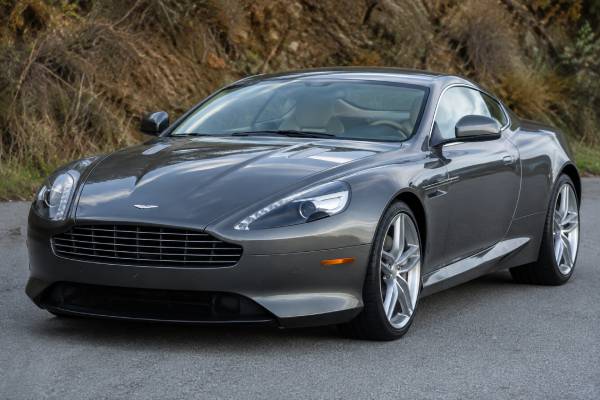
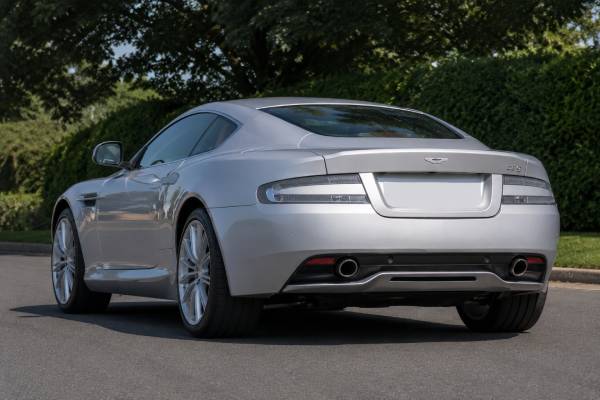
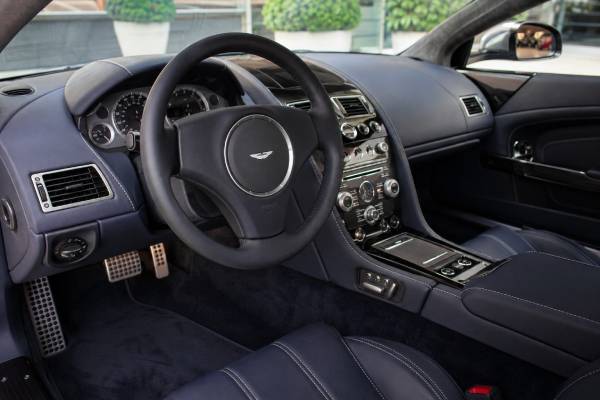
The 510 hp Aston Martin DB9 is more than a late facelift. Introduced for the 2013 model year, it combines the cleaner DB9 identity with major ideas from the Virage and DBS: the AM11 V12, carbon-ceramic brakes, three-stage adaptive damping, wider 20-inch rear wheels, and a substantially reworked body and structure. It is faster and more controlled than the 470 bhp car while remaining a civilised grand tourer rather than an overt track special.
This guide covers the AM11 coupe sold from the late-2012 introduction through the arrival of the 540 bhp DB9 GT in 2015. All standard cars use the six-speed Touchtronic 2 automatic; there is no factory manual in this generation. Identification still matters because registration dates can blur the transition from the 470 bhp model and into the GT. Buyers should also look beyond the appealing carbon-ceramic brake specification. Battery condition, damper operation, transmission behaviour, cooling, oil leaks, tyres, electronics, body repairs, and documented servicing determine whether a car is ready to use or merely inexpensive to buy.
Table of Contents
- Why the 2013 DB9 Is a Major Revision
- AM11 Specifications and Factory Figures
- Engine, Transaxle, and Performance Delivery
- Carbon-Ceramic Brakes and Three-Stage Damping
- Cabin, Technology, and Everyday Use
- Maintenance, Risks, and Recall Checks
- Selecting the Right 510 hp Coupe
Why the 2013 DB9 Is a Major Revision
The AM11 DB9 is the most comprehensively re-engineered standard coupe in the model’s life. It preserves the aluminium VH architecture and front-mid-engine/rear-transaxle layout, but changes the engine, braking system, damping, wheels, body panels, aerodynamics, and structural detail.
Aston Martin introduced this version after the short-lived Virage, absorbing much of that car’s positioning and technical content into a single DB9 range. The exterior remained recognisably DB9, yet almost every visible surface was reconsidered. The nose gained a larger grille and a more pronounced lower intake, the bonnet and front wings were revised, the side strakes became more assertive, and the rear treatment incorporated a more integrated spoiler profile and diffuser. The body was also slightly longer than before.
The aluminium structure was strengthened, with Aston Martin citing a roughly 20 percent increase in coupe rigidity compared with the previous DB9. Greater stiffness gives the suspension a more stable platform, which helps both ride and steering precision. It also matters as the car ages: a sound shell allows the dampers and bushes to do their intended work rather than compensating for movement elsewhere.
The AM11 V12 raised output to 510 bhp and torque to 620 Nm. Changes included revised block and cylinder-head details, dual variable camshaft timing, larger throttle bodies, an uprated fuel pump, altered intake paths, and combustion-chamber work. The power peak moved to 6,500 rpm and torque to 5,500 rpm, making the engine feel more willing at the top end while preserving the broad response expected of a large naturally aspirated unit.
A six-speed Touchtronic 2 automatic is the only transmission. By 2013 the absence of a manual simplified the range but removed one reason some buyers favour 470 bhp cars. The automatic uses a rear transaxle, a carbon-fibre propeller shaft, and a limited-slip differential. It is not as fast-shifting as the later eight-speed system in the Vanquish, yet it suits the DB9’s long-legged character.
Standard carbon-ceramic brakes and three-stage adaptive damping are central to the redesign. They reduce unsprung mass, increase heat capacity, and give the driver Normal, Sport, and Track damper settings. These features improve capability but introduce ownership questions that do not apply in exactly the same way to earlier steel-braked cars.
AM11 Specifications and Factory Figures
The 510 hp DB9 is a naturally aspirated petrol coupe with rear-wheel drive, a front-mid-mounted V12, and a rear six-speed automatic transaxle. Its larger wheels and carbon-ceramic brakes distinguish it mechanically from the 470 bhp model as clearly as the engine output does.
| Specification | Value |
|---|---|
| Engine | AM11 5,935 cc all-alloy naturally aspirated V12 |
| Valvetrain | Four overhead camshafts, 48 valves, dual variable camshaft timing |
| Maximum power | 510 bhp (380 kW; 517 PS) at 6,500 rpm |
| Maximum torque | 620 Nm (457 lb-ft) at 5,500 rpm |
| Fuel system | Electronic sequential multi-point injection |
| Engine position | Longitudinal front-mid-mounted |
| Fuel | Premium unleaded |
| Specification | Factory figure |
|---|---|
| Transmission | Touchtronic 2 six-speed automatic rear transaxle |
| Final-drive ratio | 3.46:1 |
| Differential | Limited-slip |
| Propeller shaft | Carbon fibre inside an aluminium torque tube |
| 0–100 km/h (0–62 mph) | 4.6 seconds |
| Maximum speed | 295 km/h (183 mph) |
| Specification | Value |
|---|---|
| Front suspension | Independent double wishbones with anti-dive geometry |
| Rear suspension | Independent double wishbones with anti-squat and anti-lift geometry |
| Damping | Three-stage adaptive system: Normal, Sport, Track |
| Front brakes | 398 mm carbon-ceramic discs, six-piston calipers |
| Rear brakes | 360 mm carbon-ceramic discs, four-piston calipers |
| Front wheels and tyres | 8.5J × 20; 245/35 ZR20 Pirelli P Zero |
| Rear wheels and tyres | 11J × 20; 295/30 ZR20 Pirelli P Zero |
| Measurement | Value |
|---|---|
| Length | 4,720 mm |
| Width including mirrors | 2,061 mm |
| Height | 1,282 mm |
| Wheelbase | 2,740 mm |
| Kerb weight | 1,785 kg |
| Fuel capacity | 78 litres |
| Seating | 2+2 |
| Measurement | Published figure |
|---|---|
| Combined consumption | 14.3 L/100 km |
| CO₂ emissions | 333 g/km |
| North American estimate | 13 mpg city / 19 mpg highway |
The data should be read as model identification and comparison information, not as a promise that every market car has identical equipment. Wheels, trim, audio, seats, and special-edition content can vary, while real fuel use depends heavily on traffic and journey length.
Engine, Transaxle, and Performance Delivery
The AM11’s advantage is not a large reduction in acceleration time; it is a more energetic response across the upper half of the rev range and a stronger sense that the engine, damping, and brakes belong to one developed package.
At low speed, the V12 remains tractable and smooth. The greater throttle area and revised cam control do not make it temperamental in traffic. Apply more accelerator and the engine builds force in a clean, uninterrupted sweep. Its 510 bhp peak arrives 500 rpm higher than the AM09’s, rewarding the driver for holding a gear rather than relying only on torque.
The Touchtronic 2 transmission has conventional torque-converter smoothness during parking and urban use. In automatic mode it generally keeps the engine relaxed; the column-mounted paddles allow earlier downshifts and greater control on a winding road. Shift time is visibly slower than in a modern dual-clutch or eight-speed automatic, but healthy period operation should still be consistent. Flared shifts, delayed Drive or Reverse, harsh engagement, and fault messages need diagnosis.
The 3.46 final-drive ratio is shorter than that of the previous automatic, contributing to response. The rear transaxle and torque tube remain important to balance and driveline rigidity. Listen for clunks when taking up drive, vibration under load, or noise that changes between acceleration and overrun. Some driveline movement is normal, but a specialist should judge anything pronounced.
Factory acceleration of 4.6 seconds to 100 km/h is still brisk, yet the car’s speed is deceptive. The long bonnet, refined cabin, and progressive engine can make the road rate feel lower than it is. Drivers need to read the speedometer rather than rely on noise or drama. The 183 mph top speed is lower than the 470 bhp car’s published 190 mph despite greater power, reflecting gearing, aerodynamic specification, and the way Aston Martin positioned the revised model rather than a lack of performance.
A cold start is one of the most revealing inspection moments. The engine should fire quickly, settle to an even idle, and clear any brief condensation without persistent coloured smoke. Warning lights should complete their normal check. After warm-up, test light throttle, sustained load, full-load response when safe, overrun, and a hot restart. Misfires can damage catalysts, so rough running should not be dismissed as stale fuel without evidence.
Cooling performance must be evaluated in traffic and after a demanding drive. Fans should operate and temperature should remain stable. Inspect for dried coolant, pressure loss, hose deterioration, and radiator contamination. Oil seepage may be hidden by undertrays; the source and quantity are more important than a seller’s reassurance that all V12s leak.
Carbon-Ceramic Brakes and Three-Stage Damping
The standard carbon-ceramic brakes are a major performance benefit and a major inspection priority. They resist fade and reduce unsprung mass, but replacement costs make casual visual assessment unacceptable.
The front system uses 398 mm discs and six-piston calipers; the rear uses 360 mm discs and four-piston calipers. In normal road use, a healthy system should have a firm, predictable pedal and strong deceleration. Some noise at low speed or when cold can occur, but grinding, pulling, vibration, a changing pedal, or warning messages require investigation.
Carbon-ceramic discs should be assessed for physical damage, remaining life, and correct history. Look for chips at the edges, impact marks, deep scoring, abnormal surface change, heat damage, and evidence of incompatible cleaning chemicals. Disc mass or the approved diagnostic method may be needed to judge wear; thickness alone is not always sufficient. Ask the inspecting specialist to document disc condition and estimated remaining service life.
Pad choice and installation matter. Incorrect compounds can produce poor feel or damage expensive discs. Wheels should be removed if necessary to inspect inner faces and calipers. Brake fluid remains a time-based service item even when the friction hardware is advanced. Cars used only gently can still have old, moisture-laden fluid.
The adaptive damping system offers Normal, Sport, and Track settings. Normal should remain composed rather than loose, Sport should reduce body movement without making the car crash, and Track is intended for the smoothest surfaces and most aggressive use. The button is not proof of operation. Test each mode on a suitable road and check for warnings, leakage, uneven response, or a corner that continues to oscillate.
Twenty-inch wheels and wide 295-section rear tyres increase grip but make tyre condition and geometry more influential. Check inner shoulders, sidewall damage, date codes, repairs, and matching specification. Old tyres can make the car noisy and brittle; incorrect pressures can disguise or exaggerate damping problems. Buckled wheels may produce speed-dependent vibration that balancing cannot solve.
Suspension bushes and ball joints wear gradually. The car may still pass a basic roadworthiness test while losing the precision that distinguishes the AM11 chassis. Ask for a lever inspection, not only a visual glance. If significant components are renewed, a full alignment by a workshop familiar with Aston Martin settings should follow.
Cabin, Technology, and Everyday Use
The 510 hp DB9 is comfortable enough for regular touring, but its infotainment and packaging reveal the age of the platform. Buy it for the driving environment, materials, and V12—not because its electronics compete with a current luxury car.
The driving position is low, the bonnet is visible, and the fixed paddles remain in place as the wheel turns. Front-seat comfort is generally excellent when the seat motors, memory, heating, and lumbar functions work correctly. Rear seats are highly restricted and better used for bags or occasional children. The boot accepts touring luggage more readily than the Volante’s, especially when soft cases are chosen.
Aston Martin’s glass Emotion Control Unit inserts into the centre console to start the car. Both keys should be present and fully functional. Replacement and programming can be inconvenient, and chipped glass is not merely cosmetic. Test central locking, door-handle deployment, boot and fuel releases, alarm functions, and the emergency access provisions described in the owner information.
Navigation, audio, Bluetooth capability, and console design vary with model year and options. The original interface can be slow by modern standards. Judge whether it operates as designed rather than whether it feels current. Aftermarket conversions may improve connectivity but can introduce trim damage, battery drain, poor sound integration, or lost factory functions if installed badly.
Climate control must cool promptly and regulate both sides. Weak performance may involve refrigerant loss, condensers, compressors, sensors, or control faults. Test heated screens and demisting because a car used only in dry weather may hide deficiencies until a wet trip.
Interior condition strongly affects value. Leather can shrink around the dashboard and binnacle, seat bolsters wear, headlining can loosen, and gloss surfaces scratch. Check for mismatched retrimming, loose stitching, odour, water staining, and damaged seatbelt guides. Repair quality matters more than absolute originality when the work is documented and visually correct.
The car is wide at more than two metres including mirrors, and the doors need space. Parking sensors should work reliably. The low nose and long overhang are vulnerable to ramps, kerbs, and careless recovery. Inspect the splitter, undertrays, wheel arches, and front substructure rather than judging the car only at eye level.
Maintenance, Risks, and Recall Checks
Annual specialist attention is the safest ownership pattern, regardless of mileage. The objective is to preserve systems before they fail, not merely change oil after a warning appears.
Confirm the service interval and operations for the exact market and VIN through official owner information. At minimum, expect yearly oil and filter service, a broad physical inspection, a diagnostic scan, and time-based fluid work. Brake fluid, coolant, spark plugs, transaxle lubricant, differential service, filters, and auxiliary items should have documentary support appropriate to age and mileage.
Battery management remains fundamental. These cars can display unrelated warnings when voltage falls, and prolonged storage can shorten battery life. Use an approved maintenance charger, but test capacity and charging output rather than assuming a plugged-in car has a healthy electrical system. Inspect grounds and terminals before authorising module replacement.
Look for oil around engine joints, coolers, hoses, the transaxle area, and undertrays. Identify whether residue is old or active. Check coolant concentration and condition, fan operation, hoses, and evidence of overheating. The AM11 is robust when maintained, but the number of cylinders and tight packaging make access and diagnosis more labour-intensive than on an ordinary car.
Transmission service history and behaviour should be assessed together. A fluid labelled long-life is not an excuse to ignore leaks, contamination, harshness, or age. Specialist advice may differ by market and use; the key is to use the correct fluid and procedure, then verify shift quality rather than perform indiscriminate flushing.
The 2013–2014 production period intersects a safety recall concerning a transmission switch printed-circuit board on specified cars, which could cause a shift to neutral without driver input. A wider throttle-pedal lever campaign and the later Park-pawl software recall also touched portions of DB9 production. Only a VIN query can establish inclusion and completion.
Body repairs require suitable aluminium knowledge. Check paint edges, panel gaps, adhesive seams where visible, and underbody attachments. Aluminium can corrode beneath paint when coatings are damaged, while steel fasteners and brackets can rust. A repair invoice and photographs are valuable because polished paint alone cannot establish structural quality.
Selecting the Right 510 hp Coupe
The best AM11 coupe is not necessarily the lowest-mileage or most highly optioned one. It is the car with verified identity, continuous care, healthy carbon-ceramic brakes, stable electronics, and no unresolved structural or cooling questions.
Start with the VIN, build date, and factory specification. Confirm that the car is the 510 bhp AM11 model rather than a late 470 bhp car or a 540 bhp GT. GT badges, wheels, clear rear lamps, or black trim can be retrofitted, so the build record takes priority over appearance. Verify colour and trim when originality affects the price.
Read invoices chronologically and list missing operations. Useful evidence includes annual services, brake-fluid changes, coolant, plugs, transaxle or differential work, batteries, tyres, damper or bush replacement, brake measurements, air-conditioning repairs, and completed recalls. A recent dealer stamp without itemised work should not erase a five-year gap.
Commission an independent specialist inspection before discussing minor cosmetics. Request a cold start, complete scan of all modules, battery and alternator test, cooling pressure assessment where justified, oil-leak inspection, transmission test, damper check in all modes, suspension play, carbon-ceramic brake assessment, wheel and tyre inspection, underbody review, and paint/body observations.
The test drive should include rough and smooth surfaces, urban manoeuvring, steady cruising, safe full-load acceleration after warm-up, repeated braking, paddle operation, Park/Reverse/Drive selection, and a hot restart. The car should track straight and settle after one body movement. Recheck for smells, fluid drops, new warnings, or a changed idle after heat soak.
Budget a realistic reserve. Even a sound example may need old tyres replaced despite deep tread, a battery, fluids unsupported by invoices, geometry, cosmetic correction, or preventive cooling work. Carbon-ceramic brake replacement is the major low-probability/high-cost exposure, which is why a professional condition report has direct financial value.
Special editions and option combinations can influence desirability, but they should not distract from fundamentals. Carbon trim, premium audio, rare paint, and special stitching do not make a car with damaged discs or damp electronics a good purchase. Conversely, a modestly specified car with exceptional history may be the better long-term ownership proposition.
Ask how the car was actually used. Repeated short urban journeys can leave the battery depleted and the engine seldom fully warm, while occasional long tours may be mechanically kinder despite adding mileage. Storage records, charger use, tyre dates, and the pattern of annual inspection help distinguish thoughtful low use from inactivity. A seller who can explain warm-up practice, fluid checks, and recent long-distance operation provides more useful evidence than a claim that the car was “never driven in rain.”
The 510 hp DB9 occupies a useful position in the range. It has the body and chassis development of the final generation without the price premium attached to the GT name. It remains refined enough for distance, dramatic enough for an occasion, and mechanically distinctive in an era dominated by turbocharged downsizing. Secure the right example, maintain it on time, and its maturity becomes an asset rather than a layer of complexity.
References
- Aston Martin DB9 | Past Models | Aston Martin (UK) | Aston Martin UK 2026
- DB9 – 2026 (Historic Model)
- 2013 DB9 Brochure 2013 (Factory Brochure)
- Owner’s Guides | Car Ownership | Aston Martin (UK) | Aston Martin UK 2026
- Defect Information Report 2014 (Recall Documentation)
- Park Pawl may not Engage, Allowing Vehicle to Move 2017 (Recall Database)
Disclaimer
The information here is a general guide and does not replace factory procedures, a VIN-specific recall search, or inspection by a qualified technician. Equipment, figures, service requirements, and campaign coverage can change with production date and market, so verify the individual car before purchasing, servicing, or repairing it.
Please pass this article along on Facebook, X/Twitter, or another platform if it clarified the model; sharing makes in-depth buyer and maintenance information easier to discover.