
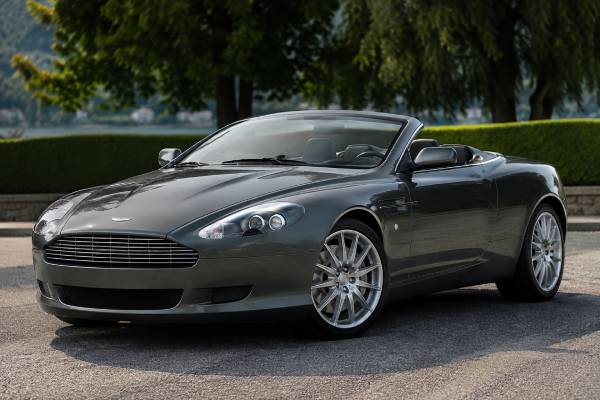
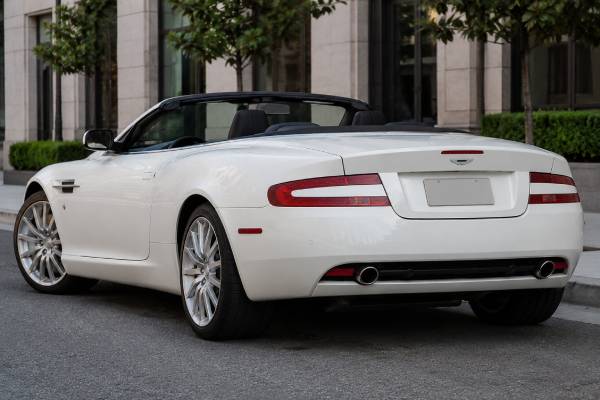
The original Aston Martin DB9 Volante turns the early DB9’s V12 grand-touring formula into a genuinely usable four-seat convertible. It is not simply a coupe with its roof removed: Aston Martin engineered additional underbody reinforcement, strengthened the windscreen surround, installed pop-up rollover protection, and packaged a power-operated fabric roof beneath a hard tonneau. The result preserves the DB9’s elegant proportions and relaxed long-distance character, although it carries more weight and gives up some structural precision to the coupe.
This guide covers the 450 bhp AM04-powered Volante built from 2005 through the early 2008 changeover. Registration year alone is not enough to identify it because later 2008 cars can have the revised 470 bhp AM09 engine and updated chassis specification. On an ageing Volante, condition matters more than mileage or colour. A healthy V12 is only one part of the purchase: the roof mechanism, drainage paths, seals, battery condition, body alignment, trim, brakes, suspension, and service history all deserve equal attention.
Table of Contents
- Why the First DB9 Volante Matters
- Volante Specifications and Packaging
- Roof, Body, and Safety Engineering
- Open-Road Performance and Comfort
- Convertible-Specific Maintenance
- Fault-Finding by System
- How to Buy a Good AM04 Volante
Why the First DB9 Volante Matters
The 450 bhp DB9 Volante is the earliest open DB9 and the version that established Aston Martin’s modern convertible design language. It combines the clean original body, a naturally aspirated V12, and a roof system that disappears beneath a solid cover rather than sitting visibly behind the cabin.
Aston Martin launched the DB9 coupe as the first series-production car from Gaydon and the first model based on its bonded-aluminium VH architecture. The Volante followed for the 2005 model year. Its purpose was not to chase the coupe’s ultimate stiffness or acceleration. It was designed as a glamorous high-speed tourer that could remain refined with the roof raised and feel special at ordinary road speeds with the roof lowered.
The 5.9-litre V12 sits behind the front axle, while the gearbox is mounted at the rear as a transaxle. A carbon-fibre shaft runs inside a rigid torque tube between them. This centralises major masses and helps the reinforced Volante retain balanced responses.
Two six-speed transmissions were offered. The Graziano manual is scarce, direct, and highly desirable to some enthusiasts, but clutch condition and correct operation are critical because replacement is labour-intensive. The ZF-based Touchtronic 2 automatic is far more common and suits the car’s easygoing personality. It can be left in Drive or controlled through steering-column paddles, and it avoids the automated-manual behaviour found in some rival exotics of the era.
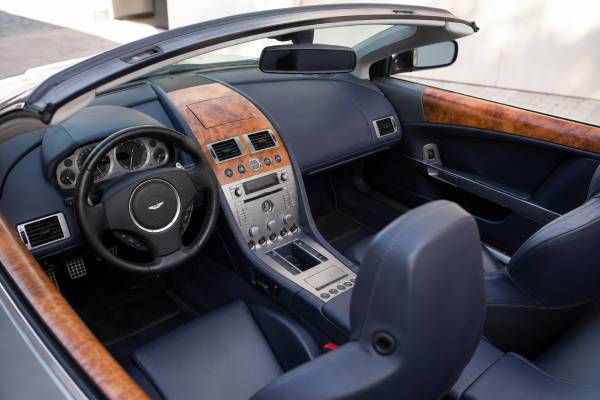
The cabin is nominally a 2+2. Adults can use the rear seats only for short trips, especially with taller occupants in front, but the seats are useful for children, coats, and soft luggage. The boot is less flexible than the coupe’s because the folded roof and its hardware occupy space behind the cabin. Buyers planning road trips should test their actual bags rather than relying on the presence of a boot lid.
Volante Specifications and Packaging
The AM04 Volante is a front-mid-engined, rear-wheel-drive petrol convertible with a rear transaxle. Its engine output matches the contemporary coupe, but added structural and roof-system mass slightly reduces acceleration and changes how the suspension works over uneven roads.
| Specification | Value |
|---|---|
| Engine | AM04 all-alloy 5,935 cc naturally aspirated V12 |
| Valvetrain | Four overhead camshafts, 48 valves |
| Compression ratio | 10.2:1 |
| Maximum power | 450 bhp (335 kW) at 6,000 rpm |
| Maximum torque | 570 Nm (420 lb-ft) at 5,000 rpm |
| Engine position | Longitudinal front-mid-mounted |
| Drive | Rear-wheel drive with limited-slip differential |
| Propeller shaft | Carbon fibre, enclosed in an aluminium torque tube |
| Specification | Six-speed manual | Touchtronic 2 automatic |
|---|---|---|
| Gearbox location | Rear transaxle | Rear transaxle |
| Final-drive ratio | 3.54:1 | 3.154:1 |
| Driver control | Conventional clutch and floor lever | Automatic modes and column-mounted paddles |
| Character | More involving and uncommon | Smoother in traffic and more widely available |
| Specification | Factory figure |
|---|---|
| 0–60 mph | 4.9 seconds |
| 0–100 km/h | 4.9 seconds manual; 5.1 seconds automatic |
| Maximum speed | 300 km/h (186 mph) |
| Fuel capacity | 80 litres |
| Roof operating time | 17 seconds |
| Seating | 2+2 |
| Specification | Value |
|---|---|
| Body structure | Bonded and riveted aluminium VH platform with convertible reinforcement |
| Front suspension | Independent double wishbones with coil springs and anti-roll bar |
| Rear suspension | Independent double wishbones with coil springs and anti-roll bar |
| Front brakes | 355 mm ventilated steel discs, four-piston calipers |
| Rear brakes | 330 mm ventilated steel discs, four-piston calipers |
| Front wheels and tyres | 8.5J × 19 wheels; 235/40 ZR19 tyres |
| Rear wheels and tyres | 9.5J × 19 wheels; 275/35 ZR19 tyres |
| Measurement | Value |
|---|---|
| Length | 4,710 mm |
| Width excluding mirrors | 1,875 mm |
| Height | 1,318 mm |
| Wheelbase | 2,745 mm |
Published figures can differ slightly by market, measurement standard, equipment, and production date. For ownership decisions, the important comparison is with the coupe: the Volante has the same powertrain and core footprint, but it is heavier, taller, less spacious in the luggage area, and structurally tuned around open-body use.
Roof, Body, and Safety Engineering
The Volante’s roof must operate smoothly, seal evenly, and stow without straining or pausing. Any reluctance is a reason to investigate before purchase, because a fault can involve adjustment, microswitches, hydraulic components, damaged trim, weakened batteries, or water-related electrical problems rather than a single inexpensive part.
The multi-layer fabric hood is electrically and hydraulically operated. When lowered, it folds behind the cabin and is covered by a hard tonneau that maintains the DB9’s clean shoulder line. The system was engineered for one-touch operation and takes roughly 17 seconds under normal conditions. Owners should follow the handbook’s operating conditions, keep the vehicle level, and avoid repeatedly cycling the roof from a weak battery.
Removing a fixed roof eliminates a major structural load path. Aston Martin responded with additional bracing in the sills and underbody, a stronger windscreen frame, and local reinforcement around the cabin. The changes make the Volante sufficiently composed for its intended use, but no reinforcement can make it identical to a coupe without a large weight penalty. On poor roads, a sound car may still show a small amount of windscreen shake or secondary body movement. Loud knocks, changing door gaps, or pronounced scuttle movement are not normal characteristics to dismiss.
Rollover protection is integrated behind the rear seats. The system uses deployable hoops designed to work with the reinforced windscreen surround. Because this is safety equipment, warning lights, damaged covers, previous accident work, or signs that the system has deployed require specialist assessment. A cosmetically repaired car may still have unresolved restraint-system faults.
Weather sealing depends on a chain of components rather than the fabric alone. The front header seal, side-rail seals, rear glass bonding, tonneau seals, door glass adjustment, and drainage routes must all work together. Frameless windows lower slightly when a door is opened and rise into the roof seal when it closes. Slow or incorrectly indexed glass can create wind noise and leaks even when the roof fabric is intact.
Drainage is equally important. Water entering the roof well is expected to be directed safely out of the body. Blocked outlets, displaced tubes, debris, or poorly repaired trim can allow moisture into carpets, control units, connectors, and sound insulation. A dry-looking cabin on a sunny sales day is not proof of a dry car. Inspect beneath removable carpet sections, around the rear bulkhead, in the boot, and along low points where moisture can collect.
Panel condition deserves unusual care because many exterior parts are aluminium or composite and repair standards vary. Look along the car in reflected light for waviness, colour mismatch, overspray, sanding marks, and uneven shut lines. Open and close both doors with the roof up and down. They should latch cleanly without needing to be lifted. Door drop can arise from worn hinges, adjustment, or previous body movement.
Open-Road Performance and Comfort
The early Volante is quick enough to feel effortless rather than frantic. Its strongest qualities are the V12’s linear response, the transaxle layout’s balance, and the way the car settles into fast, flowing roads without constantly demanding aggressive inputs.
The AM04 engine builds speed progressively. There is useful torque from low revs, but the engine becomes more urgent and vocal as it approaches its 6,000 rpm power peak. Unlike a modern turbocharged engine, it does not deliver one abrupt surge. Throttle position, engine speed, and acceleration remain closely connected, which makes the car easy to meter on a damp road and satisfying even when the driver uses only part of its performance.
With the roof raised, wind noise should be present but not overwhelming. Excessive whistling from one corner usually points to glass or seal adjustment. With the hood lowered, the wind deflector makes a substantial difference to cabin turbulence, especially for two occupants. Buyers should confirm that the correct deflector is present because replacements can be expensive and used examples are not always available in the required trim.
The automatic is the natural touring transmission. In normal use it shifts unobtrusively, and the fixed paddles let the driver select gears without turning the controls with the wheel. It is not as fast or predictive as a current multi-ratio automatic, so an unfamiliar driver may mistake normal period behaviour for a fault. Harsh engagement, delayed selection, slipping, repeated warnings, or inconsistent operation when hot are different matters and require diagnosis.
The manual changes the car’s personality. The clutch is heavier than that of an ordinary saloon, and the linkage can feel deliberate until warm, but the driver has direct control over the V12. Test for clutch slip by applying substantial throttle in a high gear at moderate engine speed; the revs should not rise independently of road speed. Also listen for driveline clunks and check that reverse and every forward gear engage cleanly.
Steering is hydraulic and communicates more road texture than later electrically assisted systems. It should feel consistent around the straight-ahead position and load progressively through a bend. Pulling, vibration, or an off-centre wheel can indicate tyre problems, alignment, worn suspension joints, damaged wheels, or previous impact repairs.
Ride quality is generally supple, but the combination of low-profile tyres, considerable mass, and ageing dampers can expose neglected cars. A good Volante controls one body movement and then settles. Repeated bouncing, knocking, nervousness over mid-corner bumps, or a floating rear end suggests wear rather than inherent convertible softness.
Braking performance remains strong when the standard steel system is healthy. Pedal travel should be consistent, and there should be no steering vibration under a firm stop. Corroded inner disc faces, seized components, old fluid, or unevenly deposited pad material can spoil braking even when the visible outer faces look acceptable.
Convertible-Specific Maintenance
A DB9 Volante should be maintained as both a V12 grand tourer and a complex weatherproofing system. Annual servicing is the minimum baseline; roof inspection, drain cleaning, battery support, and moisture checks should be part of routine ownership rather than repairs performed only after a leak appears.
Aston Martin’s period schedule calls for service at 10,000-mile or 16,000-kilometre intervals, or every 12 months, after the initial service. Low-mileage cars still need time-based attention. Oil absorbs contaminants, brake fluid takes up moisture, rubber hardens, coolant ages, and electrical contacts deteriorate whether the odometer moves or not.
At each annual service, ask the workshop to inspect the roof fabric, stitching, rear window, seals, tension straps, hinge points, tonneau movement, and visible hydraulic areas. The mechanism should be cycled while battery voltage is stable. Do not lubricate random components with a general-purpose spray; unsuitable products can attract grit, stain trim, swell seals, or interfere with sensors. Use only procedures and products appropriate to the mechanism.
Clean drains gently and confirm that water exits where intended. High-pressure air or rigid wire can disconnect or puncture a tube. A controlled water test is more useful: apply water to one region at a time, observe the exits, then inspect the interior for moisture. Repeat with the roof raised and examine the header, side glass, rear quarters, and tonneau area.
The fabric roof should be washed with a soft brush and a product intended for convertible material. Household detergents can strip protective treatment or leave residues. Bird droppings and tree sap should be removed promptly. Reproofing may be appropriate after cleaning, but it cannot repair failed stitching, delamination, damaged seals, or a leaking rear window bond.
Battery health is especially important because the roof, window drops, seats, locks, modules, and starter place substantial demands on the electrical system. A quality maintenance charger is sensible for a car used occasionally. Before condemning a control unit, a specialist should test the battery under load, charging voltage, grounds, and stored fault codes. Low voltage can produce multiple warnings that disappear after the underlying supply problem is corrected.
The V12 itself benefits from regular use and careful warm-up. Check the oil level according to the handbook and look for seepage around the engine, hoses, coolers, and undertrays. A spotless underside immediately after cleaning can conceal a leak just as easily as it can demonstrate care, so inspect after a proper drive. Cooling fans should operate correctly, temperature should remain stable in traffic, and there should be no dried coolant residue around joints or the expansion system.
Brake fluid is a time-based item; the period owner information specifies annual replacement. Coolant replacement is listed at five years, while transmission and differential service depends on gearbox type and mileage. Spark plugs have a long scheduled interval, but age, misfire history, and access labour make documentary proof valuable. A specialist familiar with DB9 service schedules can identify which jobs are genuinely due rather than treating every visit as an oil change.
Tyres should match across each axle, carry suitable speed and load ratings, and be recent enough to remain pliable. Low annual mileage often leaves impressive tread on old rubber. Check date codes, inner shoulders, sidewalls, and flat spotting. Correct geometry is essential because worn bushes or poor alignment can consume the inside edges while the outer tread looks healthy.
Fault-Finding by System
The most expensive Volantes are often those with several moderate faults rather than one catastrophic failure. Diagnose the car system by system, price each defect realistically, and assume that visible neglect may extend to areas not yet inspected.
Roof and water ingress
Operate the hood more than once and watch both sides. The tonneau should lift and close evenly, the fabric should fold without snagging, and the front should clamp without manual help. Stop if the system strains or becomes asymmetrical. Inspect the headlining for rub marks, damp patches, and evidence of previous intervention. Smell the cabin after it has been closed; mustiness is a useful warning even when surfaces feel dry.
Water can travel before becoming visible, so a wet front carpet does not always mean the leak is directly above it. Check door membranes, glass adjustment, roof seals, drains, rear-quarter areas, boot seals, and air-conditioning drainage. Moisture near electronics should be treated urgently because corrosion can continue after the carpet has dried.
Electrical operation
Test every switch with the engine running and again after a restart. Include seat movement and memory, mirrors, windows, central locking, lamps, parking sensors, climate control, navigation, audio, boot release, fuel flap, instrument display, and both remote keys. Intermittent faults are often revealed by repeated operation, heat soak, or low-voltage events.
The pop-up door handles and frameless windows should coordinate correctly. A window that fails to drop can catch the roof seal when the door opens. A handle that sticks may need cleaning, adjustment, or component replacement; forcing it can damage surrounding paint or mechanism parts.
Engine, exhaust, and cooling
Insist on a cold start. The V12 should fire promptly and settle without persistent smoke, misfire, or warning messages. Brief noises need interpretation by someone familiar with the model, but sustained knocking, heavy ticking, low oil-pressure warnings, or uneven running are not acceptable. Scan all modules even if the dashboard is clear because recently erased faults and pending codes can reveal a pattern.
Exhaust corrosion, loose shields, failed valves, and damaged hangers can create rattles. Listen from beneath the rear of the car and compare both banks. Cooling-system weakness may appear only in traffic or after a hard drive, so a short trip around the block proves little.
Suspension, brakes, and structure
Worn bushes and ball joints create knocks, vague steering, uneven tyres, and imprecise braking. Inspect dampers for leakage and springs for damage. Wheels are vulnerable to kerb impact and poor refinishing; cracks, buckles, or excessive balancing weights justify closer examination.
Look under the car for crushed lifting points, scraped reinforcement, corrosion on steel attachments, and evidence of impact. The aluminium architecture does not rust like a conventional steel shell, but it can corrode where coatings are breached or dissimilar materials meet, and structural repairs demand the correct bonding and alignment processes.
Recall and campaign checks
Recall applicability must be confirmed by VIN and market. Campaigns affecting portions of the wider DB9 population have included front lower control-arm cam bolts, battery cable routing, throttle-pedal components, and automatic-transmission Park engagement. A model-year match does not prove inclusion, and absence from a generic online list does not prove completion. Obtain written confirmation from an Aston Martin dealer or the relevant national recall database.
How to Buy a Good AM04 Volante
Buy the best-documented, driest, most consistently maintained car you can afford. A bargain price does not compensate for a failing roof, damp electronics, tired suspension, overdue servicing, and poor body repairs arriving together.
Begin by confirming identity. The build date, VIN, engine specification, and factory equipment should establish that the car is the 450 bhp AM04 version. The 2008 overlap makes this essential. Check whether the seller’s description confuses registration date, model year, and production date, and verify any claim of a rare manual transmission or special factory specification through records.
Review invoices rather than relying on stamps alone. A service book can show regular visits while revealing nothing about the jobs performed. Useful history identifies oil grade, brake-fluid changes, coolant work, plugs, transmission or differential service, batteries, tyres, brakes, suspension, roof repairs, water leaks, and recall completion. Large recent expenditure is valuable only when the work was correctly diagnosed and documented.
Inspect the car dry, then perform a controlled water test with permission. Raise and lower the roof, leave it closed long enough to check header alignment, and look at the fabric both taut and folded. Examine seals for crushing, tears, shrinking, and heavy application of silicone intended to disguise a leak. Confirm that both windows index and that the tonneau sits flush.
A pre-purchase inspection should be carried out by an Aston Martin specialist with suitable diagnostic equipment and experience of the VH platform. Ask for a written report covering fault codes, battery and charging condition, underbody, oil and coolant leaks, suspension play, brake measurements, tyre dates, body repairs, roof function, moisture, and recall status. Compression or further engine tests may be justified if the cold start, running quality, history, or scan results create doubt.
Drive the car from cold until fully warm. Use urban speeds, rough surfaces, open roads, and repeated low-speed manoeuvres. The temperature must remain stable, the steering must not pull, and no warning should appear after heat soak. Test the automatic in all modes or the manual under load. Apply the brakes firmly when safe, listen with the roof up and down, and recheck beneath the car after the drive.
Allow a substantial first-year reserve even after a clean inspection. The car may need age-related work that was not urgent at the sale date: a battery, tyres, geometry, fluids, minor seal adjustment, cosmetic refurbishment, or preventive hose replacement. Insurance and storage conditions also matter. A dry garage with battery power and enough room to open the long doors is part of sensible ownership.
The manual and automatic appeal to different buyers, but condition outranks transmission. A superb automatic is a better purchase than a tired manual bought only for rarity. Likewise, unusually low mileage is not automatically desirable if the car has sat unused, developed flat-spotted tyres, missed annual service, or spent years with a discharged battery.
The right early DB9 Volante should feel cohesive. The roof works without drama, the cabin smells dry, the V12 starts cleanly, controls operate repeatedly, and the chassis feels calm rather than loose. Found in that state, it offers something increasingly uncommon: open-air motoring with a naturally aspirated twelve-cylinder soundtrack, discreet styling, and true long-distance ability.
References
- Aston Martin DB9 | Past Models | Aston Martin (UK) | Aston Martin UK 2026
- DB9 VOLANTE – 2026 (Historic Model)
- untitled 2006 (Factory Brochure)
- Aston Martin DB9 Owner’s Manual Service Periods 2005 (Owner’s Manual)
- 10V-449 (5 Pages) 2010 (Recall Database)
- Battery Cable may Short Circuit 2017 (Recall Database)
Disclaimer
This guide is general information, not a diagnosis, valuation, or repair instruction for an individual car. Specifications, equipment, service operations, and recall eligibility can differ with VIN, production date, transmission, and sales market, so confirm them against factory information and obtain a specialist inspection before purchase or work.
Please share the article through Facebook, X/Twitter, or another platform when it is useful; that support helps detailed motoring resources reach more owners.