

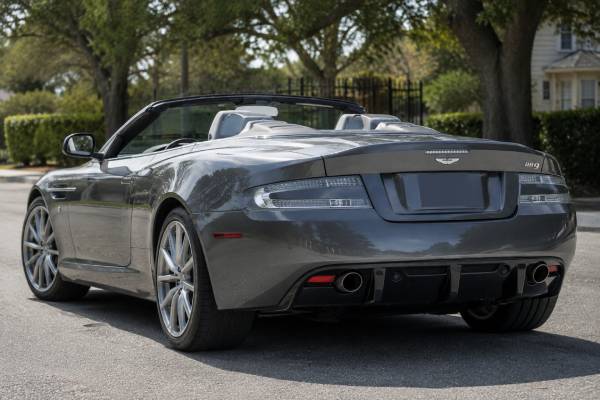
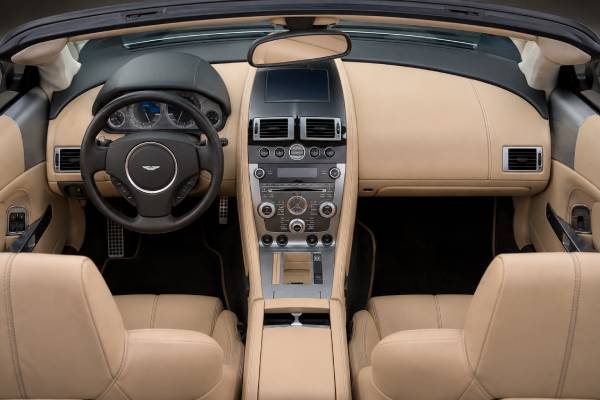
The 470 hp Aston Martin DB9 Volante combines the original open DB9 shape with the most useful mechanical development before the major 2013 redesign. Its AM09 V12 produces 600 Nm, adaptive damping gives the chassis a wider operating range, and buyers can still choose between a rare six-speed manual and the more common Touchtronic 2 automatic. It is less rigid and heavier than the coupe, yet that is not a flaw in the concept: the Volante was created for fast, comfortable, roof-down touring rather than lap times.
This guide covers cars built from the 2008 update through 2012. Registration dates overlap at both ends, so the VIN, engine specification, and factory record must confirm the version. A convincing purchase is defined by more than a smooth engine. The powered hood, window indexing, seals, drains, battery, electronic modules, body alignment, suspension, brakes, and service history all need to work as one system. A dry, correctly maintained Volante is a memorable grand tourer. A damp or electrically unstable example can become expensive before its mechanical strengths have any chance to matter.
Table of Contents
- The AM09 Volante Explained
- Performance, Dimensions, and Hardware
- How the Convertible Structure Works
- Touring Character With the Roof Up or Down
- Age-Related Care and Service
- Roof, Electrical, and Chassis Problems
- A Volante Buyer’s Decision Process
The AM09 Volante Explained
The AM09 Volante is the 470 bhp open DB9, positioned between the 450 bhp launch model and the 510 bhp 2013 car. Its appeal lies in retaining the original proportions while adding stronger performance and more sophisticated damping.
Underneath, the familiar VH architecture uses bonded and riveted aluminium sections rather than a conventional welded steel monocoque. The 5.9-litre V12 is mounted well back in the nose, and the gearbox sits at the rear as a transaxle. A carbon-fibre shaft runs inside an aluminium torque tube between them. This packaging helps offset the natural disadvantages of a large front-engined convertible by keeping major masses between the axles.
The AM09 engine develops 470 bhp at 6,000 rpm and 600 Nm at 5,000 rpm. Compared with the earlier AM04 unit, it has a higher compression ratio and revised breathing and calibration. The difference is most obvious during overtaking and at higher engine speeds. It remains progressive rather than explosive, with no turbocharger changing the relationship between the throttle and the rear tyres.
The Volante body uses reinforcement in the sills, floor, windscreen surround, and other structural areas to replace some of the load paths lost with the fixed roof. Deployable rollover hoops sit behind the rear seating area. The fabric hood folds beneath a solid tonneau in about 17 seconds, preserving the clean rear-deck line that distinguishes the car from convertibles with exposed folded material.
Adaptive damping is a meaningful advantage over the earliest Volante. It can better reconcile primary ride comfort with control of the heavier open body. Even so, it cannot eliminate every secondary movement on a rough road. A slight tremor through the windscreen is characteristic; repeated shaking, clunks, doors that move in their apertures, or a chassis that takes more than one motion to settle point toward wear, poor tyres, or damage.
The cabin has four seats in name, but rear legroom is extremely limited. The rear area is most useful for children or additional luggage. Boot capacity is reduced by roof packaging, so the car works best with soft bags. Owners who tour should regard the wind deflector, correct luggage strategy, and dry-weather storage as practical equipment rather than accessories.
Performance, Dimensions, and Hardware
This version is a naturally aspirated petrol V12 with rear-wheel drive. It shares its engine and core driveline with the contemporary coupe but carries open-body reinforcement and roof equipment, which influence acceleration, ride, and luggage space.
| Specification | Value |
|---|---|
| Engine | AM09 5,935 cc all-alloy naturally aspirated V12 |
| Valvetrain | Quad overhead camshafts, 48 valves |
| Compression ratio | 10.9:1 |
| Power | 470 bhp (350 kW; 477 PS) at 6,000 rpm |
| Torque | 600 Nm (443 lb-ft) at 5,000 rpm |
| Fuel system | Electronic sequential multi-point injection |
| Drive | Rear-wheel drive |
| Specification | Manual | Touchtronic 2 |
|---|---|---|
| Transmission | Six-speed rear transaxle | Six-speed automatic rear transaxle |
| Final-drive ratio | 3.54:1 | 3.154:1 |
| Differential | Limited-slip | Limited-slip |
| Propeller shaft | Carbon fibre in alloy torque tube | Carbon fibre in alloy torque tube |
| Driver input | Clutch pedal and floor lever | Automatic modes and column paddles |
| Specification | Published figure |
|---|---|
| 0–60 mph | 4.6 seconds |
| 0–100 km/h | 4.8 seconds |
| Maximum speed | 306 km/h (190 mph) |
| Official combined consumption | 14.8 L/100 km automatic; 16.6 L/100 km manual |
| Fuel tank | 80 litres |
| Fuel | Premium unleaded |
| Specification | Value |
|---|---|
| Structure | Bonded aluminium VH platform with Volante reinforcement |
| Suspension | Independent double wishbones front and rear |
| Dampers | Adaptive damping system |
| Front brakes | 355 mm ventilated steel discs with four-piston calipers |
| Rear brakes | 330 mm ventilated steel discs with four-piston calipers |
| Front wheels and tyres | 8.5J × 19; 235/40 ZR19 |
| Rear wheels and tyres | 9.5J × 19; 275/35 ZR19 |
| Measurement | Value |
|---|---|
| Length | 4,710 mm |
| Width excluding mirrors | 1,875 mm |
| Wheelbase | 2,745 mm |
| Roof operation | Power-operated fabric hood; 17 seconds |
| Seating | 2+2 |
| Rollover protection | Reinforced windscreen surround and deployable rear hoops |
Small published differences arise from market specification, options, transmission, and measurement method. Buyers should use the figures to identify the model, then judge the individual car through its documentation and physical condition.
How the Convertible Structure Works
The roof system, glass, seals, drains, and body reinforcement must be assessed together. A hood that opens is not necessarily a healthy convertible if it leaks, strains, sits unevenly, or depends on manual assistance.
The fabric roof uses articulated frame members and a powered mechanism to move between the windscreen header and the stowed position. When lowered, the rear tonneau opens, the hood folds into its well, and the cover closes over it. Correct operation is coordinated by switches and control logic that need stable voltage and accurate position information. One misadjusted component can stop the sequence to prevent damage.
Watch the roof from outside on both sides. Movement should be symmetrical, the fabric should fold predictably, and the tonneau should not catch painted edges or trim. The front header should seat evenly. Jerky motion, repeated pauses, hydraulic noise without movement, or a need to push one side indicates a fault that deserves diagnosis before further cycling.
Frameless side windows form part of the seal. Each glass pane should lower a small amount when its door is opened and rise into the roof seal after closing. Incorrect indexing can cause wind noise, water entry, and damage to the rubber. Window regulators, door latches, control modules, and battery condition can all influence this simple-looking action.
Water management is designed around controlled entry and exit. The outer fabric sheds most rain, but channels and drains deal with water around the roof well and body joints. Leaves, dirt, displaced tubes, or careless trim work can divert moisture into the cabin or boot. Sound insulation can hold a surprising quantity while the visible carpet feels nearly dry.
Check the front footwells, under seats where accessible, the rear-quarter area, boot floor, electronic compartments, and the space around the roof mechanism. Look for tide marks, white corrosion on terminals, green copper staining, swollen fibreboard, water-spotted leather, mould, dehumidifier residue, and a sweet or musty smell. A recently detailed cabin can hide symptoms but not always the evidence beneath it.
The aluminium body does not remove corrosion risk. Aluminium can oxidise beneath paint, especially at damaged edges and around dissimilar metal contacts. Steel brackets and fasteners can rust, and badly executed repairs can introduce galvanic problems. Panel repair requires knowledge of the original bonding and material system; ordinary body-shop methods may restore appearance without restoring structure.
Touring Character With the Roof Up or Down
The AM09 Volante is at its best on a flowing road with enough distance for the engine, damping, and cabin to settle into their work. It delivers speed with little drama, and the roof-down experience makes the V12’s progressive voice more important than the stopwatch.
At low speed, the engine is tractable and the controls are measured. As revs rise, intake and exhaust sound become richer without the abrupt step of turbo boost. The added torque gives the car stronger roll-on performance than the 450 bhp version, useful when overtaking without forcing the gearbox to select the shortest possible ratio.
The automatic suits relaxed travel. Its torque converter makes manoeuvring smooth, and Drive works well with the engine’s broad range. Paddle control is useful before a bend or on a descent, but shift speed should be judged against its era. A healthy transmission may feel slower than a modern unit while still operating correctly. Flare, shunt, delayed engagement, inconsistent hot behaviour, and warning messages are not period charm.
A manual Volante is much rarer. It requires more effort but gives the driver direct control of engine speed and load. Check clutch bite, slip, judder, release noise, and selection when cold and hot. A clutch near the end of its life can turn a desirable specification into an immediate major bill.
Roof-up refinement should be adequate for motorway travel. Listen for a localised whistle that changes when gentle hand pressure is applied near a seal; it can reveal adjustment needs. General wind noise is inevitable, but loud buffeting, flapping fabric, or water staining is not. With the roof down, the removable wind deflector greatly improves comfort for two people. Confirm it is included and that its frame and mesh are undamaged.
Adaptive damping gives the car more control than the first Volante while retaining compliance. The correct sensation is a large car that takes one smooth movement and settles. If it bounces repeatedly, crashes at one corner, steers differently left and right, or becomes nervous on rough bends, inspect dampers, bushes, ball joints, tyres, wheels, and geometry.
The brakes should feel powerful and progressive. Cars that sit can develop corrosion on hidden disc surfaces, and old fluid can lengthen or soften pedal response. Test with several stops after warming the system. Steering vibration, pulsing, pulling, or a burning smell requires investigation.
Open-top use exposes the cabin to ultraviolet light, dust, and sudden weather. Leather tops, dashboard surfaces, veneer, switchgear, and seat bolsters can age faster than in a coupe. A car that was always enjoyed roof-down may be mechanically sound but cosmetically expensive to return to a high standard.
Age-Related Care and Service
Regular time-based maintenance is more valuable than unusually low mileage. The factory service framework calls for attention every 12 months or 10,000 miles/16,000 kilometres after the initial service, and a Volante needs roof and moisture checks added to that mechanical schedule.
Engine oil and filter replacement is the baseline, not the full service. The workshop should inspect belts, hoses, fluid levels, leaks, cooling fans, exhaust, mounts, suspension, steering, brakes, tyres, battery, charging output, restraint warnings, and every roof-related function. A complete diagnostic scan should cover all accessible modules.
Brake fluid is specified as a regular time-based replacement in period owner information. Coolant has a longer interval but should not be ignored because the car has covered few miles. Spark plugs, transmission lubricant, and differential oil follow mileage and version-specific requirements. Ask for the correct schedule for the VIN and gearbox rather than applying a generic “annual service” label.
A battery maintainer is close to essential for occasional use. Connect it in the approved manner and ensure the battery itself remains healthy. A charger can mask reduced capacity: the car may start after being plugged in yet drop voltage sharply during roof operation or a hot restart. Load testing provides better evidence.
Exercise the roof regularly in suitable conditions. Leaving it untouched for months does not preserve seals or pivots. First check that the fabric and well are clean, the battery is supported, and the temperature is appropriate. Complete the cycle rather than stopping midway, and investigate any change in sound or speed.
Clean the fabric with products intended for convertible hoods and a soft tool. Aggressive pressure washing can force water past seals or damage stitching. Keep the rear glass and surrounding bond clean, treat rubber only with compatible products, and remove debris from channels before it reaches drains. Reproofing improves water beading but cannot cure a mechanical leak.
Tyres age even when tread remains. Read the date codes, inspect sidewalls and inner shoulders, and replace axle sets with matching suitable tyres. Correct pressures should be set cold. After suspension or tyre work, use a workshop able to align the car accurately; an ordinary quick toe adjustment may not correct the underlying geometry.
Storage should be dry, ventilated, and accessible enough to open the long doors without damage. Avoid leaving the car under a non-breathable cover while damp. Before seasonal storage, clean and dry the hood, stabilise the battery, check tyre pressures, and avoid applying the parking brake in a way that encourages the pads to remain stuck for months.
Roof, Electrical, and Chassis Problems
Most ownership problems become manageable when caught early. The warning signs to take seriously are moisture, repeated low-voltage events, changing roof behaviour, unstable temperature, transmission irregularity, tyre wear, and chassis noises.
Roof faults can originate in switches, sensors, wiring, hydraulic components, frame alignment, tensioning parts, tonneau movement, or a weak electrical supply. Do not keep pressing the switch after the system stops. Continuing can bend a frame member, mark paint, overheat a motor, or make diagnosis harder. Record where the sequence halted and have fault codes read.
Electrical complaints often cluster. Slow cranking, random warnings, forgotten window indexing, inoperative parking sensors, and roof refusal may share a battery or ground problem. Conversely, assuming every fault is low voltage can delay repair of water-damaged modules or broken wiring. Test supply voltage first, then diagnose each remaining issue.
Cooling problems require immediate attention. Verify stable temperature in traffic, correct fan operation, clean coolant, and absence of residue or pressure loss. Oil leaks should be traced with undertrays removed or properly inspected. Persistent misfire can damage catalysts, so a rough-running V12 should not be driven hard while waiting for a convenient service date.
The adaptive dampers, bushes, links, and joints wear gradually. Inspect both axles, not only the corner making noise. A car with new front tyres but heavy inner-edge wear may have been fitted with rubber instead of receiving the suspension repair and alignment it needed. Damper warning messages, visible leakage, or different behaviour between modes are useful clues.
Recall checks must be VIN-based. Depending on production date and market, the wider DB9 range has been subject to campaigns involving throttle-pedal components, automatic-transmission Park engagement, and other safety items. Ask an Aston Martin dealer for the outstanding-campaign status and retain written confirmation.
Cosmetic parts are not inexpensive. Pitted lamps, damaged grille bars, cracked undertrays, kerbed wheels, shrinking leather, marked veneer, and missing wind deflectors can add a large sum when corrected together. Treat condition as a financial category, not merely presentation.
A Volante Buyer’s Decision Process
The strongest purchase is the car that remains dry, works repeatedly, has chronological invoices, and passes a specialist inspection. Mileage and rarity become meaningful only after those conditions are met.
Confirm the engine version first. A 2008 registration can describe an early 450 bhp car or the AM09 update, and a late-registered car can sit outside the advertised production assumptions. Match the VIN and build date to factory or dealer data. Check that claimed options, special-edition features, and transmission type are authentic.
Read the invoices in order. Look for annual service, fluid changes, batteries, tyres, suspension work, roof adjustment, water-leak repair, brake measurements, plugs, transmission or differential service, air-conditioning work, and recall completion. A large invoice is reassuring only when it identifies the cause, parts, and result.
Inspect the hood dry, then conduct a controlled water test with the seller’s permission. Cycle it at least twice with the engine or approved support state specified by the handbook. Watch window movement, tonneau alignment, and header engagement. Leave the roof raised while checking for moisture and listen during the drive for localised air leaks.
The body should be viewed in daylight from several angles. Check metallic paint match, panel waviness, overspray, door alignment, wheel finish, underbody impact, and signs of poor lifting. Inspect around steel fasteners and panel edges for bubbling. Confirm that doors latch in the same manner with the roof up and down.
Commission an independent Aston Martin specialist, not simply the seller’s usual workshop, for the pre-purchase inspection. Request module scans, battery and charging tests, cold start, hot restart, leak checks, cooling assessment, roof and drain inspection, suspension play, brake condition, tyre ages, body-repair observations, and a VIN recall query. Cost estimates turn a descriptive report into a decision tool.
Drive for long enough to heat the engine and transmission. Use uneven roads, steady cruising, acceleration, braking, parking manoeuvres, and roof-up and roof-down running. Test climate control and every electrical function after the drive because heat soak can expose intermittent faults.
Choose transmission according to the life the car will lead. A manual offers rarity and engagement but may require a costly clutch. The automatic is common, calm in traffic, and entirely appropriate to the Volante. Condition remains the deciding factor. A carefully maintained automatic is a better grand tourer than a neglected manual purchased for future collectability.
Plan a first-year reserve for work that a pre-purchase inspection cannot date perfectly. Fluids, tyres, a battery, alignment, seal adjustment, or cosmetic repair may be prudent even on a good car. With that margin and appropriate storage, the 470 hp Volante can be used rather than feared: an elegant, naturally aspirated V12 convertible that is fast enough for modern roads and civilised enough for a long journey.
References
- DB9 VOLANTE – 2026 (Historic Model)
- Aston Martin DB9 | Past Models | Aston Martin (UK) | Aston Martin UK 2026
- THE ASTON MARTIN DB9 IS THE 2011 (Factory Brochure)
- Aston Martin DB9 Owner’s Manual Service Periods 2005 (Owner’s Manual)
- SAFETY RECALL ACTION 2014 (Recall Documentation)
- Park Pawl may not Engage, Allowing Vehicle to Move 2017 (Recall Database)
Disclaimer
This material is intended as a general ownership and buying reference, not as a substitute for workshop diagnosis, official repair information, or inspection of a specific DB9. Confirm specifications, service tasks, equipment, and safety campaigns by VIN, build date, transmission, and market before making decisions.
When this guide proves useful, please share it on Facebook, X/Twitter, or another network so other owners and buyers can find the same information.