


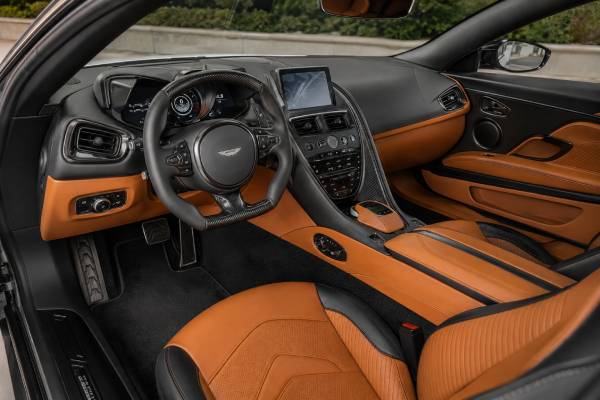
The 2023 Aston Martin DBS 770 Ultimate coupe is the final and most powerful factory version of the AM7 DBS. Its 5.2-litre twin-turbo V12 produces 770 PS, equivalent to 759 bhp, while torque remains 900 Nm. Aston Martin paired that output with faster transmission calibration, a more directly mounted steering column, increased body stiffness, unique adaptive-damper tuning, revised aerodynamics, and model-specific 21-inch wheels. The claimed top speed is 340 km/h, and production was limited to 300 coupes.
Those numbers make the car collectible, but they do not explain the whole purchase. An Ultimate must be authenticated through its VIN, factory record, numbered plaques, and original components. It also carries the normal service demands of a complex twin-turbo V12 grand tourer plus the financial risk of rare carbon-fibre, wheel, trim, and chassis-specific parts. This guide separates the 770 Ultimate from a dressed-up standard DBS, explains its engineering changes, and provides a practical framework for maintenance, inspection, and ownership.
Table of Contents
- Why the 770 Ultimate is a distinct model
- Engine, transmission, and performance data
- Steering, structure, and suspension revisions
- Aerodynamics, brakes, wheels, and tyres
- Using the Ultimate without damaging its value
- Maintenance, diagnostics, and special parts
- Authentication and pre-purchase inspection
Why the 770 Ultimate is a distinct model
The DBS 770 Ultimate is a factory-engineered finale, not a regular 715 hp DBS with a cosmetic pack. Aston Martin announced it as the fastest and most powerful DBS of the generation and capped the entire run at 499 cars: 300 coupes and 199 Volantes.
The name refers to metric horsepower. Its 770 PS rating converts to approximately 759 bhp or 566 kW. Torque stayed at the standard DBS peak of 900 Nm, but the engine’s air path, ignition strategy, turbo boost, and calibration were revised. The chassis, steering, transmission software, dampers, body details, wheels, cabin treatment, and build identification were also changed.
A genuine coupe should be supported by several layers of evidence:
- VIN and factory build data identifying DBS 770 Ultimate;
- original invoice or certificate with coupe body style and option list;
- limited-edition sill plaques numbered within the 300-coupe allocation;
- model-specific horseshoe bonnet vent, front splitter, side-sill treatment, and rear diffuser;
- original 21-inch multi-spoke honeycomb wheels or documentary evidence explaining their absence;
- Sports Plus seats and the factory Ultimate interior treatment, unless a documented option altered the seat choice;
- service records that identify the car correctly rather than as a generic DBS.
No single visual cue proves authenticity. Plaques and badges can be copied; wheels can be installed on another car; carbon pieces can be reproduced. Conversely, a genuine Ultimate may temporarily wear different wheels or have a repaired component. The conclusion must come from matching the VIN, factory record, numbered identity, equipment, and physical construction.
The coupe’s place in Aston Martin history adds another reason for precision. It was presented as the last DBS of this production line and, at launch, the most powerful production Aston Martin. Later models can change company power records, but they do not change the 770 Ultimate’s role as the AM7-generation farewell.
Buyers should also separate scarcity from condition. All 499 cars were allocated before release, yet a limited build does not guarantee careful use, correct repair, or uninterrupted maintenance. Rarity can make deferred faults more expensive because unusual parts are harder to source and originality matters more strongly at resale.
| Item | Verified detail |
|---|---|
| Model year | 2023 |
| Body covered here | Two-door 2+2 coupe |
| Total DBS 770 Ultimate production | 499 cars |
| Coupe allocation | 300 cars |
| Volante allocation | 199 cars |
| Factory status at announcement | All examples allocated before release |
Engine, transmission, and performance data
The 770 Ultimate remains a petrol-only, rear-wheel-drive grand tourer. It uses the AE31 5.2-litre twin-turbo V12 and rear-mounted ZF eight-speed automatic familiar from the DBS, but its final calibration increases peak output and sharpens the connection between engine and rear axle.
| Specification | Value |
|---|---|
| Engine layout | All-alloy, 60-degree twin-turbocharged V12 |
| Displacement | 5,204 cc (5.2 litres) |
| Valve gear | Quad overhead camshafts, 48 valves, variable cam timing |
| Maximum power | 770 PS (759 bhp; approximately 566 kW) at 6,500 rpm |
| Maximum torque | 900 Nm (663 lb-ft) from 1,800–5,000 rpm |
| Boost change | Maximum turbo boost pressure increased by 7% |
| Fuel | Premium unleaded petrol to the applicable market specification |
The additional output did not come from displacement or a larger torque headline. Aston Martin modified the air and ignition pathways, raised maximum turbo boost by seven percent, and reshaped the power and torque delivery. The practical result is greater force near the upper end of the rev range while retaining the broad mid-range that defines the standard car.
The engine’s hot-vee turbo arrangement places the turbochargers within the V, shortening exhaust routing and helping response. Water-to-air charge cooling manages intake temperature. These systems create intense heat around the engine bay, so cooling-system health, correct oil, clean heat exchangers, and complete warm-up and cool-down habits are more important than the car’s low annual mileage may suggest.
| Measure | Value | Explanation |
|---|---|---|
| Transmission | Rear mid-mounted ZF eight-speed automatic | Ultimate-specific shift calibration |
| Differential | Mechanical limited-slip differential | Mounted with the rear transaxle |
| Driven wheels | Rear | No all-wheel drive or hybrid motor |
| 0–60 mph | 3.4 seconds | Manufacturer brochure claim |
| Maximum speed | 340 km/h (211 mph) | Manufacturer claim |
A faster shift map does not mean the gearbox should be abrupt in ordinary driving. In GT mode, light-throttle changes should remain controlled and repeatable. Sport and Sport Plus increase urgency and hold gears longer. A thump when selecting Drive or Reverse, delayed engagement, inconsistent paddle response, or harsh shifts after the oil is warm deserves diagnosis rather than being excused as “Ultimate character.”
The acceleration figure should be treated as a controlled-test claim. Tyre temperature, surface, fuel load, weather, gradient, launch technique, and measurement method affect real results. More importantly, 900 Nm reaches only the rear tyres. On a cold or damp public road, traction—not engine power—is the limiting system. A progressive throttle application is faster and safer than forcing the electronics to correct a large demand.
Maximum speed is similarly a capability figure, not a road target. It depends on tyre condition and rating, correct pressure, aerodynamic integrity, suspension health, and a suitable closed environment. Damage to the splitter, underbody, diffuser, wheels, or alignment matters greatly at speeds far below the published maximum.
Steering, structure, and suspension revisions
The most meaningful Ultimate changes are beneath the headline power figure. Aston Martin increased steering connection, stiffened selected body areas, recalibrated the adaptive dampers, and retuned control software so the chassis could respond more precisely to the V12.
A solid-mounted steering column replaces the more isolated arrangement used in the standard DBS. The intent is to transmit a clearer sense of front-tyre load and surface texture. This does not mean every vibration is normal. Wheel imbalance, bent rims, tyre defects, hub runout, worn joints, or accident damage can still produce unwanted movement and should be diagnosed mechanically.
Local front-end lateral stiffness rose by 25 percent through changes that included a strengthened front crossmember. Aston Martin also specified a thicker rear shear-panel undertray, contributing to an approximately three-percent increase in global torsional stiffness. Those percentages describe particular engineering measurements; they should not be interpreted as a 25-percent increase in the stiffness of the entire car.
| Area | Factory change | Driver-facing purpose |
|---|---|---|
| Steering column | Solid-mounted installation | Greater detail and connection |
| Front structure | Enhanced front crossmember | 25% increase in local front lateral stiffness |
| Rear underbody | Thicker shear-panel undertray | Supports structural rigidity |
| Whole structure | Combined revisions | Approximately 3% greater torsional stiffness |
| Adaptive damping | Unique calibration and software tuning | Improved response without discarding GT ability |
| Transmission control | Unique calibration | Quicker shifts and stronger interaction |
The suspension still follows the AM7 layout, with front double wishbones, a rear multi-link arrangement, coil springs, anti-roll bars, and adaptive dampers. The distinction lies in calibration and the stiffer platform supporting it. A buyer should therefore avoid assuming that a standard DBS can be made equivalent through an engine tune and wheels. The factory package relies on coordinated hardware and software.
During a road test, the coupe should track cleanly, build steering effort consistently, and settle after a bump without repeated oscillation. Drive on smooth and broken surfaces. Excessive tramlining can come from tyre wear or pressure; pulling can reflect alignment, a damaged tyre, brake drag, or structural repair. Compare left and right steering response and note whether the wheel returns naturally after a bend.
Inspect every underbody brace, shield, and fixing. Because an upgraded undertray is part of the structural package, missing fasteners or impact damage should not be dismissed as cosmetic. A poor repair can alter stiffness, airflow, noise, and protection. Any evidence of grounding should lead to a closer inspection of the front substructure, cooling components, exhaust, and carbon-fibre edges.
Ride modes should create a clear but plausible change. If one corner remains unusually stiff, the car bounces, or a damper warning appears intermittently, use a complete module scan and physical inspection. Replacing parts based only on a fault code can be expensive; wiring, connectors, ride-height information, battery voltage, and software can also affect the system.
Aerodynamics, brakes, wheels, and tyres
The Ultimate’s body changes serve cooling and aerodynamic balance as well as identification. Its deeper front splitter, horseshoe-shaped bonnet vent, carbon-fibre side sills, and revised rear diffuser were developed as a connected package.
The larger bonnet opening helps remove heat from the engine bay, while the splitter improves front airflow and the diffuser balances the rear. Owners should preserve clear passages and correct panel fit. Paint-protection film must not obstruct openings or trap lifting edges near hot areas, and body repairs should restore the original geometry rather than merely matching the colour.
The unique 21-inch multi-spoke honeycomb wheels draw inspiration from Aston Martin’s Valkyrie and Victor designs. They are fitted with Pirelli P Zero tyres measuring 265/35 R21 at the front and 305/30 R21 at the rear. Verify the exact tyre specification, including load and speed ratings, rather than buying only by size.
| Component | Verified specification |
|---|---|
| Front brakes | 410 x 38 mm ventilated carbon-ceramic discs |
| Rear brakes | 360 x 32 mm ventilated carbon-ceramic discs |
| Wheels | Model-specific 21-inch multi-spoke honeycomb design |
| Front tyres | 265/35 R21 Pirelli P Zero |
| Rear tyres | 305/30 R21 Pirelli P Zero |
| Front body change | Deeper splitter and horseshoe bonnet vent |
| Rear body change | Revised diffuser for aerodynamic balance |
Carbon-ceramic brakes tolerate high temperatures and save unsprung mass relative to comparable iron discs, but they are not maintenance-free. Inspect for edge chips, surface damage, contamination, signs of impact from wheel removal, and uneven wear. Ask for the approved measurement procedure and remaining pad life. A polished sales description is not a substitute for numerical condition data.
Wheel condition matters for both safety and authenticity. Check inner and outer rims for bends, cracks, welds, refinishing, missing markings, and excessive runout. A wheel can look perfect after refurbishment yet remain structurally questionable. Repeated balancing weights or vibration at a specific road speed should prompt a wheel, tyre, hub, and alignment investigation.
Tyre age can be more important than tread depth on a low-mileage collectible. Read all four date codes, inspect inner shoulders, and look for cracking, flat spots, repairs, or mismatched production. The car’s stability systems are calibrated around a coordinated tyre set. Mixing brands, models, or substantially different ages can change breakaway behaviour.
The splitter and side sills sit low. Inspect their lower surfaces with the car raised correctly, and check the rear diffuser and floor for contact marks. A small carbon crack can spread, and a repair that is acceptable on a frequently used standard car may reduce the value of a limited Ultimate if it is undocumented or visibly non-original.
Using the Ultimate without damaging its value
The healthiest ownership strategy is controlled use, not permanent display. Regular, fully warmed journeys exercise seals, brakes, dampers, gearbox, exhaust valves, climate control, and battery charging while revealing developing faults before they become severe.
Begin each drive gently. Let oil and coolant temperatures rise under moderate load rather than idling for a long period or applying boost immediately. After sustained hard use, finish with calmer running so temperatures can stabilise. This is sensible turbocharged-engine practice, not a special ritual requiring excessive stationary idling.
Use a compatible battery conditioner when the car will stand. The Ultimate contains many control modules, and low voltage can produce communication faults, warning messages, failed start attempts, or interrupted updates. A conditioner maintains charge, but periodic capacity testing still matters. Record battery replacement and coding or registration procedures where applicable.
Protect original surfaces intelligently. High-quality paint-protection film can defend the bonnet, front bumper, splitter, sills, and rear arches, but installation quality determines whether it helps or harms. Inspect film edges, cut lines, trapped debris, adhesive lift, yellowing, and the paint beneath. Avoid drilling or irreversible mounting for trackers, cameras, or phone equipment.
Keep every removed original part. Reversible changes may still affect warranty, insurance, or value, and an engine tune is especially difficult to justify on a car whose factory calibration defines the model. Added boost or torque can alter thermal load, gearbox behaviour, emissions compliance, and diagnostic history while making the car less authentic.
Mileage should be documented rather than feared. Record each service, tyre change, alignment, battery test, ceramic-brake measurement, paint-protection installation, and repair with dates and odometer readings. Photographs before and during body work can preserve confidence. A car with moderate, transparent use may be easier to assess than an ultra-low-mileage example with long unexplained storage.
Plan journeys around width, ground clearance, fuel availability, and secure parking. The long doors and wide rear body need space, while steep ramps can damage the splitter. The car has no need to demonstrate its maximum speed to feel special; the steering and mid-range response are available at ordinary road speeds.
If track use is contemplated, confirm insurer, warranty, noise, tyre, brake, and venue requirements in advance. Have the car inspected before and after, monitor pressures correctly, and avoid assuming carbon ceramics eliminate all heat limits. Track evidence need not make a car unacceptable, but undisclosed use, overheated components, or careless kerb strikes should affect the decision.
Maintenance, diagnostics, and special parts
Annual specialist servicing should continue regardless of mileage. The 770 Ultimate’s low production volume makes accurate records and correct model-specific parts especially important, and Aston Martin issued dedicated aftersales launch information to its dealer network.
Core maintenance and inspection areas include:
- correct engine oil and filter, with leak inspection;
- engine and charge-cooling circuits, pumps, hoses, and heat exchangers;
- intake system, ignition, turbo control, and stored misfire data;
- eight-speed transaxle, limited-slip differential, torque tube, and mounts;
- carbon-ceramic brakes, fluid condition, and parking brake;
- adaptive dampers, joints, wheel bearings, alignment, and underbody structure;
- battery capacity, charging output, module communication, and software level;
- carbon panels, aerodynamic pieces, wheels, tyres, and cabin-specific trim.
A pre-service cold start provides information that a warm handover cannot. The V12 should fire promptly, idle evenly after its initial flare, and show no persistent smoke, knocking, strong fuel smell, or unresolved warnings. Inspect for fresh oil and coolant as well as dried residue that indicates a slow leak.
A diagnostic scan should be saved before codes are cleared. Review engine, transmission, differential-related systems, adaptive damping, steering, braking, restraints, body controls, infotainment, and battery history. Multiple voltage codes may share one cause; an isolated misfire or boost code may not. Diagnosis should combine fault frequency, freeze-frame data, live values, physical testing, and service information.
Cooling deserves close attention because the uprated engine creates substantial heat. Inspect front openings for debris and damage, check heat-exchanger faces without bending fins, and verify stable temperatures during a proper road test. Dried coolant, repeated top-ups, fan irregularities, or a sweet odour require pressure testing and source identification.
Model-specific components should be ordered by VIN. Ultimate wheels, body pieces, plaques, upholstery, and calibrated items may differ from standard DBS parts even when they appear interchangeable. Before approving a repair, confirm availability, lead time, supersession, finish, and whether software coding or calibration is required.
Body repair should be handled by a facility experienced with bonded aluminium and carbon fibre. Ask how damage will be mapped, how panels are removed and bonded, which measuring system is used, and how corrosion protection and aerodynamic sealing will be restored. A low-quality repair can affect both driving accuracy and long-term value.
Recall, safety-campaign, and service-action checks must be VIN-specific and market-specific. Public databases are useful, but the authorised service record may show software or technical actions not visible in a general recall search. Obtain both before purchase and keep completion invoices with the car.
Authentication and pre-purchase inspection
A DBS 770 Ultimate coupe should pass two inspections at once: one for mechanical condition and another for identity and originality. Skipping either can turn a scarce car into an expensive dispute.
Ask an Aston Martin specialist to complete the following:
- decode the VIN and obtain the factory build specification;
- match numbered plaques and body style to the documented allocation;
- verify Ultimate engine, software, chassis, wheel, trim, and aerodynamic details;
- inspect paint depth, carbon weave, bonded structure, fasteners, and underside;
- perform a cold start, complete module scan, and battery health test;
- road-test steering, damping, braking, transmission, and differential when fully warm;
- measure ceramic discs and pads using the approved method;
- check wheel runout, tyre age and specification, ride height, and alignment;
- confirm service, campaign, recall, warranty, and repair history;
- price every immediate defect using realistic parts availability and labour.
Provenance should be coherent. Registration records, invoices, export documents, service entries, odometer history, and ownership dates should tell the same story. Investigate gaps rather than inventing explanations. For a car that crossed markets, verify that lighting, instruments, emissions equipment, communications hardware, and legal registration were converted correctly.
Examine the limited-edition details closely, but do not let them distract from fundamentals. A pristine plaque cannot compensate for overheated brakes, old tyres, a weak battery, coolant loss, gearbox faults, or accident repair. Equally, a stone-chipped front can be evidence of honest use rather than neglect if the structure and carbon remain sound.
Pricing should reflect specification, originality, colour, regional history, mileage, condition, taxes, and documentation. Q by Aston Martin work can be valuable when factory-proven and tasteful, yet rarity of colour is not automatically desirability. Compare completed transactions where possible rather than ambitious advertised prices.
Decide how the car will be used before buying. A collector may prioritise delivery mileage, matching accessories, untouched film, and complete presentation items. A driver may accept careful paintwork or moderate mileage in exchange for recent tyres, healthy brakes, and frequent servicing. Neither approach is wrong, but paying collector money for a driver-condition car is avoidable.
Set aside a contingency even after a clean inspection. Insurance, secure storage, annual service, premium fuel, tyres, ceramics, battery support, carbon repair, electronic diagnosis, and rare trim can all carry flagship costs. The limited production number does not limit the size of a repair bill.
The DBS 770 Ultimate succeeds because its upgrades are coordinated. It is not simply a stronger engine: its steering connection, selected structural stiffness, damping, transmission response, cooling, aerodynamics, tyres, and brakes were developed together. Preserve that integration, document every intervention, and the coupe can remain both an absorbing grand tourer and a credible final chapter of the AM7 DBS.
References
- DBS 770 Ultimate | Aston Martin 2023 (Manufacturer Brochure)
- Unleashing DBS 770 Ultimate: A ferocious farewell to Aston Martin’s Super GT flagship | Aston Martin 2023 (Manufacturer Technical Release)
- ASTON MARTIN AFTERSALES 2023 (DBS 770 Ultimate Essential Aftersales Launch Information)
- Owner’s Guides | Aston Martin 2026 (Manufacturer Owner Documentation)
- Aston Martin Timeless | Certified pre-owned luxury sports cars 2026 (Manufacturer Pre-Owned Standards)
- Aston Martin Luxury Car Servicing | Aston Martin 2026 (Manufacturer Service Information)
Disclaimer
This article is informational and does not replace professional diagnosis, repair, valuation, authentication, or a VIN-specific inspection. Specifications, software, service procedures, options, legal requirements, and campaign coverage can vary by market and production date. Confirm critical information with official Aston Martin owner, build, and workshop documentation for the exact car.
Please share this guide on Facebook, X/Twitter, or an Aston Martin owners’ forum if it supported your research and may help another enthusiast.