
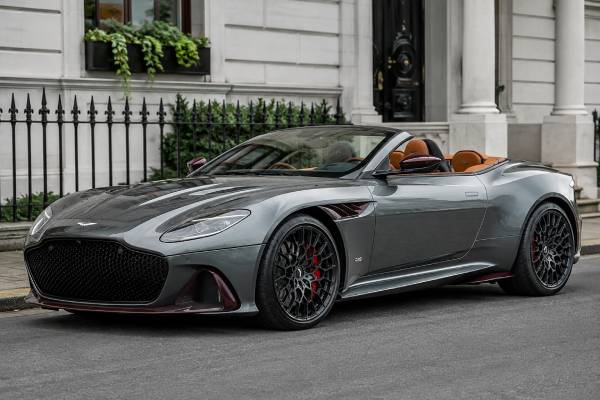
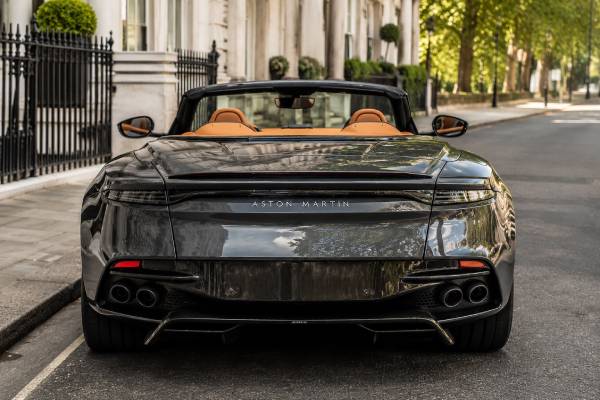
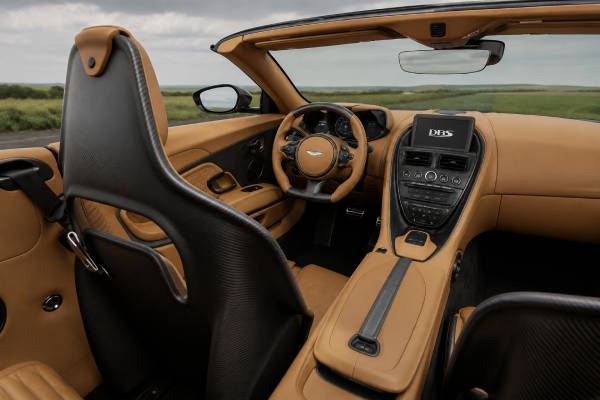
The 2023 Aston Martin DBS 770 Ultimate Volante is the open-roof finale of the AM7 DBS line and the rarer body style in the 499-car Ultimate programme. Only 199 Volantes were allocated, each combining a 759 hp twin-turbo V12 with a powered fabric roof, rear-mounted eight-speed automatic, rear-wheel drive, carbon-ceramic brakes, model-specific chassis tuning, and a claimed 340 km/h maximum speed. It is both an extreme convertible and a numbered collector car.
That dual role changes how it should be bought and maintained. The roof, seals, drains, glass indexing, carbon-fibre bodywork, unique wheels, structural upgrades, and model-specific trim all need separate verification. A copied plaque or body kit cannot turn a standard DBS Volante into an Ultimate, while a genuine car can lose value through undocumented repair or missing original parts. This guide focuses on the Volante’s distinct engineering, the checks required to preserve open-top function, and the evidence needed before paying for its rarity.
Table of Contents
- The case for the Ultimate Volante
- Convertible construction and roof operation
- V12 output, driveline, and factory upgrades
- Open-air dynamics, aerodynamics, and braking
- Preserving a numbered open-top car
- Workshop care, diagnostics, and water control
- Buying, authenticating, and valuing an example
The case for the Ultimate Volante
The Ultimate Volante is not merely the coupe with its roof removed. It combines the AM7 convertible’s roof mechanism and body reinforcement with the 770 programme’s higher-output engine, sharper transmission calibration, revised steering mounting, structural work, unique damper tune, distinctive aerodynamic surfaces, and limited-edition presentation.
Aston Martin divided production into 300 coupes and 199 Volantes. All were allocated before release. The smaller open-top quantity makes the Volante numerically rarer, but rarity alone does not decide desirability. Some collectors prefer the coupe’s fixed-roof purity and lower mass; others value the Volante because no other body style exposes the V12 soundtrack and the 770 Ultimate’s sense of occasion in the same way.
| Item | Verified detail |
|---|---|
| Model year | 2023 |
| Body style | Two-door 2+2 Volante with powered fabric roof |
| Total Ultimate production | 499 cars |
| Volante allocation | 199 cars |
| Coupe allocation | 300 cars |
| Allocation status at launch | All cars sold ahead of release |
Authentication begins with the VIN and factory record. The build sheet should name the correct derivative, body, market, colour, trim, and options. Numbered sill plaques should be consistent with the Volante allocation, but a plaque alone is not proof because plates and badges can be reproduced. Match documentation with the car’s engine calibration, chassis features, wheels, bodywork, seats, trim, and service-system identity.
Characteristic factory details include the horseshoe bonnet vent, deeper front splitter, revised rear diffuser, carbon-fibre side-sill treatment, 21-inch honeycomb wheels, and Ultimate cabin elements. Sports Plus seats in semi-aniline leather and Alcantara were standard, with Aston Martin’s performance seat available as an option. A different seat therefore needs build-sheet confirmation rather than instant rejection.
The car should also be distinguished from a standard 715 bhp DBS Volante carrying later accessories. The Ultimate’s 770 PS output, seven-percent increase in maximum boost pressure, structural changes, solid-mounted steering column, calibration work, and limited-edition identity are coordinated factory features. An engine remap and replica carbon pieces do not reproduce the complete model.
Prospective owners should decide whether they want to collect, tour, or do both. A display-focused car may be judged heavily on delivery items, film, finish, mileage, and untouched components. A touring example can remain valuable with sensible use if every service, tyre, roof adjustment, repair, and protective treatment is documented.
Convertible construction and roof operation
The powered roof is central to the Volante’s condition and value. It uses an eight-layer fabric construction and folds into a stack about 260 mm high, allowing the body to retain a low rear profile. The system was tested through more than 100,000 cycles during the original Volante development programme.
| Feature | Manufacturer detail |
|---|---|
| Roof construction | Eight-layer fabric hood |
| Opening time | 14 seconds |
| Closing time | 16 seconds |
| Folded stack height | Approximately 260 mm |
| Development durability testing | More than 100,000 operating cycles |
| Remote operation | Supported near the vehicle under specified conditions |
Operate the roof before any road test and again afterward. A correct cycle should be smooth, symmetrical, and uninterrupted: windows index, latches release, the frame moves evenly, fabric folds in the intended pattern, and covers settle flush. Hesitation, clicking, uneven motion, a raised deck edge, warning messages, or a need to repeat the command requires investigation.
Battery condition has a direct effect on roof behaviour. The mechanism depends on motors or hydraulic assistance, control modules, position sensors, latches, and window communication. A weak battery can create an incomplete cycle or misleading fault trail. Do not repeatedly operate a struggling roof to prove a point; stabilise voltage and diagnose the system.
Inspect the fabric dry and clean. Look along each fold line for abrasion, thinning, pulled threads, punctures, distorted seams, colour variation, and contact marks. Examine the bond and seal around the rear glass. Fresh dressing can make material appear uniform while hiding wear, so ask what products were used and whether any repair has been made.
The roof should normally be stored closed during long periods. Leaving it compressed can set folds, while a partially open roof places the mechanism in an unsuitable state. Before lowering it, remove debris and confirm there is clear space around the deck. Never put bags, cloths, or detailing tools where the moving panels can catch them.
Water management must be tested, not assumed. Use a gentle, controlled flow around the header rail, roof seams, rear quarters, side glass, and rear window. High-pressure washing can force water past seals in a way that normal rain does not and can damage fabric or trim. After the test, inspect front and rear carpets, seat-belt exits, storage areas, boot lining, low cavities, battery location, and nearby modules.
Drain paths should be clear and correctly connected. Debris, polish, leaves, body-shop sealant, or a displaced tube can redirect water into hidden areas. Musty odour, fogged glass, corrosion on seat or trim fixings, water lines, swollen carpet backing, or repeated electrical oddities can indicate previous ingress even when the surface is dry.
Side-window indexing completes the seal. Each glass should drop slightly as its door opens and return cleanly into the roof seal when closed. Misadjusted glass can cause wind noise, leaks, seal damage, or contact with the roof frame. Test both doors and windows from inside and outside, including one-touch operation and anti-trap behaviour.
V12 output, driveline, and factory upgrades
The Ultimate Volante uses the same 770 PS engine specification announced for the coupe. Its 5.2-litre twin-turbo V12 produces 759 bhp at 6,500 rpm and 900 Nm from 1,800 to 5,000 rpm, sending power to the rear transaxle through a carbon-fibre propeller shaft.
| Specification | Value |
|---|---|
| Engine | AE31 all-alloy, 60-degree twin-turbocharged V12 |
| Displacement | 5,204 cc (5.2 litres) |
| Maximum power | 770 PS (759 bhp; approximately 566 kW) at 6,500 rpm |
| Maximum torque | 900 Nm (663 lb-ft) from 1,800–5,000 rpm |
| Engine changes | Modified air and ignition pathways; 7% higher maximum turbo boost pressure |
| Transmission | Rear mid-mounted ZF eight-speed automatic with Ultimate calibration |
| Differential | Mechanical limited-slip differential |
| Driven wheels | Rear-wheel drive |
| Maximum speed | 340 km/h (211 mph), manufacturer claim |
The torque figure did not rise above the regular DBS’s 900 Nm. Instead, Aston Martin altered airflow, ignition, maximum boost, and the shapes of the output curves to deliver more peak power and a stronger high-rpm finish. That matters because the Ultimate is not defined by a simple low-speed torque increase that could be copied through an aggressive remap.
The rear ZF transmission received a unique calibration to improve shift speed and driver interaction. At low load in GT mode, it should still behave like a refined grand-touring gearbox. Use manual paddles and stronger acceleration only after the engine and driveline are fully warm. Delayed engagement, repeated flare, heavy thumps, inconsistent shifts, or warnings are faults to be diagnosed, not proof that the calibration is “race-like.”
Ultimate chassis changes support the output. A solid-mounted steering column increases the detail reaching the driver’s hands. Front-end lateral stiffness rose by 25 percent in the specified local measurement through an enhanced crossmember, while a thicker rear shear-panel undertray helped raise overall torsional stiffness by about three percent. Adaptive damper and control software were recalibrated for the model.
| System | Ultimate revision |
|---|---|
| Steering | Solid-mounted steering column for greater connection |
| Front structure | Enhanced crossmember; 25% greater local lateral stiffness |
| Rear underbody | Thicker shear-panel undertray |
| Global structure | Approximately 3% increase in torsional stiffness |
| Damping | Unique adaptive-damper calibration |
| Control systems | Model-specific software tuning |
| Transmission | Revised shift calibration |
Those figures apply to the 770 programme and should be interpreted carefully. A 25-percent local improvement does not mean the complete convertible body is 25 percent stiffer. The Volante retains the structural demands of an open roof, and its condition depends on correct underbody parts, bonding, alignment, and repair quality.
On the road, the V12’s broad torque can overwhelm cold or wet rear tyres quickly. Use GT mode until conditions, temperatures, and space justify more response. The stability systems can reduce a mistake, but they cannot create grip. Roof-down sound also encourages the driver to use more throttle than the situation requires; smooth inputs preserve traction and reveal the chassis more clearly.
Open-air dynamics, aerodynamics, and braking
The Volante’s performance is shaped by airflow and mass as much as engine output. The fabric roof and its mechanism add weight relative to the coupe, while open-cabin airflow changes noise and sensation. The Ultimate’s body changes were intended to maintain cooling and aerodynamic balance at very high speed.
A deeper front splitter directs air and strengthens the car’s visual stance. The large horseshoe bonnet vent helps engine-bay cooling. Carbon-fibre side sills visually lower the body, and the revised rear diffuser balances the front changes. Inspect these pieces as functional components rather than decorative accessories.
| Item | Verified specification |
|---|---|
| Front brakes | 410 x 38 mm ventilated carbon-ceramic discs |
| Rear brakes | 360 x 32 mm ventilated carbon-ceramic discs |
| Wheels | 21-inch multi-spoke honeycomb design |
| Front tyres | 265/35 R21 Pirelli P Zero |
| Rear tyres | 305/30 R21 Pirelli P Zero |
| Front aero and cooling | Deeper splitter and horseshoe bonnet vent |
| Rear aero | Revised diffuser |
Roof-down driving makes acceleration feel more vivid and changes what the driver can hear. Wind noise may conceal a wheel-bearing hum, tyre resonance, exhaust leak, or body rattle, so conduct a purchasing road test in both configurations. With the roof closed, listen for whistle around glass, header seals, and rear quarters. With it open, check for trim movement and abnormal vibration.
The solid-mounted steering column should provide information rather than harsh shaking. A tremor at a narrow speed range can indicate wheel or tyre runout; a pull may reflect alignment, brake drag, road crown, or repair damage. Test on more than one road surface and inspect the inner tyre shoulders, which can wear without being obvious from outside.
Carbon-ceramic brakes can squeal during light, cold use, but severe vibration, grinding, pulling, warning messages, impact chips, or surface deterioration require specialist measurement. Wheel removal must be done carefully because a dropped rim can damage a ceramic disc. Ask for documented pad and disc condition rather than accepting “ceramics last forever.”
The honeycomb wheels are valuable identity pieces. Examine both faces and barrels for bends, cracks, welds, refinishing, and incorrect markings. Cosmetic restoration can conceal a history of impact, and repeated balancing cannot correct structural runout. Verify that tyres match in brand, model, specification, age range, load rating, and speed rating.
Low carbon edges are vulnerable on ramps and kerbs. Inspect the splitter, sill undersides, floor, strengthened rear undertray, and diffuser on a suitable lift using approved points. Grounding can damage cooling, airflow, structure, and finish at once. Missing or improvised fasteners deserve correction with the correct parts.
Preserving a numbered open-top car
Preservation does not require avoiding every mile. It requires using the car in a way that controls heat, moisture, battery discharge, tyre ageing, surface damage, and loss of original components.
Use the V12 for journeys long enough to reach stable operating temperature. Apply modest load while warming rather than extended stationary idling, and reduce intensity before stopping after sustained hard driving. Repeated short starts can leave moisture in the exhaust and oil, drain the battery, and cycle the roof and windows without giving the charging system time to recover.
Connect an approved smart conditioner during storage. A maintained voltage level helps the roof and electronic modules, but have battery capacity tested because an aged battery can appear charged and still collapse under load. Record the battery date and any required configuration procedure.
Store the Volante with the roof fully closed in a dry, ventilated, secure space. Ensure the fabric is clean and completely dry first. Avoid plastic covers that trap condensation; a clean, breathable indoor cover can be appropriate when correctly fitted. Keep the car away from leaking pipes, airborne sanding dust, birds, tree sap, and chemicals that can stain the hood.
Clean the roof with products and tools approved for automotive fabric. Aggressive brushes, domestic detergents, pressure washers, and excessive waterproofing product can damage fibres, alter colour, or block water paths. Remove loose dirt gently and allow the material to dry before lowering it.
Retain all original equipment and presentation items: wheels, tyre accessories, manuals, keys, charger, wind deflector where supplied, luggage pieces, car cover, certificates, build documents, and removed trim. Model-specific pieces may be costly or unavailable later. Reversible personalisation is easier to accept when the original parts remain with the car.
Engine tuning is especially risky on the Ultimate. The factory’s 759 hp calibration is a core identity feature and already raises boost and thermal load over the standard DBS. Further changes may affect cooling, transmission behaviour, emissions, warranty, insurance, diagnostics, and resale. A buyer cannot easily verify how aggressively a modified car was used.
Keep a chronological ownership file. Include service invoices, diagnostic reports, software updates, campaign completion, tyre dates, alignment printouts, ceramic measurements, roof adjustments, leak tests, battery tests, paintwork, film, and transport records. Detailed documentation converts maintenance from a claim into evidence.
Workshop care, diagnostics, and water control
The Ultimate Volante needs annual model-aware servicing and condition-based checks, even with very low mileage. Its mechanical systems, convertible hardware, and rare trim age on different schedules, so a stamped book without supporting work is not enough.
A thorough service programme should cover:
- correct engine oil and filter, with leak and level checks;
- both engine-cooling and charge-cooling systems;
- radiator and heat-exchanger cleanliness and damage;
- ignition, intake, boost control, exhaust valves, and fault data;
- rear transaxle, differential, torque tube, mounts, and software;
- carbon-ceramic brakes, brake fluid, and parking brake;
- adaptive dampers, suspension joints, steering, alignment, and wheel bearings;
- roof mechanism, fabric, seals, drains, latches, glass indexing, and boot interlocks;
- 12-volt battery health, charging system, module communication, and sleep current;
- carbon bodywork, aerodynamic parts, wheels, tyres, and underbody fasteners.
Start diagnosis with the car genuinely cold. The V12 should start promptly and settle without continuing smoke, heavy fuel smell, abnormal mechanical noise, repeated misfire, or warning messages. Check oil and coolant areas from above and below. Dried staining can identify a slow leak even when no liquid reaches the floor.
Save a full diagnostic report before clearing anything. Low-voltage events often create multiple communication codes, but they should be linked to battery and charging evidence. Misfire, boost, mixture, cooling, transmission, damping, roof, restraint, or body-control codes require system-specific testing.
Cooling performance must be verified under load. The upgraded engine produces significant heat, and blocked front cores, damaged fins, weak pumps, leaks, or fan faults can become expensive. Watch live temperatures during a correct road test and investigate repeated top-ups or coolant odour.
For the roof, stabilise battery voltage, operate the system repeatedly, inspect position data and latches, and then carry out a controlled water test. A workshop should trace moisture back to its entry path, confirm drain condition, and dry hidden materials properly. Simply replacing a visible seal may not solve a disconnected drain or misindexed window.
Body and underbody work requires technicians familiar with bonded aluminium, carbon fibre, and the Ultimate’s structural pieces. Ask for measurement, repair-method, bonding, corrosion-protection, and calibration details. Replacement parts should be ordered against the VIN because an ordinary DBS component may fit physically while differing in finish, construction, or specification.
Aston Martin issued dedicated DBS 770 Ultimate aftersales launch information covering new features, documentation, technical support, and special tools. That makes it reasonable to ask a repairer whether it has access to current factory information rather than relying on experience with the standard DBS alone.
Recall and service-action status must be checked by VIN in the car’s market. Public recall databases are one part of the process; authorised service systems can also show software and technical campaigns. Keep proof of completion, particularly if the vehicle has moved between countries.
Buying, authenticating, and valuing an example
A pre-purchase inspection should prove what the car is, how it has been used, and what it will need next. The purchase premium is justified only when identity, originality, condition, and records support one another.
Commission an independent specialist to perform:
- VIN decoding and factory build-sheet confirmation;
- numbered-plaque and Volante-allocation consistency checks;
- verification of engine, software, chassis, wheels, body, seats, trim, and options;
- cold start, full module scan, battery test, and charging assessment;
- repeated roof cycling, window indexing, drain inspection, and leak test;
- paint-depth, carbon-fibre, bonded-structure, and underside examination;
- warm road testing of steering, damping, gearbox, differential, and brakes;
- ceramic-disc and pad measurement, wheel runout, tyre dating, and alignment review;
- service, repair, recall, campaign, warranty, and odometer reconciliation;
- a written cost schedule for immediate and forecast work.
Judge accident and cosmetic repair in context. A professionally refinished bumper or renewed film can be acceptable on a driven car. Structural damage, cracked bonded joints, mismatched carbon weave, missing fasteners, poorly fitted roof parts, or an undocumented replacement Ultimate panel are more serious. Photographs and invoices should show what happened and how it was corrected.
Market value depends on region, tax, colour, options, mileage, owners, provenance, originality, and condition. Advertised prices can remain aspirational for long periods, so completed sales are more useful when available. A rare Q specification may command a premium, but only if factory documentation confirms it and future buyers find it desirable.
Compare the car with both related choices. A standard 715 hp DBS Volante offers nearly the same open-air experience for less money and may be easier to use without concern over mileage. The 770 Ultimate coupe is more numerous but has the fixed-roof configuration some drivers prefer. The Ultimate Volante earns its place through scarcity and theatre, not because it is automatically the objectively better purchase for every owner.
Prepare an ownership reserve beyond routine service. Premium fuel, specialist insurance, secure storage, tyres, carbon-ceramic brakes, battery support, roof and seal work, cooling repairs, dampers, electronics, carbon-fibre damage, and rare trim can each be expensive. Confirm parts availability before agreeing to buy a car with a missing or damaged model-specific component.
A properly authenticated and maintained DBS 770 Ultimate Volante is a compelling final expression of Aston Martin’s V12 convertible. Its value lies in the complete factory combination: numbered rarity, 759 hp output, chassis revisions, carbon aerodynamics, roof-down drama, and grand-touring usability. Preserve that combination rather than chasing more power or cosmetic imitation, and the car can remain both usable and historically coherent.
References
- DBS 770 Ultimate | Aston Martin 2023 (Manufacturer Brochure)
- Unleashing DBS 770 Ultimate: A ferocious farewell to Aston Martin’s Super GT flagship | Aston Martin 2023 (Manufacturer Technical Release)
- DBS SUPERLEGGERA VOLANTE: ASTON MARTIN OPENS THE TOP ON THE ULTIMATE OPEN TOP GT EXPERIENCE | Aston Martin 2019 (Volante Roof and Body Engineering)
- ASTON MARTIN AFTERSALES 2023 (DBS 770 Ultimate Essential Aftersales Launch Information)
- Owner’s Guides | Aston Martin 2026 (Manufacturer Owner Documentation)
- Aston Martin Luxury Car Servicing | Aston Martin 2026 (Manufacturer Service Information)
Disclaimer
This article provides general information and is not a substitute for professional diagnosis, repair, authentication, valuation, or a VIN-specific inspection. Specifications, procedures, software, options, campaigns, and legal requirements can vary by market and production date. Verify critical details with official Aston Martin build, owner, and workshop documentation for the exact vehicle.
Please share this guide on Facebook, X/Twitter, or an Aston Martin owners’ forum if it helped your research and may be useful to another buyer.