
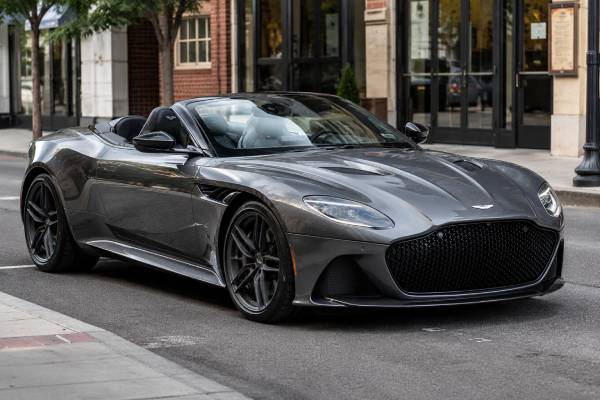
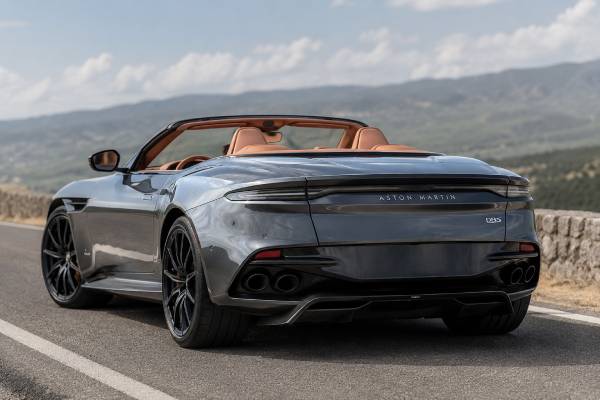
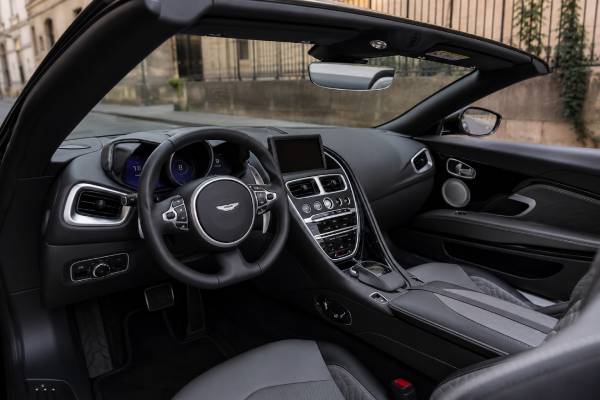
The 2022–2023 Aston Martin DBS Volante is the late-production, open-roof version of the AM7 flagship. It keeps the model’s defining hardware: a 715 hp 5.2-litre twin-turbo V12, 900 Nm of torque, rear-mounted eight-speed automatic transmission, rear-wheel drive, adaptive suspension, carbon-ceramic brakes, and an eight-layer fabric roof. Aston Martin claimed 0–100 km/h in 3.6 seconds and a 340 km/h top speed, figures that made it one of the fastest production convertibles of its period.
Its appeal is broader than straight-line performance. With the roof raised, it can cover long distances with genuine grand-touring comfort; with the roof lowered, the exhaust note and sense of speed become much more immediate. Buying one still requires discipline. Late registration does not automatically prove late model-year specification, and a regular 715 hp DBS Volante is not a 770 Ultimate Volante. This guide explains identification, engineering, roof care, real-world operation, maintenance, and the checks that matter before purchase.
Table of Contents
- Placing the late DBS Volante in the range
- Verified specifications and packaging
- Powered roof, seals, and drainage
- How the Volante delivers its performance
- Touring, storage, and seasonal use
- Service priorities and fault-finding
- Choosing and inspecting a 2022–2023 example
Placing the late DBS Volante in the range
The 2022–2023 DBS Volante is mechanically the continuation of the car launched as the DBS Superleggera Volante, but the later model uses the shorter DBS name. It remains the standard 715 bhp convertible and must be distinguished from the limited, 759 hp DBS 770 Ultimate Volante introduced for 2023.
That distinction is important because online advertisements frequently mix registration year, model year, badge wording, and special-edition status. A car registered during 2022 might have been built to an earlier specification, while a late-build vehicle may not have reached its first owner until the following calendar year. The VIN, factory build record, compliance label, original invoice, and dealer history are more reliable than the date on the registration document alone.
A correctly identified late regular-production car should show the following fundamentals:
- AM7-generation DBS Volante body and powered fabric roof;
- AE31 5.2-litre twin-turbo V12 rated at 715 bhp or 725 PS;
- 900 Nm torque output and rear-mounted ZF eight-speed automatic;
- model-year evidence for 2022 or 2023;
- original paint, wheel, carbon-fibre, upholstery, and option codes;
- no claim to 770 Ultimate status without a numbered build plaque and supporting factory documentation.
The 770 Ultimate is not merely a trim package. It has a 770 PS engine calibration, additional structural changes, a solid-mounted steering column, revised transmission and damper tuning, distinctive bonnet and aerodynamic parts, unique 21-inch wheels, and a limited production allocation. A standard DBS Volante wearing copied badges or aftermarket wheels does not gain that identity.
Late-production cars can differ among themselves. Aston Martin offered extensive colour and trim choice, including Q by Aston Martin commissions, and equipment could vary by market. Badges and minor presentation details also changed during the brand’s transition to its updated wings emblem. Those details can be valuable, but they do not replace documentary proof of the car’s underlying specification.
For an owner intending to drive rather than preserve a numbered finale, the regular late Volante has a strong case. It delivers the same 211 mph headline speed as the Ultimate, retains a slightly less aggressive chassis character, and may be easier to buy without paying a substantial collectibility premium.
Verified specifications and packaging
The DBS Volante is a petrol internal-combustion car without hybrid assistance. Its V12 sits at the front, while the transmission and limited-slip differential are grouped at the rear to improve mass distribution. Figures below reflect manufacturer data for the AM7 Volante and late-market homologation; fuel and emissions results can vary by country and test cycle.
| Specification | Value |
|---|---|
| Engine | AE31 all-alloy, 60-degree twin-turbocharged V12 |
| Displacement | 5,204 cc (5.2 litres) |
| Valve gear | Quad overhead camshafts, 48 valves, variable cam timing |
| Charge cooling | Water-to-air intercooling |
| Maximum power | 715 bhp (725 PS; 533 kW) at 6,500 rpm |
| Maximum torque | 900 Nm (663 lb-ft) from 1,800–5,000 rpm |
| Fuel type | Premium unleaded petrol to the applicable market requirement |
| Specification | Value |
|---|---|
| Transmission | Rear mid-mounted ZF 8HP95 eight-speed automatic |
| Driven wheels | Rear-wheel drive |
| Differential | Mechanical limited-slip differential |
| Final-drive ratio | 2.93:1 |
| Torque connection | Carbon-fibre propeller shaft inside an alloy torque tube |
| Primary drive modes | GT, Sport, and Sport Plus |
| Measure | Value | Context |
|---|---|---|
| 0–100 km/h (0–62 mph) | 3.6 seconds | Manufacturer claim |
| 0–161 km/h (0–100 mph) | 6.7 seconds | Manufacturer claim |
| Maximum speed | 340 km/h (211 mph) | Manufacturer claim |
| Roof opening time | 14 seconds | Powered cycle |
| Roof closing time | 16 seconds | Powered cycle |
| WLTP combined consumption | About 13.5 L/100 km | Late-market published value |
| WLTP combined CO₂ | About 306 g/km | Late-market published value |
| Specification | Value |
|---|---|
| Front suspension | Forged double wishbones, coil springs, anti-roll bar, adaptive dampers |
| Rear suspension | Multi-link arrangement, coil springs, anti-roll bar, adaptive dampers |
| Steering | Electric power assistance; approximately 2.27 turns lock-to-lock |
| Front brakes | 410 mm ventilated carbon-ceramic discs |
| Rear brakes | 360 mm ventilated carbon-ceramic discs |
| Front tyres | 265/35 ZR21 |
| Rear tyres | 305/30 ZR21 |
| Specification | Value |
|---|---|
| Body style | Two-door 2+2 convertible |
| Length | 4,715 mm (185.6 in) |
| Width including mirrors | 2,145 mm (84.4 in) |
| Maximum body width | 1,970 mm (77.6 in) |
| Height | 1,295 mm (51.0 in) |
| Wheelbase | 2,805 mm (110.4 in) |
| Quoted dry weight | From 1,863 kg (4,107 lb) |
| Weight distribution | Approximately 50% front / 50% rear |
Dry weight excludes items included in many road-ready or kerb-weight definitions. Fuel, fluids, options, accessories, and regional equipment all raise the mass of a usable car. Use the exact homologated figure when arranging transport or calculating a lift’s capacity.
Powered roof, seals, and drainage
The roof system is the defining maintenance difference between the Volante and the coupe. Aston Martin used an eight-layer fabric construction that folds into a stack about 260 mm high, preserving the rear profile while providing insulation when raised. It was durability-tested through more than 100,000 operating cycles during development.
A healthy roof should unlatch, move, fold, stow, and secure itself in one continuous, even sequence. Watch both sides from outside the car. The fabric should not bunch against trim, the frame should not pause or twist, and the deck panel should settle flush. Repeat the operation after the car has been driven, because a marginal hydraulic, electrical, sensor, or voltage problem can behave differently when warm.
The remote operating function can be useful, but it does not remove the need to observe the surroundings. The roof needs clear space above and behind the car, and loose objects must not be left on the rear deck. Never force a stalled mechanism or repeatedly cycle it with a weak battery. The control system depends on stable voltage and accurate position feedback.
Inspect the fabric in several lighting conditions. Look for abrasion along fold lines, pulled stitching, small cuts, discolouration, shrinking around the rear glass, and evidence of harsh brushing or unsuitable chemicals. A clean roof is not automatically a sound one; freshly applied dressing can temporarily hide uneven colour or water behaviour.
Weather sealing deserves a deliberate water test. With the roof correctly closed, apply a gentle flow over the header rail, side glass, rear quarters, and rear window area rather than using a high-pressure lance. Then inspect the carpets, seat-belt exits, parcel area, boot floor, battery compartment, and electronic-module locations. A musty smell, misted lamps, tide marks, corrosion on fasteners, or repeated window fogging can reveal a leak that is not visible during a dry inspection.
Drain paths must remain open. Leaves, road debris, pollen, wax, and incorrect body-shop sealant can divert water into the cabin or luggage area. Cleaning should follow model-specific guidance because probing blindly with hard wire or compressed air can disconnect or damage a drain tube.
The side windows form part of the seal. Their short-drop and indexing functions should lower the glass slightly when the door opens and raise it into the roof seal when closed. Misalignment can produce wind noise, water entry, glass contact, or premature seal wear. Test both doors repeatedly and inspect the top edges of the glass for marks.
Much of the exterior is carbon fibre, including panels and aerodynamic pieces that are costly to repair correctly. Examine exposed weave, painted surfaces, mounting points, lower edges, and clear coat. A small impact can crack a splitter or diffuser without creating obvious damage above. Paint-depth readings help, but interpreting carbon and composite panels requires an inspector familiar with the material.
How the Volante delivers its performance
The Volante is extraordinarily fast, yet its character is shaped more by torque and flexibility than by chasing engine speed. The V12 produces its full 900 Nm from 1,800 to 5,000 rpm, so even moderate throttle can create substantial rear-wheel load.
The turbochargers are mounted within the engine’s vee, shortening the gas path and helping response. Water-to-air charge cooling controls intake temperature, while the rear transaxle helps keep the car’s mass near an even front-to-rear split. The arrangement gives the long-nosed convertible more agility than its size suggests, but it does not make it light or immune to poor conditions.
GT mode is the sensible default on public roads. It softens powertrain and damper responses and lets the gearbox use the engine’s broad torque. Sport and Sport Plus make the accelerator, shifts, exhaust, and chassis feel more urgent. They do not create additional tyre grip. Cold rubber, standing water, dust, painted road markings, or a mid-corner bump can overwhelm the rear tyres long before the engine reaches full output.
The roof changes perception. Lowering it exposes the driver to exhaust sound, wind, surface noise, and the physical pressure of acceleration. That can make normal road speeds feel more dramatic and can also make it harder to hear an unfamiliar mechanical noise. A buying road test should therefore include time with the roof both raised and lowered.
Aston Martin claimed 177 kg of maximum-speed downforce for the Volante, only slightly below the coupe figure published at launch. Aerodynamic devices include the front splitter, underbody management, rear diffuser, and Aeroblade system that directs air through the rear bodywork. These components work as a package. Damaged undertrays, non-standard ride height, poorly repaired carbon, or cosmetic add-ons can disturb cooling and airflow even when the car still looks impressive.
Carbon-ceramic brakes reduce unsprung mass and tolerate high temperature, but road feel depends on condition and temperature. Light-use squeal can occur, especially when cold. Grinding, vibration, pulling, warning messages, deep edge damage, or visible surface defects require assessment. Replacement cost makes a measured inspection essential rather than relying on appearance alone.
The Volante’s added structure and roof hardware make it heavier than the coupe. The claimed 0–100 km/h time is two-tenths slower, but the difference is difficult to exploit safely on a road. What the driver notices more often is the extra sense of occasion and the need to manage body width, low-profile tyres, and enormous torque with care.
Touring, storage, and seasonal use
The DBS Volante works best when used for substantial journeys and stored with attention to battery, moisture, tyres, and roof condition. Repeated short trips are a poor match for its heat cycles, charging needs, and fuel consumption.
Before a long tour, confirm tyre pressures when cold, tread condition across the full width, date codes, wheel security, fluid levels, current service status, and that the tyre repair equipment is present and in date. The staggered 21-inch tyres may not be readily available in every location, so roadside-assistance coverage and route planning matter more than they do in an ordinary car.
Luggage should be test-fitted rather than judged from a volume figure. The roof mechanism and body shape constrain usable space, and soft bags usually work better than rigid cases. Keep items away from moving roof components and confirm that the luggage-area separators or sensors, where fitted, are correctly positioned before operating the top.
Roof-down comfort depends on speed, temperature, passenger height, and whether the wind deflector is installed. Carrying a light layer and eye protection can make an evening drive much more comfortable. Apply sunscreen on long open journeys; wind can conceal the intensity of sun exposure.
For storage, use a compatible smart battery conditioner connected according to Aston Martin guidance. A healthy battery should still be tested periodically because maintaining voltage does not prove capacity. Do not leave the roof half-operated, and do not habitually store the car for long periods with the fabric compressed. Closing the roof helps preserve its shape and protects the cabin.
The storage area should be dry, ventilated, secure, and free from condensation. A breathable indoor cover can protect paint only when the car is clean and the cover fits correctly. A dirty or loose cover can abrade carbon-fibre clear coat and paint. Avoid parking beneath pipes, timber dust, or materials that can drip chemicals onto the roof fabric.
Tyres can develop temporary flat spotting after standing. Correct pressure and occasional meaningful use are preferable to repeatedly moving the car a few metres. For extended storage, follow professional advice about pressure adjustment or suitable supports; never place loads under carbon or unapproved lifting points.
Winter use is possible on appropriate tyres, but tyre availability, low ground clearance, salt exposure, and immense rear-wheel torque need consideration. If the car is driven on treated roads, clean the underside and wheel areas carefully without directing aggressive pressure at seals, electrical connectors, brake components, or the fabric roof.
Fuel economy varies widely. Steady-distance cruising can be respectable relative to the performance, while urban operation and frequent boost increase consumption sharply. The published combined figure is a test result, not a guaranteed ownership average. Budgeting should assume premium fuel and a shorter range than the tank size initially suggests.
Service priorities and fault-finding
A complete annual service record is the foundation of safe ownership, but a high-output Volante also needs inspection based on age, use, heat exposure, and storage history. Low mileage does not suspend the ageing of fluids, seals, tyres, batteries, fabric, or electronic components.
A specialist service visit should review:
- engine oil, filter, leaks, and service date;
- engine-cooling and charge-cooling circuits;
- front radiator and heat-exchanger condition;
- air filters, intake joints, and turbo-related fault data;
- transmission, differential, torque tube, and mounts;
- carbon-ceramic discs, pads, fluid, and parking-brake operation;
- adaptive dampers, bushes, joints, wheel bearings, and alignment;
- tyres, wheel runout, and evidence of impact damage;
- roof operation, seals, drains, glass indexing, and water ingress;
- battery state of health, charging, software, and stored module faults.
Begin with a true cold start
Ask that the engine not be warmed before inspection. It should start promptly and settle evenly without persistent smoke, strong raw-fuel odour, repeated misfire, abnormal knocking, or unresolved warning messages. Check beneath the car and around reservoirs, hose connections, pumps, and heat exchangers for fresh fluid or dried residue.
A full diagnostic scan must include every control module, not only the engine controller. Low-voltage history can create numerous unrelated codes, but it should not be dismissed automatically. Misfire, boost-control, mixture, catalyst, cooling, transmission, roof, restraint, or network faults need cause-based diagnosis.
Test the driveline through temperature changes
Select Drive and Reverse when cold, then repeat after a proper road test. Engagement should be prompt and consistent. Use light throttle, manual paddle shifts, steady motorway speed, and stronger acceleration only after full warm-up. Rough shifts may relate to software, adaptations, mounts, differential play, or internal wear; a specialist should interpret data before parts are replaced.
Listen for unusual vibration or clunks as torque changes from acceleration to overrun. Some mechanical connection is normal in a powerful rear-transaxle car, but repeated impacts, rumbling, or speed-related vibration are not. Inspect the torque tube and rear assembly for leakage or signs of previous removal.
Measure expensive components
Carbon-ceramic brakes require more than a visual glance. Ask for pad measurements and disc assessment using the manufacturer-approved method. Inspect the wheel barrels because careless tyre fitting can chip a disc. Wheels should be checked for cracks, welds, bends, and excessive runout, especially if the car has had repeated tyre-balancing attempts.
Adaptive damper leakage, uneven ride height, steering pull, or inside-edge tyre wear can indicate alignment or suspension problems. A smooth road test alone may not reveal them. Use a lift and alignment records, and inspect the low front splitter, floor panels, sills, and rear diffuser for grounding.
Treat the roof as a complete system
Operate the roof several times with a healthy battery, inspect live diagnostic data if behaviour is inconsistent, and perform a controlled leak test. Confirm both side windows index correctly and that the boot opens and closes without roof-state errors. Dampness should be traced to its route rather than masked with drying or fragrance.
Campaign and recall status is VIN- and market-specific. Check the appropriate national database and obtain an authorised Aston Martin service printout. Confirm software actions and service campaigns as well as safety recalls; a clean public recall search does not necessarily show every manufacturer action.
Choosing and inspecting a 2022–2023 example
The best late DBS Volante is the car with the clearest identity and the fewest deferred needs, not automatically the one with the lowest odometer. Continuous care, correct use, dry storage, intact carbon, a healthy roof, and recent age-sensitive maintenance are more valuable than an impressive specification hiding unresolved faults.
Commission a model-aware pre-purchase inspection that includes:
- VIN, model year, build sheet, option, and badge verification;
- cold start followed by a fully warmed road test;
- complete diagnostic scan and battery capacity test;
- repeated roof cycling and a controlled water-ingress check;
- paint-depth, carbon-fibre, underside, and accident-repair assessment;
- wheel runout, tyre date, alignment, and suspension inspection;
- measured carbon-ceramic brake condition;
- transmission behaviour and driveline leak review;
- recall, campaign, software, and service-history confirmation;
- a written estimate for all immediate and near-term work.
Study the ownership pattern. Long, regular journeys with annual servicing can be healthier than years of short starts, display storage, and battery discharge. Ask how the roof was stored, whether drains were maintained, where the car was parked, and whether leaks or window adjustments have occurred. Invoices are more persuasive than verbal assurances.
Originality affects value, but tasteful, reversible upgrades can improve usability. Paint-protection film, a carefully integrated smartphone interface, or a documented battery connection may be sensible. Engine tunes, lowering hardware, wheel spacers, non-standard exhaust work, cut wiring, or replica Ultimate parts require much closer scrutiny. Confirm emissions legality, insurer acceptance, calibration quality, and the availability of original parts.
Compare three alternatives honestly. An earlier DBS Superleggera Volante delivers essentially the same 715 hp mechanical package and may cost less. The 2022–2023 DBS Volante offers late production and simplified badging. The 770 Ultimate Volante adds rarity and meaningful engineering changes but normally costs substantially more. The right answer depends on use rather than headline status.
Budget beyond the purchase price. Include premium fuel, insurance, secure storage, annual servicing, battery support, tyres, alignment, brake contingency, roof and seal work, cooling-system repairs, dampers, electronics, and carbon-fibre damage. A discounted car that immediately needs tyres, ceramics, roof repair, and paint correction can become the most expensive choice.
A sound 2022–2023 DBS Volante is a rare combination: a genuinely open grand tourer with supercar-level speed, a forceful V12, and enough refinement for distance. Its complexity is manageable when maintenance is documented and faults are addressed early. Buy on evidence, protect the roof and carbon, keep the battery healthy, and use the car often enough for its systems to work as intended.
References
- Discover why James Bond chose the Aston Martin DBS as his best car. The epitome of British craftsmanship, performance and luxury 2026 (Manufacturer Pre-Owned Model Page)
- DBS SUPERLEGGERA VOLANTE: ASTON MARTIN OPENS THE TOP ON THE ULTIMATE OPEN TOP GT EXPERIENCE | Aston Martin 2019 (Manufacturer Technical Release)
- Unleashing DBS 770 Ultimate: A ferocious farewell to Aston Martin’s Super GT flagship | Aston Martin 2023 (Final-Edition Comparison)
- Vehicle Detail Search – 2022 ASTON MARTIN | NHTSA 2026 (Recall Database)
- Aston Martin Timeless | Certified pre-owned luxury sports cars 2026 (Manufacturer Pre-Owned Standards)
- Aston Martin Luxury Car Servicing | Aston Martin 2026 (Manufacturer Service Information)
Disclaimer
This article is for general information and is not a substitute for professional diagnosis, repair, valuation, or a VIN-specific inspection. Specifications, service procedures, software, options, campaigns, and legal requirements vary by market and production date. Confirm critical details with official Aston Martin owner and workshop documentation for the exact vehicle.
Please share this guide on Facebook, X/Twitter, or an Aston Martin forum if it helped your research and could assist another buyer.