

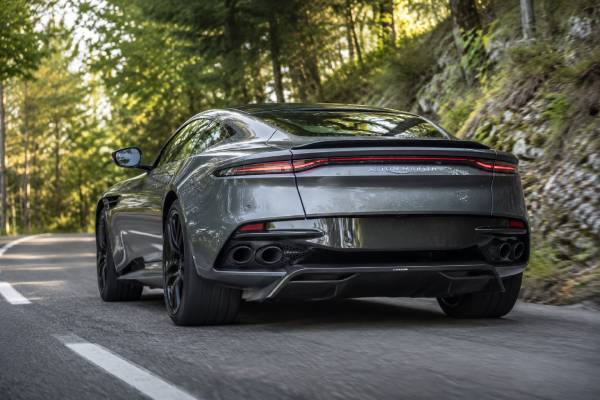
The 2018–2021 Aston Martin DBS Superleggera is a 715 hp, rear-wheel-drive super-GT built around a front-mid-mounted 5.2-litre twin-turbo V12 and a rear-mounted eight-speed ZF automatic. It is faster, more forceful, and far more torque-rich than the naturally aspirated DBS it followed, yet it remains a 2+2 grand tourer rather than a stripped track special. Carbon-fibre exterior panels, carbon-ceramic brakes, adaptive damping, active aerodynamics, and a 211 mph maximum speed place it at the top of Aston Martin’s regular production range for the period.
The car’s biggest strength is accessible performance: 900 Nm arrives from 1,800 rpm, so it accelerates hard without requiring high revs. Its biggest buying risk is the cost of restoring a poorly maintained example. Tyres, ceramic brakes, dampers, carbon panels, cooling hardware, electronic modules, and V12 work are expensive. A complete history and a model-specific inspection therefore matter more than a low advertised price.
Table of Contents
- Super-GT purpose and lineage
- DBS Superleggera technical data
- Twin-turbo V12 and eight-speed transaxle
- Carbon structure, aero, and chassis
- Cabin technology and real-world use
- Maintenance, reliability, and recalls
- Pre-purchase strategy and value
Super-GT purpose and lineage
The DBS Superleggera was designed to sit above the DB11 as Aston Martin’s most aggressive front-engine series model. It uses the DB11 generation’s bonded aluminium architecture, but its body, aerodynamics, engine calibration, transmission setup, suspension tuning, brakes, tyres, and visual identity create a clearly different car.
The DBS name connects the model to Aston Martin flagships from 1967 onward. “Superleggera” revives the Italian term associated with Touring’s lightweight construction work on historic Aston Martins. The modern car does not use Touring’s original tube-frame method; the badge expresses a lightweight design theme. Aston Martin used carbon fibre for the bonnet, roof, boot lid, front splitter, diffuser, and other exterior elements, helping the DBS achieve a quoted dry weight of 1,693 kg—72 kg less than a contemporary DB11 V12 by the manufacturer’s comparison.
This is not light in absolute terms, but the weight is well managed. The engine sits low and rearward, the gearbox is mounted at the rear, and the carbon-fibre propeller shaft runs through a torque tube. The arrangement supports a near-even front-to-rear balance and gives the car more composure under power than its long bonnet suggests.
The “super-GT” description is useful. The DBS combines supercar acceleration and braking with luggage space, two small rear seats, a compliant GT mode, and enough cabin comfort for long journeys. It is less agile and less compact than a mid-engine sports car, but more usable over distance. A buyer should decide whether that blend is the objective. Anyone seeking the sharpest possible circuit tool may prefer a lighter car; anyone seeking V12 performance without sacrificing touring ability will understand the DBS immediately.
DBS Superleggera technical data
The DBS Superleggera is a conventional petrol ICE vehicle with a twin-turbocharged V12, no hybrid system, rear-wheel drive, and a rear-mounted automatic transaxle. The following figures apply to the standard coupe; market homologation and equipment can alter economy, emissions, and weight definitions.
| Specification | Value |
|---|---|
| Engine | All-alloy 5,204 cc twin-turbocharged V12 |
| Valve gear | Quad overhead camshafts, 48 valves, dual variable cam timing |
| Compression ratio | 9.3:1 |
| Charge cooling | Water-to-air intercooling |
| Maximum power | 715 bhp (725 PS; 533 kW) at 6,500 rpm |
| Maximum torque | 900 Nm (663 lb-ft) from 1,800–5,000 rpm |
| Engine position | Front mid-mounted |
| Fuel system | Petrol direct injection |
| Specification | Value |
|---|---|
| Transmission | Rear mid-mounted ZF eight-speed automatic |
| Final-drive ratio | 2.93:1 |
| Drive | Rear-wheel drive |
| Differential | Mechanical limited-slip differential |
| Torque management | Dynamic torque vectoring through brake and stability systems |
| Propeller shaft | Carbon-fibre shaft within an alloy torque tube |
| Measure | Value | Condition |
|---|---|---|
| 0–100 km/h (0–62 mph) | 3.4 seconds | Manufacturer claim |
| Maximum speed | 340 km/h (211 mph) | Manufacturer claim |
| Combined fuel consumption | 12.28 L/100 km (22.9 mpg UK) | Initial estimated published figure |
| Combined CO₂ | 285 g/km | Initial estimated published figure |
| Specification | Value |
|---|---|
| Front suspension | Forged double wishbones, coil springs, anti-roll bar, adaptive damping |
| Rear suspension | Multi-link, coil springs, anti-roll bar, adaptive damping |
| Damper modes | GT, Sport, and Sport Plus |
| Steering | Electric power assistance, 13.09:1 ratio, 2.4 turns lock-to-lock |
| Front brakes | 410 mm ventilated carbon-ceramic discs |
| Rear brakes | 360 mm ventilated carbon-ceramic discs |
| Front tyres | 265/35 ZR21 Pirelli P Zero |
| Rear tyres | 305/30 ZR21 Pirelli P Zero |
| Specification | Value |
|---|---|
| Body | Two-door 2+2 coupe |
| Length | 4,712 mm (185.5 in) |
| Width including mirrors | 2,146 mm (84.5 in) |
| Maximum body width | 1,968 mm (77.5 in), excluding mirrors |
| Height | 1,280 mm (50.4 in) |
| Wheelbase | 2,805 mm (110.4 in) |
| Dry weight | From 1,693 kg (3,732 lb) |
| Weight distribution | 51% front / 49% rear |
A dry-weight figure excludes operating fluids and may differ substantially from a ready-to-drive kerb weight. Compare like with like when evaluating rivals or transport limits.
Twin-turbo V12 and eight-speed transaxle
The engine’s defining characteristic is its broad 900 Nm torque plateau. Maximum torque begins at only 1,800 rpm and continues to 5,000 rpm, so the DBS accelerates with little delay in almost any road gear. The driver does not need to chase the redline to access serious performance.
The 5.2-litre V12 uses two turbochargers and water-to-air charge cooling. Compressing intake air creates heat; the charge-cooling circuit removes that heat to maintain air density and control combustion temperatures. This makes coolant condition, pump operation, hoses, heat exchangers, and airflow through the front of the car important. A car that performs normally in a short test may show heat-management issues only after repeated acceleration or slow traffic in warm weather.
Cylinder deactivation and stop/start were included to reduce fuel use under suitable conditions. Their presence does not make the DBS economical. Real consumption depends strongly on journey length, temperature, speed, traffic, and throttle use. Owners should also understand that repeated short journeys are hard on a high-output engine because oil and exhaust components may not reach stable temperature.
The ZF automatic sits at the rear and is calibrated for the DBS’s torque. GT mode softens the powertrain’s responses, Sport increases urgency, and Sport Plus makes the throttle and gear strategy more aggressive. The fixed paddles allow manual selection without turning the steering wheel paddles away from the driver’s fingers.
A healthy transmission should engage promptly, creep smoothly, and make clean shifts at both light and heavy load. Harsh selection, repeated flare, delayed reverse engagement, or a heavy thump on overrun requires investigation. Software, adaptation, fluid condition, mounts, differential lash, and other driveline components can influence behaviour, so an accurate diagnosis should precede any claim that the gearbox itself has failed.
The immense torque also makes rear tyres a consumable. Full-throttle use in low gears can overwhelm cold or worn tyres even with stability control active. Matching high-quality tyres, correct pressures, and proper alignment are essential to both performance and safety. Mixing tyre models or using old low-mileage tyres undermines the chassis.
Carbon structure, aero, and chassis
The DBS Superleggera’s engineering is not limited to more engine output. Its carbon body, aerodynamic devices, ceramic brakes, and chassis calibration are intended to make the extra power usable at speed.
Aston Martin developed the DB11’s Curlicue and Aeroblade concepts further. Air is managed around the front wheel arches, along the body, and through the rear aero system. An F1-inspired double diffuser contributes to a quoted 180 kg of downforce at maximum speed without a stated drag penalty. The exact number matters less in normal ownership than the implication: splitter, undertray, diffuser, vents, and panel fit are functional parts, not decoration.
Inspect these components from below. Front splitters are vulnerable to ramps and parking stops; diffusers and undertrays can be damaged by road debris. A repaired carbon component should have documented workmanship and correct mounting. Cracks can extend beneath clear coat or paint, while poor alignment may alter airflow and create noise.
The suspension uses double wishbones at the front and a multi-link rear layout. Adaptive dampers respond to road and driver inputs, with GT, Sport, and Sport Plus settings. GT is the default for imperfect roads and long journeys. Sport reduces body movement and sharpens response. Sport Plus is most useful on smooth roads where tyre temperature and surface quality support the firmer setup.
The car should feel stable rather than nervous. Tramlining, steering pull, a crooked steering wheel, or sudden rear movement can indicate tyre wear, alignment error, damaged wheels, worn joints, or an incorrect repair. The 21-inch tyres have limited sidewall height, so wheel damage can occur without an obvious external bend. A road-force balance and runout check may be needed if vibration persists.
Carbon-ceramic discs reduce unsprung mass and tolerate high temperatures, but replacement cost is substantial. Visual inspection should cover chips, cracks, scoring, surface condition, edge damage, and contamination. A specialist can measure disc wear using the manufacturer’s procedure. Do not assume that low mileage guarantees good discs; impact during wheel removal, aggressive cleaning, track heat, or incorrect pads can cause problems.
Cabin technology and real-world use
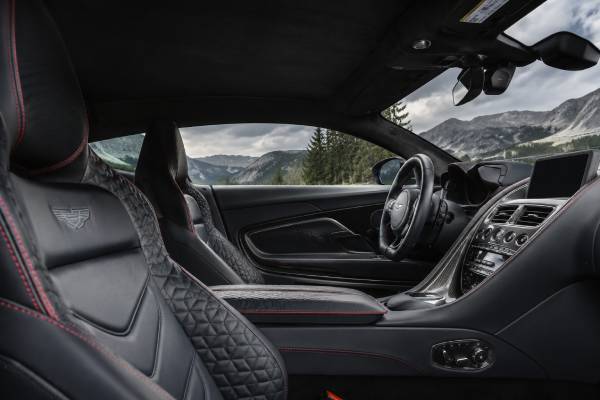
The DBS cabin mixes traditional Aston Martin materials with infotainment hardware from the company’s Mercedes-era technical partnership. It feels special through leather, Alcantara, carbon trim, metal details, and the dramatic seating position, but the interface now appears dated beside newer luxury cars.
The central screen, rotary controller, touchpad, navigation, Bluetooth, USB functions, 360-degree camera, and parking sensors should all be tested. Screen graphics and smartphone integration are not current-generation, yet the basic system should operate without freezing or spontaneous rebooting. Reversible aftermarket phone-integration solutions can improve usability, but poor installations can introduce noise, battery drain, or damaged trim.
The 2+2 layout is more useful for bags than adults. Rear access is tight and legroom is minimal. The boot works for weekend luggage, although the opening shape can limit bulky items. Buyers should bring the luggage they expect to carry, especially if the car will be used for touring.
Visibility is acceptable forward but restricted to the rear quarters. The camera and sensors are therefore important rather than optional conveniences. Check every camera view in daylight and low light. A damaged camera, painted-over sensor, or misaligned bumper after repair may create warnings or inaccurate distance information.
Ride quality in GT mode is firm but compatible with long journeys. Road noise rises on coarse surfaces, and the wide tyres can follow ruts. The car’s width—more than 2.1 metres including mirrors—is a practical issue on older roads, garages, and automated parking systems. Measure the intended parking space before purchase rather than trusting nominal garage dimensions.
The electrically controlled exhaust gives the car distinct personalities. Quiet start can reduce the initial flare in suitable markets and software versions, while Sport and Sport Plus open the sound character. Exhaust-valve rattles, leaks, or warning lights should be diagnosed. A louder aftermarket exhaust may sound appealing but can complicate warranty history, emissions compliance, and resale.
Maintenance, reliability, and recalls
The DBS Superleggera can be dependable when maintained proactively, but neglect is costly because many systems are tightly packaged and model-specific. Annual servicing is advisable even when mileage is low, with additional work based on time, distance, operating conditions, and the official schedule for the VIN.
Key maintenance priorities include:
- correct engine oil and filter service;
- cooling and charge-cooling system inspection;
- brake-fluid replacement by time and ceramic-disc assessment;
- transmission and differential leak checks;
- tyre age, inner-edge wear, and pressure monitoring;
- adaptive-damper and suspension-joint inspection;
- battery health, charging voltage, and software updates;
- air-conditioning operation and condenser condition;
- underbody carbon and aerodynamic panel inspection.
A cold start should be part of every serious inspection. The V12 should settle quickly, without persistent smoke, severe tapping, hunting idle, or warning messages. Look for oil leaks around covers, lines, and the lower engine. Check coolant level only when cold and inspect the front heat exchangers for debris or damage. Bent fins and blocked airflow can reduce cooling capacity.
Low-voltage events can create multiple apparently unrelated faults. Cars stored for weeks should use an approved battery conditioner. Before diagnosing expensive modules, verify battery capacity, terminal condition, charging output, and sleep-current behaviour. Both keys should be present and functional because replacement and programming are not trivial.
Recalls must be checked by VIN, not by model name alone. One U.S. safety recall covered a small number of 2019–2020 DBS Superleggera vehicles for potentially loose front-seat airbag fasteners. Another campaign or service action may apply depending on build date and market. A dealer printout and the relevant national recall database are better evidence than a seller’s verbal assurance.
Common inspection concerns are often wear or usage related rather than proof of a universal design defect. These include worn rear tyres, wheel damage, carbon splitter scrapes, ceramic-brake issues, battery-related warnings, camera or sensor faults, leather wear, and poor alignment. The distinction matters: a properly maintained car should not be described as unreliable merely because repairs are expensive when needed.
Pre-purchase strategy and value
A DBS Superleggera should be bought after a specialist has inspected the complete car, scanned every module, and priced immediate needs. The pre-purchase inspection should be independent of the selling party whenever possible.
Ask for the following evidence:
- VIN and build specification: Confirm model year, original colours, options, market, and any special-edition claims.
- Continuous service history: Detailed invoices are more valuable than stamps alone. Look for annual attention and correct parts.
- Recall and software status: Obtain a dealer or authorised-service printout where available.
- Tyre and wheel information: Record tyre dates, tread across the full width, wheel repairs, and alignment history.
- Brake report: Request measured carbon-ceramic disc condition and pad life, not “brakes look fine.”
- Paint and carbon assessment: Identify accident repair, refinishing, cracks, stone damage, and underside contact.
- Diagnostic report: Review current, stored, and pending faults plus battery-voltage history where accessible.
A proper road test begins at cold start and includes urban manoeuvres, rough surfaces, a steady cruise, several transmission modes, firm braking, and strong acceleration only after temperatures are normal. Listen for driveline clunks, suspension knocks, exhaust rattles, and wind noise. Check that the car tracks straight and that all dynamic modes produce a clear but sensible change.
Do not let low mileage dominate the decision. A very low-mileage car may have old tyres, repeated battery discharge, stuck exhaust valves, dried seals, corroded brake hardware, and missed time-based servicing. Conversely, a regularly used car with excellent records may be mechanically healthier even if its odometer is higher.
Running costs should be planned at flagship level. Routine servicing is only the baseline. Tyres, ceramic brakes, wheel refurbishment, dampers, body carbon, windscreen replacement, electronic modules, and V12 cooling work can be significant. Insurance, secure storage, fuel, and specialist transport also belong in the budget.
The strongest cars combine original specification, excellent cosmetics, full provenance, correct tyres, clean diagnostics, and evidence of careful use. Special editions can command premiums, but authenticity and condition still lead. Modifications may reduce value unless they are reversible, documented, and from a respected source.
The DBS Superleggera is compelling because it delivers effortless torque, visual drama, and genuine touring ability in one car. It is not a bargain supercar simply because depreciation has reduced the purchase price. Buy the best-inspected example rather than the cheapest one, preserve its records, and address small faults before they spread into multiple systems.
Early-production context should be part of the inspection. The 2018 launch specification established the car’s performance, but individual examples may have received later software, replacement modules, revised parts, or dealer actions during the first years of ownership. Ask for an authorised service printout alongside invoices, then compare dates, odometer readings, campaign entries, and the reason for each update. A car that has been maintained regularly and brought to current factory status can be a better proposition than a lower-mileage example with gaps.
The cooling package also deserves inspection from the front face inward. The large grille openings expose radiators and charge-cooling heat exchangers to leaves, insects, gravel, and careless pressure washing. Bent fins reduce airflow; accumulated debris traps moisture; a repaired bumper can leave ducts or seals incorrectly installed. With the engine fully warm, verify stable temperatures, correct fan operation, and no coolant odour. A diagnostic road test should include steady cruising and controlled boost so the specialist can compare commanded and actual values rather than judging the system only at idle.
Finally, confirm that any aftermarket phone interface, tracker, camera, exhaust controller, or audio work is fused, reversible, and documented. Poor additions can create battery drain or network faults that appear unrelated to the installation.
References
- Introducing the new DBS Superleggera: two illustrious names; one magnificent Super GT | Aston Martin USA 2018 (Manufacturer Technical Release)
- DBS Superleggera | Aston Martin UK 2018 (Manufacturer Model Page)
- Aston Martin DBS Superleggera TAG Heuer Edition | Aston Martin USA 2019 (Manufacturer Special-Edition Information)
- Vehicle Detail Search – 2019 ASTON MARTIN | NHTSA 2026 (Recall Database)
- 1200 New Jersey Avenue SE 2020 (Safety Recall Acknowledgement)
- Aston Martin Luxury Car Servicing | Aston Martin 2026 (Manufacturer Service Information)
Disclaimer
This article provides general information and cannot replace a professional inspection, diagnosis, or repair procedure. Specifications, torque settings, service intervals, software, and recall eligibility vary by VIN, market, equipment, and production date. Verify all work against official Aston Martin owner and workshop documentation for the exact car.
Please share the guide through Facebook, X/Twitter, or a relevant enthusiast community if it was useful and you would like to support further technical articles.