

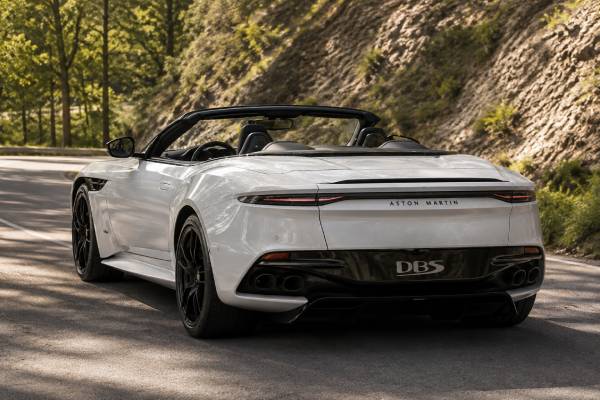
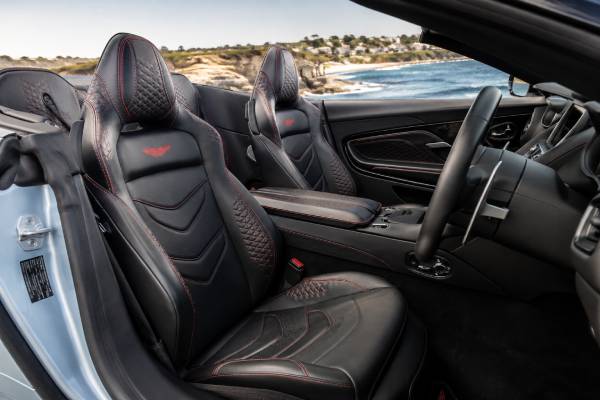
The 2019–2021 Aston Martin DBS Superleggera Volante is a 715 hp open-top flagship that retains the coupe’s 211 mph maximum speed. Its eight-layer fabric roof opens in 14 seconds, closes in 16 seconds, and folds into a compact 260 mm stack beneath the rear tonneau. The 5.2-litre twin-turbo V12, rear-mounted eight-speed automatic, carbon-ceramic brakes, adaptive suspension, and rear-wheel drive remain, but dry weight rises to 1,863 kg and the aerodynamics are recalibrated around the convertible body.
The Volante’s appeal is obvious: it combines a broad 900 Nm torque curve with direct access to the V12 exhaust note. Its inspection demands are less obvious. Buyers must assess the powered roof, drains, seals, tonneau, carbon trim, water ingress, body rigidity, tyres, ceramic brakes, battery health, and cooling systems. This guide focuses on those convertible-specific priorities while explaining the car’s exact technical layout and ownership requirements.
Table of Contents
- Open-top flagship engineering
- Volante specifications and data
- Roof system, aerodynamics, and structure
- V12 performance and driving modes
- Touring comfort and everyday use
- Maintenance, roof care, and faults
- Used-car inspection and purchase
Open-top flagship engineering
The DBS Superleggera Volante is not merely a body-style alternative; it is a different engineering compromise. Aston Martin retained the coupe’s full engine output and top-speed claim while adding structural reinforcement, a powered roof, a different rear deck, revised airflow management, and convertible-specific calibration.
The body begins with the bonded aluminium architecture shared with the contemporary DB11 family. Carbon fibre is used for the large clamshell bonnet and several exterior aerodynamic elements. Removing the fixed roof requires stronger load paths through the lower body, windscreen structure, rear bulkhead, and surrounding components. That reinforcement, plus the hood mechanism, raises the quoted dry weight by about 170 kg compared with the coupe.
The added mass changes the car’s feel more than its straight-line ability. Acceleration to 100 km/h takes a claimed 3.6 seconds rather than 3.4, yet maximum speed remains 340 km/h. More important in normal driving, the Volante carries greater inertia into braking zones and direction changes. It therefore rewards smooth steering, progressive braking, and respect for tyre temperature.
Aston Martin’s aim was to maintain the DBS’s super-GT identity rather than chase minimum weight. The car still provides 2+2 seating, a usable boot for weekend travel, adaptive damping, climate control, cameras, parking sensors, and a well-insulated roof. With the hood raised it functions as a fast grand tourer; with the hood lowered it becomes a much more theatrical machine.
The model was announced in April 2019, with deliveries scheduled from the third quarter of that year. The Superleggera name remained through the 2021 model-year scope covered here. Later cars dropped the Superleggera wording while retaining the basic 715 hp mechanical package.
Volante specifications and data
This is a petrol-only internal-combustion vehicle. The front-mid-mounted twin-turbo V12 drives the rear wheels through a rear transaxle; there is no hybrid motor or all-wheel-drive system. Figures below apply to the standard DBS Superleggera Volante, with market-specific homologation differences noted where relevant.
| Specification | Value |
|---|---|
| Engine | All-alloy 5,204 cc twin-turbocharged V12 |
| Valve gear | Quad overhead camshafts, 48 valves, dual variable cam timing |
| Compression ratio | 9.3:1 |
| Charge cooling | Water-to-air intercooling |
| Maximum power | 715 bhp (725 PS; 533 kW) at 6,500 rpm |
| Maximum torque | 900 Nm (663 lb-ft) from 1,800–5,000 rpm |
| Engine position | Front mid-mounted |
| Fuel | Premium unleaded petrol to the market-specific requirement |
| Specification | Value |
|---|---|
| Transmission | Rear mid-mounted ZF eight-speed automatic |
| Final drive | 2.93:1 |
| Drive | Rear-wheel drive |
| Differential | Mechanical limited-slip differential |
| Propeller shaft | Carbon-fibre shaft within an alloy torque tube |
| 0–100 km/h (0–62 mph) | 3.6 seconds |
| 0–161 km/h (0–100 mph) | 6.7 seconds |
| Maximum speed | 340 km/h (211 mph) |
| Specification | Value |
|---|---|
| Body style | Two-door Volante with 2+2 seating |
| Roof construction | Eight-layer powered fabric hood |
| Opening time | 14 seconds |
| Closing time | 16 seconds |
| Folded roof stack | 260 mm |
| Remote operation | Available from the key within about 2 metres under stated conditions |
| Factory roof testing | More than 100,000 operating cycles during development |
| Specification | Value |
|---|---|
| Front suspension | Double wishbones, coil springs, anti-roll bar, adaptive damping |
| Rear suspension | Multi-link, coil springs, anti-roll bar, adaptive damping |
| Dynamic modes | GT, Sport, and Sport Plus |
| Steering | Electric assistance, 13.09:1 ratio, 2.27 turns lock-to-lock |
| Front brakes | 410 mm ventilated carbon-ceramic discs |
| Rear brakes | 360 mm ventilated carbon-ceramic discs |
| Front tyres | 265/35 ZR21 Pirelli P Zero |
| Rear tyres | 305/30 ZR21 Pirelli P Zero |
| Specification | Value | Condition |
|---|---|---|
| Length | 4,715 mm (185.6 in) | Manufacturer data |
| Width including mirrors | 2,145 mm (84.4 in) | Manufacturer data |
| Maximum width excluding mirrors | 1,970 mm (77.6 in) | Rear body width |
| Height | 1,295 mm (51.0 in) | Manufacturer data |
| Wheelbase | 2,805 mm (110.4 in) | Manufacturer data |
| Dry weight | From 1,863 kg (4,107 lb) | Excludes operating fluids |
| Weight distribution | 50% front / 50% rear | Manufacturer data |
| Combined consumption | 14.0 L/100 km (20.1 mpg UK) | Initial estimated WLTP figure |
| Combined CO₂ | 295 g/km | Initial estimated NEDC figure |
Official economy numbers are useful for taxation and comparison but do not predict every owner’s result. Short journeys, cold starts, urban traffic, roof-down aerodynamic drag, and frequent boost use can raise consumption substantially.
Roof system, aerodynamics, and structure
The roof system is the Volante’s most important additional mechanism and the first system a buyer should test. It must operate evenly, seal correctly, store compactly, and communicate with the windows, tonneau, latches, and body-control electronics.
Aston Martin used eight layers of insulation and acoustic material to give the raised hood a smooth exterior shape and reduce cabin noise. The compact folded stack helps preserve luggage space and the low rear profile. The hood was offered in several exterior colours, with multiple interior headliner choices, and buyers could specify carbon fibre for the windscreen surround, tonneau cover, and rear waterfall.
The opening sequence takes 14 seconds and the closing sequence 16 seconds. Operation should be smooth from beginning to end. The deck should rise without twisting, the hood frame should fold in a controlled way, and the tonneau should settle flush. The side windows must drop and rise at the correct points. Hesitation, asymmetry, repeated warning messages, or the need to help the roof by hand indicates a problem even if the cycle eventually completes.
Battery voltage matters. Roof motors, latches, pumps or actuators, sensors, and windows operate together and draw meaningful current. A weak battery can stop the sequence and create faults. Test the roof only with a healthy battery and follow the owner’s manual for ignition state, vehicle speed, temperature, and obstruction checks.
The aerodynamic work is unusually serious for a convertible. The coupe produces a quoted 180 kg of downforce at maximum speed; the Volante produces 177 kg, only 3 kg less. Aston Martin revised the Aeroblade system for the fabric-roof profile and retained the front splitter, airdam, side-strake flow management, Curlicue outlets, and double diffuser.
This makes panel fit and underside condition technically important. Inspect the front splitter for scraping and cracks, the diffuser for impact damage, the side strakes for secure mounting, and the tonneau for misalignment. Carbon parts can be costly, and poor repairs may be hidden beneath paint or clear coat.
Open-body stiffness should be judged over uneven surfaces at low and medium speeds. Some secondary shake is possible, but loud scuttle movement, changing door alignment, roof-latch noise, or a car that feels loose diagonally may indicate worn components or accident repair. Pay particular attention to the sills, windscreen base, rear bulkhead, and underbody—areas central to convertible strength.
Water management deserves a separate check. Fabric roofs and movable seals rely on channels and drains. Look beneath mats, behind seats, in the boot floor and side compartments, around the roof stowage area, and near electronic modules. A dry-looking outer hood does not prove the car is watertight. Staining, musty odour, misted lamps, corrosion on connectors, or recently shampooed carpets can reveal a history of leaks.
V12 performance and driving modes
The Volante’s performance is defined less by the peak 715 hp number than by 900 Nm available from 1,800 to 5,000 rpm. That wide plateau gives immediate overtaking performance and makes the car feel fast without sustained high revs.
The two turbochargers compress the intake air, while water-to-air charge coolers manage temperature before combustion. Boost response is quick for a large turbocharged engine, but full torque still arrives with greater force than in the naturally aspirated DBS. On cold or damp roads, a heavy throttle application can challenge the rear tyres before the driver expects it.
GT mode is the correct default for unfamiliar roads. It relaxes throttle, transmission, and damper responses while preserving ample performance. Sport sharpens gear selection and body control. Sport Plus gives the most urgent powertrain response and firmest dynamic setup. The modes do not change the laws of grip; warm tyres, smooth inputs, and road space remain essential.
The rear-mounted ZF automatic supports the car’s balance and handles the V12’s torque. In automatic mode it can cruise quietly, then select several lower ratios when asked for acceleration. Fixed paddles allow the driver to control gears without losing their location during steering. A healthy transmission should select Drive and Reverse promptly, creep smoothly, and avoid flare or repeated harshness.
The exhaust is a major part of the Volante experience. Electrically controlled valves alter the sound with the mode, and quiet start can reduce the initial flare where fitted. Check for exhaust-valve rattles, uneven sound between banks, leaks, or warnings. Aftermarket exhaust changes can affect emissions compliance, warranty history, drone, and resale, so documentation matters.
Compared with the coupe, the Volante feels slightly less immediate in a rapid sequence of bends. The 170 kg dry-weight difference adds inertia, while the open body can transmit different secondary movements. Yet the 50:50 quoted distribution and adaptive damping keep it composed. Its strengths emerge on fast, flowing roads where the driver can use the torque and enjoy the roof-down sound without constant braking and direction changes.
The carbon-ceramic brakes are powerful and resistant to fade. A firm, consistent pedal is expected. Some low-speed noise can occur, but vibration, heavy pulsing, grinding, or a long pedal is not normal. The car’s mass means tyre and brake condition directly affect stopping confidence.
Touring comfort and everyday use
The DBS Superleggera Volante is usable as a touring car, but its width, low nose, limited rear space, and dated infotainment require realistic expectations. It is better for two people with carefully chosen luggage than for four adults.
With the roof raised, the multi-layer hood reduces wind and weather intrusion effectively. Listen for localised whistles around the A-pillars and side glass. Wind noise that changes when pressing a seal may point to adjustment rather than a worn fabric top. Roof creaks on rough roads can come from seals, latches, frame joints, or body movement and should be diagnosed rather than covered with lubricant.
Roof-down comfort depends on side-window position, seat height, speed, and whether the optional wind deflector is installed. The deflector should be present if included in the original specification, and its frame and mesh should be undamaged. At motorway speed, wind exposure can become tiring even when buffeting is controlled.
The rear seats are small and work best for bags. Boot capacity is constrained by the convertible package, though the low roof stack was designed to preserve useful space. Test actual luggage before a long trip. Do not load objects where they can interfere with the roof stowage mechanism.
The 360-degree camera and parking sensors are important because the car is 2,145 mm wide including mirrors and has a long, low front end. Test every camera view, sensor zone, mirror function, and the reverse tilt feature. A misaligned bumper, painted sensor, damaged camera, or weak battery may produce intermittent parking faults.
The infotainment system offers navigation, Bluetooth, USB playback, radio, and a central controller, but it does not match current smartphone integration. Reversible upgrades may add modern functionality. Avoid installations that splice factory wiring, create battery drain, obstruct ventilation, or damage carbon and leather trim.
Seat heating, ventilation where fitted, memory, climate control, and the heated rear glass should all be checked. Air conditioning is especially important in a convertible because owners often use the roof down in warm weather but still need cool air at lower body level. Weak cooling can indicate refrigerant loss, condenser damage, sensor faults, or compressor issues.
Maintenance, roof care, and faults
A robust service plan treats the Volante as two systems: a high-output V12 super-GT and a complex convertible. Annual servicing should continue even at low mileage, while roof, drainage, and battery care should be checked more frequently when the car is stored outdoors or used seasonally.
Powertrain and cooling
Use the correct engine oil and filter and inspect for leaks at each service. The V12 should start promptly from cold and settle without sustained smoke, misfire, or abnormal mechanical noise. Diagnostic scanning should include stored and pending faults, because intermittent ignition, boost, emissions, or sensor problems may not illuminate a warning during a short test.
Cooling-system condition is critical. Inspect the engine and charge-cooling circuits, hoses, reservoirs, pumps, front heat exchangers, fans, and undertrays. Debris trapped in the front openings can reduce airflow. A car that has overheated or repeatedly lost coolant deserves deeper investigation.
The eight-speed transaxle and differential should be checked for leaks and smooth operation. Service requirements vary by market and documentation; do not assume “filled for life” means fluid condition never matters. A specialist can interpret shift quality, adaptations, and fluid history correctly.
Roof and body care
Clean the fabric with products intended for convertible hoods. Avoid close-range pressure washing, household detergents, stiff brushes, and silicone products on surfaces not approved for them. Keep the roof stowage area free of leaves, grit, and loose items.
Operate the roof periodically under correct conditions. A mechanism left untouched for months can develop stiff joints, dry seals, or unnoticed sensor issues. Do not repeatedly cycle it to “exercise” the system when the battery is weak. A compatible conditioner is one of the most useful accessories for an infrequently used Volante.
Drain channels should be inspected and cleared using the approved method. Forcing wire or compressed air through an unknown route can detach a hose or damage a valve. Water leaks must be traced to their source—seal alignment, blocked drain, damaged membrane, glass bonding, or body repair—rather than treated with random sealant.
Wear items and recurring inspection points
Owners and buyers should monitor:
- tyre date codes, inner-edge wear, and sidewall damage;
- wheel cracks, buckles, and poor refurbishment;
- carbon-ceramic disc chips, scoring, wear, and contamination;
- adaptive-damper leaks and suspension knocks;
- front splitter, diffuser, and carbon sill damage;
- roof-frame marks, tonneau alignment, and seal compression;
- battery capacity, charging voltage, and key condition;
- camera, parking sensor, climate, and infotainment faults;
- leather shrinkage, stitching wear, and water staining.
Recall applicability must be checked by VIN. A U.S. campaign included a small number of 2020 Superleggera Volante vehicles for front-seat airbag fasteners. Other campaigns or technical actions may differ by country and build date. Obtain documentary confirmation from an authorised Aston Martin service point or the relevant national database.
Used-car inspection and purchase
The right DBS Superleggera Volante is the car with a dry cabin, flawless roof operation, healthy cooling system, measured ceramic-brake condition, correct tyres, clean diagnostics, and continuous documentation. Colour and mileage come after those fundamentals.
Inspect the car in this order:
- Confirm identity and original build. Match VIN, model year, colours, wheels, roof colour, carbon packages, and interior trim to factory information.
- Study invoices, not only stamps. Look for annual service, fluid work, tyres, batteries, software, recalls, and any roof repairs.
- Start from cold. Observe smoke, idle, noises, warnings, and charging behaviour.
- Cycle the roof twice. Watch every stage, check window indexing, and inspect the stowed and closed positions.
- Check for water. Examine carpets, boot cavities, roof well, headlining, and electronic areas.
- Inspect on a lift. Review carbon, undertrays, leaks, suspension, wheels, tyres, and ceramic discs.
- Drive roof-up and roof-down. Check seal noise, body movement, transmission, steering, brakes, and all modes.
- Scan every module. A generic engine-code reader is not enough for a car with this many linked systems.
Ask the inspector to estimate immediate and two-year costs. A car needing tyres, roof adjustment, a battery, brake work, a damaged splitter, and overdue fluids can require a large sum soon after purchase even if it drives well for ten minutes.
Low mileage can be attractive, but long periods of storage create their own risks. Batteries fail, tyres age, seals flatten, brakes corrode, exhaust valves stick, and fluids absorb moisture. A regularly driven example with excellent records may be the safer purchase.
Running costs reflect the original flagship price. Beyond fuel and annual service, owners should reserve funds for 21-inch tyres, ceramic brakes, dampers, roof components, carbon body parts, electronic modules, windscreen work, and specialist labour. Secure dry storage is valuable, but the car should still be driven long enough to reach full operating temperature.
The Volante is less pure than the coupe if judged only by mass and chassis response. It is more compelling if the priority is occasion. The combination of an open cabin, 900 Nm, a 211 mph-capable chassis, and a hand-finished interior is rare. Careful inspection preserves that appeal; buying on appearance alone risks inheriting the most expensive parts of both a supercar and a convertible.
References
- DBS SUPERLEGGERA VOLANTE: ASTON MARTIN OPENS THE TOP ON THE ULTIMATE OPEN TOP GT EXPERIENCE | Aston Martin 2019 (Manufacturer Technical Release)
- Introducing the new DBS Superleggera: two illustrious names; one magnificent Super GT | Aston Martin USA 2018 (Coupe Engineering Background)
- Service Policy Letter 2019 (Volante Aftersales Launch Information)
- Vehicle Detail Search – 2019 ASTON MARTIN | NHTSA 2026 (Recall Database)
- 1200 New Jersey Avenue SE 2020 (Safety Recall Acknowledgement)
- Aston Martin Luxury Car Servicing | Aston Martin 2026 (Manufacturer Service Information)
Disclaimer
This article is for informational purposes and does not replace professional diagnosis, roof adjustment, inspection, or repair. Specifications, procedures, torque values, intervals, software, and recall coverage can vary by VIN, market, build date, and equipment. Use the official owner’s manual and Aston Martin workshop documentation for the exact vehicle and seek qualified technical advice.
Please share this guide on Facebook, X/Twitter, or an Aston Martin community if it helped; sharing supports the creation of more detailed owner resources.