
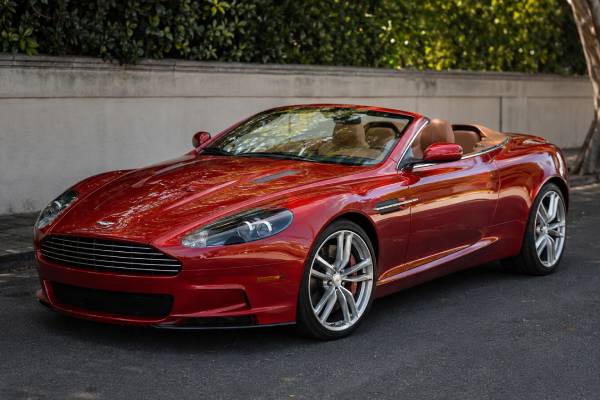
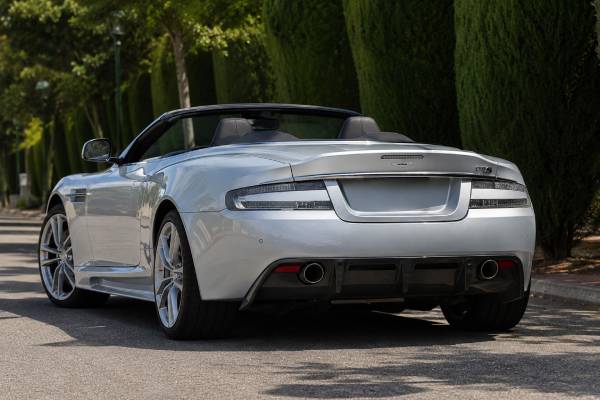
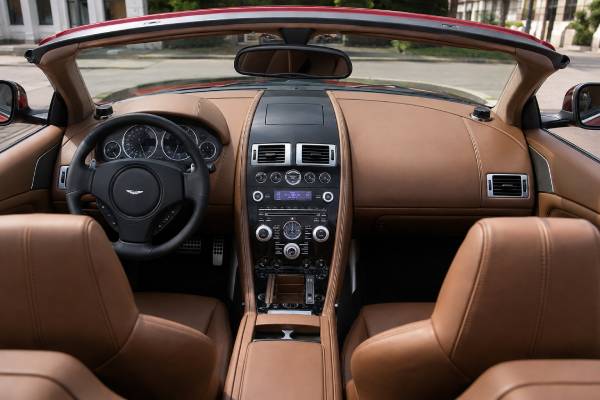
The 2009–2012 Aston Martin DBS Volante turns the naturally aspirated V12 flagship into an open car without reducing its claimed 190 mph capability. That achievement defines the model: it is not simply a DBS coupe with its roof removed, but a carefully reinforced, aerodynamically developed grand tourer built around a compact fabric hood. The 5.9-litre V12, rear transaxle, carbon-ceramic brakes, adaptive dampers, and carbon-fibre body elements remain, while the roof system adds weight, complexity, and a very different ownership experience.
For a buyer, the roof and body condition deserve as much attention as the engine. A healthy Volante should seal cleanly, operate smoothly, remain dry, and feel structurally composed on imperfect roads. A neglected example can conceal water damage, hydraulic or mechanical roof faults, tired seals, damaged carbon trim, worn dampers, or expensive brake needs. This article separates the Volante-specific engineering and inspection points from the advice that applies to the fixed-roof DBS.
Table of Contents
- Why the Volante is different
- DBS Volante specification
- Roof, body, and weather protection
- Performance and road manners
- Service strategy for an open V12
- Faults, wear, and inspection signs
- Choosing the right Volante
Why the Volante is different
The DBS Volante is a high-speed convertible designed to preserve the coupe’s flagship character. Its strongest appeal is sensory: the unfiltered V12 sound, low seating position, and long bonnet turn ordinary journeys into events, while the insulated fabric roof allows the car to remain a usable GT when weather changes.
Production began in 2009, two years after the DBS coupe was revealed. Aston Martin chose a folding fabric hood rather than a heavy retractable hardtop. That decision kept the roof package compact and preserved the flowing rear profile. The hood stows beneath a hard tonneau without creating the tall rear deck seen on some convertibles of the period.
Removing a roof changes how loads travel through a car. The Volante therefore uses structural reinforcement around the sills, floor, windscreen area, rear bulkhead, and other load paths. The additional structure and roof mechanism raise mass to roughly 1,810 kg, depending on specification and the weight standard used. The extra weight is noticeable in rapid direction changes, but it does not turn the car into a soft cruiser. The steering remains direct, the brakes remain powerful, and the rear-mounted transaxle helps preserve balanced weight distribution.
The Volante also offers 2+2 seating, though the rear seats are best treated as occasional space or luggage storage. With the roof folded, luggage capacity is more restricted than in the coupe. Buyers who plan long trips should test their actual bags rather than relying on a volume figure alone.
Three ownership differences matter most:
- the roof must be exercised and maintained, not left untouched for years;
- drains, seals, and water management need routine inspection;
- body flex, rattles, and alignment reveal more about accident repair or wear than they do in the coupe.
DBS Volante specification
This car uses a conventional petrol V12 with no hybrid assistance. Power goes to the rear wheels through a rear-mounted six-speed transaxle. Both manual and Touchtronic 2 automatic versions exist, although automatic cars are far more common in many markets.
| Specification | Value |
|---|---|
| Engine type | All-alloy, naturally aspirated 60-degree V12 |
| Displacement | 5,935 cc (5.9 litres) |
| Valve gear | Four overhead camshafts, 48 valves |
| Maximum power | 510 bhp (517 PS; 380 kW) at 6,500 rpm |
| Maximum torque | 570 Nm (420 lb-ft) at 5,750 rpm |
| Engine location | Front mid-mounted |
| Fuel | Premium unleaded petrol to the market-specific octane requirement |
| Specification | Value |
|---|---|
| Transmission choices | Six-speed manual or six-speed Touchtronic 2 automatic transaxle |
| Drive layout | Rear-wheel drive |
| Differential | Mechanical limited-slip differential |
| Propeller shaft | Carbon-fibre shaft within an alloy torque tube |
| 0–100 km/h (0–62 mph) | Approximately 4.3 seconds |
| Maximum speed | Approximately 306 km/h (190 mph) |
| Specification | Value |
|---|---|
| Body | Two-door fabric-roof Volante with 2+2 seating |
| Structure | Bonded aluminium VH architecture with composite and carbon-fibre panels |
| Length | Approximately 4,721 mm (185.9 in) |
| Width | 1,905 mm (75.0 in), excluding mirrors |
| Height | Approximately 1,280 mm (50.4 in) |
| Wheelbase | 2,740 mm (107.9 in) |
| Kerb weight | Approximately 1,810 kg (3,990 lb), depending on definition and equipment |
| Specification | Value |
|---|---|
| Front suspension | Double wishbones, coil springs, anti-roll bar, adaptive dampers |
| Rear suspension | Double wishbones, coil springs, anti-roll bar, adaptive dampers |
| Front brakes | 398 mm ventilated carbon-ceramic discs with six-piston calipers |
| Rear brakes | 360 mm ventilated carbon-ceramic discs with four-piston calipers |
| Front tyre | Typically 245/35 ZR20 |
| Rear tyre | Typically 295/30 ZR20 |
| Item | Practical note |
|---|---|
| Fuel tank | Approximately 78 litres (20.6 US gal) |
| Roof operation | Fully powered fabric hood; operation should be checked through a complete cycle |
| Roof use | Operate only under the conditions and speed limits stated in the owner’s manual |
| Battery support | A compatible conditioner is advisable for infrequently used cars |
| Tyre replacement | Match size, load, speed rating, and approved type across each axle |
Fuel use is high, especially in short journeys where the engine and transmission rarely reach efficient operating temperature. A steady long-distance drive is the most favourable case. Frequent short starts also place more stress on the battery, exhaust system, and fluids than occasional mileage suggests.
Roof, body, and weather protection
The roof is the defining technical system on the DBS Volante and should be inspected as a complete mechanism. Looking only at the outer fabric is not enough. The frame, drive system, tonneau movement, seals, latches, sensors, drains, headlining, and window indexing all work together.
Begin with the roof closed. The fabric should sit evenly without unusual ripples, local sagging, abrasion marks, or faded patches. Stitching must be intact and the rear glass should be securely bonded. Check the top edge of the windscreen, side windows, rear quarters, and tonneau for equal gaps. One side sitting higher can indicate adjustment problems, worn joints, previous repair, or an interrupted operating cycle.
Run the roof from fully closed to fully open and back again. It should move at a consistent pace, without loud cracking, repeated stopping, hesitation, or help from the operator. Watch the side windows drop and return. A window that fails to index can damage a seal or allow water and wind noise. Do not accept “it only needs resetting” without proving that a reset solves the issue.
Water management is equally important. Convertibles are designed to channel some water through drains rather than exclude every drop at the outer layer. Blocked drains can redirect water into the cabin, boot, or electronic areas. Examine:
- front footwells beneath removable mats;
- carpet edges behind the seats;
- the boot floor and side compartments;
- trim around the roof stowage well;
- seat-belt exit points and rear side panels;
- headlining and the upper windscreen frame.
A perfume, dehumidifier, or freshly shampooed carpet can mask damp. Use touch and smell, and inspect after rain or a controlled water test if the seller agrees. Any water ingress should be traced before purchase because replacing seals without clearing the actual drain or alignment problem can waste money.
The roof fabric benefits from gentle cleaning with products intended for convertible tops. Aggressive pressure washing, household detergents, and stiff brushes can damage the water-repellent finish or force moisture past seams. The mechanism should be kept free of leaves and grit. Lubrication points and adjustment procedures belong to specialist documentation; random application of grease can contaminate trim and attract dirt.
Structural condition is assessed on the road. A small amount of movement over a diagonal driveway is normal in an open car, but strong windscreen shake, clunks from the scuttle, changing door gaps, or repeated trim movement deserves investigation. Compare both sides and drive over the same uneven surface at low speed. Accident repair near the sills or windscreen base is especially important because those areas contribute to open-body stiffness.
Performance and road manners
The Volante gives up some immediacy to the coupe through added mass, yet it retains the essential DBS powertrain and high-speed ability. Its best environment is a fast, flowing road or long motorway journey rather than a tight circuit.
The naturally aspirated engine delivers a smooth rise in output. At low revs it behaves like a large luxury engine, pulling cleanly without drama. As engine speed rises, induction and exhaust noise become more prominent and throttle response feels increasingly urgent. The final third of the rev range is where the car separates itself from a normal grand tourer.
Manual examples demand deliberate inputs. The clutch, gearshift, and hydraulic steering create a physical driving experience, but the extra convertible mass makes smoothness more rewarding than aggression. Touchtronic 2 cars suit relaxed travel and allow manual control through fixed paddles. Drivers accustomed to modern dual-clutch gearboxes should expect slower shifts and a more traditional torque-converter feel.
The adaptive dampers should contain body movement without making the ride brittle. On a rough road, the Volante may feel busier than the coupe because the open structure transmits some secondary movement, but it should remain stable. A car that follows road grooves, tramlines strongly, or feels loose may have old tyres, incorrect pressures, worn suspension components, or poor alignment.
The carbon-ceramic brakes require temperature and pedal familiarisation. In ordinary conditions the pedal should be firm and predictable. Light noise at low speed can occur, particularly after washing or in damp weather, but vibration, heavy pulsing, or grinding is not normal. The system is powerful enough that old tyres can become the limiting factor, which is why tyre age and condition are safety issues rather than cosmetic details.
Roof-down driving changes the perceived speed. Wind management is good for a car of this period, but buffeting depends on seat position, side-window position, and any wind deflector fitted. At high speeds, hearing protection and common sense matter even when the car feels stable. The top-speed figure is not a roof-down recommendation.
Service strategy for an open V12
The best maintenance plan combines annual mechanical servicing with seasonal roof and moisture checks. Low mileage does not justify skipping either. A Volante that covers 1,000 miles in a year may still need more attention than a regularly driven car because seals, battery charge, brakes, and tyres suffer during storage.
A practical yearly routine includes:
- engine oil and filter replacement to the correct specification;
- inspection for oil, coolant, and hydraulic leaks;
- diagnostic scan and battery/charging-system test;
- brake-fluid age check and full carbon-ceramic brake inspection;
- tyre pressure, tread, date-code, and inner-shoulder inspection;
- suspension bush, damper, spring, and alignment assessment;
- roof operation, seal, drain, and water-ingress inspection;
- air-conditioning performance and condensate-drain check;
- underbody, splitter, sill, and diffuser examination.
Spark plugs, filters, coolant, transmission fluids, differential oil, and other service items should follow the market- and VIN-specific schedule. Owners often focus on engine oil while neglecting brake fluid, coolant age, gearbox oil, or the pollen filter. A service invoice should list what was actually changed, not simply state “major service.”
Storage technique matters. The car should be clean and dry, with the roof fully closed and latched unless official guidance states otherwise. Maintain the 12-volt battery with an approved conditioner. Do not leave tyres underinflated, and move the car sufficiently to avoid loading the same tread area for months. Merely starting the engine briefly in a garage is not beneficial; it can add moisture to the oil and exhaust without reaching full temperature.
After a long lay-up, inspect fluid levels, tyre condition, brake surfaces, and the area beneath the car before driving. Operate the roof only after confirming the battery is strong. A voltage drop during a roof cycle can stop the mechanism mid-operation and create a fault that would have been avoided with battery support.
Faults, wear, and inspection signs
Most costly DBS Volante problems give warning signs. The value of a specialist inspection is that it connects those signs to likely systems before a buyer commits.
Powertrain clues
Cold starting should be prompt, with no persistent smoke. A lumpy idle, flashing warning light, or hesitation under load can point to ignition, fuel, intake, or sensor issues. Oil staining around the upper engine and timing-cover regions needs assessment, as does coolant residue around hoses, radiators, and the expansion tank.
On manual cars, test the clutch in a high gear at moderate revs and strong throttle only after the engine is warm and road conditions are safe. Engine speed should not rise without matching acceleration. Check for judder, release-bearing noise, and a very high bite point. Automatic cars should select Drive and Reverse promptly and shift consistently at light and heavy throttle.
Chassis and brake clues
Inspect carbon-ceramic discs under strong light. Chips at the edge, impact marks, severe scoring, or an uneven surface merit specialist measurement. Ask whether wheels have been refurbished; careless removal can strike a disc, and poor refinishing may hide cracks or distortions in a wheel.
Dampers should not leak. Knocking over low-speed bumps can come from bushes, joints, top mounts, or loose trim, so diagnosis should not rely on sound alone. Uneven tyre wear often reveals alignment or suspension issues before the car feels obviously wrong.
Roof and cabin clues
Slow roof movement, asymmetry, repeated warning messages, or manual assistance indicate a fault even if the roof eventually closes. Check the emergency closing tools and instructions are present. Examine the headliner for pinching and the tonneau for contact marks.
Electrical oddities may begin with a weak battery. Confirm both keys work, the alarm behaves normally, and every window completes its short drop-and-rise sequence. Test parking sensors, seat controls, mirrors, audio, navigation display, and climate control. Multiple unrelated warnings appearing together often justify a battery and charging-system test before replacing modules.
Choosing the right Volante
Buy the Volante that proves its condition through records and inspection. Attractive colour combinations and low mileage are secondary to a dry cabin, healthy roof, sound carbon brakes, correct tyres, stable cooling system, and documented servicing.
A thorough purchase file should contain registration history, service stamps, detailed invoices, recall evidence, spare-key information, tyre dates, and any roof or body repair records. Match the options to the original build data where possible. Special colours and rare manual transmissions can add desirability, but only when authenticity is documented.
During the test drive, use the car both roof-up and roof-down. Roof-up driving reveals seal noise, rattles, and water-management issues; roof-down driving exposes tonneau movement, wind-deflector condition, and cabin electronics. Allow enough time for the engine, brakes, and transmission to reach temperature. A five-minute route around a dealership is not a meaningful assessment.
Budgeting should include a contingency beyond routine service. A Volante has every major cost centre of the coupe plus a complex roof. Large expenses can include ceramic discs, adaptive dampers, clutch and flywheel work, automatic-transmission repairs, cooling-system components, carbon-fibre panels, roof mechanisms, seals, and interior trim damaged by water.
Manual examples are rare and may suit a collector who wants maximum interaction. Touchtronic 2 examples are easier to find and can be more relaxed on long trips. The better choice is the one that matches use. A car driven often in traffic may be more enjoyable as an automatic; a weekend car on open roads may justify the manual’s extra involvement.
Before paying a deposit, commission an inspection from a technician who knows both VH-platform Aston Martins and convertible systems. Request a written report with brake condition, diagnostic findings, tyre dates, roof observations, fluid leaks, paint readings, and estimated repair costs. That report is more useful than a generic checklist marked “all good.”
The DBS Volante is not the rational route to open-air speed. It is heavier, more complex, and less practical than the coupe. It succeeds because it preserves the character of a naturally aspirated V12 flagship while making the engine, landscape, and journey more immediate. A carefully chosen car remains a distinctive modern classic; a hurried purchase can turn the same complexity into an expensive restoration project.
Storage history deserves the same attention as mileage. A Volante kept under a waterproof outdoor cover may have suffered trapped condensation even when the hood looks clean, while a garaged car can still develop leaks if drains were ignored. Ask where the vehicle spent winters, whether the roof was normally left raised, and whether any cabin drying, seal replacement, or window adjustment appears on invoices. Inspect after rain if possible rather than relying entirely on a freshly detailed, dry presentation.
A useful ownership test is a quiet drive with the hood raised immediately after the water check. Listen at the header rail, upper glass corners, and rear quarters. A local whistle often points to alignment or seal compression, whereas broad wind noise may be normal for the body style. Photograph and price defects before agreeing terms; roof trim, seals, and adjustment can demand specialist labour even when no major component has failed.
References
- DBS & DBS Volante | Casino Royale Car | Aston Martin (UK) 2026 (Historic Model Page)
- DBS VOLANTE – 2026 (Manufacturer Media Archive)
- DBS – 2026 (Manufacturer Media Archive)
- Vehicle Detail Search – 2009 ASTON MARTIN DBS | NHTSA 2026 (Recall Database)
- October 1, 2010 2010 (Safety Recall Acknowledgement)
- Aston Martin Luxury Car Servicing | Aston Martin 2026 (Manufacturer Service Information)
Disclaimer
This guide is informational and does not replace professional diagnosis, repair, or a model-specific pre-purchase inspection. Specifications, roof procedures, torque values, service intervals, and campaign coverage can differ by VIN, market, model year, and equipment. Check the official owner’s manual, workshop information, and Aston Martin service records before performing work or making a purchase decision.
Sharing this article on Facebook, X/Twitter, or an owners’ group helps support further detailed vehicle guides.