


The original Aston Martin DBX is the 550 PS V8 model that launched the company into the luxury-SUV market. Sold from the 2020 model period through the transition to the refreshed DBX707-led range in 2024, it was not built from a shared mass-market SUV platform. Aston Martin developed a bonded-aluminum structure, fitted a 4.0-liter twin-turbo V8, and combined air suspension with a powerful 48-volt active anti-roll system. The result is a five-seat vehicle that can tow, carry 632 liters of luggage, and cover poor roads while still responding more like a grand tourer than a conventional heavy SUV. Used examples now span early launch cars, heavily optioned Q commissions, and later vehicles with production improvements, so condition and configuration matter more than registration year alone. This guide explains the standard DBX’s engineering, specifications, model-year context, daily behavior, maintenance priorities, and the checks that separate a sound car from an expensive project.
Table of Contents
- Why the original DBX is distinct
- Factory specifications for the 550 PS DBX
- Platform, suspension, and all-wheel drive
- Performance, comfort, and real-world use
- Cabin, practicality, and model-year context
- Maintenance priorities for long-term health
- Used DBX buying process
Why the original DBX is distinct
The 542 hp DBX is the foundation of the AM8 family, not a detuned DBX707 created afterward. Its chassis, packaging, and control systems established the character that later versions intensified.
Aston Martin began physical development testing before the production reveal in November 2019, with prototypes used on public roads, test tracks, off-road routes, and demanding climate programs. The engineering brief had to cover jobs no earlier Aston Martin was designed to do: accommodate adults across two rows, provide a useful cargo area, tow up to 2,700 kg where approved, cope with rough surfaces, and retain high-speed stability.
Rather than adapt an existing sedan or buy a complete SUV architecture, Aston Martin created a dedicated bonded-aluminum platform. Bonding and riveting extrusions, castings, and sheet sections allow stiffness to be placed where required without relying on a single conventional steel unibody recipe. The structure also lets the roofline, wheelbase, seating position, and suspension mounting points serve this specific model. At 2,245 kg in the manufacturer’s published kerb-weight figure, it is not light in absolute terms, but the mass has to be judged alongside a 5,039 mm body, all-wheel drive, air suspension, active roll control, luxury equipment, and towing hardware.
The engine is an Aston Martin-calibrated form of the Mercedes-AMG M177-family 4.0-liter twin-turbo V8. Output is 550 PS, equal to about 542 mechanical horsepower, with 700 Nm of torque. The turbos sit inside the V of the cylinder banks, shortening gas paths and keeping the package compact. Aston Martin developed the intake, exhaust, cooling, software, and drivability for the DBX rather than simply installing another model’s complete powertrain.
The standard car’s identity is balance. It is substantially quicker than most drivers need, but its 4.5-second 0–100 km/h claim is not the only objective. Throttle response, low-speed smoothness, ride quality, steering accuracy, and the ability to remain composed with passengers and luggage matter just as much. Buyers comparing it with the 697 hp DBX707 should therefore decide whether they value the original model’s calmer calibration and lower purchase price more than the later car’s wet-clutch gearbox, carbon-ceramic brakes, and sharper response.
Factory specifications for the 550 PS DBX
This version is a petrol-only internal-combustion SUV. It has no traction motor, plug, or high-voltage propulsion battery; its 48-volt system powers chassis functions such as electronic roll control rather than making the vehicle a hybrid.
| Specification | Value | Notes |
|---|---|---|
| Engine configuration | Twin-turbocharged V8 | Longitudinal front installation |
| Displacement | 3,982 cc (4.0 liters) | M177-family architecture |
| Maximum power | 550 PS (542 hp; 405 kW) | Manufacturer rating |
| Maximum torque | 700 Nm (516 lb-ft) | Manufacturer rating |
| Fuel | Premium unleaded petrol | 98 RON recommended; minimum requirements vary by market |
| Fuel tank | 85 liters (22.5 US gal) | Published original DBX figure |
| Light-load feature | Cylinder deactivation | Operates when control conditions permit |
| Specification | Value |
|---|---|
| Transmission | 9-speed torque-converter automatic |
| Driven wheels | All four wheels |
| Center torque control | Active electronically controlled center differential |
| Rear axle | Electronic limited-slip differential |
| Manual selection | Steering-column-mounted shift paddles |
| Propeller shaft | Carbon-fiber construction |
| Specification | Value | Basis |
|---|---|---|
| 0–100 km/h (0–62 mph) | 4.5 seconds | Manufacturer claim |
| Maximum speed | 291 km/h (181 mph) | Manufacturer claim |
| Maximum braked trailer weight | 2,700 kg (5,952 lb) | Market, hitch, and license conditions apply |
| Seating capacity | 5 | Two rows |
| Luggage volume | 632 liters | Manufacturer figure |
| Rear backrest | 40:20:40 split-folding | Standard layout |
| Specification | Value |
|---|---|
| Length | 5,039 mm (198.4 in) |
| Width without mirrors | 1,998 mm (78.7 in) |
| Width with mirrors | 2,220 mm (87.4 in) |
| Height | 1,680 mm (66.1 in) |
| Wheelbase | 3,060 mm (120.5 in) |
| Turning circle | 12.4 m (40.7 ft) |
| Kerb weight | 2,245 kg (4,949 lb) |
| Specification | Value | Configuration |
|---|---|---|
| Front suspension | Double wishbone | Adaptive dampers and air springs |
| Rear suspension | Multi-link | Adaptive dampers and air springs |
| Air-spring design | Triple chamber | Variable effective spring rate |
| Ride-height range | Up to 45 mm higher or 50 mm lower | Relative to standard setting; operating limits apply |
| Active roll control | 48-volt eARC | Up to 1,400 Nm per axle |
| Front brake discs | 410 mm ventilated iron | Six-piston calipers |
| Rear brake discs | 390 mm ventilated iron | Electronic parking brake |
| Common 22-inch front tire | 285/40 R22 | Check actual wheel package |
| Common 22-inch rear tire | 325/35 R22 | Check actual wheel package |
These are core factory figures, not a substitute for a VIN-specific data card. Wheels, seats, driver-assistance equipment, regional lighting, emissions hardware, and trim vary widely, especially because Q personalisation was an important part of DBX ordering.
Platform, suspension, and all-wheel drive
The DBX’s ability to feel smaller than its dimensions comes mainly from its body control and torque management. The systems work together, so a fault in tires, alignment, ride height, or voltage can change the character of the whole vehicle.
The front double-wishbone and rear multi-link layouts give engineers independent control over wheel movement and alignment through suspension travel. Triple-chamber air springs can connect or isolate air volumes, changing effective stiffness without requiring a harsh fixed spring. Adaptive dampers then adjust resistance to vertical motion. This separates two jobs: the air system supports the body and changes spring behavior, while the dampers control how quickly movement occurs.
Electronic active roll control, called eARC, uses a 48-volt electrical supply to apply counter-torque at the axles. Aston Martin quoted up to 1,400 Nm of anti-roll force per axle. On a straight, the system can allow more independence between left and right wheels for comfort; in a corner, it resists lean. That is why a DBX can ride a broken road without the permanently stiff feel often associated with heavy performance SUVs.
The height adjustment also serves more than off-road image. Raising the body improves clearance at low speed, while lowering can aid loading, entry, aerodynamics, or high-speed stability depending on the selected mode. Control software limits certain heights by speed, and owners should not expect the car to remain at its maximum setting on a motorway. A healthy system moves without one corner lagging, repeated compressor cycling, or persistent suspension messages.
All-wheel drive uses an active center differential and an electronic rear limited-slip differential. The center device alters front-to-rear distribution, while the rear unit manages torque across the axle. The advantage is predictive control: the car can prepare for a corner or a low-grip event based on steering angle, throttle, yaw, and wheel-speed information rather than waiting for prolonged spin.
Correct tires are part of that control network. Four different tread depths or unapproved constructions can produce small rolling-radius differences. Those differences may keep the center system working when it should be relaxed, create low-speed binding sensations, or reduce the accuracy of stability-control decisions. On a prospective purchase, brand, model, size, speed rating, load rating, date code, and tread depth are all relevant. A set of premium tires is a smaller expense than diagnosing driveline behavior caused by a mismatched set.
Steering is electrically assisted but calibrated for response rather than isolation. It should feel consistent as lock is added and return cleanly after a turn. Notches, noises, a crooked steering wheel, or a tendency to follow road camber can come from tires and alignment, but damage or sensor calibration must also be considered. Because the wheels are large and the vehicle is wide, curb and pothole impacts are common enough to justify a careful geometry check.
Performance, comfort, and real-world use
The original DBX is fast without being frantic. Its strongest real-world quality is the way it delivers broad V8 torque and controlled movement while still allowing smooth starts and quiet long-distance travel.
The torque converter helps the car creep gently and launch without the low-speed abruptness of a performance clutch. In normal modes, the nine-speed gearbox uses the engine’s 700 Nm output rather than holding unnecessary revs. Sport settings sharpen throttle and shifts, keep gears longer, alter exhaust behavior, and command firmer chassis responses. Manual paddles are useful on descents because they let the driver hold a lower gear and reduce repeated brake use.
A 4.5-second sprint to 100 km/h remains serious performance for a 2.2-tonne SUV. More important is the easy mid-range acceleration available for overtaking. The vehicle should pull cleanly once warm, with no hesitation, warning lamp, or sudden reduction in output. Strong performance tests should never be attempted on a cold engine or during an inspection before oil and coolant have reached normal temperature.
The brake system uses large iron discs rather than the carbon-ceramic equipment fitted to the DBX707. Iron rotors generally tolerate everyday low-temperature use well and can be less costly to replace, but the size and vehicle mass still make service expensive. Brake feel should be progressive. Judder can indicate disc thickness variation, deposits, corrosion, wheel issues, or suspension play, so diagnosis should not jump directly to one cause.
Ride quality depends heavily on wheel choice and tire condition. A car on large wheels with hardened, overinflated, or unevenly worn tires can feel much harsher than the suspension design intends. Test the same example on sharp urban edges, a flowing road, and a steady motorway. Listen for knocks at low speed and observe whether the body continues bouncing after a crest. A luxury SUV should settle promptly without crashing over every joint.
Terrain modes and raised suspension give the DBX useful ability on snow, gravel, wet fields, and rutted access roads. It is not designed as a substitute for a low-range expedition vehicle. Ground clearance, tire sidewalls, approach angles, cooling, and recovery options still set limits. The low-profile performance tires fitted to many cars are often the first constraint. Drivers who regularly face winter conditions should use a complete, approved winter wheel-and-tire package rather than relying on electronics alone.
Towing is credible because of the long wheelbase, torque, and 2,700 kg rating, but setup matters. Use the approved tow system and confirm local nose-weight, train-weight, speed, and license restrictions. Trailer stability cannot correct poor loading. Heavy items belong low and near the trailer axle, tire pressures should be adjusted as specified, and the driver should allow far more braking distance.
Cabin, practicality, and model-year context
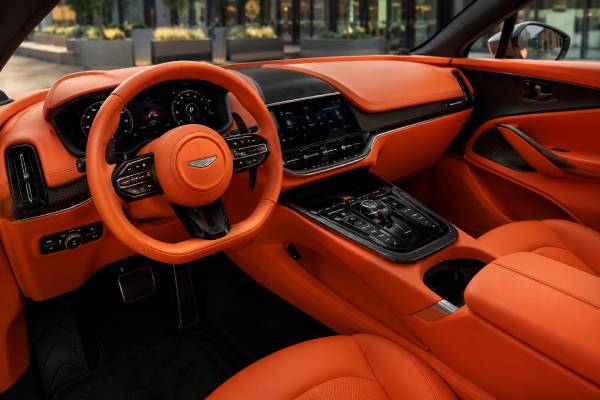
The DBX cabin is spacious and richly finished, but the 2020–2024 original model must be understood as the first-generation interior, not the later redesigned touchscreen environment. A buyer should assess its controls on their own merits rather than assume that every DBX has the same electronics.
The long 3,060 mm wheelbase creates genuine rear legroom, and the roof shape avoids the severe headroom sacrifice found in some coupe-style SUVs. The center console is bridged, leaving storage below for a handbag or large bottle. Door pockets, a glovebox, rear storage, and the 632-liter luggage bay make the vehicle practical for travel. The three-part rear backrest permits long items to pass through while two outer passengers remain seated.
Front visibility is good for a vehicle this size, but the body is nearly two meters wide before mirrors. Camera clarity, parking sensors, mirror folding, and surround-view stitching should all be tested. One failed camera may affect the usefulness of several displayed views. Also inspect the powered tailgate for smooth travel and correct stopping, especially where a low garage ceiling may have led an owner to set a reduced opening height.
Original DBX models use a 12.3-inch digital instrument panel and a 10.25-inch center display with a console controller. Apple CarPlay availability and other functions can depend on market and software. This system differs materially from the in-house touchscreen arrangement introduced in the comprehensively updated DBX707 cabin for the 2024 production period. The older interface is not automatically defective because it lacks the newest design, but slow startup, spontaneous reboots, dead pixels, failed audio channels, or non-working controls should be priced as faults.
The model-year labels can be confusing because registration date, build date, and market introduction do not always match. Early cars may have been built in 2020 and registered later. Limited editions such as Bowmore or AMR-themed models have their own specifications. The original 550 PS DBX remained the core V8 offering until Aston Martin repositioned the updated DBX707 as its sole SUV powertrain in 2024. That does not mean every car registered in 2024 has the refreshed interior; verify the actual build record and cabin design.
Options influence experience and resale. Seat style, ventilation, audio system, wheel design, exterior packs, towing equipment, paint, and Q materials can differ. More equipment is not always better. A complex option that does not work is a liability, while a restrained specification with excellent history may be easier to own. Confirm every advertised feature physically and against the factory order data.
Maintenance priorities for long-term health
A DBX responds best to regular specialist attention, stable battery voltage, correct tires, and complete diagnostic work. Low annual mileage does not remove time-based maintenance needs and can create its own problems through inactivity.
Engine oil should be renewed according to the official schedule for the VIN and operating market, with the specified oil standard rather than a generic “fully synthetic” substitute. Repeated short trips, track-style use, towing, dust, or long storage can justify more conservative care. Allow the engine to warm before sustained boost and give it a gentler final mile after hard running so temperatures can stabilize.
Cooling inspection should cover visible hoses, expansion tanks, radiator faces, intercooler circuits, fans, and dried deposits. The tightly packaged hot-V engine produces significant heat. A sweet smell, recurring low level, fan that runs unusually often, or residue around joints deserves a pressure test and correct diagnosis. Coolant type cannot be chosen by color alone, and bleeding procedures must follow service information.
The 12-volt battery is a frequent source of misleading symptoms in low-use luxury cars. Modules may record communication faults or disable functions as voltage drops. Keep stored vehicles on an approved conditioner connected at the designated points. A battery test should measure capacity and starting performance, not merely show 12 volts at rest. After replacement, any required registration or adaptation must be completed.
Suspension care begins with observation. Record the parked height, look again after several hours, and note compressor frequency. Inspect air lines and dampers for leaks, check ride-height sensor links, and scan chassis modules. Replacing a compressor without finding an air leak can destroy the new unit. Likewise, a warning caused by low voltage should not prompt parts replacement before the electrical supply is stable.
Driveline fluids and adaptation procedures are model-specific. The nine-speed transmission, active center unit, front differential, and electronic rear differential work under high load. Follow Aston Martin intervals and fluid specifications, particularly if the vehicle has towed or spent time in heat. Shudder, delayed engagement, or clunks require a road test and data review; random fluid additives are not a repair.
Brakes, tires, and alignment deserve inspection at every service. Measure inner and outer pads, inspect both disc faces, and clean corrosion from mounting surfaces when work is performed. Check the inside edges of all tires with the vehicle safely lifted. A steering wheel that is off-center after tire replacement is a reason for geometry measurement, not cosmetic repositioning.
Finally, maintain a record of software updates and campaigns. Modern DBX behavior depends on coordinated control modules. An update may address drivability, infotainment, charging, or warning logic, but software should not be applied blindly to mask a hardware problem. Ask the servicing workshop to document fault codes before and after work.
Used DBX buying process
A successful DBX purchase is evidence-led: identify the exact car, inspect it cold, scan it fully, and cost every defect before agreeing on value. Appearance and low mileage are not enough for a vehicle with interconnected chassis, driveline, and electronic systems.
Begin with identity. Match the VIN in the windscreen, body, documents, and diagnostic report. Obtain the factory specification and verify paint, trim, wheels, brakes, seats, towing equipment, and Q features. Check registration and title history, outstanding finance where the local system allows, accident records, and manufacturer campaign status. Recall lookup should be VIN-based because applicability can differ within a model year.
Service history should show time as well as distance. Look for itemized invoices from an Aston Martin dealer or qualified specialist, not only book stamps. Note gaps, repeated visits for the same warning, battery replacements, tire dates, alignment work, software updates, and cooling or suspension repairs. A recent expensive repair can be reassuring when it is documented and completed correctly; vague claims that “everything was done” are not.
Inspect before the engine is started. Look beneath the front and center of the vehicle for leaks or damaged undertrays. Check panel gaps, paint texture, glass dates, wheel rims, tire shoulders, brake surfaces, and the condition of lower bodywork. Inside, operate every seat movement, heater, ventilation function, climate zone, camera, light, switch, power outlet, key, and tailgate setting.
The professional inspection should include a complete module scan, battery and charging tests, cooling-system pressure checks, suspension leak-down observation, brake measurements, wheel and tire assessment, and a lift inspection of joints, bushings, lines, exhaust, and underbody. Compression or more invasive tests are not routine on every healthy car, but they may be justified by symptoms or history.
Drive the car from cold through several conditions. Initial engagement should be prompt and controlled. At low speed, listen for clicking, binding, knocks, and brake scrape. On a faster road, check steering-center stability, gearbox shifts, boost delivery, vibration, and damper control. Use all chassis modes once it is safe and warm. After the drive, recheck fluid odor, fan behavior, leaks, and stored faults.
Budget beyond the purchase price. Insurance, premium fuel, large tires, brakes, annual servicing, battery care, and unexpected electronic or suspension work are normal parts of ownership. A warranty can reduce risk, but read exclusions, labor-rate limits, diagnosis rules, and claim authorization requirements. Confirm whether the policy covers air suspension, active roll control, infotainment, differentials, and consequential damage.
The original DBX is a strong choice for a buyer who wants Aston Martin character with family and touring usefulness, and who does not need the DBX707’s extra edge. Its dedicated platform and sophisticated suspension remain technically interesting, while the 550 PS V8 supplies more than enough pace. The right example will feel cohesive, quiet, and controlled. The wrong one may display a collection of seemingly minor faults that are expensive because they involve systems, not isolated parts. Buy the history and behavior of the individual car, not merely the badge or model year.
References
- ASTON MARTIN UNVEILS DBX: AN SUV WITH THE SOUL OF A SPORTS CAR | Aston Martin 2019 (Manufacturer Launch)
- ASTON MARTIN’S FIRST SUV POWERS INTO FINAL STAGES OF DEVELOPMENT | Aston Martin 2019 (Development Information)
- ASTON MARTIN OPENS DOOR TO INTERIOR DETAILS & PRICING OF DBX | Aston Martin USA 2019 (Interior Details)
- Aston Martin DBX 2026 (Manufacturer Pre-Owned Model Guide)
- DBX Quick Start Guide | Aston Martin UK 2026 (Quick Start Guide)
- Check for Recalls: Vehicle, Car Seat, Tire, Equipment | NHTSA 2026 (Recall Database)
Disclaimer
This article provides general information and is not a replacement for professional diagnosis or repair. Specifications, maintenance intervals, torque values, software, and procedures can change with VIN, market, equipment, and production date, so consult the official Aston Martin service information for the vehicle. Arrange an independent specialist inspection before purchase. Sharing this guide on Facebook, X/Twitter, or another platform helps support our work.