
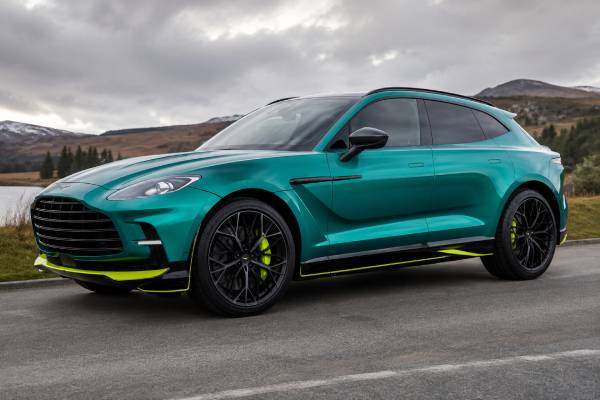
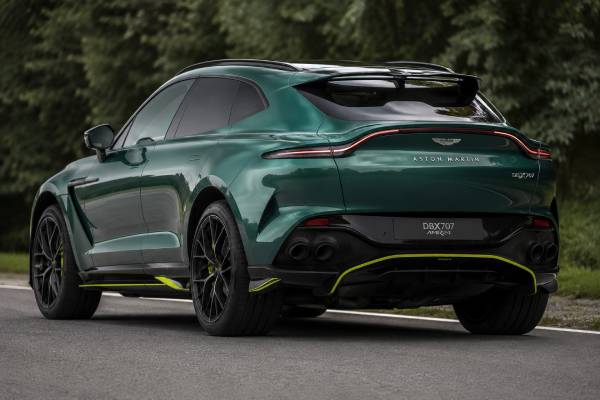
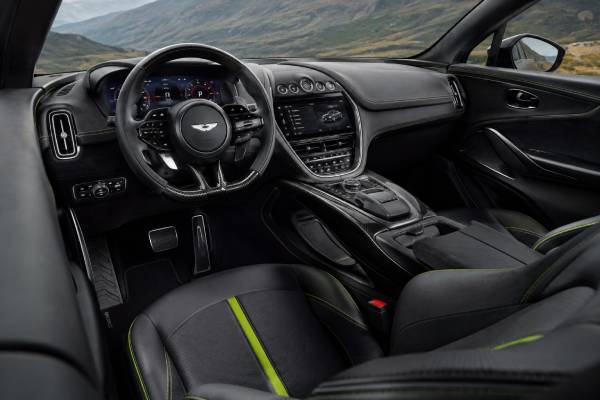
The Aston Martin DBX707 AMR24 Edition pairs the 697 hp DBX707 with the redesigned cabin and Formula 1-inspired appearance introduced for the 2024 production update. Announced in July 2024, it offers Podium Green, Onyx Black, or Neutron White paint; Racing Green or AMR Lime brake calipers; 23-inch Fortis wheels; optional lime or Trophy Silver accents; an AMR24 engine plaque; and two distinct interior colorways. Unlike the earlier AMR23 Edition, the AMR24 is built around Aston Martin’s newer dashboard, touchscreen infotainment, wireless smartphone integration, and revised chassis software. Its engine, wet-clutch transmission, carbon-ceramic brakes, and 707 PS output remain standard DBX707 hardware. This makes the edition an important crossover point: it combines a named racing theme with the more modern cabin many buyers wanted, but it does not provide a separate performance tune. The following guide explains what is genuinely unique, how the updated systems affect ownership, which specifications apply, and how to authenticate and inspect a 2024 or 2025 example.
Table of Contents
- AMR24 Edition in one clear definition
- Performance and chassis specification
- Three exteriors, two cabins, and one engine plaque
- The 2024 cabin is the major functional change
- How the AMR24 differs from the AMR23
- Maintenance for a high-output connected SUV
- Buyer checklist and edition verification
AMR24 Edition in one clear definition
The AMR24 Edition is a factory color-and-trim curation for the updated DBX707, named after Aston Martin’s 2024 Formula 1 challenger. It carries the road SUV’s normal 707 PS mechanical specification and adds edition-specific identification rather than extra horsepower.
Aston Martin announced the model on July 3, 2024. The company described it as sharing a racing identity with the AMR24 Formula 1 car and the official DBX707 medical car. The phrase “racing identity” is the accurate one: the road vehicle does not share the race car’s chassis, hybrid system, aerodynamics, or competition components. Its link is expressed through color, trim, plaques, and the wider brand story.
The timing is significant. In April 2024, Aston Martin had already revealed a comprehensive DBX707 update with an in-house infotainment system, new dashboard, new center console, improved cameras, presenting door handles, revised mirrors, and detail changes to damper and air-spring calibration. Production of that refreshed car was due to begin in the second quarter of 2024. The AMR24 Edition therefore starts with the new interior rather than the earlier DBX architecture used when the AMR23 Edition was announced.
The factory listed three exterior colors and multiple combinations instead of one mandatory appearance. A legitimate AMR24 can be Podium Green, Onyx Black, or Neutron White. Calipers can be Aston Martin Racing Green or AMR Lime. The 23-inch Fortis wheel can be satin or gloss black. Lower body treatment can use gloss black or carbon fiber, with Lime Green or Trophy Silver accents. This flexibility means there is no single photograph against which every car can be judged.
Inside, buyers could choose an Onyx Black monotone Inspire Sport cabin with lime stitching and piping, or an Onyx Black and Eifel Green duotone treatment with lime contrast stitching. Detail selections included extended carbon fiber with dark-chrome jewelry or titanium mesh with satin chrome. AMR24 engraving on the sills, a foil Aston Martin logo on the dash, a lime hand-stitched saddle strap at the wireless charging area, and the exclusive engine plaque provide more specific references.
Aston Martin did not publish a fixed global production number in the launch release. Treat any numbered rarity claim as unverified until supported by a factory or market-allocation document.
Performance and chassis specification
The AMR24 is an internal-combustion DBX707 with no traction hybrid system. Its speed comes from a twin-turbo V8, direct wet-clutch gearbox, active all-wheel drive, carbon-ceramic braking, and electronically coordinated suspension.
| Specification | Value | Source context |
|---|---|---|
| Engine layout | 4.0-liter twin-turbo V8 | DBX707 specification |
| Displacement | 3,982 cc | 83 mm bore; 92 mm stroke |
| Compression ratio | 8.6:1 | Manufacturer full specification |
| Maximum power | 707 PS (697 hp; 520 kW) at 6,000 rpm | Unchanged for AMR24 |
| Maximum torque | 900 Nm (663 lb-ft) at 4,500 rpm | Unchanged for AMR24 |
| Fuel type | Premium unleaded petrol | Required octane differs by market |
| Fuel tank | 87 liters (23.0 US gal) | DBX707 manufacturer figure |
| Specification | Value | Operation |
|---|---|---|
| Transmission | 9-speed automatic with wet starting clutch | Supports fast shifts and launch control |
| Driven wheels | All-wheel drive | Active front-to-rear torque management |
| Rear torque capability | Up to 100 percent | Demand and grip dependent |
| Rear differential | Electronic limited-slip unit | Controls left-to-right torque |
| Propeller shaft | Carbon fiber | Lower rotating mass than steel |
| Manual control | Steering-column shift paddles | Gear retention under driver command |
| Specification | Value | Basis |
|---|---|---|
| 0–60 mph | 3.1 seconds | Manufacturer claim |
| 0–100 km/h (0–62 mph) | 3.3 seconds | Manufacturer claim |
| 0–160 km/h (0–100 mph) | 7.4 seconds | Manufacturer claim |
| Maximum speed | 310 km/h (193 mph) | Manufacturer claim |
| WLTP combined consumption | 14.2 L/100 km (19.9 UK mpg) | Published DBX707 figure |
| Maximum braked towing mass | 2,700 kg (5,940 lb) | Correct tow equipment and local approval required |
| Specification | Value |
|---|---|
| Body style | Five-door performance SUV |
| Seating | 5 |
| Length | 5,039 mm (198.4 in) |
| Width excluding mirrors | 1,998 mm (78.7 in) |
| Width including mirrors | 2,220 mm (87.4 in) |
| Height | 1,680 mm (66.1 in) |
| Wheelbase | 3,060 mm (120.5 in) |
| Luggage volume | 632 liters |
| Rear backrest | 40:20:40 split-folding |
| Component | Specification | AMR24 configuration |
|---|---|---|
| Front suspension | Double wishbone, adaptive damping, air spring | Updated 2024 software calibration |
| Rear suspension | Multi-link, adaptive damping, air spring | Updated 2024 software calibration |
| Body-roll control | 48-volt electronic active system | Integrated with drive modes |
| Front brakes | 420 mm carbon-ceramic discs | Six-piston calipers; Racing Green or AMR Lime |
| Rear brakes | 390 mm carbon-ceramic discs | Electronic parking brake |
| Edition wheels | 23-inch Fortis | Satin black or gloss black |
| Front tires for 23-inch package | 285/35 R23 | Use approved construction and load rating |
| Rear tires for 23-inch package | 325/30 R23 | Use approved construction and load rating |
The updated 2024 car received calibration changes intended to improve transient body control, but Aston Martin said the class-leading core hardware was unchanged. The AMR24 release did not identify a separate edition-only chassis map.
Three exteriors, two cabins, and one engine plaque
Authentication begins by accepting that factory variation is intentional. The AMR24 is a curated menu, so a white car with silver accents can be as genuine as the green-and-lime combination most often pictured.
Podium Green provides the closest visual link to the Formula 1 team. Onyx Black makes the accent color and body shape more graphic, while Neutron White creates a high-contrast technical appearance. Each paint needs a different inspection approach. Metallic and gloss finishes can be measured and polished with care; any satin or special finish requires methods appropriate to its surface. Check the factory paint code and Q order rather than relying on a sales description such as “racing green.”
The lower package may be gloss black or visible carbon fiber. Lime Green accents are the obvious motorsport choice, while Trophy Silver offers a quieter link. Inspect accent alignment from front to rear, especially at joins between splitter, sill, and diffuser. Stone impacts are expected on a used SUV, but rough edges, incorrect line width, or a color mismatch can show that one section was remade without the proper reference.
Fortis wheels are part of the advertised AMR24 specification. Both satin and gloss black were offered, so refinishing must match the original order. Examine spoke roots and inner barrels for cracks, deformation, or excessive coating that hides damage. The wide 23-inch tires provide little protection against potholes. A cosmetic wheel repair is acceptable when structurally assessed and documented; an unknown weld is not.
Inside, the monotone Onyx Black option uses lime stitching and piping to create the theme. The duotone option adds Eifel Green leather with lime contrast stitching. Carbon and dark chrome produce the more overtly sporting environment; titanium mesh and satin chrome appear brighter and more technical. Compare seat perforation, piping, stitching, dash trim, door veneers, and jewelry to the build data.
The small details are useful because they are harder to reproduce coherently:
- AMR24 etched into the door sills;
- Aston Martin logo applied in foil to the dashboard panel;
- lime hand-stitched saddle strap at the wireless charging station;
- AMR24 plaque on the engine;
- correct caliper color, wheel finish, and exterior accent combination.
The engine plaque deserves close inspection for attachment, typography, finish, and agreement with delivery photographs. It proves little by itself because a plaque can be moved. Its evidential value comes from matching a VIN-confirmed edition with all the surrounding details intact.
The 2024 cabin is the major functional change
For an owner, the AMR24’s new interior matters more every day than its Formula 1 branding. It replaces the earlier console-driven infotainment arrangement with Aston Martin’s own connected touchscreen system while retaining physical controls for important vehicle functions.
A 12.3-inch driver display sits behind the steering wheel, and a 10.25-inch central touchscreen is integrated into the dashboard. The central display supports capacitive touch and multi-finger gestures. Wireless Apple CarPlay and Android Auto, multiple USB-C connections, online connectivity, and support through the Aston Martin customer app were part of the update. Availability of individual connected services still depends on market, subscription, phone, and software version.
Aston Martin retained dedicated controls for gear selection, drive mode, heating and ventilation. Separate switches also provide access to suspension, stability control, exhaust, lane support, and parking sensors. This reduces the need to search through a screen while driving. During inspection, verify both the digital command and the physical control because a button can operate while a display tile fails, or the reverse.
The dashboard has a stronger horizontal line, vertical air vents, redesigned door pulls, and new material areas. Presenting exterior door handles move outward when the car is unlocked, and revised mirrors integrate cameras for the 3D parking view. These features add convenience but also add motors, sensors, heaters, cameras, and calibration points. Test every handle repeatedly from both keys and confirm that mirrors move, fold, heat, and display clear camera images.
Standard audio became a 14-speaker, 800-watt Aston Martin Premium system. The optional Bowers & Wilkins setup uses 23 speakers and 1,600 watts, including overhead channels, dedicated bass speakers, and a subwoofer. Confirm the original audio option from the build record, then listen to each area at modest volume. Buzzing trim, a silent channel, or amplifier shutdown should not be dismissed because the system is complex.
Wireless charging is especially relevant because the AMR24 saddle strap identifies the edition. Test charging with a compatible phone after removing an unusually thick case. Excessive heat, repeated connection loss, or a warning may involve alignment, the phone, software, or the charging pad. Avoid cutting or replacing the strap without first documenting its exact stitching and attachment.
The updated interior also provides a clear date marker. A claimed AMR24 with the old dashboard deserves immediate documentary explanation. Registration timing alone cannot turn an earlier car into the factory edition announced in July 2024.
How the AMR24 differs from the AMR23
The AMR24 is not merely an AMR23 with a changed number. It uses a broader exterior palette, a revised set of edition markers, and the later DBX707 cabin, while the engine and headline performance remain the same.
The AMR23 launched around Podium Green, Racing Green calipers, Q fender badges, lime-accented carbon elements, and an Onyx Black/Eifel Green interior. The AMR24 permits Podium Green, Onyx Black, or Neutron White; Racing Green or AMR Lime calipers; Lime Green or Trophy Silver accents; two interior colorways; and a specific engine plaque. The AMR24 release emphasizes the updated dashboard and Bowers & Wilkins system.
That produces several practical buying distinctions:
- Choose AMR23 for the direct visual connection to Aston Martin’s successful 2023 season and its launch-era Podium Green exclusivity.
- Choose AMR24 for the newer touchscreen, app connectivity, revised dashboard, updated cameras, and broader factory color choice.
- Do not expect a performance advantage from one edition to the other; both use 707 PS and 900 Nm.
- Compare build date and actual cabin, not only the model year printed in an advertisement.
- Verify edition details separately because ordinary DBX707s can now be ordered in colors once associated with special models.
The AMR24’s wider option range makes documentary evidence even more important. A visual checklist copied from one press car can incorrectly reject another genuine car. Factory build data should identify exterior paint, lower package, accent color, wheel finish, caliper color, interior environment, veneer, jewelry, audio, and edition items.
Condition can outweigh edition preference. A properly maintained AMR23 with complete records may be a better purchase than a neglected AMR24 with damaged carbon ceramics and an incomplete digital account. Conversely, a buyer who finds the older interface frustrating may never enjoy the earlier car despite its provenance. The right choice is the version whose history, cabin, and intended use align.
Neither edition should be treated as a substitute for the Formula 1 car. Their appeal is the way a road-going SUV captures a season’s visual language while preserving full five-seat practicality. That is a stronger and more accurate story than unsupported claims about race-derived components.
Maintenance for a high-output connected SUV
The AMR24 needs traditional high-performance service and modern software discipline. Mechanical health, battery voltage, network connectivity, and account ownership all affect whether the vehicle works as designed.
Service the V8 by VIN, using the specified oil approval, filter, and interval. Low annual distance is not a reason to leave old oil in a turbocharged engine. Short trips can add moisture and fuel dilution, while high-load use raises heat. Warm the engine before sustained boost and avoid shutting it down immediately after an intense run.
Inspect the cooling package at every visit. The front openings can collect insects, leaves, and road debris; bent or blocked fins reduce heat exchange. Look for dried coolant, hose swelling, reservoir changes, oil seepage, and fans that run unexpectedly. Pressure testing and scan data should guide repair. Never mix coolant because two fluids happen to share a color.
The wet clutch and nine-speed transmission should engage consistently from cold and shift cleanly after warm-up. Parking-speed feel is more direct than a torque converter, but shudder, delay, overheated-clutch messages, or harsh repeated engagement require investigation. Follow official fluid and adaptation procedures rather than applying a generic schedule from another M177 vehicle.
Air springs, dampers, and active roll control should be scanned and physically tested. Park on level ground, measure corner heights, operate permitted modes, and recheck later. Frequent compressor running indicates that leakage or sensor trouble may be forcing the pump to compensate. Correct the cause before the compressor is damaged.
Carbon-ceramic brakes require trained inspection. Protect discs during wheel removal and keep them free of oil and detailing products. Pad thickness, disc surface, edge condition, impacts, and manufacturer wear criteria all matter. Carbon ceramics can be durable in correct use, but replacement is costly enough that a written condition report is valuable.
Tire pressure and matching are critical on the 23-inch staggered fitment. Inspect inner shoulders, sidewall bubbles, flat spots, date codes, and tread-depth differences. One replacement tire of a different construction may affect steering and all-wheel-drive operation even when its nominal size matches. Alignment should be measured after a pothole strike or unexplained wear.
The 12-volt battery supports presenting handles, cameras, displays, locks, trackers, connected services, and control modules. Use an approved conditioner during storage. Diagnose low-voltage events before replacing unrelated electronics. Keep software updates, app account changes, subscriptions, and campaign work documented. When ownership changes, the seller should remove personal data and transfer or release connected services through the proper process.
For finish care, match the method to paint, carbon, accent material, wheel coating, and interior leather. Avoid harsh wheel acid near painted calipers and carbon discs. Keep the engine plaque dry and do not polish away its surface. Photograph edition details before repair and retain replaced original parts.
Buyer checklist and edition verification
The right AMR24 should pass three tests: factory identity, current technical condition, and digital handover readiness. A failure in any one area can create cost or uncertainty after purchase.
Ask for the VIN and contact an authorized Aston Martin source before viewing. Confirm that the record identifies an AMR24 Edition and lists its exact paint, accent, wheel, caliper, cabin, trim, audio, and market. Request the original invoice, order sheet, warranty-start date, service printout, campaign status, and any Q correspondence. Do not accept a generic DBX707 certificate as proof of the named edition.
Check the physical identifiers in a logical sequence. Begin outside with paint, lower package, accents, wheels, calipers, and badges. Continue under the bonnet with the AMR24 engine plaque. Inside, inspect sill engraving, dash foil logo, saddle strap, seat colorway, stitching, piping, veneer, jewelry, and audio equipment. Photograph discrepancies and ask for documentation of any repair or replacement.
The mechanical and electronic examination should include:
- Cold start and complete dashboard self-check without a pre-cleared warning history.
- Full-module diagnostic scan, battery test, charging assessment, and software-version review.
- Engine oil and coolant inspection, cooling-system pressure test, and turbo/charge-air checks.
- Low-speed wet-clutch behavior, warm shift quality, differential operation, and driveline vibration.
- Air-suspension height changes, parked level retention, damper leaks, and active roll-control data.
- Carbon-ceramic disc and pad evaluation under official criteria.
- Tire date, inner wear, construction, tread matching, wheel runout, and alignment.
- Paint-depth mapping, carbon inspection, accent alignment, and film condition.
- Every touchscreen zone, physical switch, camera, presenting handle, mirror, climate function, seat, key, tailgate, and audio channel.
- App eligibility, account release, subscriptions, tracker status, privacy reset, and local connected-service support.
Drive the vehicle only after it is warm enough for meaningful assessment. Begin with gentle maneuvering, then use an uneven road, a steady cruise, and progressive acceleration. The body should settle quickly, steering should remain centered, and shifts should be decisive without repeated shock. Braking should be stable and straight. Re-scan after the drive because heat- or speed-dependent faults may not appear while stationary.
Estimate near-term costs before setting a price. Include annual service, battery age, tire life, brake condition, wheel repair, paint or film work, software support, warranty, and insurance. An AMR24 premium is difficult to justify when its unique items are missing or undocumented. A standard refreshed DBX707 may be the better value for a driver who cares mainly about the new cabin.
The AMR24 Edition’s strongest case is its combination of the DBX707’s established performance, the 2024 technology overhaul, and a clearly named Formula 1 theme. It is more usable than a purely decorative special because the cabin update improves daily interaction. Still, the purchase should be based on evidence rather than race imagery. Confirm the factory record, inspect the high-cost systems, complete the digital handover, and choose the specification you will enjoy rather than the one most often photographed.
References
- Aston Martin unifies the marque’s exhilarating Formula 1® racing pedigree and the supercar of SUVs with unique DBX707 AMR24 – 2024 (Edition Launch)
- Aston Martin DBX707: Technically advanced interior to match class-leading performance – 2024 (Interior and Chassis Update)
- Aston Martin DBX707 Satin Neutron White – Full Specification – 2022 (Technical Specifications)
- Introducing the Aston Martin DBX707: The world’s most powerful luxury SUV – 2022 (Engineering Background)
- Aston Martin DBX707 | Luxury SUV | Aston Martin 2026 (Model Information)
- Check for Recalls: Vehicle, Car Seat, Tire, Equipment | NHTSA 2026 (Recall Database)
Disclaimer
This guide is for informational purposes and is not a substitute for professional diagnosis, repair, software support, valuation, or edition authentication. Specifications, torque values, maintenance intervals, connected features, and procedures can vary by VIN, market, options, and build date; verify them through official Aston Martin service documentation. Obtain an independent specialist inspection before purchase. Please share the article on Facebook, X/Twitter, or another platform if it was valuable.