
The Aston Martin DBX S is the lighter, more powerful flagship introduced above the continuing DBX707. Announced in April 2025 with customer deliveries expected from the fourth quarter, it raises the twin-turbo V8 to 727 PS, or about 717 hp, by using larger compressor wheels and internal turbo technology transferred from the Valhalla program. Torque remains 900 Nm, while revised gearbox logic, a four-percent faster steering ratio, a 12.0-meter turning circle, new bodywork, and optional lightweight components sharpen the vehicle’s response. A carbon-fiber roof, magnesium wheels, polycarbonate grille, and carbon lower panels can reduce mass by as much as 47 kg, but that maximum applies only to a carefully selected specification. The standard car does not automatically include every weight-saving part. DBX S also retains five seats, all-wheel drive, carbon-ceramic brakes, air suspension, and the modern Aston Martin touchscreen cabin. This guide explains the differences from DBX707, the technical data, option logic, maintenance demands, and the evidence buyers should require.
Table of Contents
- Why Aston Martin created DBX S
- DBX S specifications and capability
- Valhalla-influenced turbocharging and gearbox
- Lightweight options and what they really save
- Faster steering, body control, and braking
- S design, cabin, and everyday usability
- Maintenance, specification checks, and buying
Why Aston Martin created DBX S
DBX S exists to add response and reduce mass rather than replace the DBX707 with a completely new platform. Its changes concentrate on the parts a driver feels first: upper-rev power, gearchange behavior, steering speed, body control, unsprung weight, center of gravity, and sound.
The S suffix traditionally identifies a more focused Aston Martin. Here it builds on the refreshed DBX707 architecture and modern in-house infotainment.
The engine gains 20 PS, moving from 707 to 727 PS. This is a relatively small peak increase of about 2.8 percent, but Aston Martin placed the benefit at the top of the rev range and revised the gearbox to use the extended range. The 0–100 km/h claim remains 3.3 seconds because traction and launch conditions already limit the first part of acceleration. The clearer improvement appears at higher speed: Aston Martin states that 0–200 km/h takes 0.3 second less than in DBX707.
Weight reduction is selective. A lighter roof changes the center of gravity; lighter wheels reduce unsprung and rotational mass; a lighter grille shifts distribution slightly rearward; and carbon lower parts remove mass around the body perimeter. These changes influence response in different ways, so the result is more valuable than removing the same number of kilograms from a single low, central location.
The S also receives a faster steering ratio and a turning circle reduced from about 12.4 to 12.0 meters. That improves both direction changes and parking. Revised automatic downshifts in Sport and Sport+ make the car feel more alert without requiring the driver to use paddles for every corner.
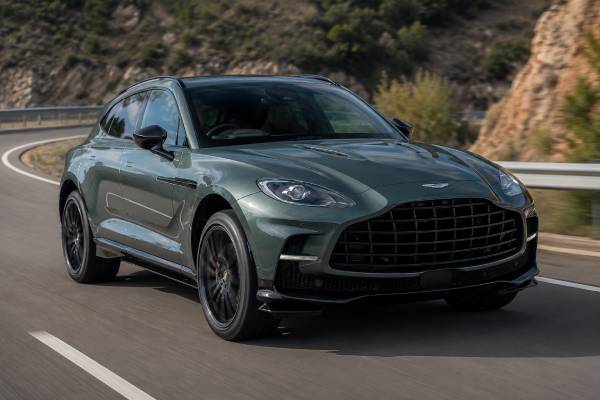
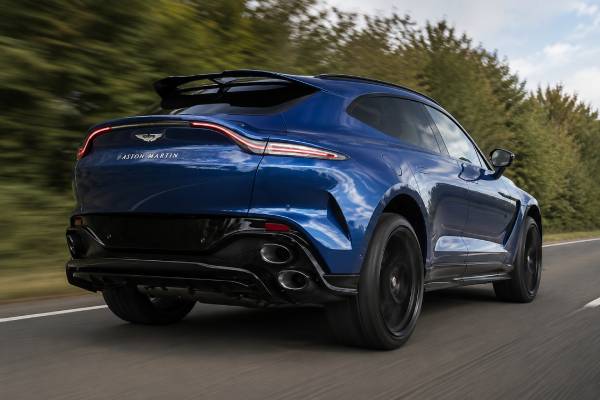
Visually, DBX S is not a badge-only derivative. It has a new grille treatment, lower splitter, side sills with upturned air elements, reprofiled rear bumper and diffuser, vertically stacked quad exhaust outlets, S fender badges, and an available three-color lower livery. Inside, herringbone seat design, Alcantara, S embroidery, treadplates, and an engine plaque create a separate identity.
As of 2026, DBX S and DBX707 appear as separate members of the Aston Martin range. Buyers should compare them by actual specification because an option-heavy S with maximum lightweighting is a different proposition from a standard S on forged aluminum wheels and a panoramic roof.
DBX S specifications and capability
DBX S remains a petrol-only performance SUV with a front-mounted V8 and variable all-wheel drive. The 48-volt system supports active chassis functions rather than electric propulsion, so the vehicle has no charge port or official electric range.
| Specification | DBX S value | Difference from DBX707 |
|---|---|---|
| Engine | 4.0-liter twin-turbocharged V8 | Same basic displacement and layout |
| Displacement | 3,982 cc | Unchanged |
| Maximum power | 727 PS (717 hp; 535 kW) | 20 PS higher |
| Maximum torque | 900 Nm (663 lb-ft) | Unchanged peak figure |
| Turbo change | Larger compressor wheels and internal improvements | Technology transferred from Valhalla development |
| Fuel type | Premium unleaded petrol | Use VIN- and market-specified octane |
| Exhaust | Modified active system with stacked quad outlets | Revised sound and rear packaging |
| Specification | Value | S calibration |
|---|---|---|
| Transmission | 9-speed automatic with wet starting clutch | Upshift points matched to extended rev range |
| Automatic downshifts | More aggressive in Sport and Sport+ | Edition-specific control strategy |
| Drive system | Variable all-wheel drive | Active distribution by demand and grip |
| Maximum front torque share | 50 percent | Manufacturer stated capability |
| Maximum rear torque share | 100 percent | Manufacturer stated capability |
| Rear differential | Electronic limited-slip differential | Coordinates rear-wheel torque |
| Measure | Published value | Context |
|---|---|---|
| 0–100 km/h (0–62 mph) | 3.3 seconds | Manufacturer claim |
| 0–200 km/h (0–124 mph) improvement | 0.3 second quicker than DBX707 | Manufacturer comparison |
| Maximum speed | 310 km/h (193 mph) | Unchanged from DBX707 |
| Steering ratio | 4 percent faster | Compared with DBX707 |
| Turning circle | 12.0 m (39.4 ft) | Approximately 0.4 m smaller |
| Maximum optional weight reduction | 47 kg (104 lb) | Requires the applicable lightweight specification |
| Component | Specification | Choice or effect |
|---|---|---|
| Suspension | Adaptive triple-chamber air springs and electronic dampers | Mode-dependent spring and damper control |
| Roll control | Electronic active system | Maximum stated body roll of 1.5 degrees at the limit |
| Standard wheels | 23-inch forged aluminum | Standard DBX S fitment |
| Optional wheels | 23-inch magnesium | Saves 19 kg (42 lb) of unsprung mass |
| Front brakes | 420 mm carbon-ceramic discs | Six-piston calipers |
| Rear brakes | 390 mm carbon-ceramic discs | Electronic parking brake |
| 23-inch front tires | 285/35 R23 | Verify DBX S-approved construction |
| 23-inch rear tires | 325/30 R23 | Staggered fitment |
| Specification | Value | Notes |
|---|---|---|
| Body type | Five-door, two-row performance SUV | Bonded-aluminum AM8 architecture |
| Seats | 5 | Rear backrest split 40:20:40 |
| Length | 5,039 mm (198.4 in) | Core DBX body measurement |
| Width excluding mirrors | 1,998 mm (78.7 in) | Garage and parking consideration |
| Width including mirrors | 2,220 mm (87.4 in) | Mirrors deployed |
| Wheelbase | 3,060 mm (120.5 in) | Supports rear space and stability |
| Luggage capacity | 632 liters | DBX family manufacturer figure |
| Audio | 800 W, 14 speakers standard | 1,600 W, 23-speaker Bowers & Wilkins optional |
Exact kerb weight depends on the roof, wheel, grille, carbon, cabin, and market specification. Publishing a single “lightweight” number without stating those options can make an ordinary configuration appear to have equipment it does not possess.
Valhalla-influenced turbocharging and gearbox
The engine upgrade is about airflow at high rpm. Larger compressor wheels and internal turbo improvements allow the V8 to sustain more air mass near the top of its operating range, producing 20 additional PS without increasing the published 900 Nm torque peak.
A compressor wheel pressurizes intake air before it enters the cylinders. A larger wheel can move more air at high flow, but turbo design must balance inertia, efficiency, heat, and response. Aston Martin’s claim of Valhalla technology refers to the turbo hardware knowledge transferred from its mid-engine supercar program; it does not mean the DBX S uses Valhalla’s complete hybrid powertrain.
Torque stays at 900 Nm, while the engine sustains output farther up the rev range. That helps explain the unchanged 0–100 km/h claim and improved acceleration toward 200 km/h.
The nine-speed wet-clutch transmission is carried over in hardware concept. Instead of a fluid torque converter, a multi-plate clutch operating in oil connects the engine at launch. It can transmit high torque directly and supports launch control. DBX S changes the software: upshifts occur at points suited to the extended rev range, and automatic downshifts become more assertive in Sport and Sport+.
Drivers should feel the difference during rapid road use rather than creeping traffic. At low speed, clutch take-up should remain predictable, though it may feel more deliberate than a conventional automatic. A slight mechanical sense is not the same as a fault. Repeated judder, delayed engagement, overheating messages, flared shifts, or a heavy selection shock require investigation.
The active all-wheel-drive system can distribute up to half of available torque to the front axle and all of it to the rear when conditions call for that balance. This flexibility supports traction without forcing the car into a fixed front-heavy feel. The electronic rear differential then manages the final split across the rear axle. Tire circumference, sensor accuracy, fluid condition, and software all influence the result.
The modified exhaust reinforces the higher-rev behavior. Vertically stacked outlets create a distinct rear view, while active valves change sound with mode and load. A louder cold start or sport setting does not excuse rattles, leaks, uneven valve movement, or an emissions warning. Inspect the complete exhaust, heat shields, actuators, and rear diffuser after any impact.
Owners should use the engine’s extra range only after fluids and tires are warm. The fact that full torque is electronically available does not mean cold oil, a cold clutch, or cold carbon-ceramic brakes are ready for repeated maximum acceleration.
Lightweight options and what they really save
The advertised 47 kg reduction is a maximum configuration, not the baseline difference on every DBX S. Buyers should identify each fitted component and add no savings that the factory did not assign to that exact option.
The optional carbon-fiber roof is the most strategically placed reduction. It replaces the panoramic glass arrangement and removes roof rails, saving 18 kg at the vehicle’s highest point. Lowering mass high above the road reduces the center of gravity and the leverage that mass applies during cornering. The effect can be more noticeable than removing 18 kg near the floor.
The roof uses a large single-weave carbon panel. Inspect weave continuity, clear-coat quality, edge sealing, bonding, and any evidence of impact. Carbon does not tolerate casual drilling for racks or accessories. Because roof rails are deleted, owners lose the conventional mounting point for a roof box or bicycle system. That practical cost should be accepted before ordering the option.
Optional 23-inch magnesium wheels save 19 kg of unsprung mass, improving wheel response and steering feel. Their coating and structure require specialist inspection; generic heating or repair can be unsuitable.
A lightweight polycarbonate honeycomb grille replaces the standard all-metal double-vaned grille. It contains more than 25,000 facets and removes mass ahead of the front axle, helping shift distribution rearward. The visual choice is also dramatic: the honeycomb treatment looks more technical, while the standard metal grille preserves a traditional Aston Martin face. Inspect polycarbonate for cracks, clouding, stone damage, and secure mounts.
Carbon fiber can be specified for lower body parts, including the side treatment, wing, bumper, and diffuser, with a claimed further saving of 7 kg for the relevant package. These pieces live in vulnerable areas. Check under the front splitter, along sill edges, and around diffuser fins for scrapes or delamination. Paint or film can conceal a repair, so inspect mounting points and use angled light.
The maximum total also depends on interactions. Aston Martin states that magnesium wheels are associated with deletion of roof rails, and the carbon roof itself removes the rails. Option compatibility must come from the factory order system. A buyer should not assume that separate advertised savings can always be added together on a configuration that was never offered.
The carbon roof best targets center of gravity but removes panoramic glass and roof rails. Magnesium wheels prioritize steering response but demand specialist care. The grille and carbon lower package add smaller savings and greater exposure to impact. Standard parts remain sensible when carrying ability and repair simplicity matter more than the maximum reduction.
Faster steering, body control, and braking
DBX S gains agility from quicker steering and lower optional mass, while its suspension hardware builds on the revised calibration introduced to DBX707 in 2024. It is intended to respond sooner without becoming nervous.
A four-percent steering-ratio change sounds small, but it reduces the hand movement needed for a given front-wheel angle. The car feels more immediate entering a bend and requires less steering in tight maneuvers. Aston Martin also quotes a 12.0-meter turning circle, about 0.4 meter smaller than DBX707. That improvement is useful in garages and city streets, not only on a fast road.
The suspension combines triple-chamber air springs, adaptive electronic dampers, and active roll control. Air chambers alter effective spring rate; damper valves control motion; the electronic roll system applies torque to resist lean. Aston Martin states that maximum body roll is limited to 1.5 degrees at the limit while retaining enough movement for natural feedback.
Drive modes change spring rate and roll-stiffness balance through a corner. The aim is not simply to make every setting hard. A compliant straight-line response helps tires maintain contact over broken surfaces, while controlled roll and damping improve confidence during direction changes. The optional magnesium wheels reduce the mass the dampers must manage, which can benefit both comfort and precision.
A healthy car should rise and lower evenly, hold its parked level, and settle after a bump without repeated oscillation. An S badge does not make suspension knocks normal. Check air leakage, compressor frequency, ride-height sensors, damper seepage, bushings, ball joints, wheel condition, and stored chassis faults.
Carbon-ceramic discs remain 420 mm at the front and 390 mm at the rear. They provide repeated heat resistance and reduce unsprung weight compared with iron brakes, but their inspection requires material-specific criteria. Protect the discs whenever wheels are removed. Assess chips, edges, surface condition, pads, calipers, and wear limits rather than relying on visual shine.
The 23-inch staggered tires influence every chassis claim. Incorrect pressure, mixed construction, age hardening, or inner-edge wear can make the car tramline or feel harsh. Magnesium wheels cannot compensate for poor tires. Use the approved fitment and keep tread depths close enough for the all-wheel-drive system.
When testing DBX S, focus on coordination. Steering input, body movement, torque delivery, gearbox response, and braking should feel like parts of one system. A powerful engine can distract from a wheel imbalance or weak damper during a brief demonstration, so use low speed, uneven roads, steady cruising, and progressive load as well as acceleration.
S design, cabin, and everyday usability
The DBX S looks and feels more focused, but it remains a five-seat luxury SUV with normal luggage space and connected infotainment. The key compromises come from lightweight options, large dimensions, and high-performance consumables rather than a stripped cabin.
At the front, the standard grille uses dark metal vanes, while the optional honeycomb version supplies a lighter and more radical look. A unique splitter and outer aerodynamic planes frame the cooling openings. From the side, upturned sill elements guide airflow and solid-metal S badges use red enamel. At the rear, stacked quad exhausts, a new bumper, diffuser, and optional lower livery make the S easy to distinguish.
Rosso Corsa Red, Trophy Silver, or Podium Green lower liveries emphasize the splitter, sills, and diffuser. Inspect their low-mounted edges closely and document any repair.
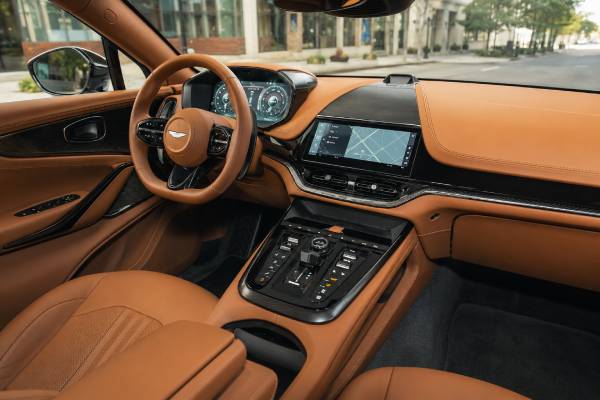
Inside, the standard theme uses herringbone graphics that widen up the seatback. Alcantara covers seats, headlining, center console, lower dashboard, and upper trim, while semi-aniline leather protects high-wear bolsters. A full semi-aniline leather cabin is available for owners who prefer a more traditional luxury feel. Red belts, S embroidery, treadplates, headrest wings formed through embossing and debossing, and an S engine plaque complete the identity.
Alcantara reduces glare but can flatten where touched. Use approved gentle cleaning and address leather dye transfer early.
The infotainment architecture matches the refreshed DBX generation: a 12.3-inch driver display, 10.25-inch touchscreen, wireless smartphone integration, physical controls for major functions, and connected services. Standard audio is 800 watts with 14 speakers; the Bowers & Wilkins option is 1,600 watts with 23 speakers. Test software, cameras, presenting handles, app eligibility, and every audio channel.
Practicality remains strong with five seats, 40:20:40 rear folding, and 632 liters of luggage capacity. The carbon roof removes panoramic glass and roof rails, while magnesium wheels demand more caution on potholes. The body is still 2,220 mm over mirrors. A smaller turning circle helps, but owners should measure parking bays and lifts.
DBX S is therefore not an all-or-nothing track special. It can be ordered as a luxurious, moderately lighter flagship or configured close to the maximum 47 kg saving. The right version depends on whether the owner values roof carrying, glass roof ambience, repair simplicity, steering detail, or collector-style option content.
Maintenance, specification checks, and buying
DBX S is too new for broad long-term pattern data, so the safest ownership approach is strict factory servicing, careful baseline records, and immediate investigation of faults. Buyers should evaluate specification as closely as condition because the options determine much of the engineering story.
Start with the factory build sheet. Confirm whether the car has the carbon roof, magnesium wheels, honeycomb grille, carbon lower package, livery, Alcantara or leather interior, audio option, caliper color, and market equipment. A seller’s phrase “full lightweight pack” must be matched to actual components. Record the part numbers and original standard pieces supplied with the car.
Engine maintenance requires the VIN-specific oil approval and schedule. Because the turbo hardware is distinct, do not assume that every DBX707 software file or replacement turbo component is correct for DBX S. Check service campaigns and calibration status through an authorized source. Warm the engine before high load and monitor oil, coolant, fan behavior, boost response, and misfire data.
Cooling works hard at this output. Inspect heat exchangers, hoses, reservoirs, and unexplained fluid loss, and clean debris without bending fins.
Wet-clutch and driveline behavior should be documented from new. Note engagement quality, adaptation, fluid service, and any launch-control use. Aggressive Sport+ downshifts are an intended calibration feature; shudder, overheating, delayed drive, or a warning is not. Use official transmission, transfer, and differential fluids and procedures.
The lightweight components add specialized checks:
- Inspect the carbon roof for impact, bonding, clear coat, edge seals, and unauthorized accessory mounting.
- Examine magnesium wheels for coating damage, corrosion, cracks, deformation, and evidence of unapproved repair.
- Check the polycarbonate grille for chips, cracks, clouding, loose mounts, and chemical damage.
- Inspect carbon lower parts from underneath, not only at eye level.
- Verify that deleted roof rails or other option interactions match the factory record.
Carbon-ceramic brakes need a qualified condition report. Tire service should be performed by a shop that can protect both ceramic discs and magnesium wheels. Record disc criteria, pad life, tire dates, tread depth across the width, and alignment. Replace tires with DBX S-approved construction and keep the staggered set matched.
Battery support matters because stored vehicles continue to power security, keyless, camera, handle, and network systems. Use an approved conditioner, test capacity during service, and interpret electronic faults only after voltage is stable. When ownership changes, transfer or release the connected account, tracker, app, and privacy data correctly.
A pre-purchase inspection should include a cold start, complete module scan, battery and charging test, cooling pressure test, boost data, clutch and gearbox assessment, all-wheel-drive operation, suspension height retention, carbon-ceramic evaluation, wheel and tire inspection, alignment, paint and carbon review, and full function test of the cabin. Re-scan after a varied road test.
DBX S is the right choice for a buyer who will appreciate the details beyond its extra 20 PS. The carbon roof and magnesium wheels can alter feel more meaningfully than the peak-power number, while the steering and gearbox calibration make normal roads more engaging. A standard DBX707 remains extremely fast and may be easier to repair. Compare both with equivalent tires and condition, confirm every S option, and pay for the configuration whose benefits you will actually use.
References
- Aston Martin DBX S: A new flagship for the supercar of SUVs – 2025 (Manufacturer Launch)
- DBX S | Performance Luxury SUV | Aston Martin 2026 (Current Model Information)
- DBX S | Performance Luxury SUV | Aston Martin USA 2026 (US Output Information)
- Aston Martin DBX707: Technically advanced interior to match class-leading performance – 2024 (Cabin and Chassis Foundation)
- Aston Martin DBX707 Satin Neutron White – Full Specification – 2022 (Platform Specifications)
- Check for Recalls: Vehicle, Car Seat, Tire, Equipment | NHTSA 2026 (Recall Database)
Disclaimer
This article is informational and is not a substitute for professional diagnosis, repair, option verification, or valuation. Specifications, intervals, software, torque values, lightweight components, and procedures may vary by VIN, market, and equipment; check official Aston Martin service and build documentation for the individual vehicle. Arrange a qualified inspection before purchase. Please share this guide on Facebook, X/Twitter, or another platform if it helped you.