


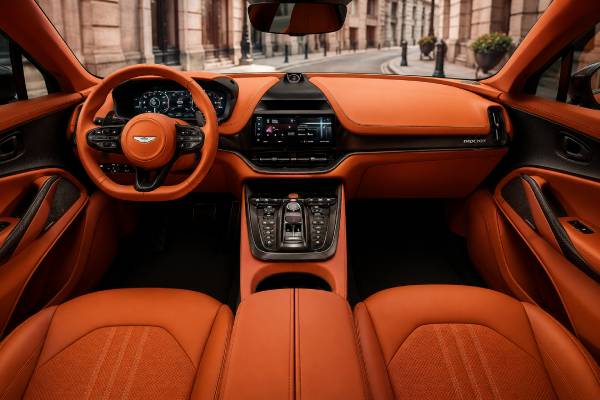
The Aston Martin DBX707 is the high-performance evolution of the AM8 SUV, launched in 2022 with 707 PS, 900 Nm, a wet-clutch nine-speed gearbox, carbon-ceramic brakes, and a 310 km/h top-speed claim. It is not simply an original DBX with more boost. Aston Martin revised the turbocharging, transmission, differential control, suspension calibration, braking, steering response, cooling, bodywork, and aerodynamics to create a more direct vehicle. In 2024 the company then transformed the cabin with its own touchscreen infotainment, connected services, new dashboard, revised controls, cameras, mirrors, door handles, and updated chassis software while leaving the central 697 hp hardware intact. Used buyers therefore face two clear eras: the launch interior from 2022 through early 2024 production, and the substantially refreshed cabin that followed. This guide covers both, explains the mechanical systems without confusing model-year and registration dates, and provides practical advice on servicing, running costs, common inspection priorities, and choosing the right DBX707.
Table of Contents
- DBX707 development from 2022 to 2026
- Complete core specifications
- Engine, wet clutch, and torque delivery
- Brakes, suspension, and high-speed control
- Old cabin or new cabin
- Service, running costs, and storage
- How to buy the right DBX707
DBX707 development from 2022 to 2026
The DBX707 has one basic performance identity but two major cabin phases.
At its 2022 launch, the DBX707 sat above the 550 PS DBX. Aston Martin increased output by 157 PS and torque by 200 Nm, fitted ball-bearing turbochargers, and replaced the standard model’s torque-converter transmission with a nine-speed unit using a wet starting clutch. Carbon-ceramic brakes became standard, all-wheel-drive software was recalibrated, final-drive response was shortened, and the suspension, steering, differentials, stability control, and body package were retuned.
The exterior announced the difference through a larger grille, new daytime-running-light treatment, additional cooling inlets, a pronounced front splitter, sculpted sills, vented rear arches, an extended spoiler, a larger diffuser, and four exhaust outlets. These are functional and visual components. Cooling, lift balance, and high-speed stability matter when a five-seat SUV is claimed to reach 193 mph.
The launch cabin retained the original DBX dashboard architecture. It used a 12.3-inch digital driver display and a 10.25-inch central screen controlled mainly by a rotary interface and touchpad. Materials, sports seats, steering wheel, drive-mode controls, and trim differentiated the 707, but the underlying infotainment generation was a common criticism among buyers comparing it with newer rivals.
Aston Martin addressed that issue in April 2024. The revised car received a fully redesigned interior, a 10.25-inch touchscreen, a 12.3-inch driver display, wireless Apple CarPlay and Android Auto, USB-C connections, online services, and customer-app support. The company retained physical switches for frequently used mechanical and climate functions. Presenting door handles, new mirrors with integrated cameras, and updated parking views changed the exterior interaction as well.
The 2024 update also recalibrated electronic dampers and air springs to improve transient body control. Aston Martin described the engine, wet-clutch gearbox, all-wheel drive, and carbon-ceramic brake hardware as unchanged. DBX707 became the brand’s sole SUV powertrain at that point, replacing the earlier multi-engine lineup in the core range.
Special versions—including AMR23, Japan Midnight Podium, and AMR24—add their own color, trim, or market stories. They should be compared with a standard DBX707 of the same production phase, because their named identity does not automatically change output. For 2025 and 2026, verify market equipment and current software by VIN rather than assuming every advertised model year has identical features.
Complete core specifications
The DBX707 is a petrol-only, front-engine, all-wheel-drive SUV. It uses a conventional fuel tank and 12-volt starting network alongside a 48-volt chassis electrical system; it is not a mild-hybrid propulsion model and has no external charging port.
| Parameter | DBX707 value |
|---|---|
| Engine configuration | 90-degree twin-turbocharged V8 |
| Displacement | 3,982 cc (4.0 liters) |
| Bore × stroke | 83 × 92 mm |
| Compression ratio | 8.6:1 |
| Maximum output | 707 PS (697 hp; 520 kW) at 6,000 rpm |
| Maximum torque | 900 Nm (663 lb-ft) at 4,500 rpm |
| Specific output | 138 PS per liter |
| Fuel | Premium unleaded petrol |
| Tank capacity | 87 liters (23.0 US gal) |
| Parameter | Specification | Important distinction |
|---|---|---|
| Gearbox | 9-speed automatic | Wet multi-plate starting clutch, not a torque converter |
| Launch control | Factory-equipped | Operates only within defined temperature and system conditions |
| Drive layout | Active all-wheel drive | Can direct up to 100 percent of available torque rearward |
| Rear differential | Electronic limited-slip differential | Actively manages rear-wheel torque |
| Propeller shaft | Carbon fiber | Reduces rotational inertia |
| Driver selection | Automatic modes and column-mounted paddles | Coordinates powertrain and chassis maps |
| Measure | Published result | Test context |
|---|---|---|
| 0–60 mph | 3.1 seconds | Manufacturer claim |
| 0–100 km/h (0–62 mph) | 3.3 seconds | Manufacturer claim |
| 0–160 km/h (0–100 mph) | 7.4 seconds | Manufacturer claim |
| 80–120 km/h (50–75 mph) | 1.9 seconds | Manufacturer in-gear figure |
| Top speed | 310 km/h (193 mph) | Manufacturer claim |
| WLTP combined consumption | 14.2 L/100 km (19.9 UK mpg) | Published homologation figure |
| Braked towing capacity | 2,700 kg (5,940 lb) | Market approval and correct equipment required |
| Parameter | Value |
|---|---|
| Seats | 5 |
| Length | 5,039 mm (198.4 in) |
| Width excluding mirrors | 1,998 mm (78.7 in) |
| Width including mirrors | 2,220 mm (87.4 in) |
| Height | 1,680 mm (66.1 in) |
| Wheelbase | 3,060 mm (120.5 in) |
| Turning circle | 12.4 m (40.7 ft) |
| Luggage capacity | 632 liters |
| Rear-seat layout | 40:20:40 split-folding |
| Parameter | Specification | Notes |
|---|---|---|
| Front suspension | Double wishbone with air spring and adaptive damper | Electronic calibration revised for 2024 production |
| Rear suspension | Multi-link with air spring and adaptive damper | Self-leveling capability |
| Active roll control | 48-volt electronic system | Controls body roll independently of propulsion |
| Front brake discs | 420 mm carbon ceramic | Six-piston calipers |
| Rear brake discs | 390 mm carbon ceramic | Electronic parking brake |
| Standard wheel | 22 inches | Sport design |
| Optional wheels | 23-inch cast Fortis or forged design | Availability and finish vary by year/market |
| 22-inch tires | 285/40 R22 front; 325/35 R22 rear | Staggered fitment |
| 23-inch tires | 285/35 R23 front; 325/30 R23 rear | Staggered fitment |
Optional equipment changes curb mass and usability, and public sources use different weight conventions. For that reason, the exact delivered configuration and local registration document are better references for an individual car’s weight than a blended internet figure.
Engine, wet clutch, and torque delivery
The powertrain’s defining trait is immediacy. Ball-bearing turbochargers, 900 Nm, short response gearing, a direct starting clutch, and active torque distribution make the DBX707 react more like a large performance car than a softly calibrated luxury SUV.
The M177-family V8 uses a hot-V arrangement with its turbochargers between the cylinder banks. Shorter exhaust paths help the turbines respond, while the compact package leaves room for intake and cooling systems around the engine. For the 707, Aston Martin installed ball-bearing turbochargers and specific calibration. The engine is related to units used elsewhere, but the DBX707’s cooling, exhaust, software, mounts, driveline, and service data are specific to the vehicle.
Maximum torque arrives at 4,500 rpm, yet the engine delivers strong force well below that point. In normal use, the gearbox can select a high ratio and rely on torque. In aggressive modes, it keeps the engine closer to the response zone and opens the exhaust character. A clean example should accelerate without misfire, boost hesitation, smoke, or a sudden torque reduction. Full-load testing belongs after oil, coolant, gearbox, and tires have reached suitable temperatures.
The wet clutch replaces the fluid coupling used by a torque converter. Multiple friction plates operate in oil, allowing high torque transfer and effective cooling. When launch control is activated under approved conditions, the clutch can connect the engine to the driveline more firmly. The same design creates a more definite low-speed engagement. A slight change in feel while crawling is normal; repeated judder, overheating, delayed selection, or a sharp bang is not.
Software adaptation matters. Clutch control, gearbox pressure, engine torque, differentials, and stability systems communicate during every start. A weak battery, mismatched tire, stored fault, or incomplete software work can produce behavior that seems mechanical. Good diagnosis records faults and live data before resetting adaptations or replacing parts.
All-wheel drive can route torque rearward, but the exact split changes continuously. The front axle remains available for traction and stability, while the rear electronic limited-slip differential helps the car rotate and put power down. A “100 percent rear” headline is a capability under demand, not a promise that the car drives as a fixed rear-wheel-drive vehicle.
Repeated launch control is not harmless entertainment. It heats the clutch, transfer system, differentials, tires, and engine. A prospective buyer should ask how the car was used, inspect thermal and fault history where accessible, and judge the owner’s maintenance habits. Track use or repeated performance events are not automatic rejection points, but they justify closer fluid, brake, tire, and cooling inspection.
Brakes, suspension, and high-speed control
The DBX707’s chassis systems are what make its engine output usable. Carbon-ceramic brakes reduce unsprung weight, air springs support a wide operating range, and electronic roll control prevents the tall body from leaning like a conventional SUV.
Aston Martin stated that the carbon-ceramic brake package removed 40.5 kg of unsprung mass compared with equivalent iron brakes. Unsprung mass includes parts that move with the wheels rather than the body. Reducing it helps the suspension follow road changes and improves response. The large ceramic discs also tolerate repeated heat, but they can be damaged by impact, contamination, incorrect pad material, or wear beyond their approved criteria.
Ceramic-disc condition is not judged solely by thickness. The workshop may need to examine surface pattern, edge integrity, chips, heat marks, and remaining mass or other manufacturer criteria. Wheel removal must be controlled so the rim does not strike the disc. A car advertised with “brakes for life” should be treated cautiously; no friction system is exempt from inspection.
The front double-wishbone and rear multi-link suspension use triple-chamber air springs and adaptive dampers. The air volumes can be configured to change effective spring stiffness, while damper valves alter control of movement. Ride height adjusts for loading, access, terrain, and speed conditions. One low corner, repeated height warnings, or a compressor that runs often indicates a fault even if the car eventually becomes level.
Electronic active roll control operates from a 48-volt supply and applies torque to resist body lean. It can relax on a straight road and work hard in a bend, avoiding the compromise of permanently stiff passive bars. Because it is electrical and software-controlled, battery condition and module communication matter. A low-voltage event can trigger chassis warnings that should be diagnosed after the power supply is stable.
The 2024 recalibration targeted transient body control—how the vehicle responds during rapid changes such as steering input, braking, or a crest. Buyers may notice a more precise initial response in the later car, but wheel size, tire construction, alignment, and condition can easily outweigh a subtle software difference. Compare examples on the same roads rather than assuming the newer registration plate guarantees a better ride.
Twenty-three-inch wheels improve stance and steering response but leave less tire sidewall. Inspect inner rims for deformation and tires for bubbles, cuts, flat spots, and inner-shoulder wear. Four tires must be compatible in model, approval, wear, and rolling circumference. The all-wheel-drive system should not be forced to compensate for a random replacement.
At speed, aerodynamic details and cooling openings play a real role. Damaged splitter pieces, missing undertrays, loose wheel-arch vents, or a poorly fitted diffuser can affect airflow and noise. Body repairs should restore mounting points and seals rather than merely make the surface look smooth.
Old cabin or new cabin
The cabin generation is the largest choice for used buyers. The earlier interior has the original DBX control architecture; the later one offers a modern Aston Martin touchscreen, stronger connectivity, and a redesigned dashboard.
Launch-era DBX707s provide a 12.3-inch instrument display and a 10.25-inch central screen controlled through a rotary dial and touchpad. Wired smartphone integration and region-dependent features sit within the older infotainment platform. Some owners prefer its separate controller because it can be used without reaching forward, while others consider the interface dated for the vehicle’s price.
The refreshed interior uses a 10.25-inch capacitive touchscreen with Pure Black display technology and a 12.3-inch driver screen. Wireless Apple CarPlay and Android Auto, USB-C connections, online features, and the Aston Martin app improve phone integration. Later software may add market-specific capabilities such as Apple CarPlay Ultra, but availability should be confirmed for the individual VIN, country, phone, and subscription rather than assumed from a current website.
Physical controls remain for gear selection, drive mode, climate, suspension, stability control, exhaust, lane assistance, and parking sensors. This hybrid approach is useful during performance driving because important functions do not disappear into menus. Test each control and check that the screen reflects the command accurately.
The new cabin also has presenting exterior door handles and redesigned mirrors whose whole shell swivels. Integrated cameras support a 3D parking view. These features make the car easier to live with when functioning properly, but they add calibration and repair cost. Check handle deployment from both keys, mirror folding and heating, camera alignment, parking overlays, and the absence of moisture behind lenses.
Audio differs. The updated DBX707 comes with a 14-speaker, 800-watt premium system as standard and offers a 23-speaker, 1,600-watt Bowers & Wilkins option. Earlier cars have their own audio specifications, so a seller’s “premium sound” wording is not enough. Confirm the system on the factory build record.
Both cabins provide five real seats and a 632-liter cargo area. The rear backrests fold in three parts, and towing remains available in approved markets. The new dashboard does not change the basic body dimensions, so garage width and parking length remain concerns. The car is more than 2.2 meters wide over mirrors.
A late-registered car can have the old interior, and an early registration in a market can sometimes reflect delayed model-year terminology. Identify the dashboard visually, record the build date, and use the VIN. Do not buy a “2024 facelift” based only on the registration year.
Service, running costs, and storage
DBX707 ownership requires a high-performance budget even when annual mileage is low. Premium fuel, staggered tires, carbon ceramics, specialist labor, battery care, insurance, and software support are normal expenses rather than exceptional failures.
Use the official VIN-specific service schedule. Engine oil must meet the required approval, not merely a familiar viscosity. Turbocharging, heat, short trips, dust, towing, and repeated hard use can justify earlier inspection or fluid renewal. Keep itemized invoices showing parts, fluid standards, software, mileage, and date.
Cooling is a priority. Clean debris from accessible radiator and condenser surfaces without bending fins. Investigate coolant odor, dried residue, repeated low level, or fans that run unusually. The engine, charge-air system, transmission, and electrical chassis equipment rely on controlled temperatures. A generic pressure cap or coolant chosen by color can cause more harm than a delayed repair.
Transmission and differential service should follow Aston Martin procedures. The wet clutch, front drive, transfer unit, and electronic rear differential handle enormous torque. Shudder or clunking should be diagnosed with temperature, pressure, adaptation, and fault data. Additives and universal fluids are not a shortcut.
Battery health has outsized importance, especially for cars used on weekends. An approved conditioner should be connected at the designated points during storage. Keep keys positioned as recommended and check tracker behavior. Low voltage can disable presenting handles, suspension, gearbox control, infotainment, and cameras while filling modules with communication codes.
Tires should be inspected from the inside and outside. Record date codes and measure tread across the width. The staggered setup prevents normal front-to-rear rotation, and alignment errors can consume an inner shoulder while the outer tread looks healthy. Replace with the approved size, load, speed, and construction; ideally maintain a complete matched set.
Carbon-ceramic brake service needs a written condition assessment. After wet washing, dry the brakes with gentle use before storage. Keep wheel-cleaning chemicals and tire dressing away from friction surfaces. During tire work, choose a shop equipped to handle large wheels without striking the discs.
Air suspension should not sink after parking. Operate the available heights periodically and note whether one corner moves slowly. Frequent compressor duty requires leak testing. Inspect dampers, height sensors, bushes, ball joints, and underbody mounts after pothole impacts or off-road use.
Running-cost planning should also cover:
- comprehensive insurance that recognizes options and Q content;
- secure storage suitable for the car’s width;
- paint-protection film inspection or replacement;
- connected-service subscriptions and data transfer;
- annual alignment and wheel checks where roads are poor;
- warranty exclusions for brakes, tires, track use, and diagnosis;
- depreciation differences between ordinary, special-edition, and heavily personalized examples.
How to buy the right DBX707
Choose the cabin generation first, then buy the best-documented mechanical example within that group. A newer plate or rare color cannot compensate for neglected tires, damaged ceramics, poor voltage, or an incomplete service history.
Begin remotely with the VIN, factory specification, warranty start, service printout, campaign status, ownership history, and invoices. Confirm build date, interior generation, wheel size, brake color, seats, audio, towing equipment, exterior packs, Q content, and original market. Compare the advertisement with the actual order; DBX707s can look similar while differing greatly in cost and desirability.
Arrange a cold inspection. Before startup, check ride height, fluid marks, undertrays, tire flat spots, disc surfaces, paint, glass, wheel edges, and interior wear. A seller who has warmed the engine removes useful evidence. Observe starting speed, exhaust, noises, and the complete warning-light check.
A thorough specialist examination should include:
- Battery capacity and charging test before interpreting electronic faults.
- Full diagnostic scan with stored, pending, and historical codes retained.
- Cooling-system pressure test and inspection of radiators, fans, hoses, reservoirs, and charge-air paths.
- Engine data under progressive load after warm-up, checking misfire and requested-versus-actual boost.
- Wet-clutch engagement from cold, gear changes, adaptation data, and driveline noise.
- Differential and all-wheel-drive behavior in slow turns and controlled acceleration.
- Suspension height changes, parked leak-down, damper condition, and active roll-control scan.
- Carbon-ceramic brake evaluation using Aston Martin criteria and pad measurement.
- Tire date, approval, tread match, inner-edge wear, wheel runout, and four-wheel alignment.
- Cameras, handles, mirrors, climate, seats, tailgate, keys, audio, displays, physical switches, app, and tracker.
The road test needs variety. Use parking maneuvers to expose clutch or driveline issues, broken surfaces to reveal suspension control, a steady cruise to find vibration, and progressive acceleration to assess the powertrain. Brake from moderate speed in a safe location and check stability. Re-scan afterward so temperature- and speed-related faults are not missed.
Look closely at repairs. Carbon-fiber lower pieces may conceal impact damage; wheels may have been welded; satin finishes may have glossy correction patches; and paint film can hide chips or poor refinishing. High-quality documented repairs are preferable to untouched but cracked components. Ask who performed the work and whether removed original parts are included.
Warranty is useful only when its terms match the risk. Check limits on labor rate, diagnostics, prior faults, software, air suspension, active roll control, wet clutch, differentials, carbon ceramics, infotainment, and track activity. Confirm territorial coverage if the car was imported.
The launch cabin often gives the lowest route into DBX707 performance and may appeal to drivers who like its controller. The refreshed cabin is the better choice for touchscreen and connected-service priorities. Special editions add provenance and styling, not a different 707 PS engine. Whichever version you choose, the best car will feel cohesive: prompt starting, clean power, smooth deliberate clutch engagement, stable steering, controlled body movement, strong straight braking, and electronics that work without excuses.
References
- Introducing the Aston Martin DBX707: The world’s most powerful luxury SUV – 2022 (Manufacturer Launch)
- Aston Martin DBX707 Satin Neutron White – Full Specification – 2022 (Full Specifications)
- Aston Martin DBX707: Technically advanced interior to match class-leading performance – 2024 (Interior and Chassis Update)
- Aston Martin DBX707 | Luxury SUV | Aston Martin 2026 (Current Model Information)
- DBX707 Brochure | Aston Martin | Aston Martin USA 2026 (Model Brochure)
- Check for Recalls: Vehicle, Car Seat, Tire, Equipment | NHTSA 2026 (Recall Database)
Disclaimer
This article is for informational use and does not replace professional diagnosis, repair, or vehicle inspection. Specifications, service intervals, torque values, software, options, and procedures differ by VIN, market, and production date; confirm them in official Aston Martin service documentation. Have a qualified specialist inspect any DBX707 before purchase. Please share the guide on Facebook, X/Twitter, or another platform to support our work.