
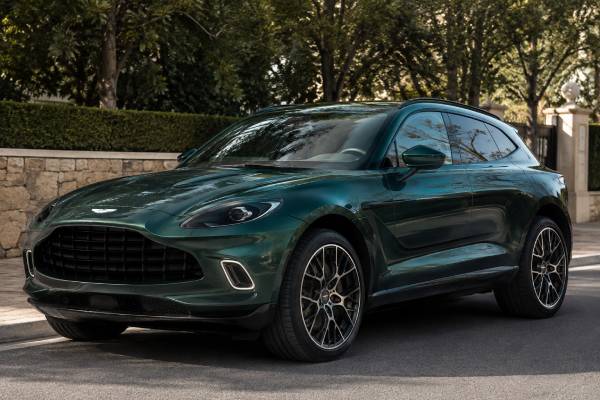
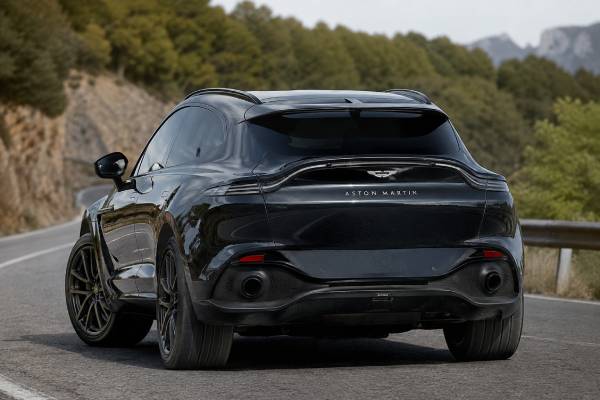
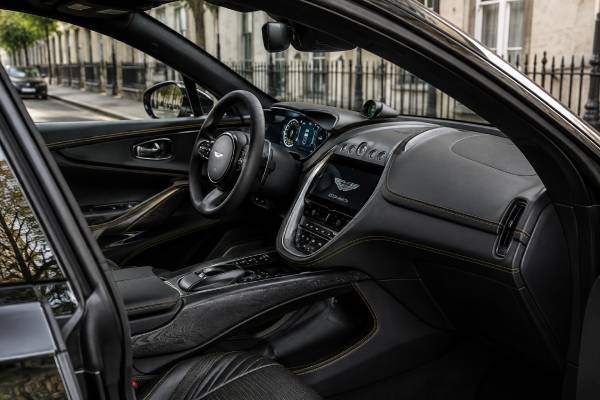
The Aston Martin DBX Q by Aston Martin & JWW turns the original V8 DBX into a carefully coordinated design commission rather than a higher-output performance derivative. Developed with Aston Martin’s Q personalisation team and automotive creator James Walker, better known as Mr JWW, it combines a specially mixed green exterior, a solid-copper badge, bronze-toned detailing, and an Alcantara-and-leather cabin. The mechanical package remains the 2021 DBX 550 specification: a 4.0-liter twin-turbo V8, nine-speed automatic transmission, active all-wheel drive, air suspension, and five-seat SUV body. That makes the car straightforward to understand but demanding to assess. A buyer must judge both the condition of an early DBX and the authenticity of a low-volume Q specification whose value rests heavily on original finishes and documentation. This guide explains the commission, records the relevant technical data, describes how it works on the road, and provides a practical inspection and ownership framework.
Table of Contents
- A collaboration built around one visual idea
- JWW DBX technical data
- Paint, copper, and cabin materials
- The standard V8 hardware underneath
- Living with the car every day
- Preserving a Q commission
- Inspection, authentication, and value
A collaboration built around one visual idea
The defining feature of this DBX is coherence: its unusual colors and materials were developed as one specification rather than selected independently from a normal options list. It is best viewed as a named Q production series with a recognizable design identity, not as a separate engine or chassis model.
Mr JWW’s public profile grew through films about high-performance and luxury cars, but the collaboration went beyond placing a signature on an existing vehicle. The exterior uses Lennox Green Metallic, described by the project as a modified form of Aston Martin’s Slipstream Green technology with a dedicated blend of eight pigments. Its appearance changes with light, moving between deep green, bronze, and warmer metallic tones. That color behavior is central to the car; repairs that flatten the effect can make even a technically correct panel look visibly wrong beside the original finish.
A solid-copper wing badge provides the clearest physical marker. The project material says the badge was stamped under 350 tonnes of pressure, fired to 800 degrees Celsius, hand-polished, and given a patina. Copper was then echoed through bronze-colored exterior and interior details so that the badge did not appear as an isolated novelty. Q fender badges and the selected trim complete the specification.
The cabin was also notable because the project described it as the first DBX offered with Alcantara. Alcantara is used with Bridge of Weir leather, Oxford Tan stitching, and bronze-toned elements. The result is less formal than a traditional monotone luxury cabin and more tactile than a purely carbon-fiber theme. It also creates additional condition checks. Alcantara can become shiny or matted where it is repeatedly touched, pale stitching can show dye transfer, and copper or bronze finishes can change character through cleaning or abrasion.
The underlying appeal therefore depends on three layers being present together:
- the original Lennox Green Metallic exterior and correct accompanying finishes;
- the copper, bronze, Q, and interior details that identify the commission;
- a complete paper trail showing that the car was supplied in the named specification.
A modified ordinary DBX could imitate individual visual features, but it would not have the same provenance. Conversely, a genuine example with poor paintwork, missing trim, or an undocumented replacement interior may be authentic yet no longer present as the designers intended.
JWW DBX technical data
Mechanically, the Q by Aston Martin & JWW car follows the original DBX V8 specification. It is an internal-combustion, five-seat luxury SUV with a front-mounted twin-turbo engine, a conventional automatic gearbox, and electronically controlled all-wheel drive; there is no hybrid traction system or externally chargeable battery.
| Specification | Value |
|---|---|
| Engine | 4.0-liter twin-turbocharged V8 |
| Engine family | Mercedes-AMG M177-derived, Aston Martin calibration |
| Displacement | 3,982 cc |
| Maximum power | 550 PS (542 hp; 405 kW) |
| Maximum torque | 700 Nm (516 lb-ft) |
| Fuel type | Premium unleaded petrol |
| Fuel tank | 85 liters (22.5 US gal) |
| Efficiency feature | Cylinder deactivation under suitable light-load conditions |
| Specification | Value | Configuration |
|---|---|---|
| Transmission | 9-speed automatic | Torque-converter type |
| Drive | All-wheel drive | Active torque distribution |
| Center differential | Electronically controlled active unit | Transfers torque between axles |
| Rear differential | Electronic limited-slip differential | Controls rear-axle torque distribution |
| Drive modes | Road, sport, terrain, and individual settings | Names and behavior depend on market/software |
| Specification | Value | Condition |
|---|---|---|
| 0–100 km/h (0–62 mph) | 4.5 seconds | Manufacturer claim |
| Maximum speed | 291 km/h (181 mph) | Manufacturer claim |
| Seating | 5 | Two-row layout |
| Rear seat split | 40:20:40 | Folding backrests |
| Luggage capacity | 632 liters | Manufacturer figure |
| Maximum braked towing capacity | 2,700 kg (5,952 lb) | Correct equipment and market approval required |
| Specification | Value |
|---|---|
| Body type | Five-door luxury SUV |
| Length | 5,039 mm (198.4 in) |
| Width excluding mirrors | 1,998 mm (78.7 in) |
| Width including mirrors | 2,220 mm (87.4 in) |
| Height | 1,680 mm (66.1 in) |
| Wheelbase | 3,060 mm (120.5 in) |
| Kerb weight | 2,245 kg (4,949 lb) |
| Turning circle | 12.4 m (40.7 ft) |
| Specification | Value | Notes |
|---|---|---|
| Front suspension | Independent double wishbone | Adaptive damping and air springs |
| Rear suspension | Independent multi-link | Adaptive damping and air springs |
| Air suspension | Triple-chamber system | Variable spring rate and ride height |
| Active roll control | 48-volt electronic anti-roll control | Up to 1,400 Nm anti-roll force per axle |
| Front brakes | 410 mm ventilated iron discs | Six-piston calipers |
| Rear brakes | 390 mm ventilated iron discs | Electronic parking brake |
| Typical 22-inch front tires | 285/40 R22 | Confirm fitted wheel specification |
| Typical 22-inch rear tires | 325/35 R22 | Confirm fitted wheel specification |
The figures identify the car’s capability, but they do not establish the exact optional equipment on one chassis. Original invoices, build records, and the vehicle identification number are the correct sources for wheel design, paint-code details, regional equipment, and any accessories fitted at delivery.
Paint, copper, and cabin materials
The special materials should be handled as preservation items, not treated like ordinary replaceable trim. A gentle, documented approach is more valuable than aggressive cosmetic correction that removes the finish responsible for the edition’s identity.
Lennox Green Metallic requires careful color matching because its eight-pigment blend changes with viewing angle and lighting. During inspection, view every panel outdoors, under workshop lighting, and from a shallow angle. A mismatch may be most obvious at the edge between a door and quarter panel. A paint-depth gauge can reveal previous work, but readings alone do not prove poor repair: hand-finishing, panel material, and factory variation can affect them. The more important questions are whether the metallic orientation is even, whether the color travels consistently across adjacent panels, and whether masking lines or overspray are present.
The copper badge is deliberately expressive rather than perfectly sterile. Copper develops patina, so a darker or warmer surface is not automatically damage. Compare both sides for consistency and look for scratches, lifted edges, adhesive disturbance, or polishing that has erased the intended texture. Household metal polish is a poor choice because it may create a bright, raw appearance that does not match the commissioned finish. Before cleaning, obtain advice from an Aston Martin dealer or conservator familiar with Q materials.
Inside, inspect Alcantara in the high-contact zones: steering-wheel rim, seat bolsters, door pulls, and center-console surfaces. Fibers should retain a soft nap rather than appear hard and glossy. Mild flattening may respond to appropriate dry cleaning and brushing, but deeply abraded material cannot be restored by adding moisture. Leather should be checked for color transfer, creasing, loose stitching, and shrinkage around heavily curved panels. Oxford Tan stitching is especially useful as a visual reference because repairs using the wrong thread shade can stand out.
Owners should photograph the cabin and exterior while the car is in excellent condition. The images establish a baseline for patina, trim alignment, and color, and they can help a future specialist reproduce a small repair without altering unrelated surfaces. Retain care-product invoices and avoid products containing strong solvents, silicone-heavy dressings, or dyes that can move between leather and Alcantara.
The standard V8 hardware underneath
The JWW edition drives like an early 550 PS DBX because its Q content does not change the engine, gearbox, brakes, or suspension. Its character comes from combining large-SUV comfort with unusually tight body control rather than from chasing the later DBX707’s acceleration figures.
The 4.0-liter V8 is mounted behind the front axle line as far as the packaging allows. Two turbochargers sit within the engine’s V, shortening the exhaust path to the turbines and helping response. Aston Martin supplied its own intake, exhaust, calibration, and installation choices, so the powertrain should not be treated as interchangeable with every other vehicle that uses an M177-family engine. Diagnostic software, cooling layout, exhaust packaging, and service procedures are DBX-specific.
A torque-converter automatic suits the original car’s broad role. It can move away smoothly in traffic and absorb low-speed driveline shock, then hold gears and respond more firmly in sport settings. Shift paddles provide manual control, but the transmission remains calibrated for a vehicle that may carry passengers, luggage, or a trailer. Hesitation, repeated thumps, or flare between gears should not be dismissed as normal aggressiveness. Software status, fluid condition, mounts, and driveline adaptation all deserve investigation if behavior is inconsistent.
The active center system and electronic rear differential manage traction without making the DBX feel permanently nose-led. On a dry road, the rear axle contributes to the car’s willingness to rotate; on slippery surfaces, the electronics can redistribute torque before obvious wheelspin develops. That capability does not cancel the laws of weight and tire grip. Four matching tires with similar tread depth are essential. A mixed set can change rolling circumference and confuse driveline behavior even when every tire is technically the correct nominal size.
The suspension is the more distinctive engineering feature. Triple-chamber air springs alter effective spring stiffness, while adaptive dampers control vertical movement. A 48-volt electronic anti-roll system applies force to resist body roll rather than relying only on very stiff passive anti-roll bars. The result can be supple in a straight line yet controlled in a bend. The system also allows the body to rise by up to 45 mm or lower by up to 50 mm from its standard reference, depending on mode and operating condition.
A healthy car should change height evenly, settle without repeated compressor operation, and remain level after parking. One low corner, frequent warning messages, or a compressor that runs excessively can indicate leakage, sensor trouble, or a control issue. Those symptoms matter more than whether the vehicle can complete a single height change during a brief viewing.
Living with the car every day
This is a usable five-seat SUV, but its width, tire cost, and early-generation infotainment require more planning than its calm cabin suggests. Owners who understand those constraints can use it regularly without treating it as a fragile display object.
At more than 2.2 meters across the mirrors, the DBX needs a generous garage opening and careful positioning in narrow parking structures. The cameras and parking sensors help, yet lenses must be clean and all views should be tested before purchase. A distorted image, blank camera, or intermittent sensor warning can turn routine parking into an expensive electronic repair.
The long wheelbase provides useful rear space and a settled motorway ride. A 632-liter luggage compartment, split rear seat, and 2,700 kg braked towing rating give the DBX real utility. Towing capacity should never be read as permission to attach any trailer without preparation. The hitch, wiring, cooling requirements, tire pressures, local license rules, and maximum train weight must all match the specific vehicle and market. A used car that has towed heavily deserves extra attention around brakes, rear suspension, driveline fluids, and cooling systems.
Fuel consumption is substantial. Short journeys are particularly inefficient because a large engine, catalytic converters, transmission, and cabin all have to reach operating temperature. Repeated cold starts also add moisture to the oil and exhaust. A regular longer drive is healthier than months of two-mile trips, provided the engine reaches full temperature before high load is used.
The original DBX cabin uses a 12.3-inch driver display and a 10.25-inch central screen controlled principally through a console interface rather than the fully touch-led system introduced on the later refreshed DBX707. Buyers should test phone pairing, navigation, audio, steering-wheel switches, seat controls, climate functions, and every USB or power outlet. Age-related dissatisfaction with the interface is a preference issue; freezes, dead controls, or missing functions are faults.
A practical ownership routine includes:
- using the recommended premium unleaded fuel and avoiding long storage with a nearly empty tank;
- maintaining a suitable battery conditioner when the car is parked for extended periods;
- checking tire pressures cold, especially before carrying a full load or towing;
- washing the wheel barrels and brake areas gently after winter road salt;
- operating all suspension heights, seat functions, cameras, and climate zones regularly;
- keeping the unique Q surfaces away from automatic brushes and generic valeting chemicals.
Preserving a Q commission
Maintenance must protect both the DBX platform and the special specification. Mechanical work should follow the VIN-specific schedule, while cosmetic work should be planned around the scarcity and finish of the commissioned parts.
Annual time-based servicing is sensible even when mileage is low. Engine oil accumulates fuel and moisture from cold running, brake fluid absorbs water, and batteries age whether the odometer moves or not. Service records should show more than stamps: invoices should identify dates, mileage, parts, software work, and any campaigns completed. Ask whether the car has a transferable service plan or warranty and confirm the terms directly rather than relying on an advertisement.
The 12-volt system supports many control modules and can cause unrelated-looking warnings when voltage falls. A car stored for display may therefore generate more electronic nuisance than a regularly driven example. Use the approved connection points and a compatible conditioner; do not improvise around the battery or jump-starting system. If warnings remain after voltage is stable, they require diagnosis rather than repeated clearing.
Tires age as well as wear. Check the four-digit date code, sidewalls, inner shoulders, and tread across the full width. The broad rear tires can conceal inner-edge wear when viewed from outside. Replace tires in axle pairs at minimum, and ideally maintain a matched set approved for the DBX’s load, speed, and handling requirements. Alignment should be checked after pothole impacts or whenever one shoulder wears faster than the other.
Brake condition cannot be judged by visible disc diameter alone. Measure pad thickness, inspect the inner and outer disc faces, and look for corrosion rings caused by low use. A heavy SUV can clean light surface rust in normal driving, but deep pitting, vibration, or a pronounced lip may require replacement. Verify that the electronic parking brake releases cleanly and that no brake warning remains stored.
Cooling-system care matters because the twin-turbo V8 uses several heat-management circuits and operates in a tightly packaged bay. Investigate coolant odor, dried residue, fan operation after shutdown, or unexplained level changes. Never open a hot system, and do not mix coolant solely by color. The exact fluid and bleeding procedure must come from Aston Martin documentation for the VIN.
For body and interior work, record every action. A local spot repair using the correct paint process may preserve more originality than refinishing a whole side. Replacing a patinated copper component with a bright new part can also create a mismatch, so retain removed pieces and obtain written confirmation of part numbers. Upholstery repairs should match material, grain, perforation, thread, and stitch pattern—not merely the nearest color.
Inspection, authentication, and value
The best example is not necessarily the lowest-mileage car; it is the one whose identity, condition, and maintenance history support each other. A proper purchase process combines Q-specific authentication with the same mechanical scrutiny required for any complex early DBX.
Start with the VIN and original supplying dealer. Request the factory build specification, invoice, warranty history, and service record. The documents should identify the named Q by Aston Martin & JWW specification and align with the car’s paint, trim, badges, wheels, and market. Confirm whether accessories or protective film were applied before delivery. A missing brochure is less important than a missing build record, although complete presentation material can still add collector confidence.
Next, inspect the vehicle cold. A seller who pre-warms the engine removes the chance to observe starting speed, smoke, belt noise, exhaust behavior, and initial warnings. Watch the instrument display through the full startup check. Listen for persistent knocks or rattles, then inspect beneath the car and around the engine bay for fresh cleaning that may conceal leakage.
A structured pre-purchase inspection should include:
- A diagnostic scan of all modules, with fault history retained rather than simply erased.
- Battery health and charging-system tests before interpreting electronic warnings.
- Suspension height changes, overnight level retention, damper behavior, and compressor duty.
- Tire make, date, tread, inner-edge condition, wheel runout, and alignment evidence.
- Brake measurements on both faces and a road test for vibration or pulling.
- Gearbox behavior from cold, low-speed driveline smoothness, and full-throttle shifts only after warm-up.
- Cooling pressure checks and inspection of hoses, radiators, fans, and dried residue.
- Operation of cameras, driver assistance, seats, climate control, tailgate, keys, and infotainment.
- Paint mapping and detailed comparison of every Q-specific component with build records.
On the road, assess more than acceleration. The steering should track cleanly, the body should settle after a crest, and the car should not hop or shimmy over broken surfaces. A quiet cabin can hide tire noise caused by cupping, so test on more than one road surface. Brake firmly in a safe place and note pedal consistency. Repeat slow turns in both directions to expose driveline binding or steering noise.
Value is sensitive to originality because the special content is the reason this DBX is distinct. Yet originality should not be used to excuse deferred maintenance. Original tires that are too old to use, untouched fluids, or an uncorrected fault do not improve the car. The strongest purchase is a correctly maintained example that retains its commissioned materials, receives sympathetic repairs, and comes with enough documentation to explain its history.
The JWW DBX suits an owner who wants a recognizable Q story but intends to use the vehicle as a grand touring SUV. It offers the same comfort, towing ability, and V8 performance as the standard early DBX while providing details that reward close inspection. It is less suitable for someone seeking the quickest DBX or a car whose special status can be maintained cheaply. Buy on provenance and condition, budget for specialist care, and treat its surfaces as part of the engineering brief rather than decorative replacements.
References
- DBX Q SUV by Aston Martin & JWW 2021 (Project Website)
- Aston Martin DBX Q | Walton-on-Thames, Surrey | HWM Aston Martin 2021 (Edition Details)
- DBX- Q by Aston Martin & JWW goes into production! | HWM Aston Martin 2021 (Production Update)
- ASTON MARTIN UNVEILS DBX: AN SUV WITH THE SOUL OF A SPORTS CAR | Aston Martin 2019 (Manufacturer Specifications)
- DBX Quick Start Guide | Aston Martin UK 2026 (Quick Start Guide)
- Check for Recalls: Vehicle, Car Seat, Tire, Equipment | NHTSA 2026 (Recall Database)
Disclaimer
This guide is for informational purposes and does not replace professional diagnosis, repair, conservation, valuation, or authentication. Specifications, procedures, intervals, software, and torque values can differ by VIN, market, options, and build date; verify them in official Aston Martin service documentation. Have a qualified specialist inspect any prospective purchase. Please share the article on Facebook, X/Twitter, or another platform if it was useful.