


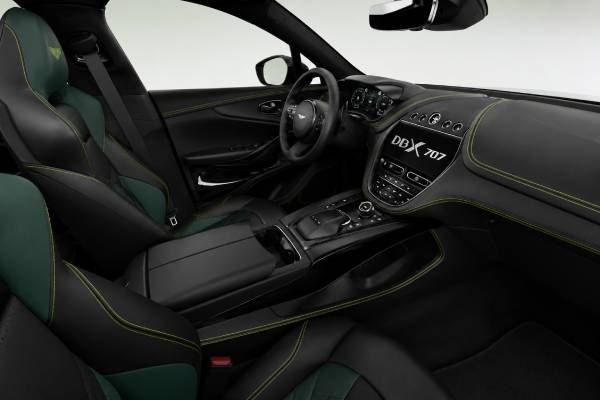
The Aston Martin DBX707 Japan Midnight Podium Edition is an 11-car, Japan-only commission created to mark the marque’s 110th anniversary. Announced in December 2023 with deliveries planned from the first quarter of 2024, it draws on Japanese late-night driving and car-club culture rather than simply repeating the global AMR23 Edition. Satin Oberon Black paint, lime accents, Q by Aston Martin fender badges, Racing Lime Green brake calipers, 23-inch satin-black wheels, and a dark green-and-black interior give the car its specific identity. Mechanically it remains a 707 PS DBX707, with 900 Nm, a wet-clutch nine-speed automatic, active all-wheel drive, air suspension, and carbon-ceramic brakes. Its tiny allocation makes documentary proof especially important: a black DBX707 with aftermarket lime details is not equivalent. This article records the exact edition content, explains the standard DBX707 hardware underneath, addresses Japan-market ownership and export questions, and lays out a careful preservation and buying process.
Table of Contents
- Eleven cars for Japan
- Midnight Podium technical specifications
- The meaning behind the black-and-lime theme
- DBX707 road performance in a Japanese setting
- Japan-market use, registration, and export
- Preservation and specialist maintenance
- Proof, condition, and purchase decision
Eleven cars for Japan
This edition is unusually easy to define because Aston Martin Japan stated both its purpose and allocation: 11 vehicles for the domestic market, celebrating 110 years of Aston Martin. The number links one car to each decade of the anniversary rather than indicating a worldwide series.
The name “Midnight” came from nighttime drives on illuminated urban expressways and from gatherings within Japanese car culture. “Podium” connects the specification with the racing colors used by Aston Martin’s AMR23 Formula 1 car and DBX707 medical car. The result is a market-specific narrative: a high-performance British SUV interpreted through the atmosphere of Japanese cities after dark.
Aston Martin Japan announced the car on December 21, 2023. Customers were to be invited to a midnight-themed debut at House of Aston Martin Aoyama, with deliveries scheduled from the first quarter of 2024. A later launch event took place in May 2024. These dates explain why a car can be called a 2023–2024 edition even though most physical deliveries belong to 2024. Build date, registration date, and edition announcement are separate facts.
The 11-car statement also changes the way authenticity should be handled. A buyer should expect more than visual resemblance. The VIN, Japan-market build record, original invoice, Q specification, anniversary material, and delivery history should agree. The strongest file may include event invitations, photographs, plaques, dealer correspondence, and service records from the original owner.
The edition was offered with additional options, so two genuine cars need not be identical in every accessory. What should remain consistent is the core curated palette:
- Satin Oberon Black on the exterior and sculpted carbon body kit;
- lime accents inspired by the AMR23 racer and Formula 1 medical car;
- Q by Aston Martin fender badges;
- Aston Martin Racing Lime Green brake calipers;
- 23-inch satin-black wheels;
- Onyx Black and Eifel Green leather with lime stitching;
- dark-satin carbon-fiber jewelry and carbon-fiber veneer;
- Q by Aston Martin sill plates tied to the edition.
The published material refers to exclusivity, but individual numbering should be verified rather than assumed. A plaque that says “Japan Midnight Podium Edition” may identify the series without stating “number X of 11.” Do not invent a sequence number from registration order or auction timing.
Midnight Podium technical specifications
The Japan Midnight Podium Edition uses the standard DBX707 internal-combustion powertrain and chassis. Its rarity comes from market allocation and Q specification, not a unique engine map, additional electric motor, or separate performance rating.
| Specification | Value | Edition context |
|---|---|---|
| Engine type | 4.0-liter twin-turbo V8 | Standard DBX707 hardware |
| Displacement | 3,982 cc | 83 mm bore and 92 mm stroke |
| Maximum power | 707 PS (697 hp; 520 kW) at 6,000 rpm | No edition-specific increase |
| Maximum torque | 900 Nm (663 lb-ft) at 4,500 rpm | No edition-specific increase |
| Compression ratio | 8.6:1 | DBX707 specification |
| Fuel requirement | Premium unleaded petrol | Use Japanese-market specified octane |
| Fuel capacity | 87 liters (23.0 US gal) | Manufacturer figure |
| Component | Specification | Practical effect |
|---|---|---|
| Automatic transmission | 9-speed with multi-plate wet starting clutch | Fast shifts and launch-control capability |
| Drive system | Active all-wheel drive | Variable front-to-rear distribution |
| Rear axle | Electronic limited-slip differential | Controls torque between rear wheels |
| Rear torque availability | Up to 100 percent | Only when system conditions allow |
| Propeller shaft | Carbon fiber | Reduces rotational mass |
| Driver control | Automatic modes and shift paddles | Changes powertrain and chassis behavior |
| Measure | Published value | Condition |
|---|---|---|
| 0–60 mph | 3.1 seconds | Manufacturer claim |
| 0–100 km/h (0–62 mph) | 3.3 seconds | Manufacturer claim |
| 0–160 km/h (0–100 mph) | 7.4 seconds | Manufacturer claim |
| Maximum speed | 310 km/h (193 mph) | Manufacturer claim; not a public-road target |
| Combined consumption | 14.2 L/100 km | Published WLTP figure for DBX707 |
| Braked towing limit | 2,700 kg (5,940 lb) | Approved tow equipment and local rules required |
| Specification | Value |
|---|---|
| Body | Five-door, two-row SUV |
| Seats | 5 |
| Length | 5,039 mm (198.4 in) |
| Width without mirrors | 1,998 mm (78.7 in) |
| Width with mirrors | 2,220 mm (87.4 in) |
| Height | 1,680 mm (66.1 in) |
| Wheelbase | 3,060 mm (120.5 in) |
| Luggage volume | 632 liters |
| Rear-seat division | 40:20:40 folding |
| Item | Specification | Midnight Podium detail |
|---|---|---|
| Suspension | Adaptive triple-chamber air springs and dampers | Standard DBX707 calibration for build phase |
| Active body control | 48-volt electronic anti-roll system | Integrated with drive modes |
| Front brakes | 420 mm carbon-ceramic discs, six-piston calipers | Racing Lime Green caliper finish |
| Rear brakes | 390 mm carbon-ceramic discs | Racing Lime Green caliper finish |
| Wheel diameter | 23 inches | Satin-black edition specification |
| Front tire size | 285/35 R23 | Confirm approved tire marking on the car |
| Rear tire size | 325/30 R23 | Confirm approved tire marking on the car |
The 23-inch tire sizes are specific to the DBX707 wheel package and provide less sidewall than the standard 22-inch arrangement. Tire condition therefore has an especially large effect on ride, wheel protection, and steering accuracy.
The meaning behind the black-and-lime theme
Satin black and lime were chosen to look vivid under artificial light, which is central to the edition’s midnight theme. Their maintenance needs are different: the satin finish should remain even and low-gloss, while the lime elements must retain sharp color and clean edges.
Satin Oberon Black cannot be corrected like a normal gloss paint. Machine polishing may create shiny patches that are impossible to blend. Wax or silicone-rich products can also alter sheen. Inspect every panel from several angles under diffuse light. Unequal gloss, circular marks, oily areas, and abrupt changes near panel edges can indicate unsuitable detailing or repair. Factory repainting is possible, but matching both color and sheen across a large panel requires an experienced refinisher.
The carbon body kit sits close to road debris. Examine the front splitter, lower side elements, wheel-arch areas, and rear diffuser for chips, cracks, scraped clear coat, and distorted mounting points. Lime accents make damage more visible but can also hide local refinishing if the stripe or painted line was reapplied afterward. Compare both sides for symmetry and consult delivery photographs where available.
The 23-inch wheels should have a consistent satin-black surface. Look at the rim edge, spoke faces, inner barrels, and bolt recesses. A repaired wheel can be perfectly serviceable, but the finish, dimensions, and structural assessment should be documented. Diamond cutting is not appropriate when the original specification is satin black. Verify that replacement wheels have the correct load rating and offset; visual similarity is not enough.
Racing Lime Green brake calipers add a second bright reference. Heat and brake dust can change the surface, while acidic cleaner can etch it. Inspect logos and color on all four corners. A mismatched front caliper may reveal replacement or repainting after damage. Caliper refinishing should preserve temperature-resistant material and avoid contamination of seals, pads, and carbon-ceramic discs.
Inside, the dark Onyx Black and Eifel Green palette is relieved by lime stitching. Check the steering wheel, seat bolsters, door pulls, console edges, and sill plates—the areas most likely to show wear. Carbon-fiber veneer should have clear, consistent weave and undamaged coating. “Q by Aston Martin” sill plates are part of the story, but original photographs and the build sheet are needed to confirm the exact engraving used on a specific car.
A preservation file should include high-resolution images taken in neutral light, close-ups of all logos and plaques, paint-film installation records, wheel-repair invoices, and any removed components. On a series of only 11, those records can become as important as the odometer when future buyers compare cars.
DBX707 road performance in a Japanese setting
The Midnight Podium Edition has far more performance than Japanese public-road speed limits can use, so its real strengths are response, control, and occasion rather than maximum velocity. Urban width and tire vulnerability are more relevant every day than the 310 km/h headline.
In traffic, the wet-clutch transmission must balance direct engagement with smooth maneuvering. It may feel more mechanical than the torque-converter gearbox in the original DBX, especially while inching into a parking space. The behavior should still be predictable. Persistent shudder, delayed engagement, a hot-clutch warning, or a heavy bang when selecting drive requires diagnosis.
The 900 Nm engine delivers rapid mid-range acceleration. Japan’s expressway merges and short overtaking opportunities can be handled without approaching full throttle. Use the more relaxed drive settings in congested areas and reserve the sharpest mapping for open, legal, dry conditions. Frequent launch-control demonstrations generate heat in the clutch, differentials, tires, and brakes without adding meaningful ownership value.
The air suspension and active roll control provide a broad range between comfort and body restraint. Expansion joints, elevated expressway seams, and uneven urban surfaces reveal whether the 23-inch tires and dampers remain healthy. A proper car should take one impact and settle. Repeated vertical motion, a sharp knock, steering kick, or a tendency to follow road grooves may point to pressure, tire age, wheel damage, alignment, or suspension wear.
Japan’s narrow streets and mechanical parking systems demand dimensional planning. At 1,998 mm wide without mirrors, 2,220 mm with them, and 5,039 mm long, the DBX707 exceeds many older parking limits. Weight and tire width may also be restricted. Owners should obtain written bay dimensions and maximum load rather than trust a visual estimate. The 12.4-meter turning circle of the standard DBX707 generation can make multi-point maneuvers necessary.
The carbon-ceramic brakes are powerful but need appropriate temperature and pedal technique. Light urban use can leave surface contamination or noise that may clear with safe, progressive braking. Squeal by itself does not prove failure, but vibration, pulling, damage, or a persistent warning needs inspection. Never attempt to “clean” the brakes with repeated high-speed stops on public roads.
Night driving also highlights lighting, camera, and glass condition. Test adaptive headlamp functions, automatic high beam where fitted, washer systems, surround-view cameras, mirror heating, and window demisting. Dark satin paint can be difficult to judge in rain, so clean cameras and parking sensors are essential rather than cosmetic.
Japan-market use, registration, and export
A car remaining in Japan benefits from its intended equipment and dealer context. An exported example may be attractive because of rarity, but legal conversion and digital support can cost more than buyers expect.
Domestic ownership involves Japan’s normal inspection, tax, parking, insurance, and vehicle-dimension requirements. A buyer should confirm the remaining inspection period, weight and engine-displacement tax treatment, compulsory and voluntary insurance, and documented parking-space eligibility. Any modified exhaust, wheel, suspension, or lighting component should be checked for inspection compliance even if it appears to be a premium accessory.
The car is right-hand drive in its home-market form. Export destinations that also use right-hand drive may still have different headlamp, rear-fog, speedometer, emissions, radio, telecommunications, and anti-theft rules. Left-hand-drive countries can register some right-hand-drive vehicles but may impose additional restrictions. A certificate of export is not the same as approval for the destination road system.
Infotainment and connected functions deserve written verification. Navigation maps, emergency calling, traffic data, mobile-app pairing, tracker services, radio bands, voice control, and over-the-air features can be tied to region. A dealer may service the mechanical vehicle while being unable to convert telecommunications hardware. Ask whether the VIN can receive local campaigns and whether replacement modules can be coded outside Japan.
Before shipment, obtain:
- the original Japanese registration and export certificate;
- certified translations where required;
- factory build and Q specification records;
- service and campaign printouts;
- both keys and tracker documents;
- clear photographs before loading;
- a battery-maintenance and alarm plan for transport;
- cargo insurance that recognizes the car’s actual value and 11-unit status.
Shipping can harm low bodywork, satin paint, wheels, and batteries. Specify approved tie-down points and sufficient ramp angle. Do not let straps pass over suspension arms, carbon pieces, or wheels without protection. On arrival, inspect the car before washing or charging, photograph any damage, and follow the correct battery connection procedure.
The destination authority should answer compliance questions before money changes hands. A rare model does not receive automatic exemptions. Obtain estimates for tax, homologation, lights, instruments, testing, storage, brokerage, and registration. A buyer who budgets only the auction hammer price and ocean freight has not calculated the cost of ownership.
Preservation and specialist maintenance
The most effective maintenance plan protects the DBX707’s high-load systems while avoiding unnecessary alteration of its edition finishes. Mileage may be low, but time, heat cycles, moisture, and battery discharge continue to age the car.
Engine oil and filters should follow the Japanese VIN-specific schedule, with more conservative care if the vehicle makes short cold trips, idles frequently, or is driven hard. Use fuel of the required octane and avoid storing the car for months with stale fuel. After sustained boost, finish with gentler running so oil and coolant temperatures can stabilize.
The cooling package should be inspected for debris, bent fins, dried deposits, hose deterioration, and fan operation. Urban vehicles can collect fine dust and leaves behind grille openings. Unexplained coolant loss or repeated fan activity needs pressure testing. Never select coolant by color or borrow a procedure from another M177 installation.
Battery support is vital for a collector-style vehicle. Alarms, trackers, keyless systems, and network modules remain active during storage. Use an approved maintainer at designated terminals, store keys at the recommended distance, and record battery age. Low voltage can produce gearbox, suspension, brake, and communication codes that complicate diagnosis.
Carbon-ceramic brakes need careful wheel removal and inspection against factory limits. Protect discs from impact, oil, tire dressing, and chemical overspray. Record pad condition and any disc measurements or weights at each major inspection. The replacement cost makes a documented baseline valuable even when no immediate work is required.
The air suspension should be exercised through its permitted settings, but repeated cycling solely for display is unnecessary. Check that all corners move together and that the car remains level after parking. If the compressor runs often, locate leakage before replacing it. Scan the active roll-control and ride-height modules during routine service.
Tire care includes pressure, inner-edge inspection, date codes, flat spotting, and matched circumference. The 23-inch fronts and rears are not interchangeable. Use the specified rotation policy—often no front-to-rear rotation is possible on staggered fitments—and replace according to condition rather than visible outer tread alone.
Satin paint should be hand washed with products designed for matte or satin finishes. Avoid polish, glaze, wax that adds gloss, and automatic brushes. Bird residue, insect matter, fuel, and mineral water spots should be removed promptly with approved methods. If protective film is considered, select a film and installer experienced with satin substrates and retain a sample and invoice.
Proof, condition, and purchase decision
A Midnight Podium Edition is worth pursuing only when its 11-car identity can be demonstrated and its mechanical condition supports the price. Rarity magnifies good evidence; it does not make defects irrelevant.
Start by asking Aston Martin Japan or an authorized dealer to validate the VIN and edition specification. The response should connect the car to the Japan-only allocation and list its factory color, trim, wheel, caliper, badge, and interior details. Compare the build date with the announcement and delivery timeline. Request the original sales invoice, Q documentation, handover photographs, event material, and each service invoice.
Then investigate the physical car. Satin paint should have consistent sheen. Carbon components should be secure and free of concealed cracks. Lime accents should match in width and position. Wheels should be straight and correctly finished. Caliper colors and logos should agree. Inside, leather, stitching, veneer, jewelry, and sill plates must align with the record. Any change can be acceptable when documented, but unexplained “upgrades” reduce confidence.
A specialist pre-purchase inspection should cover:
- Cold start, fluid levels, leak evidence, exhaust behavior, and full warning-light sequence.
- Diagnostic scans of all modules before and after battery stabilization.
- 12-volt battery capacity, alternator/charging behavior, and stored low-voltage events.
- Cooling pressure, radiator condition, fans, hoses, and turbo charge-air paths.
- Wet-clutch engagement, launch history where accessible, shift quality, and differential behavior.
- Suspension height operation, overnight level, damper leakage, and active roll-control faults.
- Carbon-ceramic disc condition using approved criteria, pad remaining life, and caliper finish.
- Wheel runout, tire age and approval, inner wear, tread matching, and alignment.
- Every camera, sensor, seat, climate function, display, audio channel, tailgate, key, and tracker.
- Paint-depth and sheen mapping plus inspection of protective film and previous repairs.
The road test should use several environments rather than a short burst around a dealer. In low-speed turns, listen for binding and suspension noise. On an uneven road, watch body settling. At steady speed, check vibration and steering center. Under progressive acceleration, verify clean boost and shifts. Brake from moderate speed in a safe area and note pedal consistency. Re-scan after the test because some faults appear only after systems reach operating temperature.
Ask for replacement-cost estimates before negotiating. Four 23-inch tires, a damaged satin panel, a carbon component, brake work, a battery, annual service, and an infotainment fault can overwhelm a seemingly generous discount. An extended warranty may help, but confirm territorial validity and whether it covers a Japan-market car after export.
The Midnight Podium Edition is compelling for a collector who understands its Japanese context and wants a tiny, documented DBX707 series. It can still be used as a fast, spacious SUV, but careful parking, specialized finish care, and high running costs remain part of the experience. Choose the car whose documents, surfaces, and mechanical behavior tell the same story. On an edition of 11, that completeness is more meaningful than an unsupported claim about future appreciation.
References
- アストンマーティンジャパンDBX707 Midnight Podium Editionを発表 | Aston Martin Japan合同会社のプレスリリース 2023 (Official Japan Announcement)
- アストンマーティン 日本限定のDBX707 Japan Midnight Podium Edition真夜中のローンチイベントを開催 | Aston Martin Japan合同会社のプレスリリース 2024 (Launch Event)
- アストンマーティン、日本国内限定仕様の「DBX707 ミッドナイト ポディウム エディション」 創立110周年を記念して11台のみ生産 – Car Watch 2023 (Edition Details)
- Aston Martin DBX707 Satin Neutron White – Full Specification – 2022 (Technical Specifications)
- Aston Martin DBX707 | Luxury SUV | Aston Martin JP 2026 (Model Information)
- DBX Quick Start Guide | Aston Martin JP 2026 (Quick Start Guide)
Disclaimer
This article is for informational purposes and does not replace professional diagnosis, repair, import compliance advice, valuation, or edition authentication. Specifications, intervals, procedures, software, and torque values vary by VIN, market, and equipment; verify them through official Aston Martin service documentation and the applicable authorities. Commission an expert inspection before buying. Please share this guide on Facebook, X/Twitter, or another platform if you found it helpful.