
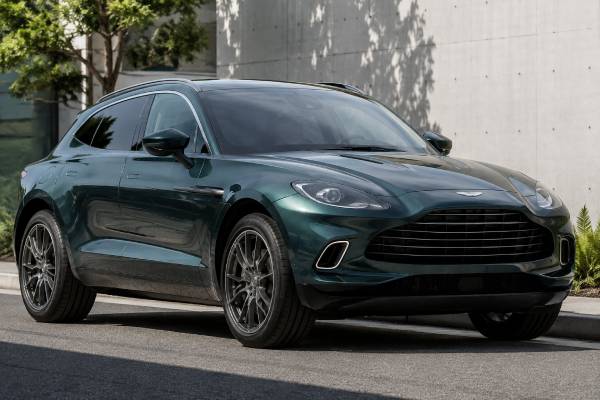
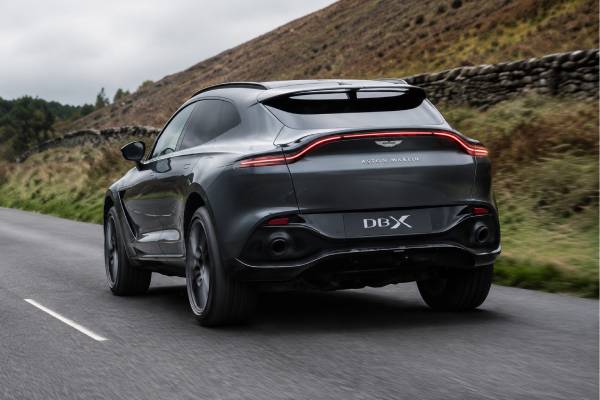
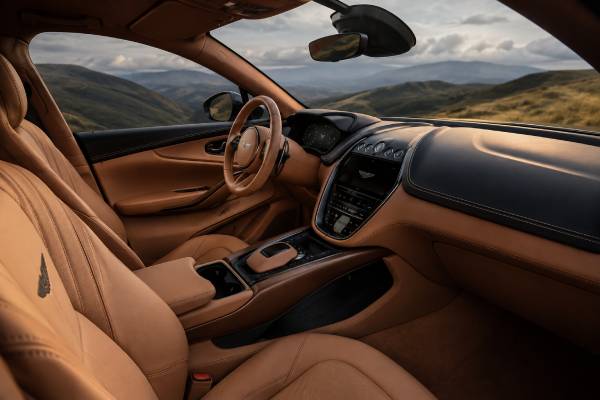
The Aston Martin DBX Straight-Six is a China-market mild hybrid that substitutes a 3.0-liter turbocharged inline-six for the original DBX V8. Introduced in late 2021, it produces 435 PS, or about 429 hp, and 520 Nm while using a 48-volt integrated starter-generator and electric auxiliary compressor to improve response and efficiency. It is not a plug-in hybrid and does not offer a meaningful electric-only driving range. Instead, the electrical system restarts the engine smoothly, recovers energy during deceleration, supports coasting functions, and assists the combustion powertrain when required. The rest of the vehicle remains recognizably DBX: a dedicated bonded-aluminum SUV platform, nine-speed automatic transmission, all-wheel drive, air suspension, electronic active roll control, and a five-seat luxury cabin. Because the model was developed specifically for China and is far rarer elsewhere, buyers must verify market specification, service support, emissions compliance, and parts access as carefully as the vehicle’s mechanical condition.
Table of Contents
- What the Straight-Six version actually is
- Straight-Six mild-hybrid specifications
- How the M256 48-volt system works
- Performance, efficiency, and DBX character
- China-market equipment and ownership context
- Service needs for two electrical systems
- Buying or importing a Straight-Six DBX
What the Straight-Six version actually is
The Straight-Six is a genuine factory DBX derivative, not an aftermarket engine conversion or a global replacement for the V8. Aston Martin launched it for China, where engine displacement and the demand for more efficient luxury vehicles made a 3.0-liter electrified powertrain commercially useful.
Its arrival also reconnected Aston Martin with a historic engine layout. The company’s post-war road cars included famous inline-six models such as the DB2 and DB4, although the modern M256-based unit is entirely different in design and origin. It comes from Mercedes-Benz technology, uses turbocharging and 48-volt assistance, and was integrated into the AM8 platform with Aston Martin calibration.
The model is properly classified as a mild hybrid, or MHEV. That term matters because “hybrid” can otherwise suggest capabilities the vehicle does not have. There is no charge port, no large traction battery, and no official electric range. The integrated starter-generator, commonly shortened to ISG, is designed to support the engine and electrical network. It can recover energy, make stop-start events more refined, and add brief assistance, but the petrol engine remains the primary source of propulsion.
A separate 48-volt electric auxiliary compressor helps build air pressure before the exhaust-driven turbocharger is fully active. This reduces the pause that can occur when a turbocharged engine is asked for torque at low speed. The 48-volt architecture can deliver more electrical power than a conventional 12-volt network without the much higher voltage and safety structure of a full hybrid.
Aston Martin positioned the Straight-Six below the 4.0-liter V8 in output. Its 435 PS and 520 Nm are substantial, but they trail the V8’s 550 PS and 700 Nm. The manufacturer’s 0–100 km/h time is 5.4 seconds rather than 4.5, and maximum speed is 259 km/h instead of 291 km/h. In exchange, the China-market published consumption figure fell to 10.5 L/100 km on the stated test cycle, and the lighter engine contributed to a claimed 30 kg vehicle-weight reduction compared with the V8.
The model years in this guide cover its launch and the period in which it was offered alongside the early DBX family. Availability and exact equipment should always be confirmed by VIN and Chinese factory documentation because production timing, registration year, and export history may not align.
Straight-Six mild-hybrid specifications
This DBX combines a turbocharged petrol engine with a non-plug-in 48-volt assistance system. Its batteries and electrical devices improve engine operation and energy recovery, but they do not turn it into a vehicle designed for sustained electric driving.
| Specification | Value | Function |
|---|---|---|
| Engine | 3.0-liter turbocharged inline-six | Primary propulsion source |
| Engine family | Mercedes-Benz M256-based | Aston Martin installation and calibration |
| Maximum system output | 435 PS (429 hp; 320 kW) | Officially published vehicle output |
| Maximum torque | 520 Nm (384 lb-ft) | Officially published rating |
| Electrical architecture | 48-volt mild hybrid | Assistance, recuperation, and electrical loads |
| Starter-generator | Integrated starter-generator | Starting, energy recovery, and torque support |
| Boost response device | 48-volt electric auxiliary compressor | Builds charge pressure before exhaust turbo response |
| External charging | None | No plug-in capability |
| Official electric range | None | Not designed as a traction-range hybrid |
| Specification | Value | Standard or condition |
|---|---|---|
| 0–100 km/h (0–62 mph) | 5.4 seconds | Manufacturer claim |
| Maximum speed | 259 km/h (161 mph) | Manufacturer claim |
| Combined fuel consumption | 10.5 L/100 km (22.4 US mpg) | China-market published test-cycle figure |
| Combined carbon-dioxide emissions | 250 g/km | China-market published figure |
| Weight difference from V8 DBX | 30 kg (66 lb) lighter | Manufacturer comparison |
| Fuel type | Premium unleaded petrol | Use the market-specified octane grade |
| Specification | Value |
|---|---|
| Transmission | 9-speed automatic |
| Drive type | All-wheel drive |
| Rear differential | Electronically controlled limited-slip differential |
| Propeller shaft | Carbon-fiber construction |
| Shift control | Automatic programs with steering-column paddles |
| Drive-mode integration | Powertrain, gearbox, steering, suspension, and stability settings coordinated by mode |
| Specification | Value |
|---|---|
| Body style | Five-door, two-row luxury SUV |
| Seating capacity | 5 |
| Length | 5,039 mm (198.4 in) |
| Width excluding mirrors | 1,998 mm (78.7 in) |
| Width including mirrors | 2,220 mm (87.4 in) |
| Height | 1,680 mm (66.1 in) |
| Wheelbase | 3,060 mm (120.5 in) |
| Luggage capacity | 632 liters |
| Rear seat split | 40:20:40 folding backrests |
| Specification | Value | Notes |
|---|---|---|
| Front suspension | Independent double wishbone | Adaptive damping and air springs |
| Rear suspension | Independent multi-link | Adaptive damping and air springs |
| Air suspension | Triple-chamber system | Variable ride height and spring behavior |
| Active roll control | Electronic anti-roll system | Uses 48-volt electrical architecture |
| Front brakes | 410 mm ventilated discs | Six-piston calipers |
| Rear brakes | 390 mm ventilated discs | Single-piston sliding caliper layout |
| Factory wheel range | 21 to 23 inches | Exact design and tires depend on order |
The table omits battery capacity and standalone electric-motor output because Aston Martin did not present this vehicle as a full hybrid with a meaningful traction battery or independently rated electric driving mode. Adding unverified component values would misrepresent the official vehicle specification.
How the M256 48-volt system works
The 48-volt system improves the petrol engine’s operation rather than replacing it. Its main benefits are faster response, smoother starting, recovered energy, and the ability to run high-demand electrical equipment more effectively.
In a conventional vehicle, a belt-driven alternator turns mechanical energy into electricity and a separate starter motor cranks the engine. The M256 architecture uses an integrated starter-generator within the powertrain. During deceleration, it can act as a generator and return energy to the 48-volt battery. During a restart or a demand for torque, it can act in the opposite direction. This integration allows the engine to stop and restart with less vibration than a traditional pinion starter.
Energy recovery is not free energy. The car harvests part of the kinetic energy that would otherwise become heat in the brakes or be lost while slowing. That electricity can later support the engine or power electrical devices, reducing the mechanical work that would otherwise come from fuel. The effect is most useful in varied driving with repeated deceleration and acceleration; a steady high-speed run offers fewer recovery opportunities.
The electric auxiliary compressor addresses a different problem. An exhaust turbocharger needs gas flow to accelerate its turbine. At low engine speed, flow may be insufficient for immediate boost. A fast electric compressor can provide charge pressure during that gap, then hand over as the exhaust-driven turbo becomes effective. The driver experiences a more immediate response without requiring a smaller turbo that might restrict high-speed airflow.
The vehicle retains both 12-volt and 48-volt electrical networks, with batteries packaged beneath the rear luggage area according to launch material. The 12-volt side supports conventional control modules and accessories, while the higher-voltage side serves the mild-hybrid and other high-load functions. A converter links the networks. This makes diagnosis more involved than checking one battery: low voltage or communication trouble on either side can affect stop-start behavior, warning messages, chassis functions, or starting quality.
Mild-hybrid terminology can create several ownership mistakes:
- It cannot be charged from a wall outlet, so searching for a charge-port fault is pointless.
- It should not be advertised with an electric range, because brief engine-off coasting is not the same as powered EV travel.
- The presence of a 48-volt battery does not permit untrained work; the system still requires correct isolation and service procedures.
- A disabled stop-start function is not always a failed hybrid component. Battery state, temperature, climate demand, steering position, engine warm-up, or stored faults may legitimately prevent operation.
- Fuel savings depend on use. The homologated result does not guarantee the same consumption in congestion, winter, short trips, or aggressive driving.
The straight-six layout also differs physically from the V8. Six cylinders share one bank, creating a long but narrow engine. The architecture is naturally well balanced for primary and secondary reciprocating forces, which helps refinement. Its lighter mass relative to the V8 may reduce load over the front, but software calibration, tires, and suspension condition have a greater effect on how a used example feels than a simple cylinder-count comparison.
Performance, efficiency, and DBX character
The Straight-Six is slower than the V8 on paper but remains a genuinely quick luxury SUV. Its 5.4-second 0–100 km/h time is sufficient for forceful overtaking, while the electrical response system is intended to make everyday acceleration feel immediate.
The difference is most noticeable at sustained high load. The V8 has 115 PS and 180 Nm more, so it accelerates harder as speed rises and reaches a higher maximum speed. The six-cylinder car instead emphasizes smoothness and a lower official consumption figure. In urban and suburban driving, the ISG’s restarts and the compressor’s low-speed support may matter more than the missing peak output.
A nine-speed automatic gives the engine closely spaced ratios and a tall cruising gear. In normal modes it can use the 520 Nm torque band without making the engine sound busy. Sport settings hold lower ratios, sharpen shifts, and coordinate the exhaust, steering, dampers, all-wheel drive, and active roll system. A driver should still allow the engine oil to warm before high boost, regardless of how quickly the coolant display reaches normal.
The DBX chassis hardware remains ambitious. Air springs control ride height and load support, adaptive dampers manage motion, and active roll control resists lean. The lighter powertrain does not turn a five-meter SUV into a sports car, but accurate steering and controlled body movement can make it easier to place than its dimensions suggest. A poorly maintained car may feel completely different: low tire pressure, old tires, alignment errors, weak voltage, or suspension faults can produce delayed reactions and uneven ride.
Efficiency should be interpreted honestly. The 10.5 L/100 km published figure is a regulated-cycle result, not a promise for every owner. Cold weather, cabin heating, short distances, traffic, roof accessories, large wheels, and rapid acceleration all raise consumption. The MHEV system is most helpful when it can recover energy and avoid unnecessary idling. It cannot overcome the aerodynamic drag, tire width, and mass of a large SUV.
Compared with the V8, the Straight-Six also changes the sound and emotional character. Its exhaust note is smoother and higher in pitch, while the V8 has a deeper pulse. That is a preference rather than a defect. Prospective buyers should drive both if possible and decide whether the six-cylinder car’s refinement and rarity compensate for the V8’s extra performance and broader service familiarity.
China-market equipment and ownership context
The strongest reason to verify a Straight-Six carefully is its market specificity. A genuine car may be mechanically sound yet difficult to register, insure, update, or service after export if its original-market systems are not supported locally.
The model was announced for China and first customer deliveries were planned from early 2022. Launch information linked its equipment to the updated 2022-model-year DBX, including wireless phone charging and new interior themes. Individual cars can still differ through paint, leather, wheels, exterior packs, driver assistance, rear-seat features, and Q personalisation.
Chinese-market infotainment, connected services, navigation data, radio frequencies, voice functions, and emergency-call systems may not work fully in another country. A language menu does not prove that the complete system can be converted. Ask an authorized dealer to check the VIN for region coding, software eligibility, maps, telecommunications hardware, and available campaigns before importing.
Lighting and glass markings also require attention. Headlamp beam pattern, rear fog-lamp arrangement, speed display, emissions labels, tire certification, and immobilizer standards can affect legal approval. These requirements are governed by the destination, not by the vehicle’s prestige or similarity to a locally sold V8. Written guidance from the registration authority is more reliable than a seller’s assurance that another car was accepted.
Parts support is a separate issue. Shared AM8 chassis components may be familiar to dealers, but M256 installation parts, calibration files, exhaust and emissions pieces, wiring, battery components, and cooling lines can be unique to the Straight-Six. Confirm whether a local Aston Martin workshop can order and program those parts. Grey-import warranties often exclude region-specific work or require the car to return to its home market.
For an owner remaining in China, the same principle applies on a smaller scale: choose a workshop with access to the correct factory systems and training for the 48-volt powertrain. An independent shop may be capable of brakes and tires but lack software, battery test equipment, or model-specific procedures. Dividing work sensibly can control cost without sacrificing diagnosis.
Service needs for two electrical systems
Reliable ownership depends on treating the petrol engine, 12-volt network, and 48-volt network as one integrated system. Replacing parts based on a single warning message is risky because a voltage or communication problem can create symptoms in several modules.
Start with scheduled engine care. Use the exact oil specification and interval listed for the VIN and Chinese operating conditions. The M256 is turbocharged and thermally complex, so short-trip use, heavy traffic, dust, and sustained high load deserve consideration when setting a conservative routine. Check for oil seepage, coolant residue, abnormal fan operation, and intake or charge-air leaks.
Both batteries require health assessment. A resting-voltage check is insufficient; capacity, internal resistance, charging behavior, converter operation, and stored energy-management faults matter. A weak 12-volt battery may prevent control units from waking correctly, while a 48-volt issue may disable recuperation, compressor assistance, stop-start, or chassis functions. Use approved connection and isolation points. Orange or specially marked electrical components must not be disturbed without the relevant service procedure and training.
Cooling may include circuits serving the engine, turbocharging system, electrical devices, and cabin. Do not mix fluids based on appearance. A low level should prompt a leak investigation, because repeatedly topping up can hide a small failure until overheating occurs. Inspect radiator and condenser faces for blockage, especially in city use where debris and fine dust can build up.
The electric auxiliary compressor and exhaust turbo must be diagnosed from data, not sound alone. Poor response can come from a boost leak, sensor, software, wastegate, compressor, fuel quality, ignition fault, or gearbox behavior. A workshop should compare requested and actual boost, electrical supply, temperatures, and fault records before replacing an expensive unit.
Chassis maintenance follows DBX principles. Test every ride height, watch whether the vehicle stays level after parking, inspect dampers and air lines, and measure compressor operation. Use four compatible tires with close tread depth. The active all-wheel-drive and stability systems assume predictable rolling circumference, and the broad inner shoulders can wear where an external glance will not reveal it.
Brake fluid, pads, discs, differential fluids, transmission fluid, filters, spark plugs, and other intervals must come from official documentation rather than a generic M256 schedule from another brand. The same engine family can have different installation temperatures, sump capacity, filtration, emissions equipment, and software. Keep invoices that name fluids and part numbers, particularly if the vehicle may later be exported or sold to a specialist buyer.
Buying or importing a Straight-Six DBX
A Straight-Six purchase should proceed in two parallel tracks: prove that the vehicle is healthy, and prove that it can be legally and practically supported where it will live. Completing only one track can leave the buyer with a fine car that cannot be registered or a legal car that cannot be repaired efficiently.
First obtain the VIN, build record, Chinese registration history, service invoices, ownership documents, and any export papers. Confirm that the factory data identifies the 3.0-liter Straight-Six MHEV rather than a V8 car with altered badging. Check engine and emissions labels, battery warnings, wheel specification, interior equipment, and the number of supplied keys. Translate important documents professionally instead of relying on screenshots or automatic summaries.
Before paying a deposit for export, request written answers to these questions:
- Will the destination authority accept the vehicle’s existing type approval, or is individual approval required?
- Which physical changes are needed for lights, instruments, glass, emissions, charging or radio equipment, and safety labeling?
- Can a local Aston Martin dealer access the VIN, supply region-specific M256 parts, perform software updates, and close campaigns?
- Will the insurer recognize the exact variant and provide agreed-value or repair coverage?
- Are import tax, displacement tax, value-added tax, customs, shipping, storage, and inspection costs included in the budget?
- What happens if the car arrives with a discharged 48-volt system or transport damage?
The mechanical inspection should be performed cold by a workshop familiar with Aston Martin diagnostics and 48-volt Mercedes-derived systems. Scan all modules before codes are cleared. Test both electrical networks, inspect cooling and boost systems, operate every suspension height, measure brakes, inspect tire date and inner wear, and road-test gearbox behavior from gentle driving through moderate load. Verify that stop-start and recuperation operate when conditions permit, but do not condemn the system solely because it remains inactive during a short test.
Inspect the underside for shipping or road damage. A large SUV can ground its undertrays during loading, and careless tie-down points may damage suspension or body components. Look for repairs to battery covers, high-current cables, exhaust shielding, and cooling lines. After the road test, recheck for fresh fluid, odor, abnormal heat, or stored faults.
The Straight-Six makes most sense for a buyer who specifically values its China-market story, inline-six refinement, and mild-hybrid engineering. It is not automatically the economical DBX: fuel use remains high, and rarity can increase service difficulty. Nor is it the performance choice against the V8 or DBX707. Its appeal lies in a distinct balance—adequate speed, smoother electrified response, lower official consumption, and an unusual place in Aston Martin history. Buy only when documentation, local support, and vehicle condition are all convincing.
References
- 阿斯顿·马丁DBX STRAIGHT-SIX兼顾澎湃性能与高能效表现 2021 (China-Market Launch)
- 超跑品牌suv阿斯顿马丁推出DBX STRAIGHT-SIX_中华网汽车 2021 (Manufacturer-Supplied Launch Coverage)
- Aston Martin DBX Straight-Six Debuts With Mercedes-Sourced Engine 2021 (Technical Overview)
- PowerPoint Presentation 2022 (Manufacturer Results Presentation)
- DBX Quick Start Guide | Aston Martin ZH 2026 (Quick Start Guide)
- ASTON MARTIN UNVEILS DBX: AN SUV WITH THE SOUL OF A SPORTS CAR | Aston Martin 2019 (Platform Information)
Disclaimer
This material is informational and is not a substitute for professional repair, electrical diagnosis, import advice, or legal approval. Specifications, intervals, torque values, software, equipment, and procedures vary by VIN and market; verify every detail with official Aston Martin service documentation and the relevant authorities. Use a qualified 48-volt specialist for electrical work. Please share this article on Facebook, X/Twitter, or another platform to support our work.