

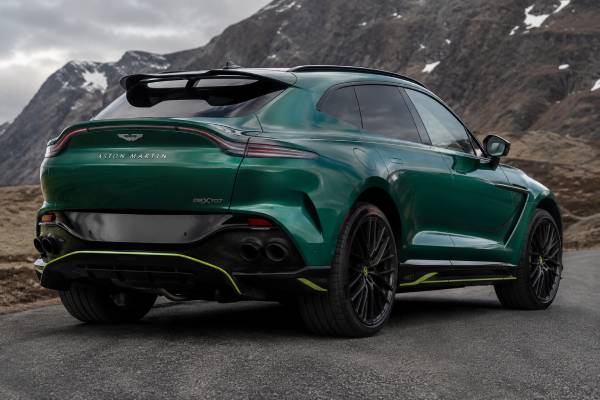
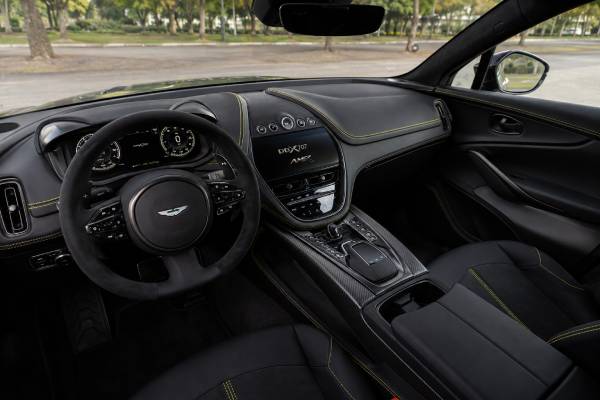
The Aston Martin DBX707 AMR23 Edition connects the company’s fastest SUV of its era with the visual identity of its 2023 Formula 1 campaign. Created through Q by Aston Martin, it uses Podium Green paint, Aston Martin Racing Green brake calipers, Q badging, available lime accents, and an Onyx Black and Eifel Green cabin with carbon-fiber details. The edition does not add power or race-car hardware beyond the standard DBX707: output remains 707 PS, or 697 hp, with 900 Nm from a 4.0-liter twin-turbo V8. That distinction is central to buying one. Its performance value comes from the already formidable DBX707 platform, while its edition value depends on factory provenance, correct color and trim, and preservation of the AMR23-specific details. Cars registered across 2023 and 2024 may also sit on opposite sides of Aston Martin’s major DBX707 cabin update, so the exact build specification matters. This guide separates the Formula 1-inspired design from the mechanical facts and explains ownership, maintenance, and authentication.
Table of Contents
- What the AMR23 Edition changes
- DBX707 AMR23 numbers and hardware
- Formula 1-inspired color and trim
- Why the DBX707 platform is so quick
- Cabin era, options, and daily use
- Care for carbon ceramics, paint, and tires
- Authenticate and inspect before buying
What the AMR23 Edition changes
The AMR23 Edition is a Q-curated design package built on the standard DBX707 mechanical specification. It celebrates Aston Martin’s 2023 Formula 1 identity, but it should not be described as a homologation special, power upgrade, or track conversion.
Aston Martin announced the model in May 2023 after a strong opening to that Formula 1 season. Its name refers to the AMR23 race car, while several details also echo the DBX707 used as Formula 1’s official medical car. Podium Green was the headline feature. At launch, the color was associated with the AMR23 racer and medical car rather than the normal DBX707 palette. Aston Martin later added Podium Green more broadly to the refreshed DBX707 range, so paint color alone no longer proves that a vehicle is an AMR23 Edition.
The factory edition specification included a unique Q by Aston Martin fender badge and Aston Martin Racing Green brake calipers. Lime accents could be applied to the sculpted carbon body kit, linking the road car visually with the bright markings on the race and medical cars. Inside, Aston Martin specified an Inspire Sport Duotone combination of Onyx Black and Eifel Green, lime contrast stitching, carbon-fiber veneer, dark satin and carbon-fiber jewelry, and AMR23-branded sill plaques.
No official launch material stated a fixed global production number. That is important when advertisements use unsupported phrases such as “one of 50” or “one of 100.” Unless a claim is backed by a factory letter, market-specific allocation document, or build data, describe the vehicle as an exclusive edition rather than assigning an invented total.
The model’s appeal rests on a clear hierarchy:
- The DBX707 supplies the engine, gearbox, brakes, chassis, and acceleration.
- Q by Aston Martin supplies the coordinated exterior and interior identity.
- Formula 1 supplies the cultural context, not direct race-car parts.
- The individual vehicle’s build record proves whether those elements were fitted at the factory.
This framework prevents two common errors. A standard Podium Green DBX707 is not automatically an AMR23 Edition, and an authentic AMR23 car does not have more than 707 PS simply because its graphics look more aggressive.
DBX707 AMR23 numbers and hardware
The AMR23 uses the DBX707’s petrol-only powertrain. It has a wet-clutch nine-speed automatic, active all-wheel drive, electronic rear differential, air suspension, active roll control, and carbon-ceramic brakes; there is no hybrid traction motor or plug-in system.
| Specification | Value | Notes |
|---|---|---|
| Engine | 4.0-liter twin-turbocharged V8 | Longitudinal front installation |
| Displacement | 3,982 cc | 83 mm bore; 92 mm stroke |
| Compression ratio | 8.6:1 | DBX707 factory specification |
| Maximum power | 707 PS (697 hp; 520 kW) at 6,000 rpm | Same as standard DBX707 |
| Maximum torque | 900 Nm (663 lb-ft) at 4,500 rpm | Same as standard DBX707 |
| Fuel | Premium unleaded petrol | Follow market octane requirements |
| Fuel tank | 87 liters (23.0 US gal) | Manufacturer specification |
| Specification | Value | Purpose |
|---|---|---|
| Transmission | 9-speed automatic with wet starting clutch | Handles higher torque and enables launch control |
| Drive type | All-wheel drive | Active front-to-rear torque distribution |
| Rear differential | Electronic limited-slip differential | Manages torque across the rear axle |
| Propeller shaft | Carbon fiber | Reduces rotating mass |
| Maximum rear torque share | Up to 100 percent | When control conditions request it |
| Launch control | Factory system | Requires correct operating conditions |
| Test | Result | Basis |
|---|---|---|
| 0–60 mph | 3.1 seconds | Manufacturer claim |
| 0–100 km/h (0–62 mph) | 3.3 seconds | Manufacturer claim |
| 0–160 km/h (0–100 mph) | 7.4 seconds | Manufacturer claim |
| Maximum speed | 310 km/h (193 mph) | Manufacturer claim |
| Combined fuel consumption | 14.2 L/100 km (19.9 UK mpg) | Published WLTP combined figure |
| Maximum braked towing capacity | 2,700 kg (5,940 lb) | Approved equipment and local limits apply |
| Specification | Value |
|---|---|
| Body style | Five-door luxury performance SUV |
| Seating | 5 |
| Length | 5,039 mm (198.4 in) |
| Width excluding mirrors | 1,998 mm (78.7 in) |
| Width including mirrors | 2,220 mm (87.4 in) |
| Height | 1,680 mm (66.1 in) |
| Wheelbase | 3,060 mm (120.5 in) |
| Luggage capacity | 632 liters |
| Rear seat | 40:20:40 split-folding |
| Specification | Value | Configuration |
|---|---|---|
| Suspension | Adaptive triple-chamber air suspension | Double-wishbone front; multi-link rear |
| Roll control | 48-volt electronic active roll control | Integrated with drive modes |
| Front brakes | 420 mm carbon-ceramic discs | Six-piston calipers |
| Rear brakes | 390 mm carbon-ceramic discs | Electronic parking brake |
| Standard wheel diameter | 22 inches | Edition order may specify 23-inch wheels |
| Optional wheel diameter | 23 inches | Cast or forged designs by market |
| 22-inch front tire | 285/40 R22 | Check tire approval marking |
| 22-inch rear tire | 325/35 R22 | Check tire approval marking |
Performance figures describe a properly prepared vehicle under controlled conditions. Road surface, tire temperature, fuel, load, altitude, and launch-control eligibility all affect results; repeated launches also impose real heat and wear on the driveline.
Formula 1-inspired color and trim
The AMR23 Edition’s special content is easiest to understand as a visual system: deep green establishes the base, lime creates high-energy contrast, and carbon fiber connects the SUV’s surfaces with motorsport imagery. Preserving that relationship matters more than making every component look newly polished.
Podium Green should be inspected in direct sun, shade, and indoor light. Metallic orientation and color travel must remain consistent between adjacent panels. Because the color later became available on regular DBX707s, the paint code should be cross-checked with the build record, not treated as stand-alone evidence. Paint-protection film may preserve the finish, but old film can yellow, lift around complex edges, or pull weak refinishing when removed. Note its installer, date, coverage, and condition.
Lime accents are vulnerable because they sit low on the carbon body kit. Stone impact, curb contact, incorrect washing, and previous film removal can mark them. Compare the left and right sides for line width, position, finish, and edge quality. A replacement stripe that looks acceptable from several meters away may be obviously wrong beside original work. Photograph the car before any repair and ask the factory network whether the relevant decal, painted accent, or component is still supplied.
The Racing Green calipers operate in a harsh environment. Brake dust and heat can discolor logos or dull the surface. Strong acidic wheel cleaner may damage both caliper finish and wheel coating. Cleaning should occur when the brakes are cool, with products confirmed safe for painted calipers and carbon-ceramic systems. A fresh caliper repaint is not automatically a benefit: incorrect color, logo type, or surface texture can weaken authenticity.
Inside, the Onyx Black and Eifel Green leather provides a more complex authentication reference than a single badge. Check seat centers, bolsters, door cards, stitching, headlining, veneer, dark-satin jewelry, and sill plaques against the original order. Lime stitching should be even and uninterrupted. Carbon-fiber weave should align consistently and should not show cloudy clear coat, edge lifting, or deep scratches.
AMR23 sill plaques are important but not sufficient proof. Plaques can be replaced or copied, while a complete factory specification is harder to imitate. Genuine identity comes from the agreement between VIN data, invoice, Q equipment, exterior finish, cabin theme, and delivery history.
Why the DBX707 platform is so quick
The DBX707’s acceleration comes from more than extra boost. Aston Martin combined a higher-output V8 with a different starting-clutch transmission, stronger torque delivery, revised differentials, carbon-ceramic brakes, and recalibrated chassis control.
Compared with the original 550 PS DBX, the engine gained 157 PS and 200 Nm. Aston Martin used ball-bearing turbochargers and revised calibration to reach 707 PS and 900 Nm. The hot-V layout places the turbos between the cylinder banks, helping packaging and response. The engine still has to move a large SUV, so cooling condition, oil quality, fuel octane, and unobstructed air paths are crucial.
The nine-speed gearbox replaces a conventional torque converter at launch with a multi-plate wet clutch. The clutch runs in oil for cooling and can transmit the higher torque more directly. It also enables a more forceful launch-control strategy. At parking speed, however, a wet-clutch transmission can feel different from a torque-converter unit. Some deliberate clutch engagement sensation is normal; repeated shudder, harsh bangs, delayed drive, or warning messages are not.
All-wheel-drive control can send all available drive torque to the rear axle when conditions allow. That does not mean the vehicle is permanently rear-wheel drive or that the front axle is unimportant. Control modules continuously assess grip, steering, yaw, throttle, and mode. The rear electronic limited-slip differential then manages distribution between the rear wheels, improving corner exit and stability.
Carbon-ceramic brakes cut unsprung mass substantially compared with equivalent iron hardware. Aston Martin quoted a 40.5 kg reduction for the DBX707 system. Less unsprung mass helps each wheel follow the road and reduces the inertia the suspension must control. The 420 mm front and 390 mm rear discs also resist heat during repeated hard braking. They remain wear components, not lifetime parts.
Air springs, adaptive dampers, and electronic active roll control allow the vehicle to change character by mode. A softer road setting can maintain travel comfort, while aggressive modes tighten body control and response. Software coordinates these systems, so a car with mismatched tires, poor alignment, weak voltage, or stored chassis faults will not deliver the intended result even if the engine is healthy.
The AMR23 Edition adds visual intensity but no separate dynamic calibration was announced. On a road test, it should therefore behave like a standard DBX707 of the same build phase, wheel package, software status, and condition.
Cabin era, options, and daily use
An AMR23 Edition may be associated with the original DBX707 cabin, while later registration timing can create confusion around the 2024 interior update. The only safe method is to inspect the actual dashboard and confirm the build date.
The initial DBX707 interior retained the earlier DBX architecture, including a 12.3-inch driver display and a 10.25-inch central display operated mainly through console controls. Aston Martin’s major 2024 update introduced an entirely redesigned dashboard and center console, a 10.25-inch capacitive touchscreen, wireless Apple CarPlay and Android Auto, USB-C connectivity, a customer app, and revised physical switches. The driver screen remained 12.3 inches. The updated range also received an 800-watt, 14-speaker standard audio system and an optional 1,600-watt, 23-speaker Bowers & Wilkins system.
The AMR23 launch specification predates that refreshed interior. A vehicle advertised as both a factory AMR23 Edition and a new-cabin car requires particularly clear documentation. It may have a later registration date, a market-specific production sequence, or an owner-created specification. Do not infer authenticity from the year on a license plate.
Regardless of cabin generation, the DBX707 remains a practical two-row SUV. Rear adults have useful room, the backrests split 40:20:40, and the 632-liter cargo area accepts normal touring luggage. Its 2,700 kg towing capability is genuine when the correct equipment is fitted, although towing with carbon-ceramic brakes, ultra-wide tires, and a high-output engine does not make running costs disappear.
Daily compromises include width, fuel use, tire sensitivity, and attention. At 2,220 mm over the mirrors, narrow garages need measurement. The 23-inch wheel option sharpens appearance but reduces tire sidewall and raises replacement cost. Podium Green and lime detailing attract visual attention, which may affect secure parking and insurance arrangements.
A buyer should test all user-facing systems rather than focusing only on the engine:
- every camera view and parking sensor;
- powered seat positions, heating, and ventilation where fitted;
- climate zones and heated glass;
- phone pairing, navigation, audio channels, and USB ports;
- tailgate opening height and hands-free function where equipped;
- both keys, alarm, tracker, and connected-service status;
- steering-wheel controls, driver assistance, and warning displays.
The best daily setup is not necessarily the most aggressive mode. Use a road program for rough surfaces and reserve launch control or maximum chassis settings for safe, suitable conditions. Let oil and drivetrain temperatures rise before demanding full output.
Care for carbon ceramics, paint, and tires
AMR23 ownership becomes expensive when cosmetic preservation and high-performance mechanical care are postponed. A planned routine is safer than waiting for the dashboard to request attention.
Carbon-ceramic discs require inspection by someone who understands their material. Surface patterns that look alarming to an owner may be normal, while edge damage, deep scoring, impact chips, heat distress, or mass loss may be serious. The service method can include weighing or measuring against manufacturer limits rather than using only an iron-disc thickness rule. Never let a wheel strike a disc during removal, and use correct lifting and wheel-handling procedures.
Pads and discs should be kept free from contamination. Tire dressing, grease, aggressive chemicals, and careless detailing can reach friction surfaces. After washing, gentle brake applications help dry the system. A car stored after being put away wet may develop pad adhesion or localized marks. If the pedal vibrates, diagnosis should consider tires, wheel mounting, hubs, suspension, deposits, and disc condition before parts are ordered.
The tires must match in specification and remain close in rolling circumference. Check inner shoulders, which are difficult to see with the vehicle on the ground, and record manufacturing dates. A low-mileage AMR23 may still need tires because of age, flat spotting, cracking, or heat cycles. Replacement should prioritize the correct Aston Martin-approved construction and load rating rather than the cheapest tire carrying the same size.
Engine service must use the VIN-specific oil standard and official schedule. Heavy urban use, repeated cold starts, high ambient temperature, towing, or frequent performance driving can justify closer monitoring. Investigate coolant loss, dried residue, oil odor, misfire, or an unusually active cooling fan. Do not apply generic M177 procedures from another car; installation, capacities, software, and access differ.
Battery condition is equally important. A DBX707 kept as a special-occasion car can spend weeks waking modules for alarms, trackers, keyless entry, and connected systems. Use an approved conditioner at the designated points. Low voltage can create multiple control faults and can interfere with suspension and driveline diagnosis.
For the edition finishes, use a hand-wash process, neutral products, clean tools, and cool surfaces. Inspect protective film and carbon clear coat at each service. Keep a small archive containing paint readings, photographs, invoices, removed original parts, tire records, and any factory correspondence. This material helps distinguish careful preservation from undocumented cosmetic correction.
Authenticate and inspect before buying
A credible AMR23 purchase requires two independent conclusions: the car is a genuine factory edition, and the underlying DBX707 is mechanically sound. One conclusion cannot compensate for failure of the other.
Request the VIN before travel. Ask an Aston Martin dealer to provide or confirm the build specification, original market, warranty start, campaign status, and service history available in the network. Match the record to Podium Green paint, Q fender badges, Racing Green calipers, lime exterior accents if ordered, Onyx Black and Eifel Green interior, lime stitching, carbon veneer, dark-satin/carbon jewelry, and AMR23 sills. Save copies of the original invoice, order form, certificate, handover material, and any Q correspondence.
Be cautious with production-number claims. A plaque may identify an edition but does not prove a global run size. Ask the seller for the exact document supporting any “one of” statement. Market allocations can also be confused with worldwide production.
A cold inspection should begin before startup. Look for unequal ride height, fluid marks, tire flat spots, wheel damage, brake-surface contamination, paint mismatch, and worn interior contact points. Observe the complete startup sequence. Warning lamps should illuminate for their checks and then clear appropriately. A battery that needs a booster is not a minor inconvenience on a module-heavy car; stabilize and test the electrical system before trusting the scan.
The specialist inspection should include:
- A full diagnostic report from every accessible control module, with freeze-frame and history data.
- Battery capacity and charging tests, followed by a second scan if voltage was low.
- Cooling-system inspection and pressure testing, including radiator condition and dried residue.
- Suspension operation through all permitted heights, leak-down observation, and damper checks.
- Carbon-ceramic disc assessment using Aston Martin limits, plus pad and caliper inspection.
- Tire dates, specification, tread-depth matching, inner shoulders, wheel runout, and alignment.
- Gearbox engagement from cold, low-speed clutch behavior, and warm shifts under progressive load.
- Paint-depth mapping, film inspection, carbon-body-kit examination, and edition-detail comparison.
- Operation of infotainment, cameras, climate, seats, driver assistance, tailgate, keys, and tracker.
On the road, the car should feel stable and coordinated rather than merely violent in a straight line. Steering should center, the body should settle after vertical movement, and power should arrive cleanly. Brake response should be repeatable after warming. A clonk, shudder, misfire, vibration, or chassis warning deserves diagnosis, not an explanation that “they all do that.”
Price must account for immediate consumables. A car needing four tires, brake work, annual service, battery replacement, paint-film removal, and a suspension repair can consume a large apparent discount. Warranty terms should be read line by line for carbon ceramics, air suspension, active roll control, wet clutch, differentials, infotainment, and diagnosis.
The AMR23 Edition is best for an owner who wants the 2023 Formula 1 narrative expressed through a factory Q specification and who appreciates the DBX707’s performance without expecting unique engine tuning. A documented, unaltered car with excellent mechanical condition is more compelling than one covered in additional graphics or unsupported rarity claims. Authenticate first, inspect second, and value the complete evidence rather than a green paint color in isolation.
References
- Aston Martin celebrates latest Formula 1® success with racecar-inspired new look for DBX707 | Aston Martin 2023 (Edition Launch)
- Introducing the Aston Martin DBX707: The world’s most powerful luxury SUV – 2022 (Engineering Overview)
- Aston Martin DBX707 Satin Neutron White – Full Specification – 2022 (Technical Specifications)
- Aston Martin DBX707: Technically advanced interior to match class-leading performance | Aston Martin 2024 (Model Update)
- Aston Martin DBX707 | Luxury SUV | Aston Martin 2026 (Current Model Information)
- Check for Recalls: Vehicle, Car Seat, Tire, Equipment | NHTSA 2026 (Recall Database)
Disclaimer
This article is informational and does not replace professional diagnosis, repair, valuation, or edition authentication. Specifications, torque values, intervals, software, and procedures may differ by VIN, market, equipment, and build date; use official Aston Martin service documentation for the specific vehicle. Arrange a qualified inspection before purchase. Please share this guide on Facebook, X/Twitter, or another platform if it helped you.