

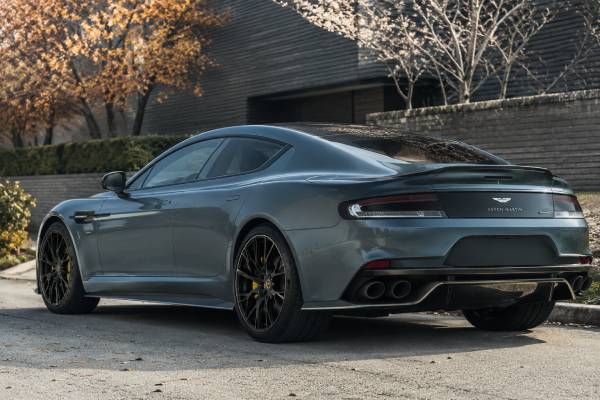
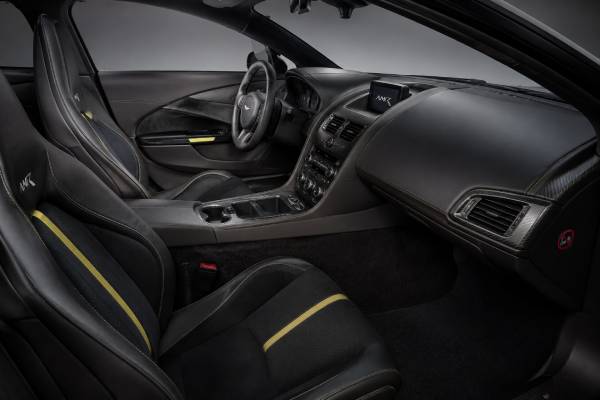
The 595 bhp Aston Martin Rapide AMR is the closing statement of the VH400 line: a 603 PS naturally aspirated V12 four-seater with a 205 mph maximum speed, carbon-fibre aerodynamics, 21-inch forged wheels, carbon-ceramic brakes, and a worldwide limit of 210 cars. It takes the Rapide’s unusual qualities—four swan-wing doors, rear transaxle, hydraulic steering, and individual rear seats—and adds the model’s most serious factory chassis and braking package.
Its significance makes condition more important, not less. Carbon parts can hide impact repairs, ceramic discs can carry enormous replacement exposure, special wheels can be restored after structural damage, and a low-mileage cabin can coexist with years of mechanical inactivity. Build date and registration year may differ, so 2018–2020 listings must be tied to the VIN and original specification.
This guide treats 595 bhp as the British expression of the official 603 PS output. It builds from engineering and braking detail toward preservation and acquisition, helping a buyer judge the AMR as both a high-speed machine and a limited-production object that must remain complete.
Table of Contents
- The Final Naturally Aspirated Rapide
- 595 bhp AMR Specifications
- Aerodynamics, Chassis, and Driver Response
- Carbon-Ceramic Brake Stewardship
- Cabin Specification and Provenance
- Long-Term AMR Preservation
- Collector-Grade Inspection and Buying Decisions
The Final Naturally Aspirated Rapide
The Rapide AMR is the final factory-developed expression of Aston Martin’s naturally aspirated four-door V12 concept. Its importance comes from that position in the model’s history as much as from its 595 bhp output.
The original Rapide arrived with 470 bhp and a six-speed transmission. Rapide S raised power to 550 bhp, then the later eight-speed S improved acceleration with 552 bhp. The AMR did not simply add another trim package. It pushed output to 603 PS, introduced the first 21-inch wheels fitted to an Aston Martin, added carbon-ceramic brakes, revised the aerodynamic surfaces, lowered the chassis, and limited production to 210.
AMR stood for Aston Martin Racing, but this car was designed for the road. Four individual seats, climate control, a liftback, and grand-touring refinement remain. The motorsport connection appears through color themes, materials, brake capacity, cooling, and chassis response rather than through removal of comfort equipment.
The 595 bhp label and the 603 PS official figure describe the same global performance level when stated in different units. Some regional sources use approximately 580 hp. A buyer should preserve the factory wording associated with the car’s original market instead of claiming that one conversion creates a rarer or stronger model.
The announced production cap matters, but it does not authenticate an individual example. Confirm the VIN, AMR build specification, edition plaque, exterior theme, interior choices, carbon components, wheel design, brake system, and original market. A genuine car may have a subtle color scheme, while a standard Rapide S may have acquired AMR-like graphics and wheels.
Dates also need interpretation. Launch occurred in 2018, yet low-volume production, transport, dealer storage, and registration can place cars into later calendar years. A 2020 registration should be described accurately, but it does not automatically mean the factory produced a mechanically revised 2020 AMR.
The model’s long-term appeal rests on five qualities:
- It is the final and most powerful production Rapide derivative.
- The V12 remains naturally aspirated and paired with a rear transaxle.
- Its brakes, wheels, damping, and aerodynamics are genuinely model-specific.
- Production was officially limited to 210 examples.
- It retains four-seat usability instead of becoming a two-seat special.
Those qualities make completeness essential. The more a car loses its original carbon, wheels, brakes, trim, or documentary chain, the more it becomes an expensive approximation of the edition rather than a strong example of it.
595 bhp AMR Specifications
The global Rapide AMR specification pairs 603 PS or approximately 595 bhp with 630 Nm, an eight-speed Touchtronic III transaxle, rear-wheel drive, and a quoted 330 km/h maximum speed. These figures define the edition, while emissions and optional equipment remain market-dependent.
| Item | Specification |
|---|---|
| Configuration | All-alloy naturally aspirated 60-degree V12 |
| Displacement | 5,935 cc (5.9 L) |
| Valvetrain | Quad overhead camshafts, 48 valves |
| Maximum power | 444 kW / 603 PS / approximately 595 bhp at 7,000 rpm |
| Maximum torque | 630 Nm / 465 lb-ft |
| Aspiration | Natural aspiration |
| Item | Specification |
|---|---|
| Transmission | Eight-speed Touchtronic III automatic transaxle |
| Driven wheels | Rear |
| Torque transfer | Carbon-fibre propeller shaft within torque tube |
| 0–100 km/h | 4.4 seconds |
| 0–60 mph | 4.2 seconds |
| Maximum speed | 330 km/h / 205 mph |
| Item | Specification |
|---|---|
| Front discs | 400 mm carbon-ceramic |
| Front calipers | Six-piston |
| Rear discs | 360 mm carbon-ceramic |
| Rear calipers | Four-piston |
| Wheels | 21-inch forged alloy |
| Front tyres | 245/35 ZR21 |
| Rear tyres | 295/30 ZR21 |
| Item | Measurement |
|---|---|
| Length | Approximately 5,019 mm / 197.6 in |
| Width excluding mirrors | Approximately 1,929 mm / 75.9 in |
| Height | Approximately 1,350 mm / 53.1 in |
| Wheelbase | 2,989 mm / 117.7 in |
| Kerb weight | Approximately 1,990 kg / 4,387 lb |
| Doors and seating | Four doors, four individual seats |
| Item | Specification |
|---|---|
| Core structure | Bonded and riveted aluminium VH architecture |
| Suspension layout | Independent double wishbones front and rear |
| Damping | AMR-tuned three-stage adaptive system |
| Steering | Hydraulically assisted rack and pinion |
| Carbon elements | Bonnet, splitter, sills, diffuser, and rear aero details |
| Exhaust | Quad-outlet AMR system |
The power peak at 7,000 rpm helps explain the car’s character. It is not built around low-speed boost; acceleration strengthens as the V12 approaches the upper rev range. The eight-speed gearbox keeps the engine available without sacrificing a relaxed high gear for touring.
Aerodynamics, Chassis, and Driver Response
The AMR’s driver appeal comes from the interaction of airflow management, lower ride height, adaptive damping, hydraulic steering, forged wheels, tyres, and high-capacity brakes. No single component creates the experience.
The carbon bonnet contains large ventilation openings that release heat and visually distinguish the car. At the nose, the splitter and revised grille treatment manage airflow around and beneath the body. Side sills control the lower profile, while the diffuser and rear lip spoiler complete the package. These are functional-looking road components rather than a promise of racing-car downforce figures.
Condition is critical because the lowest carbon pieces can strike curbs or ramps. Inspect from below with clean lighting. Small clear-coat marks differ from broken fibers, crushed mounting points, or separated laminate. A repaired part should have photographs and an invoice from a composite specialist.
The 21-inch wheels reduce tyre sidewall compared with the standard S. Steering response becomes more immediate, but impact protection decreases. A car that has encountered potholes may have a wheel that looks straight from the face yet is bent on the inner rim. Road-force balancing and bare-wheel measurement can reveal problems that cosmetic refinishing hides.
On the road, the AMR should feel firm but coordinated. The adaptive modes alter body movement without turning the car into a harsh, nervous machine. If every mode feels identical, scan the damping system. If every surface creates sharp impacts, check tyre pressure, date, wheel runout, joints, bushes, and damper condition before judging the calibration.
Hydraulic steering communicates load naturally. The wheel should remain centered on a level road and assistance should be even in both directions. Tramlining can increase with wide, low-profile tyres, but a strong pull, notch, groan, or fluid leak is a fault.
The engine’s strongest acceleration arrives high in the rev range. Warm the car fully before using it. Throttle response should be clean, and the gearbox should shift rapidly when commanded. Misfire, hesitation, or a flashing warning light under load needs immediate diagnosis; repeated high-rpm testing is not a substitute for a scan and fuel or ignition analysis.
The quad exhaust gives the AMR a sharper voice. Check valves, mounts, heat shields, rear bumper alignment, and signs of contact. Aftermarket valve controllers or exhaust changes should be reversible and documented. A loud cold start does not confirm factory software.
A complete evaluation uses the car’s full operating range without approaching illegal speeds. Low-speed maneuvers reveal gearbox and steering behavior. Rough roads reveal wheel and damper condition. Steady cruising reveals noise and vibration. Progressive acceleration tests response. Controlled braking tests stability. A hot restart and second scan reveal heat-related faults.
Carbon-Ceramic Brake Stewardship
The carbon-ceramic brake system is both a performance advantage and the largest obvious AMR-specific financial risk. Its condition must be measured by a technician familiar with the system before purchase and monitored throughout ownership.
Ceramic discs resist fade and reduce unsprung mass, but they are vulnerable to impact and mishandling. A dropped wheel, metal tool, or careless caliper support can damage a disc. Harsh wheel chemicals can contaminate surfaces. Track use or repeated very high-energy braking can create heat history that ordinary mileage does not reveal.
Do not evaluate discs only by looking for a conventional iron-disc lip. Inspection should follow the approved method for the part, including surface condition, edge integrity, weight or wear indicators where specified, and comparison with service limits. The bells, fasteners, pads, calipers, hoses, and fluid all belong in the assessment.
Warning signs include:
- Chips or missing material at the edge.
- Radial damage or surface disruption beyond normal appearance.
- Severe vibration or pulsing under braking.
- Grinding or a sudden change in pedal feel.
- Uneven pad wear or heat discoloration around hardware.
- One wheel remaining significantly hotter after ordinary driving.
- Missing records after claimed track or high-speed use.
Noise alone is not conclusive. Ceramic systems can make some sound when cold, damp, or lightly used. The question is whether noise is accompanied by physical damage, poor stopping, vibration, or a diagnostic warning.
Wheel removal requires a careful procedure. Use guide pins where appropriate, support the wheel, and prevent its inner barrel from touching the disc. Calipers should never hang from hoses. Before refitting, inspect mating surfaces and torque fasteners correctly. This is routine work for a suitable shop, not a reason to avoid using the car.
Brake fluid remains conventional in the sense that it absorbs moisture and requires time-based service. Old fluid can reduce high-temperature performance even when ceramic discs look perfect. Check the date and test result, then bleed with the correct specification and procedure.
Before purchase, obtain current replacement pricing for discs and pads in the car’s market. This turns an abstract risk into a negotiation number. A seller’s claim that ceramics “last forever” is not acceptable evidence, particularly on a car whose use history is unknown.
Preserve records with photographs and measurements at each major service. A documented trend gives future owners confidence and helps distinguish normal appearance from new damage. The goal is not to avoid braking; it is to maintain a system engineered to be used.
Cabin Specification and Provenance
The AMR cabin must be evaluated as both functional luxury equipment and limited-edition evidence. Carbon trim, special embroidery, Alcantara or leather combinations, contrast accents, and the edition plaque should agree with the VIN-linked build record.
Aston Martin offered more than one visual theme. The best-known Signature scheme uses Stirling Green with Lime accents, while Standard and Silhouette approaches can be more restrained. Interior combinations likewise vary. Authenticity therefore means consistency with the individual build sheet, not conformity to one launch photograph.
Inspect the plaque carefully. Its number and finish should be plausible and supported by documents. A plaque alone does not prove the car carries the correct bonnet, brakes, wheels, suspension, or interior. Conversely, a missing accessory does not automatically erase factory identity, but it reduces completeness and may affect value.
The original handover package can include keys, manuals, service materials, covers, chargers, and market-specific accessories. Inventory what is present. Replacements may be available, yet provenance is stronger when pieces can be traced to the car from delivery.
Function testing should be methodical. Operate all four doors, windows, mirrors, seat movements, heating or ventilation, climate zones, infotainment screen, controller, navigation, audio, Bluetooth, parking sensors, reversing camera, interior lamps, hatch, locks, alarm, and both keys. Low volume does not make electronic repairs simple.
Inspect carbon trim for cloudy clear coat, lifting edges, cracks, or inconsistent weave. Alcantara can become shiny where it is frequently handled. Leather bolsters may crease or lose dye, especially around the narrow rear openings. Repairs should match color, grain, perforation, stitching, and texture rather than merely look dark from a distance.
Provenance should form a chronological file:
- Factory build specification and original market data.
- Sales invoice and registration history.
- AMR sequence or plaque documentation.
- Service book and detailed invoices.
- Diagnostic reports and software records.
- Tyre, wheel, brake, carbon, and paint inspections.
- Records for transport, storage, and any accident repair.
- Original parts retained after reversible changes.
Mileage should progress logically across all sources. Long gaps require an explanation, particularly if the car changed country. Import documents, tax records, inspections, and dealer systems may use kilometers or miles, so convert carefully rather than treating every numerical change as fraud.
Long-Term AMR Preservation
Long-term preservation means keeping the AMR mechanically ready, cosmetically coherent, and fully documented. Static display without fluid, voltage, tyre, brake, and seal management is not preservation.
The V12 should receive scheduled oil and filter service even at low annual mileage. Inspect for leaks, stable oil pressure, clean idle, and correct response. Warm the engine through normal driving rather than revving it from cold or starting it briefly in storage.
Cooling-system health deserves priority. Clean debris from the heat exchangers using a method that does not bend fins. Check fans, hoses, expansion tank, cap, and dried residue. Run the air conditioning and monitor temperature in traffic. Bonnet vents help release heat but cannot compensate for blocked radiators.
The eight-speed transaxle should be assessed for fluid leakage, mount condition, adaptation, and shift quality. Discuss age-based fluid and filter service with an Aston Martin specialist familiar with the unit. Avoid universal flushing machines and unspecified fluid.
Battery voltage must remain stable. Use a compatible conditioner when the car is parked, but test capacity periodically. Investigate repeated discharge rather than masking it. A weak battery can cause faults in the windows, seats, alarm, infotainment, damping, and transmission.
Tyres should be replaced by age and condition, not tread depth alone. Record date codes and maintain pressure. For storage, prevent prolonged underinflation and move the car enough to avoid persistent flat spotting. The correct 21-inch sizes, ratings, and matched model are part of the chassis calibration.
Exterior care should protect carbon and paint without excessive correction. Measure paint depth before polishing, use clean wash media, and inspect film edges. Old paint-protection film may discolor or become difficult to remove; removal over repaired carbon or paint should be approached cautiously.
A useful annual preservation review includes:
- Full diagnostic scan with reports saved.
- Engine, transmission, cooling, and exhaust inspection.
- Ceramic-disc assessment and pad measurement.
- Wheel, tyre, alignment, and suspension review.
- Battery load test and charging check.
- Operation of every cabin function and both keys.
- Carbon, paint, trim, and water-ingress inspection.
- Update of photographs, values, and insurance documentation.
Drive the car far enough to operate all systems at temperature. A sustained route allows moisture to leave the exhaust and oil, exercises the gearbox, cleans the brakes, and reveals faults. Avoid salt, standing water, or poor roads when possible, then inspect and clean the underside responsibly.
Insurance should recognize limited production and AMR-specific parts. Agreed-value coverage may be appropriate, depending on market. Confirm repairer choice, transport arrangements, parts availability, and how carbon or ceramic damage will be assessed before a claim occurs.
Collector-Grade Inspection and Buying Decisions
A collector-grade inspection must prove factory identity and quantify the condition of every expensive AMR component. It is more demanding than a standard roadworthiness check and should be completed before price negotiation.
Choose an inspector who can evaluate Aston Martin electronics, bonded aluminium, carbon composites, ceramic brakes, and the eight-speed transaxle. No single general diagnostic scan replaces physical measurement. The report should contain photographs, fault-code printouts, paint readings, disc assessment, tyre dates, and written priorities.
Confirm remotely before travel:
- VIN, build date, first market, and registration history.
- Factory AMR specification and edition sequence.
- Original color theme, interior, options, wheels, and brakes.
- Service invoices and mileage progression.
- Details of paint, carbon, wheel, or accident repair.
- Presence of manuals, keys, accessories, and original parts.
Inspect the car cold. A pre-warmed engine hides starting behavior and may conceal smoke, noise, battery weakness, or initial misfire. Check warning-light self-test and save diagnostic status before any code is cleared.
On the lift, examine the aluminium structure, undertrays, jacking points, suspension mounts, carbon undersides, wheel barrels, ceramic discs, calipers, exhaust, transmission, and leaks. The lowest carbon pieces deserve close attention because transport and ramps can damage them without obvious marks from above.
The road test should include low-speed maneuvering, rough surfaces in all damper settings, steady cruise, manual and automatic shifts, progressive acceleration, and controlled braking. Recheck modules, leaks, and wheel temperatures after the drive. A fault that appears only hot can be more expensive than one visible at start-up.
Value the car from evidence. Production limit, desirable theme, low mileage, complete accessories, original paint, and strong history can support a premium. Deductions should reflect real specialist estimates for tyres, ceramic brakes, forged wheels, carbon repair, dampers, cooling, electronics, and deferred service.
Do not treat a larger power number as a valuation shortcut. A 595 bhp description is appropriate for the 603 PS global rating, while some markets use 580 hp. The VIN and market documents establish how the car should be represented. Authentic hardware and provenance matter more than unit conversion.
Modifications should be judged by reversibility and effect. A discreet modern phone interface may increase usability. Non-original wheels, iron-brake conversion, altered suspension, engine software, or missing carbon parts change the AMR proposition more fundamentally. Insist on invoices and original components.
Walk away when the sequence cannot be verified, carbon repair is concealed, ceramic discs are damaged, wheel welds are unexplained, diagnostic data has just been erased, or inspection access is restricted. Rarity does not turn uncertainty into value.
After purchase, create a baseline file immediately and maintain it. The Rapide AMR is too complex and too limited for casual recordkeeping. When engineering condition, originality, and documentation remain aligned, the 595 bhp car fulfills its role as the ultimate naturally aspirated Rapide: dramatic enough to be collectible, practical enough to use, and technically distinct enough to justify careful stewardship.
References
- Rapide AMR 2018 (official historic model page)
- 2018 Aston Martin Rapide AMR Detailed Specifications 2026 (independent specification)
- Rapide AMR 2026 (model specialist)
- Owner’s Guides 2026 (official owner resource)
- Aston Martin Rapide S 2026 (official model lineage)
- The Power of Luxury. The Art of Aston Martin. 2015 (model lineage brochure)
Disclaimer
This guide is informational and does not replace factory VIN records, market-specific certification, professional valuation, or inspection by technicians experienced with Aston Martin, carbon composites, and carbon-ceramic brakes. Output units, equipment, registration years, service requirements, and legal status can vary by car and country. Verify all claims and current condition before purchase, transport, repair, or high-performance use. Share the article with an owner or inspector responsible for preserving a Rapide AMR.