

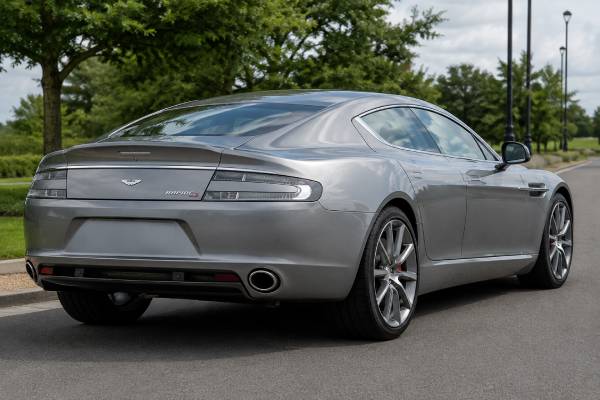
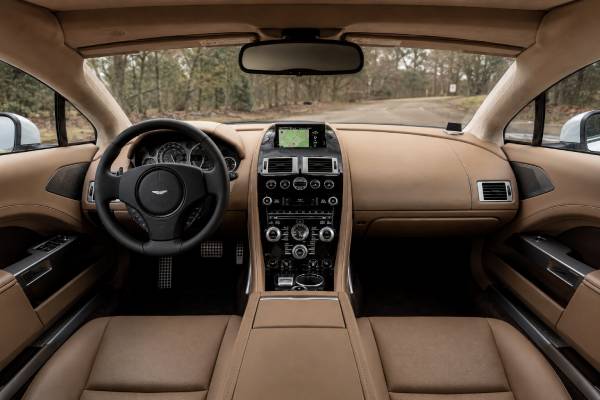
The 2013–2014 Aston Martin Rapide S is the decisive first evolution of the Rapide. It keeps the bonded-aluminium four-door architecture but replaces the original car’s relaxed 470 hp tune with a 550 hp AM11 V12, a lower engine position, revised front structure, sharper styling, and stronger performance. In this early form, power still reaches the rear wheels through the six-speed Touchtronic II transaxle, making it mechanically distinct from the eight-speed Rapide S introduced later.
That six-speed identity matters. Advertisements often group every Rapide S together, yet the AM11 car has different acceleration, consumption, transmission behavior, recall considerations, and service questions from the later 552 hp version. Its appeal lies in combining a more forceful engine with the original Rapide’s measured grand-touring rhythm.
This guide explains what changed, how the early S should feel, which figures belong to it, and how to inspect one without confusing normal character with deferred maintenance. It shows where careful evidence can turn a complex V12 Aston Martin into a credible long-distance purchase.
Table of Contents
- How the Rapide Became the Rapide S
- AM11 Technical Specifications
- Six-Speed Road Performance
- Structure, Steering, Suspension, and Brakes
- Maintenance Priorities and Service Planning
- 2013–2014 Rapide S Buying Method
How the Rapide Became the Rapide S
The Rapide S is more than a facelift because its engine installation, front structure, cooling, calibration, and performance were all revised. Aston Martin used the S badge to move the four-door model closer to its contemporary sports cars while preserving four individual seats and genuine grand-touring range.
The most visible change is the larger single-piece grille. It gives the nose a more assertive appearance, but it also reflects packaging work beneath the skin. The V12 was positioned lower in the chassis, contributing to a lower center of gravity and creating space for a revised front structure. The bonnet, bumper, grille opening, and airflow management were consequently different from the original Rapide.
Under that bonnet sits the 5,935 cc AM11 V12. Its 550 bhp output represents an 80 bhp increase over the earlier car, while maximum torque rises to 620 Nm. The engine remains naturally aspirated and rewards revs, so the S does not feel like a turbocharged luxury saloon delivering one large low-speed shove. Instead, response builds progressively and becomes increasingly urgent toward the upper range.
The rest of the layout remains recognizably Rapide. A torque tube carries drive to a rear-mounted transaxle, helping distribute mass between the axles. The four-door body is formed around Aston Martin’s bonded and riveted aluminium VH architecture. Four separate seats sit low in the cabin, with a central spine running from the dashboard into the rear compartment.
This period deserves accurate naming. The 2013 and early 2014 Rapide S uses the six-speed Touchtronic II gearbox and the 550 bhp AM11 specification described here. Later cars moved to an eight-speed Touchtronic III transmission and were commonly rated at 552 bhp or 560 PS. Registration dates can overlap launch dates, so a seller’s model-year label should never replace a VIN, gearbox identification, and factory build record.
Changes from the original Rapide include:
- Power increased from 470 bhp to 550 bhp.
- Torque increased to 620 Nm.
- Maximum speed rose to 190 mph.
- The V12 was mounted lower in the chassis.
- The front structure and exterior nose were redesigned.
- Adaptive damping and dynamic calibration were retuned.
- Engine, transmission, and stability-control software were recalibrated.
The S is therefore a useful middle ground in Rapide history. It has the visual and engine upgrades many buyers want, but it retains the more deliberate six-speed driveline. Some owners prefer the later gearbox for responsiveness; others value the early car’s fewer shifts and period feel. Neither preference removes the need to identify the car correctly.
AM11 Technical Specifications
The early Rapide S combines a 410 kW naturally aspirated V12 with a six-speed rear transaxle and rear-wheel drive. The following figures describe the 2013–2014 AM11 version; regional equipment, certification data, and optional wheel designs may differ.
| Item | Data |
|---|---|
| Engine type | All-alloy naturally aspirated V12 |
| Displacement | 5,935 cc (5.9 L) |
| Valvetrain | Four overhead camshafts, 48 valves |
| Maximum power | 410 kW / 558 PS / 550 bhp at 6,750 rpm |
| Maximum torque | 620 Nm / 457 lb-ft at 5,500 rpm |
| Compression ratio | 11.0:1 |
| Item | Data |
|---|---|
| Transmission | Six-speed Touchtronic II automatic transaxle |
| Drive | Rear-wheel drive |
| Propeller shaft | Carbon-fibre shaft within alloy torque tube |
| Differential | Limited-slip differential |
| Shift control | Automatic modes and steering-column paddles |
| Measure | Data |
|---|---|
| 0–100 km/h | 4.9 seconds |
| 0–60 mph | 4.7 seconds |
| Maximum speed | 306 km/h / 190 mph |
| Combined consumption | 14.3 L/100 km / 19.8 mpg imperial |
| CO2 emissions | 332 g/km |
| Item | Data |
|---|---|
| Length | 5,019 mm / 197.6 in |
| Width excluding mirrors | 1,929 mm / 75.9 in |
| Height | 1,360 mm / 53.5 in |
| Wheelbase | 2,989 mm / 117.7 in |
| Kerb weight | 1,990 kg / 4,387 lb |
| Fuel tank | 90.5 L / 23.9 US gal |
| Item | Data |
|---|---|
| Structure | Bonded and riveted extruded-aluminium VH platform |
| Suspension | Independent double wishbones front and rear |
| Dampers | Adaptive damping system |
| Steering | Hydraulically assisted rack and pinion |
| Front tyres | 245/40 ZR20 |
| Rear tyres | 295/35 ZR20 |
| Brakes | Ventilated iron discs with ABS and stability control |
Published consumption is a laboratory comparison figure, not a realistic promise for every route. Cold starts, short journeys, urban traffic, and enthusiastic use can produce substantially higher fuel use. The large tank gives useful touring range, but fuel grade and storage quality matter on a lightly used car.
Six-Speed Road Performance
The early Rapide S is fast because its V12 keeps pulling after many luxury cars have begun to run out of breath. It feels most convincing when the driver allows the engine to rev and uses the six-speed gearbox proactively rather than expecting instant multi-ratio kickdown.
At low speed, the engine should be smooth, stable, and free from persistent vibration. Throttle response is linear, which makes the car easy to meter in traffic despite its power. The transmission usually favors taller ratios in its relaxed setting. A sudden request for full acceleration can produce a pause while it chooses a lower gear; this is normal to a degree, but a long engagement delay, flare, bang, or warning message is not.
Manual paddle selection suits the car on a fast road. The column-mounted paddles remain in place as the wheel turns, allowing the driver to choose a gear before loading the chassis. The ratios are broad compared with the later eight-speed car, so each shift covers a larger speed range. That reduces activity on a flowing route and contributes to the model’s traditional grand-tourer character.
The 0–100 km/h figure of 4.9 seconds only tells part of the story. At motorway speeds, the V12’s sustained output and aerodynamic stability are more relevant. Overtaking performance is strong once the correct gear is selected, and the long wheelbase gives the car a settled platform. Wind noise should be controlled; excessive roar, whistle, or door-seal noise deserves investigation.
A proper road test should answer six questions:
- Does the engine start cleanly from cold and hot?
- Does the transmission select Drive and Reverse without abnormal delay?
- Are shifts repeatable in automatic and manual modes?
- Does the car track straight under acceleration and braking?
- Do the damper settings produce a clear but controlled difference?
- Are there any warnings after the drivetrain is fully hot?
Use moderate throttle first. A car that behaves only when driven gently may expose faults under heat and load, while a seller who insists on beginning with full-throttle acceleration prevents a disciplined assessment. Build temperature progressively, monitor gauges, and repeat low-speed maneuvers after the high-speed portion of the test.
The exhaust should sound fuller than the original Rapide’s, but noise alone is not proof of condition. Aftermarket valves, modified silencers, or calibration changes can alter sound. Ask for invoices, check cold-start behavior, inspect the exhaust supports, and verify that modifications have not created warning lights or poor low-speed response.
Traction and stability systems are important in a heavy, powerful rear-wheel-drive car. Warning lamps must illuminate during the self-check and then extinguish. On a safe road, gentle acceleration should feel clean rather than interrupted. Old or mismatched rear tyres can make the system appear intrusive and can mask alignment or suspension problems.
Structure, Steering, Suspension, and Brakes
The Rapide S chassis should feel precise and composed, not loose or brittle. Its aluminium structure, double-wishbone suspension, adaptive dampers, staggered tyres, and rear transaxle create balanced behavior, but age and poor repair can undermine that engineering.
Begin with structure. The bonded aluminium platform resists conventional red rust, yet it can suffer impact damage, galvanic corrosion, adhesive-joint concerns, and distorted mounting points. Inspect the underside on a lift with undertrays removed where appropriate. Look for scraped extrusions, crushed jacking points, fresh sealant, mixed fasteners, disturbed suspension bolts, and repairs that do not match factory construction.
Panel gaps on a hand-finished car may not resemble mass-market tolerances, but left-to-right inconsistency still matters. Compare door fit, bonnet height, lamp alignment, and the relationship between the large grille and surrounding panels. The four swan-wing doors should open smoothly, remain supported, and close without repeated force. Door movement can reveal hinge wear, adjustment, latch, or battery-voltage issues.
Hydraulic steering gives the driver useful information and should have consistent assistance. A heavy spot, pump noise, fluid seepage, or steering that does not naturally return toward center can indicate more than wheel alignment. Check reservoir condition, hoses, rack area, front joints, tyre pressures, and wheel geometry.
Adaptive damping is not an excuse for a harsh ride. In the softer mode, the car should absorb ordinary broken surfaces without repeated vertical movement. The firmer setting should tighten body control rather than make the suspension crash. Knocks can come from joints, bushes, top mounts, loose underbody components, or damaged wheels; diagnostic faults may also identify damper-control issues.
Tyres are part of the suspension system. The front and rear sizes differ, and a quality matched set is preferable. Record date codes and inspect the inner shoulders, where wear can be hidden. A car with deep tread but tyres older than six years still needs a safety discussion. Incorrect load or speed ratings are unacceptable on a 190 mph model.
Standard iron brakes offer strong road performance, but mass and heat make condition important. Check disc thickness and runout, pad life, hose age, fluid history, caliper operation, and parking-brake function. Surface corrosion after storage may clean up; deep pitting, cracks, vibration, or a pronounced lip requires measurement and likely replacement.
Wheel refinishing should be judged structurally as well as cosmetically. Look for cracks, weld repairs, excessive filler, uneven bead seating, and missing identification marks. A perfectly glossy wheel can still be bent. Balance vibration at motorway speed is useful evidence, though tyre flat-spotting after storage should be distinguished from permanent damage.
Maintenance Priorities and Service Planning
Preventive maintenance is cheaper than diagnosing several cascading Rapide S faults at once. The most effective plan combines annual servicing, age-based fluid replacement, battery management, cooling-system inspection, diagnostic records, and regular use long enough to reach full temperature.
Service history should show more than stamps. Detailed invoices reveal oil grade, filters, brake fluid, coolant work, spark plugs, transmission servicing, tyre dates, battery replacement, recalls, and repairs to recurring faults. A thick file is useful only when the dates, mileage, and VIN are consistent.
The V12 oil level and condition should be checked according to the correct procedure. Look for seepage around covers and seals, but avoid assuming every damp surface requires an engine-out repair. A marque specialist can clean, trace, and prioritize leaks. More urgent signs include low pressure warnings, metallic debris, coolant contamination, or noise that persists after oil circulation.
Cooling deserves special attention because heat affects the engine, transmission, air conditioning, and surrounding electronics. Inspect radiators and condensers through the grille for blocked fins, damage, and debris. Check hoses, expansion tank, cap, fans, and evidence of dried coolant. The temperature should remain stable during traffic and after a spirited run.
The six-speed transaxle needs correct operation and campaign history. Certain Rapide vehicles built through 2014 were included in a park-lock recall addressed by software. Check the VIN with an authorized source and retain proof of completion. A recall fix does not replace ordinary transmission diagnosis: engagement, shift quality, fluid leaks, mounts, and fault memory still require inspection.
Electrical health begins with battery voltage. These cars contain many modules, motors, switches, and position sensors. Low voltage can create multiple unrelated messages, window indexing trouble, seat faults, alarm behavior, or a no-start condition. Fit a battery of the correct specification, register or initialize it as required, and use a compatible conditioner during storage.
A practical annual plan includes:
- Engine oil and filter service at the specified interval or annually for low-mileage use.
- Full diagnostic scan before clearing stored faults.
- Brake-fluid testing and replacement by time.
- Coolant condition and leak inspection.
- Tyre pressure, age, damage, and alignment review.
- Underbody, suspension, steering, and brake inspection.
- Air-conditioning performance and drain check.
- Battery test under load and charging-system check.
- Confirmation that campaigns and software updates are complete.
Budget for age, not merely mileage. A 20,000-mile car can still need dampers, tyres, batteries, hoses, seals, and brake work because those components deteriorate with time. Conversely, a higher-mileage example with continuous specialist care may be the safer purchase.
Choose a workshop that can read Aston Martin systems, understands the VH platform, and is willing to document findings. General exotic-car experience is helpful but not identical to model knowledge. Ask who will perform the work, what diagnostic platform is used, and whether the shop can coordinate factory parts and recall records.
Before approving major work, request a written diagnosis that separates confirmed faults from preventive recommendations. Photographs, measurements, saved fault codes, and old parts make the invoice useful to the next technician and future buyer. This discipline also prevents one warning message from triggering expensive parts replacement without a tested cause.
2013–2014 Rapide S Buying Method
A disciplined purchase starts with identification, then history, then condition, and only then negotiation. This order prevents a polished advertisement from distracting you from the question that matters first: is the car truly the six-speed 550 hp Rapide S represented by the assignment and seller?
Request the VIN, build sheet, current registration, service invoices, diagnostic reports, recall evidence, and clear photographs before arranging travel. Compare model year with build date and gearbox. An early S should have the six-speed Touchtronic II specification. A claim that it has the later eight-speed unit may be a simple listing error, but it must be resolved before price comparison.
Inspect from cold whenever possible. Arriving to a fully warmed engine removes evidence about cold start, battery strength, smoke, noise, and initial idle. Confirm that the warning lamps perform their self-check. Operate every door, window, seat, climate zone, screen, audio function, parking aid, lamp, and key.
The pre-purchase inspection should include:
- VIN and build-specification confirmation.
- Aluminium structure and accident-repair assessment.
- Paint-depth readings and panel-alignment review.
- Complete module scan with fault codes saved.
- Cold and hot engine tests.
- Transmission engagement and shift evaluation.
- Cooling-system pressure and fan checks where appropriate.
- Suspension, steering, tyres, wheels, and brake measurements.
- Cabin electronics and water-ingress inspection.
- Road test at urban and motorway speeds.
Look beneath cosmetic preparation. Freshly detailed engine bays may hide seepage, new tyres may conceal alignment wear, and recently cleared fault memory may return only after a drive cycle. Ask when the battery was disconnected and whether any codes were erased. A transparent seller should welcome a competent inspection.
Set a repair reserve before making an offer. Price likely work using specialist parts and labor, not generic estimates. Four tyres, brake discs, dampers, a battery, several electronic faults, and overdue fluids can transform an apparently inexpensive car. Do not assume independent repairs are always cheap; access time and part availability can dominate cost.
Modifications require evidence. Exhaust changes, wheels, suspension alterations, infotainment upgrades, or engine software may suit an owner, but they can complicate diagnosis and insurance. Verify workmanship, retain original parts where possible, and check whether the modification affects emissions compliance or market registration.
The strongest purchase profile is straightforward: correct identity, continuous servicing, stable battery history, completed campaigns, matched recent tyres, measured brakes, functional electronics, clean structure, and a seller who provides records without drama. Mileage should influence price, but evidence should influence confidence more.
The early Rapide S rewards this method because it occupies a clear technical niche. It delivers the stronger AM11 engine and revised chassis while retaining the original six-speed transaxle. For a buyer who enjoys a deliberate grand-tourer rather than chasing the quickest shift time, that combination can be the reason to choose it—not a compromise to explain away.
Retain the inspection report after purchase; it becomes the first chapter of the car’s next service history and a benchmark for future changes.
References
- RAPIDE S 2018 (official historic model page)
- Aston Martin Rapide S 2026 (official past-model page)
- Aston Martin Rapide S Brochure 2013 (official brochure)
- Six-Speed Touchtronic II Automatic Transmission Park Lock Problem 2017 (recall communication)
- Rapide S 2026 (model specialist)
- Owner’s Guides 2026 (official owner resource)
Disclaimer
This guide provides general model information and cannot replace VIN-specific factory data, recall confirmation, a workshop manual, or a professional pre-purchase inspection. Specifications, options, emissions ratings, build dates, and campaign coverage may vary by country and individual vehicle. Confirm the exact transmission, equipment, service requirements, and legal compliance for the car being considered. Share this article with a technician or prospective owner who needs a structured starting point for evaluating an early Rapide S.