
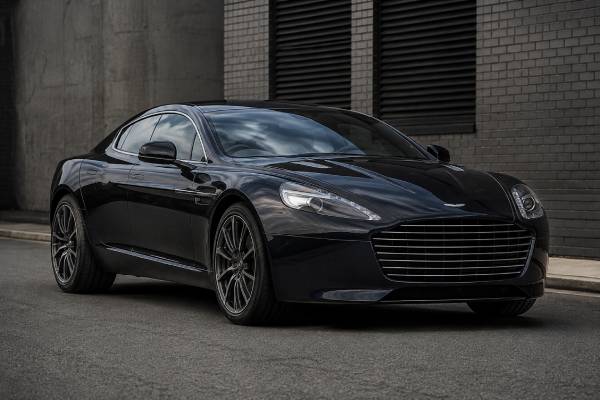
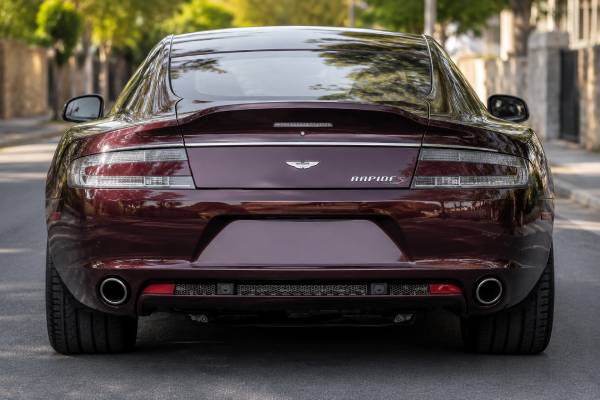
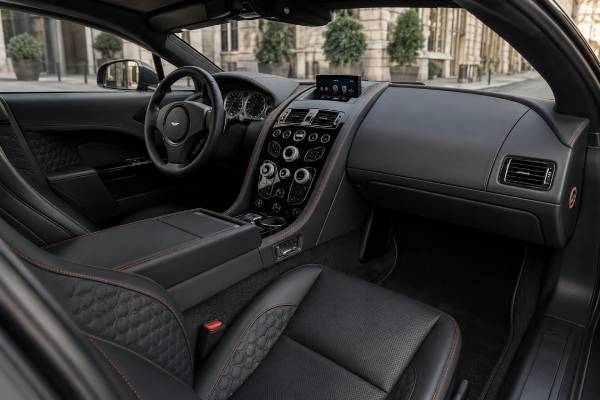
The Aston Martin Rapide S Shadow Edition is a late-production special specification that gives the four-door V12 a darker visual identity and, in its 565 bhp form, a more assertive performance package. It combines selected exterior colors, black or dark-finished details, dedicated cabin themes, sports exhaust, three-stage adaptive damping, and the eight-speed Touchtronic III transaxle. The result is not a stripped track model; it is a more theatrical version of the mature Rapide S.
The central buying challenge is specification accuracy. Shadow Editions were offered in different markets, and surviving records may quote 552 bhp, 565 bhp, or equivalent metric ratings depending on market literature and calibration. A 565 hp assignment should therefore be validated through its VIN, build sheet, market, and original sales documentation rather than inferred from color or badges.
This article begins with identity because that is where costly mistakes occur. It then examines the special equipment, technical reference data, road behavior, maintenance implications, and a purchase process designed to separate a factory Shadow Edition from an ordinary Rapide S modified to resemble one.
Table of Contents
- Shadow Edition Identity and Market Variation
- Exterior, Cabin, and Factory Equipment
- 565 hp Technical Reference
- Sports Exhaust, Damping, and Road Behavior
- Special-Edition Maintenance and Preservation
- Shadow Edition Authentication and Buying Guide
Shadow Edition Identity and Market Variation
A genuine Rapide S Shadow Edition should be identified from factory records, not from a black grille, dark wheels, or a seller’s description. Its appeal comes from a coordinated factory package, and many of its visual cues can be copied onto a standard Rapide S.
The edition appeared late in the Rapide S production cycle, commonly associated with 2016–2018 and later model-year marketing. It used the established AM29-era 5.9-litre V12 and eight-speed transaxle, then added a defined combination of colors, finishes, cabin themes, exhaust specification, and damping equipment. That timing places it after the major eight-speed engineering update and before the more extreme Rapide AMR.
Published power figures require context. Specialist and period material describe a 565 bhp Shadow Edition, while some official or market-specific listings use the standard 552 bhp rating. These figures can reflect regional calibration, certification conventions, or how a particular distributor described the package. They should not be treated as proof that every car wearing the name has identical software.
Before viewing a car, ask for:
- The full VIN and build date.
- The factory build sheet or dealer specification printout.
- The original market and first-registration country.
- Original sales invoice or launch literature where available.
- Service records showing engine or transmission software work.
- Invoices for any exhaust, wheel, suspension, or trim changes.
The VIN-linked record should explicitly support the Shadow Edition or its option package. Compare paint, leather, stitching, wheel finish, grille treatment, exhaust, and damping equipment against that record. A normal Rapide S ordered in a dark color can be attractive, but it should not command a special-edition premium without evidence.
Build year and registration year can differ, particularly for low-volume cars held in dealer stock. A car built in one calendar year may be sold as the following model year. That is not inherently suspicious. The problem arises when a seller uses a later registration date to claim equipment or output that the build sheet does not contain.
Modifications also need to be separated from factory variation. A sports exhaust can be fitted later, wheels can be refinished black, and brightwork can be wrapped or painted. Such changes may suit the car, but they do not recreate the provenance of an original package. Retained factory parts and detailed invoices reduce uncertainty.
Exterior, Cabin, and Factory Equipment
The Shadow Edition’s design is intentionally restrained and dark rather than covered in conspicuous graphics. Its strongest examples look coherent because exterior paint, black detailing, wheel treatment, leather, stitching, and trim were selected as one package.
Period descriptions associate the model with a limited palette including AML Carbon Black, Ultramarine Black, Scintilla Silver, and Solent Silver, although Aston Martin personalization means exceptions can exist. Dark exterior elements typically include the grille, window surrounds, mirror details, or wheel finish, while the cabin uses contrasting leather themes such as Dark Knight and Sahara Tan.
A buyer should verify the exact equipment rather than create a universal checklist from one advertised car. Depending on market and option content, Shadow features may include:
- Dark-finished front grille and exterior brightwork.
- Twenty-inch alloy wheels with a special dark finish.
- Shadow-specific leather colors, stitching, piping, or embroidery.
- Piano-black or dark interior trim.
- Sports exhaust with a more pronounced V12 sound.
- Three-stage adaptive damping fitted as standard within the package.
- Market-specific convenience, audio, or carbon-fibre options.
Inspect dark exterior finishes under bright, diffuse light. Gloss black shows swirl marks, chips, poor refinishing, and sanding haze more readily than lighter metal. Wrapped trim can conceal damaged brightwork or be mistaken for a factory finish. Examine edges, fasteners, and hidden surfaces where a later coating may stop.
Wheel condition matters because the finish is part of the appearance. Check for bends, cracks, welds, excessive filler, uneven color, and loss of original machining detail. A cosmetic refurbishment should be documented, and structural repair should be assessed by a wheel specialist. Tyre mounting damage around the rim can quickly spoil a rare finish.
Inside, compare the recorded leather and stitching with every seat and panel. Replaced bolsters may use a close but incorrect grain or color. Heavy dye can block perforations and create an unnatural shine. Check the rear compartment carefully because low use can preserve it, while sun exposure may still fade leather and stitching unevenly.
Piano-black trim is prone to fine scratching. Carbon-fibre pieces, if fitted, should have consistent weave and clear coat. Inspect the headlining, door-pull areas, seat backs, rear console, and sill trim for damage caused by tight access. A complete, gently aged cabin is generally more convincing than one selectively renewed without records.
The Shadow Edition should still function as a four-seat grand tourer. Test rear climate controls, entertainment equipment where fitted, seat ventilation or heating, parking aids, and the liftback. Special trim does not reduce the cost of replacing an ordinary failed switch or module, and disassembly can risk damage to edition-specific surfaces.
565 hp Technical Reference
In the 565 hp specification, the Shadow Edition uses the naturally aspirated 5,935 cc V12 with 630 Nm of torque, the eight-speed Touchtronic III rear transaxle, and rear-wheel drive. The exact homologation data should be confirmed for the car’s original market.
| Item | Specification |
|---|---|
| Engine | All-alloy naturally aspirated V12 |
| Displacement | 5,935 cc (5.9 L) |
| Valvetrain | Quad overhead camshafts, 48 valves |
| Maximum power | 421 kW / 573 PS / 565 bhp at approximately 6,650–6,750 rpm |
| Maximum torque | 630 Nm / 465 lb-ft at 5,500 rpm |
| Fuel type | Premium unleaded petrol |
| Item | Specification |
|---|---|
| Transmission | Eight-speed Touchtronic III automatic transaxle |
| Drive | Rear-wheel drive |
| Final drive | 2.73:1 |
| 0–100 km/h | 4.4 seconds |
| 0–62 mph | 4.4 seconds |
| Maximum speed | 327 km/h / 203 mph |
| Measure | Published figure |
|---|---|
| Urban consumption | Approximately 19.7 L/100 km / 14 mpg imperial |
| Extra-urban consumption | Approximately 9.2 L/100 km / 31 mpg imperial |
| Combined consumption | Approximately 12.9 L/100 km / 22 mpg imperial |
| CO2 emissions | Approximately 300 g/km |
| Emissions standard | Market-dependent; some listings identify Euro 6 |
| Item | Measurement |
|---|---|
| Length | 5,019 mm / 197.6 in |
| Width excluding mirrors | 1,929 mm / 75.9 in |
| Height | 1,360 mm / 53.5 in |
| Wheelbase | 2,989 mm / 117.7 in |
| Kerb weight | Approximately 1,990 kg / 4,387 lb |
| Fuel tank | 90.5 L / 23.9 US gal |
| Item | Specification |
|---|---|
| Structure | Bonded and riveted extruded-aluminium VH platform |
| Suspension | Independent double wishbones front and rear |
| Damping | Three-stage adaptive damping |
| Steering | Hydraulically assisted rack and pinion |
| Front tyres | 245/40 ZR20 |
| Rear tyres | 295/35 ZR20 |
| Brakes | Ventilated iron discs with ABS and stability control |
The use of “approximately” is deliberate where market documents conflict. A buyer should not use a generic table to override the emissions label, certificate of conformity, original brochure, or factory record for a particular VIN. The central mechanical distinction is the eight-speed Rapide S platform with the Shadow package and the output rating documented for its market.
Sports Exhaust, Damping, and Road Behavior
The Shadow Edition’s dynamic personality comes more from sound, calibration, and presentation than from a fundamentally new chassis. It retains the later Rapide S architecture but makes the V12 experience more noticeable through the sports exhaust and package specification.
At start-up, the engine should settle quickly after the initial flare. A richer exhaust note is expected, but metallic rattles, leaking joints, or a valve that chatters continuously are not. Inspect the rear silencers, valve actuators, vacuum or electrical controls, mounts, heat shields, and tailpipe alignment. A modified valve controller should have an invoice and a reversible installation.
The eight-speed gearbox is well matched to the V12. In normal driving it moves through ratios smoothly, then responds rapidly when the driver selects a sportier mode or uses the paddles. The engine delivers clean, linear power rather than turbocharged surge. A healthy car should pull without misfire or hesitation from moderate revs to the upper range.
Three-stage adaptive damping gives the driver a meaningful range of body control. On imperfect roads, the softest setting should remain composed rather than float. The middle mode suits brisk touring, and the firmest setting reduces roll and pitch. If the ride is severe in every mode, do not assume that is Shadow Edition tuning. Check tyre age and pressure, wheel runout, dampers, bushes, joints, and alignment.
The hydraulic steering remains one of the car’s strengths. It should be consistent around center and free from groaning, notchiness, or fluid loss. Wide front tyres can follow road camber, but persistent pulling or an off-center wheel requires geometry and suspension checks.
A Shadow Edition still weighs close to two tonnes. It changes direction best with measured inputs, and the iron brakes need proper condition to manage repeated stops. Vibration can come from disc runout, pad deposits, damaged tyres, or wheels. Measure disc thickness and runout rather than replacing parts by assumption.
Use a road-test sequence that exposes both grand-touring and low-speed behavior:
- Cold start and idle with all accessories off.
- Parking maneuvers and repeated Drive/Reverse selection.
- Broken urban surfaces in each damper mode.
- Steady cruise to identify tyre, bearing, and wind noise.
- Progressive acceleration in automatic and manual modes.
- Several moderate brake applications from increasing speed.
- Hot restart, rescan, and inspection for odor or leakage.
The car should feel cohesive. A loud exhaust paired with lazy transmission response, unstable braking, or warning lights is not special-edition character; it is a repair list. Conversely, a well-maintained example adds drama without losing the Rapide’s ability to carry four people over distance.
Special-Edition Maintenance and Preservation
Shadow Edition ownership requires ordinary Rapide S mechanical discipline plus extra care for dark exterior finishes and package-specific trim. The highest priorities remain cooling, lubrication, transmission behavior, brakes, tyres, voltage, and diagnostic history.
Annual service records should be supported by itemized invoices. Look for correct engine oil, filters, brake-fluid changes, coolant inspection, plugs at the required interval, transmission assessment, tyre dates, battery replacement, and work on adaptive damping or exhaust controls. A stamp alone rarely explains how a low-mileage car spent long periods off the road.
Cooling-system condition is essential. Debris can collect at the radiator and condenser faces, reducing airflow. Inspect hoses, expansion tank, fan operation, and dried coolant traces. During the road test, allow the car to sit in traffic with air conditioning operating, then confirm stable temperature and fan behavior.
The eight-speed transaxle should be dry and consistent. Ask a specialist whether fluid and filter service is appropriate for the car’s age and use. Avoid generic high-pressure flushing. Correct fluid, temperature procedure, adaptation assessment, and diagnostic records matter more than a one-size-fits-all “lifetime fluid” argument.
Battery condition influences the entire car. A weak battery can produce window-indexing faults, alarm behavior, seat or screen problems, and multiple warning messages. Use a compatible conditioner during storage, but replace a battery that fails load testing. Confirm charging voltage and investigate parasitic draw rather than repeatedly jump-starting the car.
Dark paint and gloss trim reveal poor washing. Preserve them with clean wash media, controlled decontamination, and minimal polishing. Measure paint before correction because an apparently dull panel may have limited clear coat after earlier work. Document paint-protection film installation and removal, especially on refinished panels.
Leather care should favor gentle cleaning over heavy recoloring. Match products to perforated and semi-aniline surfaces where applicable. Protect contrasting stitching from strong dye and avoid soaking switches or seat ventilation perforations. Record any bolster repair with photographs and material details.
An ownership file should include:
- VIN-linked build specification.
- Original sales and market literature.
- Service invoices and diagnostic reports.
- Tyre date and brake measurement records.
- Exhaust and damping repair documentation.
- Paint-depth map and refinishing invoices.
- Photographs of edition-specific trim.
- Original parts removed during reversible modifications.
Regular use is beneficial when it brings the car fully to temperature. Avoid repeated stationary starts or very short trips. Exercise the air conditioning, brakes, transmission, and all cabin functions. After winter storage, inspect tyre pressures, battery condition, fluid levels, and signs of rodents or moisture before driving hard.
Because the Shadow package is visually subtle, preserve a dated photographic record of details that can be lost during repair. Capture grille finish, wheel faces and barrels, stitching, trim, exhaust outlets, labels, and option codes. When a component must be refinished, keep before-and-after images and the product specification. This record helps a later owner distinguish sympathetic maintenance from an attempt to recreate missing factory content.
Shadow Edition Authentication and Buying Guide
Buy the Shadow Edition only after the factory identity and mechanical condition are independently proven. A dark color and sports exhaust may make an ordinary Rapide S look persuasive, but the premium belongs to a coherent, documented factory specification.
The first inspection stage can happen remotely. Obtain the VIN, build sheet, registration history, service invoices, photographs of all trim, wheel details, exhaust hardware, keys, and diagnostic reports. Ask the seller to explain any difference between the advertised 565 hp rating and factory documents. A clear answer tied to market records is acceptable; evasion is not.
At the car, compare the build record line by line. Confirm paint, leather, stitching, trim, wheel style and finish, exhaust, damping, infotainment, and convenience options. Check that badges and identifiers are period-correct and properly mounted. Photograph everything before making a decision.
The structural inspection should be performed by someone familiar with bonded aluminium. Look at underbody extrusions, jacking points, suspension mounts, seam sealer, fasteners, door alignment, and paint-depth variation. A repair is not automatically disqualifying, but its extent and quality must be known.
Run a full electronic scan before codes are cleared. Save present and historic faults, then repeat the scan after the road test. Stable battery voltage should be confirmed first. A dashboard without warning lamps proves little if the battery was recently disconnected or the faults were erased.
Mechanical inspection should cover:
- Cold and hot engine behavior, leaks, misfire data, and cooling.
- Eight-speed engagement, shift quality, adaptation, and fluid leakage.
- Adaptive-damper function and suspension wear.
- Exhaust valves, mounts, heat shields, and modifications.
- Steering rack, hydraulic lines, joints, and alignment.
- Disc and pad measurements, brake fluid, and parking brake.
- Wheel integrity, tyre specification, date codes, and inner-edge wear.
- Air conditioning, doors, windows, seats, screen, audio, and parking aids.
Calculate the purchase price from a standard later Rapide S baseline, then add only a defensible premium for verified Shadow Edition specification, condition, completeness, and documentation. Deduct realistic specialist costs for overdue work. Do not assume rarity will absorb a large mechanical deficit.
A strong car can have moderate mileage and minor cosmetic wear. Consistent use, annual care, and transparent repairs are often preferable to very low mileage with old tyres, weak voltage, corroded brakes, and long service gaps. The key is whether use and maintenance tell the same story.
Walk away when the seller will not provide the VIN, the car is pre-warmed, the output claim changes during discussion, codes have just been cleared, special trim is inconsistent, or modifications cannot be explained. These are not small administrative issues; they directly affect identity and future diagnosis.
When the records, package, and mechanical condition align, the Shadow Edition occupies a distinctive place in the Rapide range. It is more expressive than the standard eight-speed S but less specialized than the AMR. That balance—dark design, stronger soundtrack, four-seat practicality, and naturally aspirated V12 response—is precisely what makes the correct 565 hp car worth identifying carefully.
That documentary discipline is part of the special edition’s value, not merely administrative housekeeping.
References
- Aston Martin Rapide S Shadow Edition 2016 (edition brochure)
- Rapide S Shadow Edition 2026 (model specialist)
- Aston Martin Rapide S V12 565 Shadow Edition Specifications 2026 (independent specification)
- Aston Martin Rapide S 2026 (official past-model page)
- Power. Beauty. Soul. 2016 (model brochure)
- Owner’s Guides 2026 (official owner resource)
Disclaimer
This article provides general information and cannot establish whether a specific car is an authentic Shadow Edition or which output rating applies to its market. Confirm all claims through the VIN, factory build record, original sales documents, current legal records, and an inspection by a qualified Aston Martin specialist. Equipment, software, emissions certification, service intervals, and build dates can vary. Share the guide with a seller, technician, or buyer who needs to verify a Rapide S Shadow Edition before purchase.