
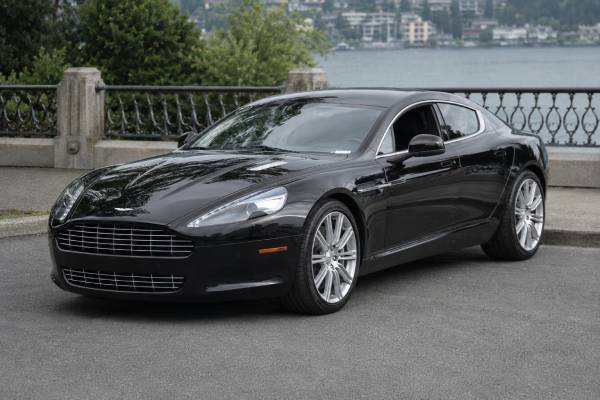
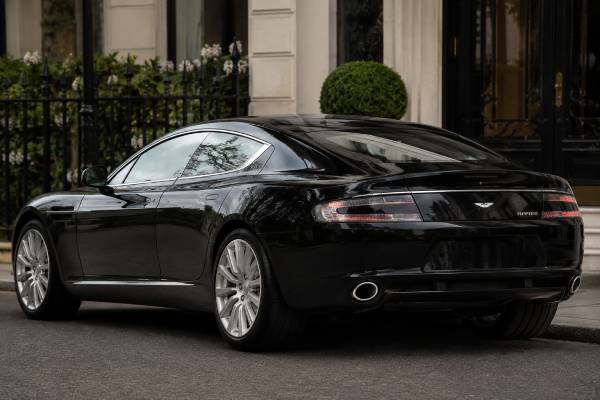
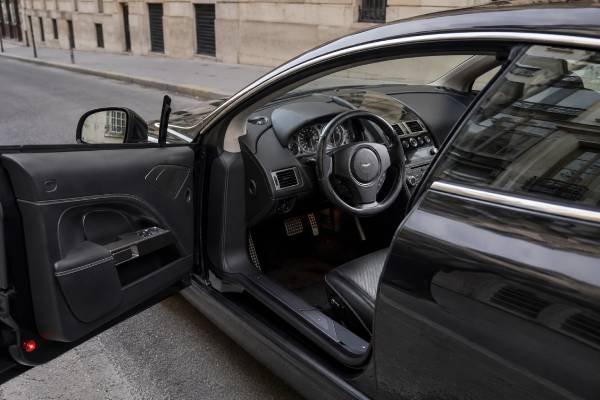
The 2011 Aston Martin Rapide Carbon Black is not a mechanically separate Rapide so much as a highly specified, dark-themed interpretation of the original four-door V12. Its appeal rests on three things: the elegant VH400 chassis, the early 470 hp AM16 engine, and a factory equipment package that is easy to imitate but difficult to reproduce correctly. That makes provenance unusually important. A genuine car should combine the designated Carbon Black exterior treatment with its intended black cabin, special wheel finish, darkened exterior details, and luxury equipment rather than merely wearing black paint and aftermarket wheels.
Underneath, it remains the first-generation Rapide: a front-mid-engine, rear-wheel-drive grand tourer with four individual seats, a rear-mounted six-speed automatic transaxle, and a bonded-aluminium structure. It is fast, refined, and far more practical than its roofline suggests, but it is also a complex, low-volume Aston Martin whose condition matters more than mileage alone. This guide explains the exact specification, what makes the Carbon Black identifiable, how it drives, what maintenance demands attention, and how to buy one without paying special-edition money for an ordinary Rapide.
Table of Contents
- What Makes the Carbon Black Different
- Technical Specifications and Factory Data
- Performance and Road Character
- Cabin, Seating, and Practicality
- Maintenance Priorities for a Low-Volume V12
- Known Risks and Pre-Purchase Inspection
- Value, Authenticity, and Buying Strategy
What Makes the Carbon Black Different
The Carbon Black is best understood as a factory-curated specification, not a higher-output model. It uses the same 470 hp, 5,935 cc naturally aspirated V12 and six-speed Touchtronic II driveline as the contemporary Rapide, while adding a coordinated exterior, cabin, wheel, and equipment package.
The visual theme was deliberately monochrome. Factory descriptions and marque records associate the edition with AML Carbon Black paint, an Obsidian Black leather interior, coarse silver contrast stitching, Piano Black trim, and dark exterior detailing. Gloss-black, diamond-turned 20-spoke wheels and a darker bonnet-mesh treatment complete the appearance. The package also commonly included comfort and convenience features that were optional on an ordinary Rapide, such as ventilated seating, rear-seat entertainment, embroidered wings, and a reversing camera.
That distinction matters because a standard black Rapide can be made to look similar. Paint colour by itself is not proof. A careful buyer should establish identity through the original build sheet, dealer invoice, factory specification record, or a marque specialist with access to the VIN configuration. Photographs of the car when new, service-book stamps, and invoices that consistently describe it as a Carbon Black provide useful supporting evidence, but they are not substitutes for factory documentation.
Production information also needs careful wording. Specialist records describe the Carbon Black as a very limited offering, particularly associated with the United States, but surviving totals can be presented differently depending on whether the count refers to production, market allocation, or completed retail deliveries. Treat any precise rarity claim as something to verify against the individual chassis record. The practical takeaway is simpler: genuine examples are uncommon, and originality has a larger effect on value than it does on an ordinary Rapide.
Important authenticity points include:
- the exact factory paint code and original exterior finish;
- the intended all-black leather and silver-stitch cabin treatment;
- correct wheel design, finish, dimensions, and date codes;
- original dark grille or bonnet-mesh details and exhaust finishers;
- documented factory options rather than later retrofits;
- VIN-matched books, keys, service history, and specification records.
A repainted bumper or refurbished wheel is not automatically a concern. These cars sit low, have wide wheels, and are now old enough to have needed cosmetic work. The concern is poor-quality work, missing edition-specific parts, or a car whose special identity relies only on a seller’s description.
Technical Specifications and Factory Data
This is a conventional petrol-powered ICE vehicle. Its 5.9-litre V12 sits behind the front axle line, while the automatic transmission and final drive are positioned at the rear to improve mass distribution. The Carbon Black equipment does not alter the essential mechanical specification of the 2011 Rapide, so the figures below describe the factory drivetrain and chassis on which the edition is based.
| Specification | Value | Notes |
|---|---|---|
| Engine family | AM16 | Hand-built Aston Martin V12 |
| Layout | Front-mid-mounted 60-degree V12 | Rear-wheel drive |
| Displacement | 5,935 cc (5.9 L) | All-alloy, naturally aspirated |
| Valvetrain | Quad overhead camshafts, 48 valves | Four valves per cylinder |
| Bore × stroke | 89.0 × 79.5 mm | Factory dimensional data |
| Maximum power | 350 kW (470 bhp) at 6,000 rpm | Market literature may use hp or bhp wording |
| Maximum torque | 600 Nm (443 lb-ft) at 5,000 rpm | Naturally aspirated delivery |
| Fuel tank | 90.5 L (23.9 US gal) | Premium unleaded petrol |
| Specification | Value |
|---|---|
| Transmission | Touchtronic II six-speed automatic |
| Transmission location | Rear-mounted transaxle |
| Drive type | Rear-wheel drive |
| Torque tube | Alloy tube with carbon-fibre propeller shaft |
| Differential | Limited-slip differential |
| Final-drive ratio | 3.46:1 |
| Specification | Value | Standard or condition |
|---|---|---|
| 0–60 mph | About 5.1 seconds | Manufacturer figure |
| 0–100 km/h | About 5.3 seconds | Manufacturer figure |
| Maximum speed | 303 km/h (188 mph) | Manufacturer figure |
| Combined consumption | About 14.9 L/100 km (19.0 mpg UK) | European test-cycle figure of the period |
| CO₂ emissions | About 355 g/km | European combined figure |
| Specification | Value |
|---|---|
| Body style | Five-door fastback with four individual seats |
| Length | 5,019 mm (197.6 in) |
| Width | 1,929 mm (75.9 in), excluding mirrors |
| Height | 1,360 mm (53.5 in) |
| Wheelbase | 2,989 mm (117.7 in) |
| Kerb weight | Approximately 1,950 kg (4,299 lb) |
| Luggage volume | 317 L; up to 886 L with rear seats folded |
| Specification | Value | Configuration |
|---|---|---|
| Front suspension | Independent double wishbones | Coil springs, anti-roll bar, adaptive dampers |
| Rear suspension | Independent double wishbones | Anti-squat and anti-lift geometry |
| Front tyres | 245/40 R20 | Factory staggered fitment |
| Rear tyres | 295/35 R20 | Factory staggered fitment |
| Front brakes | 390 mm ventilated dual-cast discs | Six-piston calipers |
| Rear brakes | 360 mm ventilated discs | Four-piston calipers |
| Parking brake | Electronic | First-generation Rapide system |
The exact equipment on a Carbon Black can still vary by market and build order. Tire brand, alarm specification, navigation mapping, entertainment hardware, and small trim details should be checked against the individual car rather than assumed from a general brochure.
Performance and Road Character
The Carbon Black drives like an early Rapide: smooth and balanced rather than violently quick by modern standards. Its strengths are the progressive V12, stable high-speed chassis, communicative steering, and the way the rear transaxle helps a long, heavy car feel composed.
The engine is the centre of the experience. With no turbochargers, response builds in a clean, linear way. It is flexible enough to move the car without constant downshifts, yet it becomes notably more urgent as revs rise. The six-speed automatic is not as fast or efficient as the later eight-speed unit fitted to newer Rapide S models. In normal driving it suits the car’s grand-touring role, but hard acceleration reveals longer shift intervals and wider ratio gaps. Steering-column paddles give the driver useful control on a winding road, especially when holding a lower gear before a bend.
Ride quality depends heavily on tyre condition and wheel integrity. The 20-inch staggered setup gives strong grip and accurate turn-in, but a bent wheel, old tyre, or incorrect pressure can make the car feel nervous or harsh. Matching premium tyres on all four corners are more important than an aggressive tread pattern. Because the front and rear sizes differ, routine rotation is generally not possible; wear patterns must be monitored separately.
The adaptive damping system broadens the car’s ability. Its softer setting works best on broken roads and long journeys, while the firmer mode reduces body movement when the road becomes faster and smoother. Do not expect a limousine ride. The Rapide remains a low sports car with a long wheelbase, and sharp impacts can enter the cabin. What it offers is controlled compliance, not isolation.
Braking performance is strong when the system is healthy. The large steel discs are expensive, and a lightly used car can develop corrosion lips, uneven deposits, or vibration. A proper road test should include gentle stops, medium-pressure braking from speed, and a check for steering shake, pedal pulsation, or pulling. Replacement costs make apparently minor brake symptoms worth investigating before purchase.
Cabin, Seating, and Practicality
The Rapide is genuinely usable for four adults, but it is not a conventional luxury saloon. Its rear seats are individual, low-mounted chairs separated by a full-length centre console, and access through the compact rear door openings requires more flexibility than a Panamera or long-wheelbase sedan.
Once inside, the rear environment is intimate and special. Each passenger has a sculpted seat, dedicated ventilation outlets, useful storage, and a view forward between the front seats. The Carbon Black’s dark leather and Piano Black surfaces create a dramatic atmosphere, though the almost entirely black specification can show dust, fine scratches, dye wear, and glossy fingerprints more readily than a lighter cabin.
The hatchback layout is a major advantage. With the rear seats in use, 317 litres is enough for soft luggage or a pair of compact weekend bags. Folding the rear seatbacks expands the quoted volume to 886 litres and creates a long load area. The opening is broad, but the roofline and interior trim make hard rectangular cases less convenient than soft bags. Buyers who intend to travel with four people should test their actual luggage rather than relying on the volume figure alone.
Carbon Black equipment can add several age-sensitive systems:
- seat ventilation fans and controls;
- rear entertainment screens, disc hardware, headphones, and remote control;
- reversing-camera image and boot-lid wiring;
- Bang & Olufsen rising tweeters and amplifier functions;
- powered seat mechanisms and memory settings;
- navigation, Bluetooth, parking sensors, and display operation.
Operate every function during inspection. A dead rear screen may not affect the way the car drives, but sourcing trim-matched components and diagnosing old infotainment hardware can be disproportionately expensive. Original accessories also support the edition’s completeness. Check for both glass keys if supplied, remote controls, headphones, manuals, tool kit, compressor or tyre-repair equipment, and the factory umbrella.
Maintenance Priorities for a Low-Volume V12
The best maintenance strategy is time-based, preventive, and supported by a specialist who understands VH-platform Aston Martins. Low annual mileage does not remove the need for fluid changes, battery care, heat-cycle inspections, or attention to seals and rubber components.
Annual servicing should include more than an oil change. The technician should inspect fluid levels and condition, diagnostic fault memory, accessory belts, cooling hoses, engine and transaxle leaks, suspension joints, brake condition, tyre age, and underbody damage. Service requirements differ by market and VIN, so the official maintenance schedule must remain the controlling document.
The 12-volt battery deserves special attention. The Rapide has numerous control modules and can become troublesome after repeated low-voltage events. A battery conditioner is sensible for a car parked for extended periods, provided it is connected in the approved manner. Slow cranking, random warning messages, lost seat memories, or inconsistent electronic behaviour can begin with poor battery health, but faults should not automatically be dismissed as “just the battery.” Test the charging system and scan all modules.
Cooling-system condition is equally important. A naturally aspirated V12 produces substantial heat, and an old expansion tank, tired cap, seep at a hose connection, or partially obstructed radiator can become an expensive problem. Look for dried coolant residue, unusual fan operation, unstable temperature, or coolant odour after a drive. Never open a hot system.
Ignition components age through both use and heat. A smooth idle and clean pull under load are good signs; hesitation, flashing warning lamps, or a stored misfire code require diagnosis. Replacing plugs or coils on a twelve-cylinder engine involves meaningful parts and labour, so invoices showing when this work was completed add value.
Other sensible preventive items include:
- regular brake-fluid replacement at the specified interval;
- inspection of differential and transmission-fluid service history;
- fresh tyres based on age and condition, not tread depth alone;
- cleaning roof and hatch drainage paths;
- lubrication and adjustment of door, hatch, and window mechanisms;
- preservation of leather with products suitable for the original finish;
- prompt repair of stone chips before corrosion develops around damaged areas or fasteners.
Do not assume a full dealer stamp history means every age-related item has been addressed. Read the invoices. A thick file that identifies specific work, parts, dates, mileage, and advisories is more useful than unexplained stamps.
Known Risks and Pre-Purchase Inspection
A pre-purchase inspection should focus on deferred maintenance, accident repair, low-voltage faults, transmission behaviour, cooling integrity, and edition authenticity. The Rapide’s main assemblies can be durable, but neglected examples become expensive quickly because access time, specialist diagnostics, and low-volume parts all add cost.
Start with a cold engine. Confirm that the car has not been pre-warmed, listen for abnormal mechanical noise, and watch the warning lamps complete their self-check. The idle should settle smoothly. A brief flare or fast idle can be normal, but persistent ticking, hunting, smoke, or fuel smell needs explanation.
During the road test, assess the six-speed transmission from cold and fully warm. Engagement of Drive and Reverse should be prompt and controlled. Upshifts and downshifts should be smooth, without flaring engine speed, thumps, or warning messages. Confirm that the electronic park function operates correctly and check the VIN for completion of applicable safety campaigns, including the park-lock software recall affecting certain six-speed Touchtronic II cars.
Inspect the bonded-aluminium structure and composite panels with a specialist’s eye. Uneven panel gaps, disturbed fasteners, overspray on seals, mismatched paint texture, or non-original weld and adhesive work can indicate previous damage. A cosmetic paint-meter reading is not enough because different materials behave differently. The goal is to understand the repair, not merely to discover that paint has been applied.
The suspension should be quiet over small, sharp bumps and stable under braking. Clunks can come from bushes, links, mounts, or dampers. Uneven tyre wear may indicate alignment problems, worn joints, or a wheel that has been repeatedly repaired. Examine the inner sidewalls and inner wheel barrels, which are easy to miss.
Check these areas methodically:
- Verify the VIN, build specification, keys, and edition-specific equipment.
- Scan every control module with Aston-capable diagnostic equipment.
- Pressure-test or closely inspect the cooling system when justified.
- Measure brake-disc condition and identify tyre dates and matching sets.
- Test every seat, window, door latch, screen, camera, sensor, and audio function.
- Inspect the underside, front splitter area, jacking points, and bonded structure.
- Confirm recall and campaign completion with an authorised source.
A seller who welcomes this level of inspection is usually easier to trust than one who relies on rarity, low mileage, or cosmetic presentation.
Value, Authenticity, and Buying Strategy
Buy the best documented, most original example you can afford rather than the cheapest black Rapide advertised as a special edition. The Carbon Black premium is justified only when the factory identity, edition-specific equipment, condition, and history all support it.
Mileage should be judged in context. A carefully maintained car with moderate mileage and regular use can be a better purchase than a very low-mileage example that has spent years with an undercharged battery, old tyres, stale fluids, and hardened seals. Evidence of long trips, annual servicing, and prompt repairs is reassuring. Repeated short ownership periods, long gaps in invoices, and cosmetic preparation immediately before sale deserve more questions.
Originality does not require untouched paint or obsolete consumables. Sensible preservation allows correct wheel refinishing, high-quality paint repair, replacement dampers, new tyres, updated software, and renewed trim when work is documented and faithful to the factory specification. Modifications that are difficult to reverse—non-original upholstery, altered suspension, drilled trim, incorrect wheels, aggressive engine tuning, or removed entertainment hardware—usually weaken the special-edition case.
Budget beyond the purchase price. A prudent first-year reserve should cover a baseline service, battery or conditioner, wheel alignment, tyres if age is uncertain, brake work if measurements are marginal, and correction of minor electronic or trim faults. The amount varies dramatically, so use the inspection findings to build a car-specific budget rather than applying a generic percentage.
The Carbon Black suits a buyer who wants an early Rapide at its most theatrical: discreet at a distance, rich in hand-finished detail up close, and powered by the original 470 hp V12. It is less suitable for someone who needs limousine rear access, modern infotainment, low fuel costs, or ordinary-car parts pricing. Purchased with evidence rather than emotion, it can deliver a rare combination of collectable specification and genuine touring usability.
A final provenance check should connect the special finish to the car’s earliest records. Period order forms, dealer photographs, option codes, and invoices for wheel or trim repair are especially useful because Carbon Black components are easy to imitate individually. Record the condition of the embroidered headrests, dark mesh, piano-black surfaces, ventilated seating, and entertainment equipment before purchase. Together, those details show whether the car remains a complete factory composition rather than a standard Rapide gradually converted toward the same appearance.
References
- Rapide Carbon Black « Aston Martins.com 2026 (Model History)
- RAPIDE 2026 (Manufacturer Historic Model Page)
- Aston Martin Rapide | 4 Door Sports Car | Aston Martin (USA) | Aston Martin USA 2026 (Manufacturer Specifications)
- The world’s most elegant four-door 2011 (Sales Brochure)
- RA-07-0028 – 6-Speed Touchtronic II Automatic Transmission Park Lock Problem 2017 (Safety Recall Action)
- Owner’s Guides | Aston Martin 2026 (Owner Documentation)
Disclaimer
This article is for informational purposes and is not a substitute for professional diagnosis, inspection, or repair. Specifications, torque values, maintenance intervals, campaign status, and procedures can vary by VIN, market, build date, and equipment. Verify all work against the official owner and service documentation for the specific vehicle.
Please share this guide on Facebook, X/Twitter, or your preferred enthusiast community if it helped you evaluate or care for a Rapide Carbon Black.