
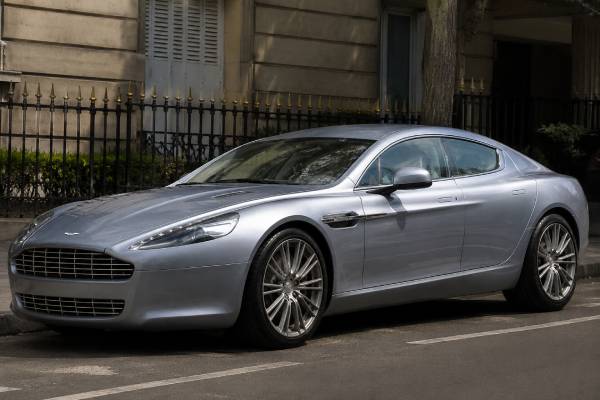
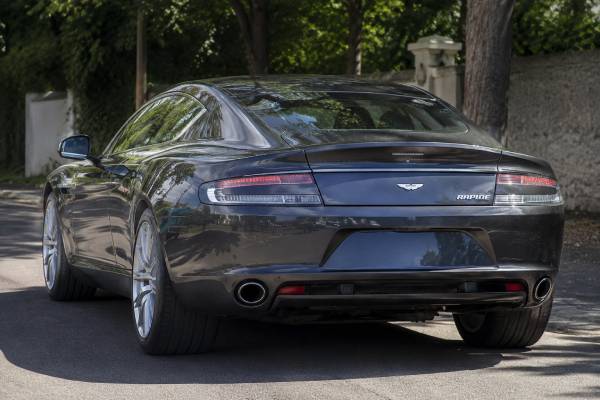
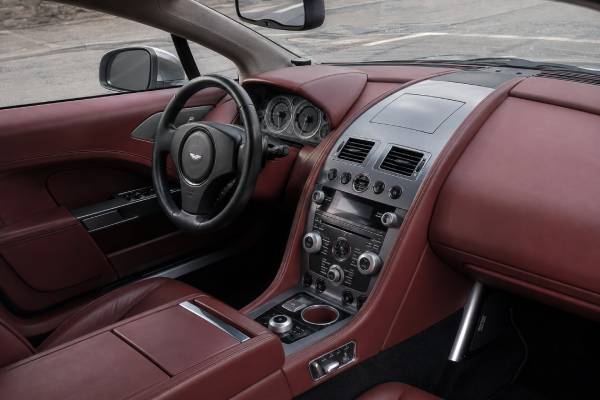
The Aston Martin Rapide Luxe turns the original 470 hp Rapide toward passenger comfort without changing its mechanical character. It retains the AM16 5.9-litre V12, rear-mounted six-speed automatic transaxle, rear-wheel drive, and bonded-aluminium VH400 structure, but combines them with a richer factory equipment package. The most useful way to view it is as a luxury specification rather than a faster trim.
That distinction matters when assessing a used car. A genuine Luxe earns its appeal from the presence and condition of its ventilated seating, rear entertainment equipment, upgraded trim, security features, and accompanying accessories—not merely from a badge in an advertisement. Build year, model year, and registration year may also differ, so the VIN specification should settle whether a 2010–2012 example was factory ordered as a Luxe.
When complete and properly maintained, the model gives rear passengers unusual attention without diluting the Rapide’s low, elegant grand-touring character. This guide explains the equipment, technical data, ownership demands, and checks that separate a convincing Luxe from an ordinary Rapide carrying extra options.
Table of Contents
- What the Rapide Luxe Represents
- Factory Luxury Equipment and Identification
- Powertrain, Chassis, and Dimensions
- Passenger Experience and Everyday Use
- Electronics, Infotainment, and Interior Preservation
- Mechanical Maintenance and Running Costs
- Rapide Luxe Buyer’s Guide
What the Rapide Luxe Represents
The Luxe is a convenience-and-craftsmanship package built on the standard early Rapide, not a separate engine or chassis derivative. Its purpose was to bundle desirable comfort features and expand the choice of colours and trim, making the four-seat GT feel more like a fully commissioned luxury car from the outset.
Period descriptions commonly associate the Luxe package with rear-seat entertainment, ventilated front and rear seats, an additional glass key, an upgraded alarm, and broader paint and interior choices. Depending on market and individual order, it may also carry premium audio, special veneers, embroidered details, a reversing camera, and other high-value options. Aston Martin’s bespoke ordering culture means that two genuine cars need not be visually identical.
The model-year question deserves care. The underlying Rapide ran from 2010 into 2012 before the Rapide S arrived, while the Luxe name became prominent in 2011-market material. A car can also have a late-year build date and a following-year registration. The correct method is to record all three where relevant:
- production or build date;
- manufacturer model year;
- first registration date.
This prevents an early registration from being used to “prove” or disprove a specification incorrectly. The VIN, factory build record, original invoice, and market-specific brochure should agree on what the car actually is.
The Luxe should not be confused with the Carbon Black special edition. A Carbon Black has a deliberate monochrome theme and its own identifying finish combination. The Luxe is broader and more flexible, focused on equipment rather than a single visual identity. Nor should it be confused with a standard Rapide that happened to receive most of the same options. The ownership experience may be similar, but authenticity and valuation depend on the original factory designation.
For buyers, the practical importance of the Luxe label is completeness. If the rear entertainment system is missing, the ventilated seats do not work, only one key remains, and the interior has been retrimmed outside the original scheme, much of the package’s reason for existence has been lost. Mechanical health still comes first, but a premium for the Luxe badge is justified only when the luxury content survives.
Factory Luxury Equipment and Identification
A genuine Luxe should be verified from documents before its equipment is judged. Option lists are supporting evidence, but factory records are stronger because ordinary Rapides could be ordered with many overlapping features.
Start with the VIN-linked build specification. It should identify the original exterior colour, primary and secondary leather colours, stitching, carpet, headlining, veneer or facia finish, wheel design, audio system, seat functions, entertainment equipment, alarm specification, and market configuration. Compare that list with the car in front of you. Any difference may be innocent—a wheel can be refinished and a damaged screen replaced—but it should have a documented explanation.
Common Luxe-associated features include:
- ventilated front and rear seats in addition to heating;
- twin-screen rear entertainment with disc player, headphones, and remote;
- an upgraded volumetric and tilt-sensing alarm;
- two glass ECU keys plus an additional key set, depending on market package;
- a wider selection of paint, leather, stitching, carpet, headlining, and veneer;
- premium audio, often the Bang & Olufsen BeoSound system;
- comfort and convenience equipment such as a reversing camera or auto-dimming mirror.
The glass key is a significant detail. It is attractive but expensive to replace and vulnerable to damage. Confirm how many functioning keys are included, whether each starts the car reliably, and whether the emergency or mechanical key elements are present. A seller’s promise that a missing key is “easy to order” should be verified with an authorised dealer before purchase.
Rear entertainment deserves a complete demonstration. Both screens should power up, display a stable image, respond to the source controls, and deliver audio through the intended headphones. Check the remote, disc mechanism, auxiliary input, wiring at the seatbacks, and trim surrounding the screens. Technology from this period is dated by modern standards, but originality matters, and repairs can require scarce components.
Seat ventilation is another differentiator that should be felt rather than assumed. Run each seat long enough to detect airflow and listen for abnormal fan noise. Weak performance can result from blocked perforations, damaged fans, wiring faults, or control problems. Heated-seat operation should be checked separately.
Cosmetic inspection should focus on whether the cabin still reflects hand-finished quality. Look for stretched leather, collapsed bolsters, dye transfer, lifted veneer, cracked Piano Black lacquer, loose stitching, damaged switchgear, and headlining sag. Minor wear is normal. Poor recolouring, mismatched leather grain, overspray on stitching, or low-quality retrimming can reduce both authenticity and visual consistency.
Powertrain, Chassis, and Dimensions
The Rapide Luxe is a petrol ICE vehicle with the same naturally aspirated V12 and rear-transaxle architecture as the regular 470 hp Rapide. Its additional equipment may affect the individual car’s mass slightly, but it does not create a different factory performance specification. The tables therefore describe the VH400 mechanical basis and identify the luxury content separately.
| Specification | Value | Notes |
|---|---|---|
| Engine type | All-alloy, naturally aspirated V12 | Front-mid-mounted |
| Engine code | AM16 | Early Rapide application |
| Displacement | 5,935 cc (5.9 L) | Marketed as a 6.0-litre V12 |
| Cylinder arrangement | 60-degree V12 | 48 valves |
| Valvetrain | Quad overhead camshafts | Four valves per cylinder |
| Bore × stroke | 89.0 × 79.5 mm | Factory dimensions |
| Maximum power | 350 kW (470 bhp) at 6,000 rpm | Manufacturer rating |
| Maximum torque | 600 Nm (443 lb-ft) at 5,000 rpm | Manufacturer rating |
| Specification | Value |
|---|---|
| Automatic transmission | Touchtronic II, six forward speeds |
| Transmission location | Rear transaxle |
| Driven wheels | Rear |
| Connection to engine | Alloy torque tube and carbon-fibre propeller shaft |
| Differential | Limited-slip |
| Final-drive ratio | 3.46:1 |
| Measure | Value | Source condition |
|---|---|---|
| 0–60 mph | Approximately 5.1 seconds | Manufacturer figure |
| 0–100 km/h | Approximately 5.3 seconds | Manufacturer figure |
| Maximum speed | 303 km/h (188 mph) | Manufacturer figure |
| Combined fuel consumption | Approximately 14.9 L/100 km | Period European combined cycle |
| CO₂ emissions | Approximately 355 g/km | Period European combined figure |
| Fuel capacity | 90.5 L (23.9 US gal) | Premium unleaded petrol |
| Specification | Value |
|---|---|
| Body and seating | Five-door fastback, four individual seats |
| Length | 5,019 mm (197.6 in) |
| Width | 1,929 mm (75.9 in) excluding mirrors |
| Height | 1,360 mm (53.5 in) |
| Wheelbase | 2,989 mm (117.7 in) |
| Approximate kerb weight | 1,950 kg (4,299 lb) |
| Luggage space | 317 L with rear seats raised |
| Maximum luggage space | 886 L with rear seatbacks folded |
| Component | Specification |
|---|---|
| Front suspension | Double wishbones, coil springs, anti-roll bar, adaptive dampers |
| Rear suspension | Double wishbones with anti-squat and anti-lift geometry |
| Front tyre size | 245/40 R20 |
| Rear tyre size | 295/35 R20 |
| Front brakes | 390 mm ventilated dual-cast discs with six-piston calipers |
| Rear brakes | 360 mm ventilated discs with four-piston calipers |
| Steering | Speed-sensitive hydraulic rack and pinion |
These figures should not be mixed with the 550 hp Rapide S that followed. The later car received a revised engine, front structure, styling, and eventually an eight-speed transmission; it is a different technical scope even though the body concept is similar.
Passenger Experience and Everyday Use
The Luxe makes the strongest case for the Rapide as a shared grand tourer. Its cabin is designed around four defined seating positions, and its extra comfort equipment is most valuable on long trips rather than brief city journeys.
Front-seat occupants receive the familiar low Aston Martin driving position. The steering wheel, high centre tunnel, and broad console create a cockpit-like feel, while the long bonnet remains visible enough to help place the car. Controls are arranged more for visual drama than modern simplicity. Learning the transmission buttons, navigation controller, climate keys, and audio menus takes time.
The rear compartment is not limousine spacious, but it can be deeply comfortable. The individual buckets support passengers through bends, the centre console provides a sense of separation, and dedicated climate outlets help on long drives. Ventilated seats are particularly useful in dark leather cabins during warm weather. The entertainment screens can occupy passengers, though a modern tablet is easier to update; the original system’s value lies in integration and completeness.
Access is the limiting factor. The rear doors are short and the roof low, so passengers step down and rotate into the seat. Anyone with reduced mobility should test the process. Tall occupants should check headroom with the seatback adjusted and the front seat set for the actual driver. A five-metre exterior does not translate into a long-wheelbase-sedan rear bench.
Luggage planning also matters. The standard 317-litre space works best with soft bags that fit beneath the sloping hatch. Four adults carrying hard cases can exceed the useful space before the published volume suggests. With only two occupants, folding the rear seats opens a long 886-litre area that handles golf bags, ski equipment, or touring luggage surprisingly well.
For everyday use, inspect practical details that are easy to overlook:
- hatch struts, powered release, latch, and parcel cover;
- front and rear cupholders and storage lids;
- door check straps and window drop function;
- parking sensors and reversing camera image;
- climate output from all zones;
- seat movement without twisting, clicking, or memory loss;
- mirror folding and heating;
- tyre-repair kit, compressor, warning triangle, first-aid kit, and umbrella.
The Luxe can be a daily car for an owner who accepts its width, fuel use, and low nose. It is less convincing in old multi-storey car parks or on repeated short trips, where the battery, engine, and exhaust system never receive a full heat cycle.
Electronics, Infotainment, and Interior Preservation
Electrical and cosmetic condition carry unusual weight on a Luxe because the trim level is defined by added equipment. A mechanically sound car with multiple dead luxury features may still require a large restoration budget.
Begin with battery voltage and charging health. Low voltage can create warning messages, disabled functions, memory loss, and communication faults across several modules. A proper diagnostic scan should be performed with the battery supported at the correct voltage. Recorded faults need interpretation by date and status; clearing them without testing proves little.
The premium audio system should be tested from every source and at low and moderate volume. Listen for silent channels, distortion, amplifier shutdown, or rising tweeters that fail to deploy. Confirm that the navigation display opens and closes correctly and that the controller responds consistently. Bluetooth capability is limited compared with modern systems, so verify the functions that matter to you rather than assuming current smartphone integration.
Rear entertainment repair can involve screens, player hardware, wiring through moving seat assemblies, remote controls, headphones, or source selection. Diagnose the whole system before buying isolated replacement parts. Used components may require coding or may have the same age-related weakness as the failed unit.
Leather preservation should be gentle. Vacuum perforated seats before applying cleaner, use products compatible with the factory finish, and avoid soaking ventilation holes. Heavy conditioners can trap dirt or create shine. On lightly coloured interiors, denim transfer and bolster wear should be treated early by a specialist rather than hidden under a generic dye.
Veneer and Piano Black surfaces need different care. Use soft, clean cloths and minimal pressure. Deep scratches, lifting veneer, or cracked lacquer require professional refinishing. A freshly polished cabin can conceal defects temporarily, so inspect under angled daylight.
Headlining material can loosen with age and heat. Check the main roof panel, pillars, sun visors, rear shelf, and trim around entertainment screens. Also look for water marks, damp carpet, corrosion on connectors, or a musty smell. Water ingress should be traced to its source—seals, drains, hatch area, or previous body repair—before cosmetic materials are replaced.
Mechanical Maintenance and Running Costs
Mechanically, the Luxe needs the same disciplined care as any early Rapide, with an additional reason to keep voltage and cabin systems healthy. Annual servicing, even at low mileage, is the safest baseline.
Engine oil should meet the specification listed for the exact market and VIN, and the level should be checked using the approved procedure. A service visit should also inspect belts, hoses, intake connections, leaks, engine mounts, diagnostic data, and evidence of misfire. Twelve spark plugs and multiple coils make ignition work more expensive than on a normal car, but ignoring a misfire risks catalytic-converter damage.
The cooling system must hold pressure and maintain stable temperature in traffic. Expansion-tank seams, caps, hose joints, radiators, and fans deserve close examination. Coolant odour after a drive, dried residue, or unexplained top-ups require investigation.
Touchtronic II operation should be smooth from cold and after a long drive. Verify prompt Drive and Reverse engagement, clean shifts, and correct Park operation. Some six-speed Rapide vehicles were subject to a park-lock software recall; only a VIN check can confirm whether a particular car was included and completed.
Suspension and steering condition determine whether the car still feels expensive. Worn bushes, links, dampers, bearings, or poor alignment can create noise and imprecision. The large wheels are susceptible to damage, and the inner rim surfaces should be checked. Use matching tyres of the correct size, load capability, and speed rating, and replace them for age or cracking even when tread remains.
Brake replacement can be a major cost. Measure steel-disc thickness and inspect for corrosion, heat checking, lips, scoring, and vibration. Brake fluid should be renewed at the official time interval. An electronic parking-brake fault also needs specialist diagnosis rather than repeated button operation.
A realistic ownership budget includes:
- annual service and inspection;
- battery testing or replacement and a quality conditioner;
- age-based fluid changes;
- premium staggered tyres and alignment;
- large brake components;
- ignition or cooling repairs as needed;
- rectification of seat, audio, entertainment, camera, or trim faults.
A reserve based on the inspection report is more useful than a fixed percentage of purchase price. Two similarly priced cars can differ by many thousands in immediate needs.
Rapide Luxe Buyer’s Guide
The strongest Luxe purchase combines verified factory status, complete luxury equipment, a clean diagnostic report, and evidence of preventive mechanical care. Low mileage is beneficial only when supported by regular use and time-based maintenance.
Ask for the build sheet before travelling to view the car. Compare its colour and option codes with photographs and the seller’s description. Confirm the number of keys and accessories. Then review service invoices chronologically, looking for gaps, repeated unresolved complaints, mileage inconsistencies, and signs that expensive advisories were postponed.
At the inspection, insist on a cold start. Check the engine idle, warning lamps, exhaust smoke, coolant temperature, and fluid smells. Operate all four seats and every Luxe-specific feature. Test windows, locks, mirrors, climate, entertainment, audio, camera, parking sensors, hatch, alarm, and both keys. Allow enough time for intermittent faults to appear.
The road test should include rough surfaces, open roads, repeated gear selections, manual shifts, firm braking, and a hot restart. The car should feel tight, quiet, and predictable. Vibration through the steering or seat may point to tyres, wheels, brakes, driveline, or mounts. Do not let a beautiful cabin shorten the mechanical assessment.
Aston-capable diagnostics and a lift inspection are essential. The technician should inspect the bonded structure, undertrays, jacking areas, leaks, brake measurements, suspension play, wheel damage, tyre dates, exhaust condition, and evidence of previous repair. Ask for estimated costs separated into urgent, near-term, and optional work.
Walk away when identity cannot be proven, water damage is present, several modules are offline, the car has poor structural repair, or the seller refuses independent inspection. Negotiable issues include worn tyres, routine servicing, a missing accessory with a confirmed replacement price, or documented cosmetic repair.
The Rapide Luxe is for a buyer who wants the original Rapide’s graceful shape and hydraulic, naturally aspirated driving experience with a fuller passenger specification. Its extra systems are not reasons to avoid it; they are reasons to inspect it more thoroughly. Choose a complete car, keep it electrically healthy, and use it often enough to exercise every function. That approach preserves both the experience and the value of the Luxe package.
References
- Rapide Luxe « Aston Martins.com 2026 (Model History)
- RAPIDE 2026 (Manufacturer Historic Model Page)
- The world’s most elegant four-door 2011 (Sales Brochure)
- 2011 Aston Martin Rapide Luxe Pours On The Luxury 2010 (Equipment Overview)
- RA-07-0028 – 6-Speed Touchtronic II Automatic Transmission Park Lock Problem 2017 (Safety Recall Action)
- Owner’s Guides | Aston Martin 2026 (Owner Documentation)
Disclaimer
This article is for informational purposes and is not a substitute for professional diagnosis, inspection, or repair. Specifications, torque values, intervals, options, recall status, and procedures vary by VIN, market, model year, and equipment. Verify all requirements in the official service information for the specific car.
Please share this article on Facebook, X/Twitter, or an appropriate owners’ group if it helped you understand or evaluate a Rapide Luxe.