


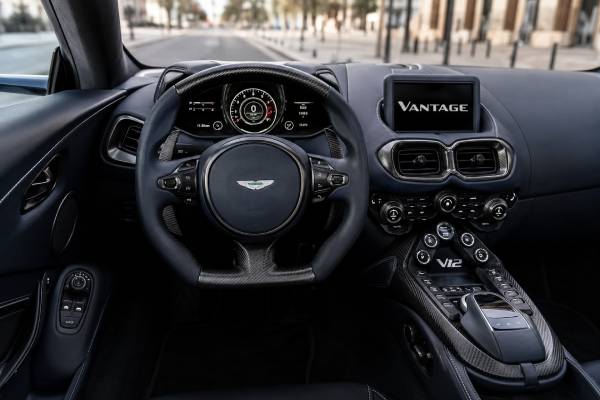
The 2022–2023 Aston Martin V12 Vantage is the most concentrated expression of the first AM6-generation coupe: a 690 hp twin-turbo V12 installed in the smallest modern Aston Martin body, backed by carbon-ceramic brakes, a widened track, and model-specific chassis tuning. Only 333 coupes were planned, so this is not merely a faster Vantage or a cosmetic limited edition. It is a distinct engineering program created as the final V12 Vantage of its era.
Its appeal is easy to understand, but buying and preserving one takes more care than reading the power figure. Weight definition, option content, carbon-fiber condition, tire age, brake wear, heat management, software history, and authenticity all influence the quality and value of an individual car. This guide explains the exact 5.2-liter coupe, how its V12 installation changed the AM6 platform, what it feels like to use, and which inspections matter before a purchase.
Table of Contents
- Why the final V12 coupe matters
- V12 Vantage specifications and technical data
- Engine packaging, cooling, and weight control
- Chassis, aerodynamics, and carbon-ceramic brakes
- Driving character and responsible performance use
- Service and long-term preservation
- Authenticity and pre-purchase checks
Why the final V12 coupe matters
The V12 Vantage matters because Aston Martin changed the car at a structural and dynamic level rather than treating the engine as a simple swap. The 333-car production run combined the brand’s 5.2-liter twin-turbo V12 with the compact AM6 coupe at a point when emissions, packaging, and product strategy made another conventional V12 sports car increasingly unlikely.
The basic idea has historical weight. Earlier V12 Vantage generations built their reputation by placing Aston Martin’s largest series-production engine in its smallest two-seat model. The 2022 car repeated that formula, but the engineering challenge was different. The AM6 had been designed around a 4.0-liter V8, rear transaxle, bonded aluminum structure, and relatively narrow body. The V12 brought more mass, cooling demand, exhaust flow, and torque. It also raised expectations: a limited finale had to feel special at ordinary speeds while remaining credible at 200 mph.
Aston Martin answered with wider front and rear bodywork, a larger grille, a reshaped front bumper, a vented clamshell bonnet, revised sills, a new rear bumper, and an aerodynamic package that could produce 204 kg of downforce at maximum speed. Much of the exterior was carbon fiber or composite material. The chassis received stiffer springs, revised anti-roll bars, new top mounts, increased body rigidity, adaptive-damper calibration, and a mechanical limited-slip differential rather than the regular V8 car’s electronically controlled unit.
The result is not a lightweight car in an absolute sense. A V12, automatic transaxle, substantial cooling system, luxury cabin, and modern crash structure bring real mass. The achievement is that Aston Martin offset part of the additional burden while increasing tire, brake, aero, and structural capability. Its quoted 390 PS per metric ton power-to-weight ratio refers to the manufacturer’s lightweight specification, not every customer car with every comfort option.
Production rarity should also be understood precisely. The announced 333 units refer to the V12 Vantage Coupe, while the later Roadster was a separate 249-car program. A coupe should therefore be authenticated as a genuine factory V12 model rather than judged only by its body kit, badges, or claimed allocation. Paint-to-sample finishes, exposed carbon, lightweight seats, and wheel choices can make two authentic cars materially different without changing the underlying production status.
Technical data for the 690 hp V12 Vantage
This Vantage is a gasoline-only internal-combustion coupe. Its front-mid-mounted 5.2-liter twin-turbo V12 drives the rear wheels through a ZF eight-speed automatic transaxle and a mechanical limited-slip differential. The essential numbers are 700 PS, equivalent to 690 bhp, 756 Nm in Aston Martin’s technical sheet, a claimed 200 mph maximum speed, and 21-inch wheels carrying model-specific Michelin tires.
| Specification | Value | Notes |
|---|---|---|
| Engine | 5,204 cc twin-turbocharged V12 | All-alloy, quad-cam, 48 valves |
| Engine family | AE31 | Front-mid-mounted installation |
| Bore × stroke | 89.0 × 69.7 mm | Technical information sheet |
| Compression ratio | 9.3:1 | Direct-injection gasoline engine |
| Maximum power | 690 bhp (515 kW / 700 PS) at 6,500 rpm | Coupe specification |
| Maximum torque | 756 Nm (558 lb-ft) at 5,500 rpm | Technical-sheet value |
| Fuel tank | 73 liters (19.3 US gal) | Premium unleaded; 98 RON recommended |
| Specification | Value |
|---|---|
| Transmission | ZF eight-speed automatic transaxle |
| Drive type | Rear-wheel drive |
| Differential | Mechanical limited-slip differential |
| Final-drive ratio | 2.93:1 |
| Propeller shaft | Carbon-fiber shaft in an aluminum torque tube |
| Gear control | Shift-by-wire with steering-wheel paddles |
| Measure | Value | Condition |
|---|---|---|
| 0–60 mph | 3.4 seconds | Manufacturer claim |
| 0–100 km/h | 3.5 seconds | Manufacturer technical sheet |
| Maximum speed | 322 km/h (200 mph) | Manufacturer claim |
| Power-to-weight ratio | 390 PS per metric ton | Manufacturer lightweight specification |
| Peak aerodynamic load | 204 kg | At maximum speed with rear wing fitted |
| Component | Specification |
|---|---|
| Front suspension | Double wishbones, coil springs, adaptive dampers, anti-roll bar |
| Rear suspension | Multi-link layout, coil springs, adaptive dampers, anti-roll bar |
| Front brakes | 410 mm carbon-ceramic discs, six-piston calipers |
| Rear brakes | 360 mm carbon-ceramic discs, four-piston calipers |
| Front wheels | 9.5J × 21, ET48 |
| Rear wheels | 11.5J × 21, ET55 |
| Front tires | 275/35 ZR21 |
| Rear tires | 315/30 ZR21 |
| Normal cold pressure | 2.2 bar (32 psi) |
| Specification | Value | Definition |
|---|---|---|
| Body type | Two-door, two-seat coupe | Bonded aluminum structure |
| Track increase | 40 mm wider than the regular V8 Vantage | Front and rear body package |
| Kerb weight | 1,795 kg (3,957 lb) | Official technical-sheet figure |
| Gross vehicle weight | 2,085 kg (4,597 lb) | Maximum permitted vehicle mass |
| Steering ratio | 13:1 | 2.27 turns lock to lock |
| Turning circle | 12.0 m (39.4 ft) | Kerb-to-kerb reference |
| Item | Specification | Practical note |
|---|---|---|
| Engine oil grade | SAE 0W-20 | Use the current VIN-specific approval |
| Oil and filter quantity | 10.79 liters (11.4 US qt) | Published service reference, not a blind fill instruction |
| Total coolant reference | 29.7 liters (31.4 US qt) | Complex multi-circuit system; official filling procedure required |
| Fuel quality | Minimum 95 RON; 98 RON recommended | Ethanol content no higher than E10 |
| Battery | 12 V, 70 Ah, 760 A | Correct charging mode and connection points matter |
How Aston Martin packaged the V12
Installing the V12 required a complete heat-management and airflow solution. The engine fills more of the bay than the V8, and its two turbochargers, exhaust system, charge coolers, lubricating system, and front heat exchangers all have to work when road speed is low as well as when the car is approaching its maximum velocity.
The enlarged front grille has about 25 percent more open area than the regular Vantage’s grille. A horseshoe-shaped outlet in the bonnet lets hot air escape from the engine compartment and reduces pressure beneath the bonnet. Additional vents and ducting manage radiator flow and brake cooling. These openings are functional, so a protective film installation, body repair, or aftermarket grille must not block them.
The V12’s placement also affects service access. Some inspections that are simple on a less crowded engine bay can require removal of covers, ducts, undertrays, or other components. A tidy top surface therefore does not prove that the engine is dry beneath its shielding. A proper pre-purchase inspection should view the car from below and look for oil residue, dried coolant, damaged hoses, heat-affected wiring, or undertray fasteners that suggest repeated incomplete work.
Weight reduction came from many smaller decisions rather than one dramatic deletion. The front bumper, bonnet, front fenders, and side sills use carbon fiber. The rear bumper and deck lid are composite. A lighter 12-volt battery was fitted, the stainless-steel exhaust uses thinner material and saves about 7.2 kg, and optional lightweight wheels save another 8 kg. Carbon-fiber performance seats could remove further mass compared with standard powered seating.
These savings should not be treated as interchangeable. A car with comfort seats, audio upgrades, extensive leather, or other equipment remains genuine, but it will not match the lightest quoted configuration. Conversely, an aftermarket exhaust or wheel set does not automatically improve the car. It can alter noise compliance, heat shielding, unsprung mass, tire fitment, calibration behavior, insurance terms, and collectability.
The V12 delivers its character through broad torque rather than a fragile high-rpm peak. Its 756 Nm technical-sheet figure arrives at 5,500 rpm, yet substantial boost is available much earlier. The rear transaxle’s calibration was developed specifically for this engine, with shortened shift times and adaptive logic intended to work on road and track. Because torque rises quickly, the quality and temperature of the rear tires are central to safe performance.
Why the chassis is more than a widened Vantage
The V12 model is substantially firmer and more disciplined than the standard early V8 car. Aston Martin increased front spring rate by 50 percent, rear spring rate by 40 percent, and front anti-roll-bar stiffness by 5 percent, while reducing rear anti-roll-bar stiffness by 41 percent to balance the wider tires and heavier engine.
The front suspension top mounts are 13 percent stiffer, and reinforced body elements raise torsional stiffness by about 8 percent and lateral stiffness by 6.7 percent. Those figures help explain why the V12 can support high aero and tire loads without relying only on very hard damping. The adaptive dampers still provide selectable modes, but their range and calibration are model-specific.
The mechanical limited-slip differential is an important distinction. A mechanical unit responds directly to wheel-speed and torque differences without waiting for a control strategy to command clutch pressure. It gives the V12 a more traditional relationship between throttle position, rear-axle load, and corner exit. Stability control and brake-based torque vectoring remain, so the car is not electronically simple; the mechanical differential is one element in a coordinated system.
Aerodynamics change the car’s high-speed balance. The front splitter, side treatment, underbody work, rear diffuser, and prominent rear wing produce up to 204 kg of downforce at maximum speed. Customers could request deletion of the rear wing, but that choice changes the complete aero balance and may affect future value. A wing-delete car should be documented as factory specified, not assumed to be missing a component after repair.
Carbon-ceramic brakes were standard because steel discs of comparable capability would add unsprung mass and struggle with repeated high-energy stops. Aston Martin said the ceramic system saved about 23 kg compared with the V8 car’s steel brakes. Reduced unsprung mass helps the wheel follow the road, but ceramic rotors demand informed care. Chips at the edge, impact damage during wheel removal, deep scoring, heat distress, and thickness or mass below the service limit can lead to an extremely expensive replacement.
Brake feel also depends on use. Carbon-ceramic systems can sound different from steel brakes, show light surface marks, and feel less immediate when cold or wet. Those characteristics do not excuse vibration, pulling, warning lights, cracked material, or pads worn near their backing plates. Inspection should use Aston Martin’s measurement procedure rather than appearance alone.
The 275 mm front and 315 mm rear tires are part of the chassis design. Their compound, construction, and approved specification influence steering effort, traction, stability-control behavior, and ride. A cheaper tire with the same printed size may not reproduce the original behavior. Mixed brands, mixed approval markings, old rubber, or large tread-depth differences across an axle are all reasons to budget for a complete set.
What the V12 is like to drive
The defining experience is not merely acceleration; it is the way a large, responsive engine changes the Vantage’s rhythm. The car can gain speed in a high gear with little warning, while the compact wheelbase and rear-wheel drive keep the driver closely involved.
At moderate pace, the V12 feels more substantial at the nose than the V8. The steering remains quick, but the car rewards deliberate inputs and a settled approach to corner entry. The broad front tires create strong initial grip, while the mechanical differential and 315-section rears can drive the car hard from an apex once load is established. On a broken road, using the softest suitable damper setting can provide more grip than choosing Track simply because it sounds serious.
The gearbox gives the car two useful personalities. Left in automatic mode, it can exploit the engine’s torque and cover distance without constant intervention. The paddles make the response more immediate when the road opens, and the shorter shift strategy gives upshifts a harder edge. Owners should still allow engine oil, transmission fluid, tires, and brakes to reach operating temperature before using full load.
A 200 mph capability does not make public-road speeds harmless. The car can compress distance rapidly, its width is greater than a normal Vantage’s, and its low carbon components are vulnerable to crests and steep entrances. Visibility over the bonnet is manageable, but the rear wing occupies part of the mirror view. Front and rear cameras, parking sensors, and careful route choice are useful rather than embarrassing.
Track use can reveal the engineering, but it changes the maintenance equation. Heat cycles consume tires even when tread remains. Brake pads and rotors need inspection before and after the event. Rubber pickup can create vibration. Wheel fasteners, pressures, fluids, and underbody components need checks, and insurance may exclude circuit driving. A novice gains more from instruction and conservative stability settings than from immediately selecting the least assisted mode.
The sound is central to the model’s value. The V12 has a smoother, more layered tone than the V8 and builds intensity as engine speed rises. Exhaust modifications can make it louder, but louder is not automatically better. Drone, warning lights, poor valve operation, altered back pressure, heat damage, or lost original parts can reduce both enjoyment and resale appeal. A reversible, documented change is easier to assess than an unknown custom system.
Maintenance and long-term preservation
The best preservation plan combines annual professional attention with careful storage and regular use. Ultra-low mileage is not a substitute for fresh fluids, a healthy battery, exercised seals, correctly heated oil, and documented inspections.
Exact service intervals depend on market, build date, and VIN, so the official maintenance schedule must control. An annual visit is a sensible baseline for a collector car even when mileage is modest. The workshop should check open campaigns, scan all modules, inspect cooling and lubrication systems, measure brakes and tires, verify alignment, assess the underbody, and update the permanent history.
The 0W-20 oil grade and 10.79-liter oil-and-filter reference are specific to the V12 technical sheet. They should not be replaced with the early V8’s 0W-40 data. The published capacity is not permission to add the full amount without following the drain, filter, temperature, and level-check procedure. The engine’s lubrication system and turbochargers require the correct approved oil, clean filling equipment, and careful final verification.
Cooling deserves equal attention. The published total reference of 29.7 liters reflects a large and complex system. A small visible loss can be meaningful, and trapped air after repair can cause trouble even when the reservoir initially looks correct. Check for staining at hose connections, radiator damage behind the grille, fan operation, warning history, and the correct coolant mixture. Do not mix products based only on color.
Battery support prevents many avoidable problems. The car has numerous control modules, electric locks, alarms, memory functions, and networked systems. During storage, use an approved smart maintainer connected at the specified points. A battery that repeatedly needs rescue charging should be tested rather than continually revived, because low voltage can interrupt updates, create misleading faults, and stress the starter system.
Carbon bodywork needs process discipline. Paint-protection film can defend exposed surfaces, but old film may discolor or pull at repaired paint. Jacking must use approved points. Wheel removal should protect ceramic rotors from impact. A pressure washer should not be aimed closely at seals, vents, electrical connections, or delicate edges. Bird contamination and insects should be softened and removed promptly rather than scrubbed across clear coat.
Storage should be dry, ventilated, and free from rodents. Raise tire pressures only within approved guidance, avoid leaving the parking brake clamped for very long periods when an approved alternative exists, and move the car enough to prevent one contact patch from carrying the load indefinitely. Starting the engine for a few minutes without driving is less useful than a proper trip that warms the complete driveline and evaporates moisture.
Keep every invoice, inspection report, campaign record, tire receipt, alignment sheet, and original part. On a 333-unit car, provenance is not administrative clutter; it is evidence that expensive systems have been cared for and that modifications can be understood or reversed.
How to inspect and buy a genuine example
Buy the history and condition before buying a color combination. A specialist inspection is essential because a V12 Vantage can look immaculate while hiding worn carbon-ceramic brakes, old tires, repaired carbon panels, cooling leaks, or unresolved electronic faults.
Start with identity. Confirm the VIN through Aston Martin’s dealer system, check the factory build specification, and match major options to the car. Verify that the model is recorded as a V12 Vantage Coupe and that any wing-delete configuration, lightweight seats, exposed carbon, special paint, wheel finish, or Q customization appears in documentation. Plaques, badges, and body parts can be copied; factory data is stronger evidence.
Then examine the structure and exterior in bright, even light. Panel gaps should be consistent, carbon weave should not show unexplained disturbance, and paint depth should make sense across adjoining panels. A repaired bumper is not automatically a reason to reject the car, but the method, parts, and invoice matter. Damage around bonded aluminum mounting points or structural sections demands expert assessment.
Use the following priorities during the inspection:
- Cold start: Arrange for the engine to be genuinely cold. Listen for abnormal mechanical noise, watch for smoke, and confirm that warning lamps complete their normal self-check.
- Diagnostic history: Scan every module, not only the engine computer. Investigate stored, pending, or recently cleared faults and compare software levels with campaign records.
- Cooling and fluids: Inspect from above and below for oil, coolant, hydraulic fluid, or residue. Confirm fluid specification and service evidence.
- Brakes: Obtain measured ceramic-rotor and pad condition using the approved method. Include replacement cost in negotiations if any component is near its limit.
- Wheels and tires: Check inner rims, repair marks, tire date codes, matching specifications, puncture repairs, and inner-shoulder wear.
- Chassis behavior: Road-test for straight tracking, clean steering return, controlled damping, quiet joints, smooth gear engagement, and predictable braking.
- Cabin equipment: Test cameras, sensors, climate control, seat functions, audio, navigation, keys, alarm, windows, lighting, and every switch.
Mileage must be interpreted with context. A car driven regularly and serviced correctly may be healthier than a display car on original tires, old fluids, and a weak battery. Conversely, track mileage can be acceptable when supported by frequent inspections and replacement records. The important question is whether the condition matches the claimed use.
Ask for original wheels, exhaust parts, seats, wing components, covers, books, keys, tools, and charging equipment where applicable. Missing items may be expensive and can make a modified car difficult to return to factory form. Also confirm warranty status, local emissions legality, insurance conditions, and whether a service contract transfers.
Finally, run recall and campaign checks by VIN immediately before purchase. Public databases identify safety recalls, while an Aston Martin retailer can see manufacturer actions and completion status. A clean dashboard on one test drive is not proof that every campaign is closed.
The strongest V12 Vantage is therefore not automatically the lowest-mileage or most vividly specified example. It is the car whose identity is beyond doubt, whose condition has been measured, whose maintenance is continuous, and whose costly original components remain intact. That combination protects both the driving experience and the significance of one of Aston Martin’s final compact V12 coupes.
References
- Introducing the new V12 Vantage: A spectacular finale for an iconic bloodline 2022
- V12 Vantage | Aston Martin 2022 (Brochure)
- V12 Vantage Vehicle Information Sheet 2022 (Technical Information)
- Owner’s Guides | Car Ownership | Aston Martin (UK) | Aston Martin UK 2026 (Owner’s Guides)
- Aston Martin Luxury Car Servicing | Aston Martin (UK) | Aston Martin UK 2026 (Servicing)
- Check for Recalls: Vehicle, Car Seat, Tire, Equipment | NHTSA 2026 (Recall Database)
Disclaimer
This article is for informational purposes and is not a substitute for professional diagnosis, maintenance, or repair. Specifications, torque values, intervals, procedures, and campaign status can differ by VIN, market, build date, and equipment; verify every critical detail against the official service documentation for the individual car.
Please share this guide on Facebook, X/Twitter, or another enthusiast community if it helped you research the V12 Vantage and you would like to support our work.