


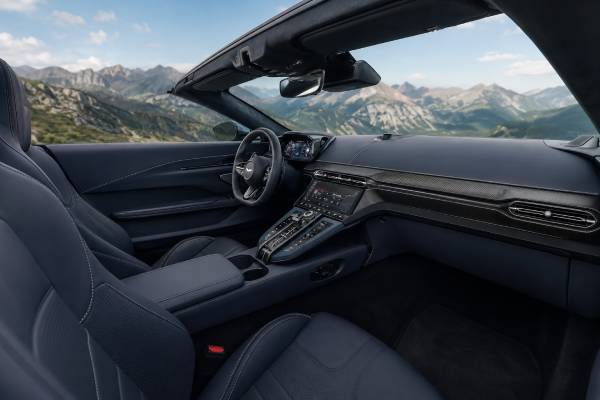
The 2025 Aston Martin Vantage Roadster turns the 656 hp redesigned Vantage into an open car without treating the convertible body as an afterthought. Coupe and Roadster were developed in parallel, which allowed Aston Martin to build roof loads, rear structure, gearbox mounting, damper calibration, and rollover protection into the program from the beginning. The finished car is only 60 kg heavier than the coupe, opens or closes its roof in 6.8 seconds, and retains the same claimed 202 mph maximum speed.
The roof is the obvious attraction, but the less visible work determines whether this Roadster feels precise and stays dependable. Its 49:51 weight distribution, eight-layer top, aluminum rollover system, roadster-specific rear damping, wider cooling package, 21-inch Michelin tires, and connected interior all need informed care. This article covers the original 665 PS, or 656 bhp, launch calibration. Newer official pages may display revised output, so prospective owners should confirm the exact production specification by VIN.
Table of Contents
- Why parallel development changed the result
- 656 hp Roadster specifications and technical data
- Fast-folding roof, structure, and rollover protection
- Roadster-specific balance and driving behavior
- Cabin, touring ability, and daily use
- Roof, chassis, and powertrain care
- Buying and inspecting the correct car
Why parallel development changed the result
The Roadster was engineered alongside the coupe, so the team could address convertible weaknesses before the body design was frozen. That approach helped limit the weight increase to 60 kg while allowing Aston Martin to alter load paths, rear body attachment, shear-panel placement, rear-damper software, and transmission mounts specifically for the open car.
Older convertibles were often created after a coupe had been completed. Engineers would remove the roof, discover lost rigidity, and add heavy reinforcement beneath the body. The 2025 Vantage Roadster still needs strengthening, but its structure was planned around both roof-up and roof-down loads. Weight-optimized shear panels laterally stiffen strategic areas, while the rear structure was attached differently to improve rigidity.
The roof itself contributes to the low mass. A Z-fold design uses fewer layers of mechanical movement than a traditional K-fold arrangement and does not require a separate powered tonneau cover. The folded stack sits low behind the seats, helping the center of gravity and preserving the car’s descending rear profile. Aston Martin calls it the fastest fully automatic convertible roof on sale at launch, completing either direction in 6.8 seconds.
The aluminum rollover-protection system uses a process Aston Martin calls “Castrusion,” combining casting and extrusion principles to create strong, light, compact components. The goal is protection without installing bulky structures that would raise the rear deck or consume more luggage space. As with any safety system, it must remain factory-correct; trim changes, audio work, or aftermarket accessories should not interfere with deployment paths.
Powertrain hardware largely follows the 2024 coupe. The 4.0-liter V8 produces 665 PS and 800 Nm, driving the rear wheels through an eight-speed ZF transaxle and electronic differential. A 3.5-second 0–60 mph claim is only one tenth behind the coupe, while maximum speed remains 202 mph. These figures show how little performance the convertible conversion costs, but they do not make the Roadster identical in feel.
Its mass distribution shifts slightly rearward to 49:51. Aston Martin recalibrated the rear dampers and retuned the rear-transaxle mountings to account for that change. The difference is useful: the open car can have its own settled, traction-rich character instead of attempting to imitate the coupe with unsuitable settings.
Technical data for the 656 hp Roadster
The launch-version Vantage Roadster is a gasoline-only, front-mid-engine, rear-wheel-drive convertible. It combines a 3,982 cc twin-turbo V8 with a rear eight-speed automatic transaxle, an electronic limited-slip differential, Bilstein DTX adaptive dampers, and a powered fabric roof. The tables below keep the 665 PS launch configuration separate from later power revisions.
| Specification | Value | Notes |
|---|---|---|
| Engine | 3,982 cc twin-turbocharged V8 | Front-mid-mounted, all-alloy construction |
| Engine family | M177-based | Aston Martin hardware, installation, and calibration |
| Charge cooling | Water-to-air | Expanded low-temperature cooling circuit |
| Maximum power | 656 bhp (489 kW / 665 PS) | Roadster launch specification |
| Maximum torque | 800 Nm (590 lb-ft) | Manufacturer figure |
| Fuel tank | 73 liters (19.3 US gal) | Use premium fuel meeting market requirements |
| Specification | Value | Condition |
|---|---|---|
| Transmission | ZF eight-speed automatic transaxle | Steering-wheel paddles and automatic modes |
| Drive type | Rear-wheel drive | Electronic rear differential |
| Final-drive ratio | 3.083:1 | Shared launch-generation gearing |
| 0–60 mph | 3.5 seconds | Manufacturer claim |
| Maximum speed | 325 km/h (202 mph) | Manufacturer claim |
| Weight distribution | 49:51 front to rear | Roadster-specific balance |
| Feature | Specification | Practical meaning |
|---|---|---|
| Roof type | Fully automatic Z-fold fabric roof | No separate tonneau cover required |
| Opening or closing time | 6.8 seconds | Complete powered cycle |
| Maximum operating speed | 50 km/h (31 mph) | Subject to approved conditions |
| Remote operation | Available through the key within approximately 2 m | Market and configuration dependent |
| Insulation | Eight layers | Designed for coupe-like roof-up refinement |
| Weight increase over coupe | 60 kg (132 lb) | Includes roof and structural changes |
| Rollover system | Aluminum ROPS using Castrusion construction | Compact strength-focused packaging |
| Component | Specification |
|---|---|
| Front suspension | Unequal-length double wishbones, coil springs, Bilstein DTX adaptive dampers |
| Rear suspension | Multi-link layout, Roadster-specific Bilstein DTX calibration |
| Steering | Non-isolated column, electric assistance, 12.8:1 ratio |
| Front wheels | 9.5J × 21 forged alloy |
| Rear wheels | 11.5J × 21 forged alloy |
| Front tires | 275/35 R21 Michelin Pilot Sport S 5, AML specification |
| Rear tires | 325/30 R21 Michelin Pilot Sport S 5, AML specification |
| Traction adjustment | Eight-step Adjustable Traction Control in the relevant mode |
| Item | Specification |
|---|---|
| Standard front brakes | 400 mm drilled cast-iron discs, six-piston calipers |
| Standard rear brakes | 360 mm drilled cast-iron discs, four-piston calipers |
| Optional front carbon ceramics | 410 mm carbon-ceramic discs |
| Optional rear carbon ceramics | 360 mm carbon-ceramic discs |
| Carbon-ceramic mass saving | 27 kg of unsprung mass versus steel brakes |
| Cooling changes | Additional charge-cooler radiator, auxiliary coolers, enlarged oil-cooler area |
| Specification | Value |
|---|---|
| Body style | Two-door Roadster with 2+0 seating |
| Structure | Extruded bonded aluminum with composite panels |
| Central display | 10.25-inch capacitive Pure Black touchscreen |
| Standard audio | 390 W, 11 speakers |
| Connected functions | Companion app, embedded connectivity, online navigation, supported smartphone integration |
| Roof colors at launch | Black, red, blue, or black and silver |
| Wheel diameter | 21 inches, with multiple factory styles and finishes |
How the fast roof avoids common compromises
The roof’s value is not just its 6.8-second speed. Its compact movement, low folded stack, eight-layer insulation, and integration with the body allow the Roadster to look balanced, remain relatively light, and provide meaningful roof-up refinement.
A Z-fold roof places the outer fabric surface on top when stowed, reducing the need for a separate hard cover. Fewer large panels and motors save mass and lower the stack. The mechanism can operate at up to 50 km/h, useful when traffic begins moving during a cycle, but the feature should not encourage casual operation over potholes or in severe weather.
Remote operation through the key can be convenient when approaching the car. The operator must remain close enough to observe the complete movement and ensure that no person, luggage, ice, branch, or loose object enters the path. The roof is fast, but it still relies on synchronized motors, latches, position sensors, window indexing, body-control modules, and stable battery voltage.
Eight layers of insulation help the raised roof approach coupe-like cabin noise. That description should be understood as a design goal, not a claim that a fabric top is acoustically identical to bonded metal. Tire noise, wind around seals, rain impact, and exterior traffic will still sound different. A whistle from one corner, visible daylight at a seal, or wet trim is not automatically normal.
The roof fabric should be allowed to dry before remaining folded for a long period. Folding damp material can trap moisture, encourage odor, and mark the surface at repeated creases. Tree sap, bird contamination, and harsh cleaners can damage the protective finish. Use a soft brush and a cleaner intended for convertible fabric, then rinse gently without forcing water into seals.
Windows participate in the sealing process by dropping slightly when a door opens and raising after closure. Test both doors repeatedly, including after roof operation. Slow movement, a glass edge striking the seal, or a window that fails to rise may come from calibration, voltage, regulator, or alignment problems. Repeatedly slamming the door is not a repair.
Water management includes channels and drains around the roof opening and rear deck. Keep them free from leaves and dirt, but avoid probing blindly with sharp wire or high-pressure air. A workshop familiar with the roof can clean the route without disconnecting a drain tube or damaging a seal.
How the open car differs on the road
The Roadster is not simply softer than the coupe. Its 49:51 mass distribution and specific rear tuning give it a slightly different way of settling into a corner, while the basic steering, differential, tire, and active-control architecture remains closely related.
With the roof up, the structure feels composed and the dampers can control body movement without needing an excessively hard baseline. Roof down, the driver becomes more aware of road texture, exhaust pulses, and airflow. Some movement through the steering wheel or mirror on a poor surface is possible in any convertible, but persistent shake, knocking, or wandering should be investigated.
The V8’s 800 Nm arrives strongly enough to make rear-tire condition decisive. Dry grip from the 325-section Michelin rears is substantial, yet cold weather, standing water, dust, old rubber, or a mismatched replacement can reduce the margin quickly. Full stability control is the appropriate road setting when conditions are uncertain.
Adjustable Traction Control offers eight intervention levels after the driver selects the relevant mode. Lower settings permit less slip, while higher numbers allow more. The system is designed to support skill development in controlled conditions, not to make public-road oversteer safe. A professional circuit or handling area gives space to learn how the electronic differential and throttle interact.
The non-isolated steering column and quick rack make alignment errors easy to feel. A Roadster that tracks straight, returns cleanly to center, and wears tires evenly is more satisfying than one dismissed as “nervous because it is a sports car.” Four-wheel geometry should be measured after a wheel impact, tire replacement, suspension work, or persistent pull.
Steel brakes suit a car driven often in mixed weather. They provide strong cold response and can be inspected with familiar dimensional methods. Optional ceramics make the steering and ride more responsive by removing 27 kg of unsprung mass and provide greater high-temperature reserve, but replacement costs are far higher. For a road-only owner, the option should be chosen for feel and condition rather than prestige.
The Roadster’s performance is easier to experience at sensible speeds because the open cabin magnifies sound and motion. The car can be rewarding on a flowing road without repeated full-throttle runs. A quieter damper mode may also be faster on rough pavement because it keeps the tires in contact rather than forcing the body to skip across bumps.
Cabin, touring ability, and daily use
The redesigned cabin makes this Vantage Roadster far easier to use every day than its predecessor. It combines connected navigation and a modern touchscreen with physical controls for functions that need quick access while driving.
The 10.25-inch display supports multi-touch input and works with an Aston Martin companion app and embedded connectivity where services are active. Navigation can use online traffic and connected search. Smartphone integration, account functions, subscriptions, and app features vary by market and software version, so test the exact combination before purchase.
Gear-selection buttons, climate controls, chassis mode, exhaust setting, parking sensors, and active-safety controls remain physical. That is valuable with the roof down, when bright light, gloves, or road vibration can make precise touchscreen input harder. During inspection, check each switch as well as the display; a responsive screen does not prove that every physical control or module communicates correctly.
Seat choice changes the Roadster’s personality. Standard powered seats support touring and make entry adjustment easier. Carbon performance seats can reduce mass and improve lateral support but may be less convenient for frequent short trips or multiple drivers. Sit in the exact car for more than a few minutes and test visibility with the roof in both positions.
The wind deflector, side-window position, and seat height influence turbulence. With the windows raised, the cabin can remain comfortable at normal touring speeds. Lowering all glass creates a stronger airflow that some drivers enjoy for short trips but find tiring on a motorway. Hearing protection can be sensible during long high-speed roof-down journeys because wind exposure accumulates even when it does not feel painful.
The fabric roof makes the car suitable for changing weather, but practical planning still matters. Soft luggage uses irregular boot space better than large hard cases. Keep the roof storage area clear, and never pack items where they can interfere with the folded mechanism. Check the owner’s guide before using racks, child equipment, or accessories; the Roadster is a strict two-seater with no towing role.
Connected-car ownership also requires a clean handover. A seller should remove personal accounts and locations, while the buyer establishes a new Aston Martin ID and confirms app pairing. Retain proof that subscriptions, warranty, roadside support, and service packages transfer where applicable.
Maintenance for the roof, chassis, and V8
A Roadster needs the coupe’s mechanical maintenance plus routine attention to its roof, drains, seals, windows, and rear structure. The most reliable schedule is VIN-specific, time-based, and supported by records even when annual mileage is low.
At service time, request a full module scan, open-campaign check, engine-oil service when due, coolant and radiator inspection, battery test, brake measurements, tire and alignment report, underbody review, roof cycle test, drain check, and verification of infotainment software. A checklist protects against a visit that focuses only on oil and ignores convertible systems.
The higher-output V8 generates substantial heat. Keep the main grille, auxiliary inlets, radiators, charge-cooler circuit, and oil cooler clean and undamaged. Road debris can collect between stacked heat exchangers where it is not obvious from the front. Unexplained coolant loss, dried residue, a sweet smell, or repeated fan behavior deserves diagnosis rather than topping up.
Use only the oil grade and filling procedure listed for the exact VIN and production date. M177-family engines appear in several Aston Martin outputs, but their service details cannot be assumed identical. The correct final level depends on temperature, drain completeness, filter replacement, and the electronic measurement procedure.
Low-voltage prevention is especially important because a roof cycle involves several synchronized systems. Connect an approved smart maintainer at the specified points when the car will remain parked. If windows lose indexing, the roof pauses, or unrelated warnings appear, test the battery and charging system before replacing components individually.
Inspect the 21-inch tires at the inner and outer shoulders. A low sports car can wear the inside edge while retaining acceptable central tread. Confirm matching AML-approved tires, date codes, puncture-repair history, and pressures from the door placard. Seasonal conditions may require a separate approved tire strategy rather than trying to use summer tires below their effective temperature range.
Brake-fluid condition matters even when mileage is low because moisture absorption is time dependent. Track or mountain use can require more frequent replacement. Steel discs should be measured for thickness and runout; carbon ceramics need the approved inspection method. Record the results so future buyers can see a trend rather than one unsupported opinion.
Roof care should be recorded too. Note seal treatment, drain cleaning, adjustment, fabric protection, and any motor or sensor repair. Operate the mechanism regularly in suitable conditions, but do not cycle it repeatedly only for display. One complete, observed cycle during a normal drive is more useful than constant demonstration on a weak battery.
How to buy and inspect the correct Roadster
Start by confirming that the car is the 665 PS launch version covered here. Later official material may show 680 PS, so the factory build record, production date, market specification, and VIN are stronger evidence than a listing headline.
Ask for the original build sheet, service history, warranty work, campaign printout, software records, tire and brake invoices, alignment reports, and details of paint-protection film. Confirm roof color, wheel design, brake type, seats, audio system, exterior packages, and Q by Aston Martin options. A configuration that appears unusual may be factory-correct, but it should be documented.
Inspect the roof dry and wet. Begin with a charged battery and operate it from inside the car, then test remote operation if fitted and permitted. Watch the front latch, fabric folds, side windows, rear deck, warning display, and final seal. Repeat the cycle after the road test. Look beneath carpets, behind seats, and in luggage areas for moisture, staining, odor, or corrosion.
The exterior check should include the low front splitter, undertrays, sills, wheel rims, door edges, rear deck, and composite panels. Paint-depth readings and consistent panel gaps help identify repair. A properly repaired cosmetic incident need not disqualify a car, but damaged bonded-aluminum structure or improvised composite work requires specialist review.
During the road test, listen for body or roof noise over diagonal bumps, but distinguish normal fabric movement from clunks or persistent shake. The steering should center, braking should remain straight, dampers should alter control predictably, and the gearbox should engage Drive and Reverse promptly. Watch temperature behavior in traffic and after a stronger acceleration run.
A specialist scan should cover all modules before and after driving. Investigate stored roof, window, battery, differential, damper, cooling, infotainment, and driver-assistance faults. Recently cleared codes may return only after several operating conditions are met. Public recall searches should be paired with an Aston Martin dealer’s VIN-specific campaign check.
Budget beyond the purchase price. Premium tires, large brakes, specialist servicing, paint or film correction, battery support, secure storage, and roof diagnosis can be significant. A cheaper car with old rubber, weak voltage, moisture evidence, or incomplete software work can cost more than a better example within the first year.
The strongest Roadster combines a smooth and dry roof, stable electronics, matched tires, measured brakes, clean cooling hardware, and continuous documentation. That condition allows the 656 hp convertible to deliver what its engineering promised: coupe-level pace and precision with a roof that can disappear before most traffic lights change.
References
- New Vantage Roadster: Engineered for real drivers, designed for open air thrills 2025
- Vantage Roadster | Aston Martin 2026 (Model Overview)
- Vantage Quick Start Guide | Aston Martin USA 2026 (Quick Start Guide)
- Owner’s Guides | Car Ownership | Aston Martin (UK) | Aston Martin UK 2026 (Owner’s Guides)
- Aston Martin Luxury Car Servicing | Aston Martin (UK) | Aston Martin UK 2026 (Servicing)
- Check for Recalls: Vehicle, Car Seat, Tire, Equipment | NHTSA 2026 (Recall Database)
Disclaimer
This article is an informational guide and does not replace qualified diagnosis, servicing, or repair. Power output, specifications, torque settings, service intervals, roof instructions, and campaign coverage can vary by VIN, market, production date, and equipment; consult the official documentation for the exact vehicle before performing work.
Please share this article on Facebook, X/Twitter, or an Aston Martin owners’ community if it was useful and you would like to support the production of detailed guides like this one.