


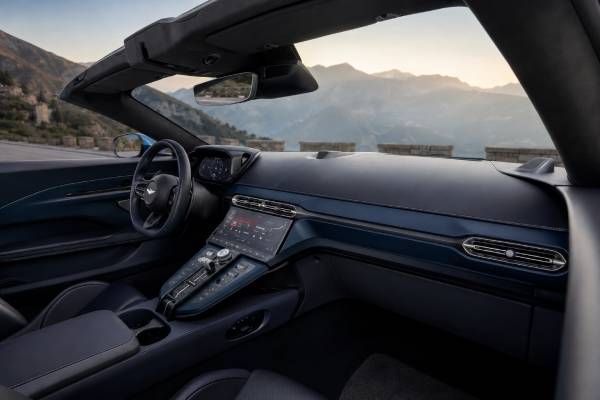
The Aston Martin Vantage S Roadster combines two demanding ideas: the sharper chassis philosophy of the 670 hp Vantage S and the lightweight 6.8-second roof of the current AM6 Roadster. Aston Martin confirmed the S for both coupe and Roadster bodies, giving the open car the 680 PS V8, S-specific throttle calibration, revised Bilstein DTX tuning, solid-mounted rear subframe, functional bonnet blades, and full-width rear spoiler.
The result is not simply the standard Roadster with another 15 PS. Direct rear-subframe mounting and altered geometry make wheel alignment and tire condition more important, while the folding roof adds its own structure, seals, drains, sensors, windows, and voltage demands. The body-specific official specification lists 1,805 kg EU kerb weight, 49:51 distribution, 0–100 km/h in 3.6 seconds, and a 202 mph maximum speed. This guide brings those Roadster values together with the S engineering package without substituting coupe-only weight or acceleration data.
Table of Contents
- How S focus and Roadster freedom coexist
- Vantage S Roadster specifications and technical data
- Applying S chassis tuning to an open body
- Roof packaging and S aerodynamics
- Road use, touring, and occasional track driving
- Preserving roof, cooling, brakes, and tires
- How to authenticate and inspect an S Roadster
How S focus and Roadster freedom coexist
The S Roadster is intended to preserve the open car’s flexibility while making its responses more immediate. The roof can disappear in 6.8 seconds, yet the chassis uses the S program’s direct rear-subframe mounting, revised dampers, altered spring-aid behavior, softer transmission mounts, and refined alignment.
That pairing creates a different objective from either related model. The standard Roadster emphasizes broad ability and top-down theater. The S Coupe pursues the lowest body mass and the most direct structural connection. The S Roadster sits between them: it accepts the convertible’s 60 kg body penalty and 49:51 mass distribution, then adds S control and aerodynamic detail without pretending it is the 1,745 kg coupe.
Power comes from the hand-built 3,982 cc twin-turbo V8 at 680 PS, equivalent to 670 bhp, and 800 Nm. The output is only modestly higher than the original 665 PS Roadster, but throttle response is tailored through pedal resistance and drive-mode-specific mapping. A driver can meter torque more precisely instead of receiving a large early response from small pedal travel.
The S suspension philosophy also avoids making the car uniformly harder. Aston Martin reduced rear spring-aid stiffness to improve compression and rebound at low speed and reduced transmission-mount stiffness by 10 percent to control vibration and powertrain movement. Those changes balance the solid rear-subframe connection, which otherwise could transmit more road texture into the open body.
Visual identity comes from central bonnet blades, hand-made fender badges, a full-width rear spoiler, and S interior details. The bonnet openings help remove heat from the hot-V engine bay. The spoiler contributes 44 kg of rear downforce at maximum speed, while front and underbody elements form the rest of the S aerodynamic package.
The S was announced in July 2025 with first deliveries expected in the fourth quarter. A car registered in 2025 or 2026 should still be verified by production date and VIN because market timing differs. A standard 680 PS Roadster and an S Roadster can share the same engine output; the S distinction rests in the complete chassis, aero, trim, and factory designation.
Technical data for the 670 hp S Roadster
The S Roadster is an ICE-only convertible with a front-mid-mounted V8, rear-mounted automatic transaxle, electronic differential, and rear-wheel drive. Its official Roadster body data include 1,805 kg EU kerb weight, 49:51 distribution, 21-inch wheels, 400/360 mm steel brakes, 12.3 L/100 km EU WLTP combined consumption, and a 3.6-second 0–100 km/h claim.
| Specification | Value | Notes |
|---|---|---|
| Engine | 3,982 cc twin-turbocharged V8 | All-alloy, front-mid-mounted |
| Engine family | M177-based | Hand-built with Aston Martin calibration |
| Compression ratio | 8.6:1 | Current Roadster specification |
| Induction cooling | Water-to-air charge cooling | Hot-V turbocharger layout |
| Maximum power | 670 bhp (507 kW / 680 PS) at 6,000 rpm | S output; regional regulation may alter power |
| Maximum torque | 800 Nm (590 lb-ft) | Official current output |
| Fuel tank | 73 liters (19.3 US gal) | Premium gasoline according to market guidance |
| Specification | Value | Condition |
|---|---|---|
| 0–100 km/h | 3.6 seconds | Official 680 PS Roadster body figure |
| Maximum speed | 325 km/h (202 mph) | Manufacturer claim |
| Transmission | Rear-mounted ZF eight-speed automatic | Automatic modes and steering-wheel paddles |
| Drive type | Rear-wheel drive | Electronic limited-slip differential |
| Final-drive ratio | 3.083:1 | Carbon-fiber propeller shaft in an alloy torque tube |
| Weight distribution | 49:51 front to rear | Roadster body specification |
| Specification | Value | Definition |
|---|---|---|
| Body style | Two-door, two-seat Roadster | Bonded aluminum structure with composite panels |
| Roof design | Powered Z-fold fabric roof | Compact 210 mm folded stack |
| Roof cycle | 6.8 seconds to open or close | Operable up to 50 km/h (31 mph) under approved conditions |
| EU kerb weight | 1,805 kg (3,979 lb) | Official EU definition |
| Length | 4,495 mm (177.0 in) | Including number-plate plinth |
| Width | 1,980 mm (78.0 in) excluding mirrors; 2,124 mm (83.6 in) including mirrors | Official dimensions |
| Wheelbase | 2,705 mm (106.5 in) | AM6 architecture |
| Ground clearance | 94 mm (3.7 in) | Low-body reference |
| Component | Specification |
|---|---|
| Front suspension | Double wishbones, coil springs, anti-roll bar, Bilstein DTX adaptive dampers |
| Rear suspension | Multi-link layout with S-specific adaptive calibration and reduced spring-aid stiffness |
| Rear subframe | Mounted directly to the body rather than through rubber isolation |
| Transmission mounts | 10 percent reduction in stiffness within the S package |
| Steering | Electric assistance, non-isolated column, 12.8:1 ratio |
| Front wheels and tires | 9.5J × 21; 275/35 ZR21 AML Michelin Pilot Sport S 5 |
| Rear wheels and tires | 11.5J × 21; 325/30 ZR21 AML Michelin Pilot Sport S 5 |
| System | Specification or effect |
|---|---|
| Standard front brakes | 400 × 36 mm two-piece steel discs, six-piston calipers |
| Standard rear brakes | 360 × 32 mm steel discs, four-piston calipers |
| Optional carbon-ceramic brakes | 410 mm front and 360 mm rear; approximately 27 kg less unsprung mass |
| Rear spoiler | 44 kg of added rear downforce at maximum speed |
| Front and underbody additions | Air dam, venturi vanes, and underbody work support S aerodynamic balance |
| Bonnet blades | Extract hot air from the engine bay |
| Specification | Value |
|---|---|
| EU WLTP combined consumption | 12.3 L/100 km (23.0 mpg imperial) |
| EU WLTP combined CO2 | 279 g/km |
| Central touchscreen | 10.25 inches, 1,970 × 720 pixels |
| Driver display | 10.25-inch TFT |
| Standard audio | 360 W, 11 speakers in current Roadster specification |
| Driver assistance | Includes AEB, adaptive cruise, blind-spot assistance, lane functions, and 360-degree camera where market fitted |
| S cabin identity | Model-specific Alcantara, leather, carbon trim, embroidery, badges, and control finishes |
Applying S chassis tuning to an open body
The central engineering question is how direct rear-subframe mounting interacts with a convertible structure. The solid connection improves axle location and feedback, while the Roadster’s shear panels, rear body attachment, and rollover system provide the stiffness needed to use that accuracy.
A coupe carries suspension loads through a closed roof ring. The Roadster redirects them through its floor, sills, bulkheads, rear structure, and added panels. Aston Martin developed the Roadster body and coupe in parallel, then applied S hardware and calibration as a complete derivative. That sequence is preferable to fitting solid mounts and stiffer software to an unrelated convertible after production.
Direct mounting makes the rear tires’ behavior easier to read. Under power, the electronic differential can build lock while the driver receives a clearer sense of load through the seat and steering. The tradeoff is that impacts and driveline motion have a more direct path into the body. Reduced transmission-mount stiffness and softer spring aids help the car absorb low-speed movement rather than shaking over every surface break.
The Roadster retains its 49:51 balance, placing slightly more static mass over the rear axle than the coupe. This supports traction but does not guarantee it. Tire temperature, surface texture, water, pressure, tread, and throttle rate still determine whether 800 Nm can be used. The S pedal map is valuable because a progressive foot movement can request torque precisely.
Alignment is especially sensitive. Camber, toe, and caster were refined for S response, and the open body has its own mass distribution. A workshop should use the exact S Roadster targets when available rather than selecting a generic AM6 Vantage entry. An off-center wheel, changing pull, excessive tramlining, or unequal inner-shoulder wear is a reason to measure all four corners.
The Bilstein DTX dampers should create an obvious but coherent range between modes. On a rough road, the most compliant setting often gives better traction and fewer body disturbances. A firmer mode suits smooth, fast transitions. A car that crashes in every mode, bounces after one compression, or knocks over small inputs needs inspection for tire pressure, wheel damage, damper faults, joints, mounts, or underbody contact.
Where the roof and aerodynamics meet
The Roadster’s roof and the S aero package influence different speed ranges but share one requirement: every moving or airflow-critical part must remain correctly aligned. Roof misadjustment causes sealing problems at normal speeds, while damaged aero components can change stability as speed rises.
The Z-fold top compacts to a 210 mm stack and needs no separate tonneau panel. It opens or closes in 6.8 seconds and can operate at up to 31 mph. Those figures make it practical during changing weather, yet operation should occur on a reasonably smooth surface with stable voltage and a clear storage area.
Side windows drop and rise to clear the fabric seals. Door glass alignment must be checked with the top raised and lowered. A window that catches, leaves a gap, or needs manual pressure can damage seals and create wind noise. Because the body is firmer than a traditional convertible, persistent misalignment is more likely a service issue than an unavoidable flex characteristic.
The S rear spoiler changes the tail visually and aerodynamically. It adds 44 kg of rear load at maximum speed and must be securely attached to the correct deck structure. A spoiler added to a standard Roadster can look convincing but does not create an authentic S and may lack the matched front and underbody pieces.
The bonnet blades are equally functional. They allow hot air to leave the engine bay, reducing pressure and helping thermal management. Paint film, mesh, detailing products, leaves, or workshop covers must not block their channels. Water entering a designed vent is managed through factory drainage; improvised sealing can trap heat or redirect water incorrectly.
Underbody vanes and the front air dam operate close to the road. The Roadster’s 94 mm clearance makes steep ramps, ferry decks, parking curbs, and lifting equipment real risks. Inspect these parts after any contact. Missing fasteners can cause a panel to flutter, scrape, or separate at speed.
Roof-down airflow is part of comfort rather than downforce. Raising the windows and using the wind deflector reduces turbulence around the seats. Long high-speed exposure can still fatigue hearing, so roof-down touring is often more pleasant at moderate pace. The S supplies enough sound and response that enjoyment does not depend on extreme speed.
Road use, touring, and occasional track driving
The S Roadster’s strongest quality is range. It can operate as a quiet, insulated two-seat tourer with the roof up, then expose the V8 and sharpen its control settings on a clear road. Track ability is available, but it should not dominate every setup choice.
The 3.6-second 0–100 km/h figure is slightly slower than the S Coupe because of body mass and traction calibration. In ordinary use the difference is negligible. The 800 Nm torque output makes overtaking response immediate, while the rear transaxle helps keep the nose from feeling engine-heavy.
Steel brakes are likely the best choice for many Roadster owners. They work predictably from cold, tolerate mixed weather, and are easier to budget for. Carbon ceramics remove 27 kg of unsprung mass and improve repeated high-temperature capability, which sharpens steering and ride as well as braking. Their replacement cost and inspection needs are the tradeoff.
Touring requires attention to luggage and weather. Pack soft bags that cannot interfere with the roof stack. Carry suitable fabric-cleaning and drying materials rather than folding a contaminated top. Plan premium-fuel stops, especially in remote areas, because enthusiastic use can reduce the range implied by the 73-liter tank.
The cabin’s two 10.25-inch displays, connected navigation, smartphone integration, cameras, and driver aids make long trips easier. They also depend on software, subscriptions, account transfer, and stable battery voltage. Download destinations and update services before a remote trip rather than assuming mobile coverage will remain constant.
On track, begin with instruction and full electronic support. Adjustable traction systems and a powerful rear-driven car can encourage overconfidence. Tire pressure should be monitored as temperature rises, and the car needs cooling laps. Inspect brakes, wheel fasteners, tire shoulders, fluids, undertrays, and roof latching before driving home.
A Roadster is not a race car simply because it has S calibration. Circuit operators may require additional rollover or helmet rules, insurance may exclude timed use, and warranty terms can depend on event type. The safest approach is a noncompetitive driver-training day with a roadworthy, fully serviced car.
Preserving roof, cooling, brakes, and tires
This model needs one integrated maintenance plan rather than separate attention to engine and roof. Heat, low voltage, tire condition, alignment, water management, and underbody damage can influence several systems at once.
Follow the VIN-specific Aston Martin schedule for oil, filters, brake fluid, inspections, and software. Do not import oil grade or quantity from another M177-powered Vantage. Different output, cooling, sump, calibration, and model-year revisions can change the approved service data. Confirm the final oil level through the official electronic procedure.
Keep the cooling path clean. Inspect the main grille, side inlets, radiator faces, oil cooler, charge-cooler circuit, bonnet blades, and underbody ducts. Remove debris without bending fins or pushing contamination between stacked coolers. Investigate coolant staining, unusual fan behavior, odor, or reduced-power messages promptly.
Battery maintenance protects the roof and the vehicle network. Use an approved smart maintainer during storage, connected at the specified points. A slow roof, lost window indexing, app disconnection, or several unrelated warnings can begin with weak voltage. Test the battery and charging system before replacing multiple modules.
Treat the fabric roof gently. Remove loose dust before washing, use a convertible-top cleaner, rinse at low pressure, and let the material dry before prolonged folding. Inspect stitching and repeated fold points. Keep drain channels clear through the approved method and document any seal, motor, sensor, or calibration work.
Tire inspection should include production dates, AML markings, puncture history, rim condition, and tread at several points. S geometry can place meaningful load on inner shoulders. Heat-cycled track tires may lose grip while retaining legal tread. Replace axle pairs with matching specification and obtain a precise alignment after installation.
Steel brake records should list pad thickness, disc thickness, runout, and condition. Ceramic records should follow factory criteria and note any wheel-removal precautions. Brake fluid absorbs moisture with time, so a low-mileage car still needs scheduled replacement. Track use justifies more frequent checks.
Inspect the solid rear-subframe mountings and related fasteners after impact or repeated track use. New vibration, clicking, or movement should be diagnosed rather than accepted as “normal for an S.” Also inspect softer transmission mounts, rear spring aids, dampers, undertrays, and spoiler hardware.
Storage should be dry and ventilated. Avoid repeated short engine starts that never warm the oil and exhaust. A complete drive that heats the engine, transmission, differential, brakes, and tires is more useful, followed by an easy cool-down. Keep invoices, diagnostic reports, alignment sheets, roof records, and original parts together.
How to authenticate and inspect an S Roadster
Authentication begins with the factory build record because a standard current Roadster can share the 680 PS output. The S Roadster should be identified by VIN as the S derivative and show the complete factory chassis, aerodynamic, interior, and software specification.
Compare the build sheet with the hand-made fender badges, bonnet blades, full-width spoiler, cabin embroidery, tread plates, engine-bay inspection plaque, wheels, brake type, seats, roof color, carbon content, and Q options. A collection of S-looking parts does not prove that the solid-mounted subframe, damper calibration, geometry, and powertrain software are present.
The roof inspection should happen before and after the road test. Start with a charged battery, operate the top from the cabin, observe remote operation if fitted, and watch the windows, latch, fabric folds, and rear deck. Check carpets, storage areas, seals, and electrical connections for dampness or staining. Test water management with an appropriate low-pressure method.
A specialist should then inspect these S-specific areas:
- Rear structure: Confirm direct subframe mounting, correct fasteners, no collision distortion, and no unexplained contact or movement.
- Aerodynamics: Check spoiler mounting, front air dam, venturi vanes, undertrays, bonnet drains, and vent openings.
- Geometry: Obtain a four-wheel measurement using the correct S Roadster targets and compare tire wear with the results.
- Brakes: Measure steel or ceramic components and price remaining life realistically.
- Cooling: Inspect all heat exchangers, hoses, reservoirs, ducts, and evidence of overheating or leakage.
- Electronics: Scan every module for stored, pending, and recently cleared faults, including roof, window, differential, damper, active-safety, and infotainment systems.
Road-test the car from cold. The engine should settle cleanly, Drive and Reverse should engage without excessive delay, and the gearbox should shift smoothly in normal mode. Steering should center, braking should remain straight, and damper modes should feel distinct. Listen for roof rattles over diagonal bumps and drivetrain noise under gentle load.
Track history is not automatically negative. Look for tire heat cycles, brake-fluid changes, rubber deposits, wheel-barrel marks, tow-eye use, and event photographs. A documented car that received pre- and post-event service can be a better purchase than one whose use is denied despite clear evidence.
Confirm recall and campaign completion by VIN through an Aston Martin retailer and the relevant public database. Verify warranty, connected-service transfer, both keys, app release, manuals, roof tools or accessories, battery maintainer, and original removed parts.
The right S Roadster is therefore not merely the loudest or most optioned example. It is the car whose S identity is proven, whose roof is dry and precise, whose alignment and tires preserve the chassis calibration, and whose maintenance shows that open-air enjoyment has not come at the expense of mechanical discipline.
References
- Aston Martin Vantage S: The peak of sports car performance 2025
- Vantage S | Aston Martin 2026 (Model Overview)
- Vantage Roadster | Aston Martin 2026 (Roadster Specifications)
- Vantage S Brochure | Aston Martin 2026 (Brochure)
- Owner’s Guides | Car Ownership | Aston Martin (UK) | Aston Martin UK 2026 (Owner’s Guides)
- Check for Recalls: Vehicle, Car Seat, Tire, Equipment | NHTSA 2026 (Recall Database)
Disclaimer
This guide is for informational purposes and does not replace professional diagnosis, maintenance, or repair. Specifications, power figures, torque settings, alignment values, service intervals, roof procedures, and campaign status can vary by VIN, market, production date, and equipment; verify all important details in current official documentation for the exact car.
Please share this article on Facebook, X/Twitter, or a relevant Aston Martin group if it helped clarify the Vantage S Roadster and you would like to support more detailed vehicle guides.