


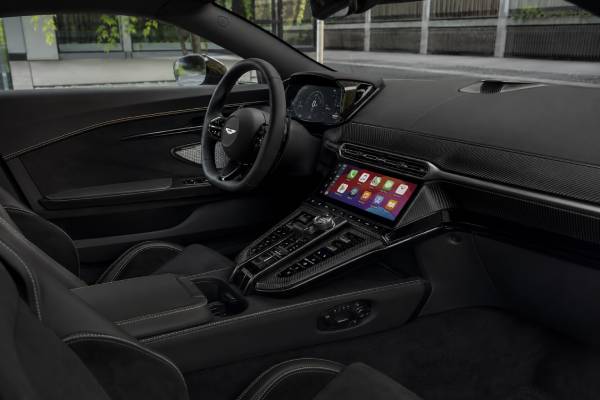
The Aston Martin Vantage S sharpens the redesigned AM6 coupe through small, connected changes rather than one oversized power increase. Its hand-built 4.0-liter twin-turbo V8 produces 680 PS, or 670 bhp, while revised launch control cuts the 0–60 mph claim to 3.3 seconds. More important, the S directly mounts the rear subframe, recalibrates its Bilstein DTX dampers, softens the transmission mounts, adjusts suspension geometry, and adds functional aerodynamic parts.
That combination gives the S a clearer identity than a badge-and-trim package. The full-width rear spoiler contributes to 111 kg of total downforce at maximum speed, the bonnet blades help extract heat, and the throttle pedal has its own resistance and mapping. Yet the car retains steel brakes, adaptive suspension, a luxurious two-seat cabin, and everyday connected technology as standard. This guide explains where the S differs, how its options alter weight and behavior, and what owners should inspect if road or track use has tested its consumables.
Table of Contents
- What the S badge changes
- Vantage S Coupe specifications and technical data
- Subframe, dampers, mounts, and geometry
- Functional aerodynamics and lightweight options
- Performance use on road and track
- Maintenance for a harder-driven Vantage
- Authenticity, options, and buying decisions
What the S badge changes
The Vantage S is the performance-focused coupe in the current Vantage range, but its purpose is response and connection rather than a dramatic new engine. Power rises to 680 PS at 6,000 rpm while torque remains 800 Nm, and Aston Martin combines that output with detailed revisions to the accelerator, launch control, rear structure, suspension, powertrain mounting, alignment, and aerodynamics.
The S suffix has a long Aston Martin history, but buyers should judge this car by its hardware. The throttle pedal uses resistance matched to an S-specific drive-by-wire map. The engine and gearbox software sharpen response. Launch Control improves the claimed 0–60 mph time by one tenth to 3.3 seconds, while 0–62 mph takes 3.4 seconds and 0–124 mph takes 10.1 seconds. Maximum speed remains 202 mph.
Chassis revisions are more extensive than the power increase suggests. The rear subframe is bolted directly to the body instead of being isolated through rubber bushes. That creates a firmer path for suspension loads and steering feedback. Bilstein DTX hardware and software are retuned, rear spring-aid stiffness is reduced, and transmission-mount stiffness falls by 10 percent. The last two changes prevent directness from turning into brittle ride or excessive powertrain vibration.
Camber, toe, and caster settings were also refined to improve front-end grip and response under high lateral loads. These alignment values work with the 275-section front and 325-section rear Michelin Pilot Sport S 5 tires. A generic alignment can therefore remove some of the precision that distinguishes the S even when all measurements appear “within Vantage range.”
Exterior identifiers have functional roles. Two central bonnet blades extract heat from the hot-V engine bay. A full-width deck-lid spoiler adds 44 kg of rear downforce at maximum speed, while a front air dam, venturi vanes, and underbody work contribute another 67 kg. Total claimed downforce is 111 kg at maximum speed, with the balance intentionally biased forward for turn-in response.
The cabin receives an Accelerate interior in Alcantara and leather, satin twill-carbon inlays, embroidered S logos, and model-specific tread plates and inspection plaque. Optional red or silver anodized controls can coordinate with belts, stitching, welt, and embroidery. These details help identify a correctly specified car, but a factory build sheet remains the reliable proof.
Technical data for the 670 hp Vantage S Coupe
The Vantage S Coupe is an ICE-only, front-mid-engine, rear-wheel-drive sports car. Its 3,982 cc twin-turbo V8 sends 670 bhp through a rear-mounted ZF eight-speed automatic and electronic differential. Standard 21-inch forged wheels, AML-specific Michelin tires, adaptive dampers, and large steel brakes form the baseline; carbon-ceramic brakes and other lightweight parts are optional.
| Specification | Value | Notes |
|---|---|---|
| Engine | 3,982 cc all-alloy twin-turbocharged V8 | Front-mid-mounted, quad-cam |
| Engine family | M177-based | Hand-built with Aston Martin calibration |
| Compression ratio | 8.6:1 | Current official specification |
| Charge cooling | Water-to-air | Hot-V turbo layout |
| Maximum power | 670 bhp (507 kW / 680 PS) at 6,000 rpm | China output may differ by regulation |
| Maximum torque | 800 Nm (590 lb-ft) | Launch release states 3,000–6,000 rpm |
| Fuel tank | 73 liters (19.3 US gal) | Premium unleaded according to market guidance |
| Specification | Value | Condition |
|---|---|---|
| 0–60 mph | 3.3 seconds | Manufacturer claim with optimized launch control |
| 0–100 km/h | 3.4 seconds | Manufacturer claim |
| 0–200 km/h | 10.1 seconds | Manufacturer claim |
| Maximum speed | 325 km/h (202 mph) | Manufacturer claim |
| Transmission | Rear-mounted ZF eight-speed automatic | Paddle control and automatic modes |
| Differential | Electronic limited-slip differential | Integrated with active vehicle dynamics |
| Final-drive ratio | 3.083:1 | Carbon-fiber propeller shaft in alloy torque tube |
| Component | Specification |
|---|---|
| Front suspension | Independent double wishbones, coil springs, anti-roll bar, adaptive damping |
| Rear suspension | Multi-link layout, coil springs, anti-roll bar, adaptive damping |
| Rear subframe | Solid-mounted directly to the body |
| Transmission mounts | 10 percent less stiff than the standard calibration used as the S development baseline |
| Dampers | Bilstein DTX adaptive system with S-specific hardware and software tuning |
| Steering ratio | 12.8:1 |
| Steering travel | 2.27 turns lock to lock |
| Component | Front | Rear |
|---|---|---|
| Standard wheels | 9.5J × 21 forged alloy | 11.5J × 21 forged alloy |
| Tires | 275/35 ZR21 Michelin Pilot Sport S 5, AML specification | 325/30 ZR21 Michelin Pilot Sport S 5, AML specification |
| Standard brakes | 400 × 36 mm two-piece steel discs, six-piston calipers | 360 × 32 mm steel discs, four-piston calipers |
| Optional carbon ceramics | 410 mm carbon-ceramic discs | 360 mm carbon-ceramic discs |
| CCB benefit | Approximately 27 kg less unsprung mass than the steel system | |
| Specification | Value | Definition |
|---|---|---|
| Length | 4,495 mm (177.0 in) | Including number-plate plinth |
| Width | 1,980 mm (78.0 in) excluding mirrors; 2,124 mm (83.6 in) including mirrors | Official dimensions |
| Height | 1,275 mm (50.2 in) | Coupe body |
| Wheelbase | 2,705 mm (106.5 in) | AM6 platform |
| Ground clearance | 94 mm (3.7 in) | Low-body reference |
| EU kerb weight | 1,745 kg (3,847 lb) | Official EU definition |
| Weight distribution | 50:50 front to rear | Manufacturer figure |
| EU WLTP combined | 12.1 L/100 km (23.3 mpg imperial) | 274 g/km CO2 |
| Feature | Verified effect |
|---|---|
| Full-width rear spoiler | Adds 44 kg of rear downforce at maximum speed |
| Front air dam, venturi vanes, and underbody work | Contribute 67 kg of additional downforce at maximum speed |
| Total downforce | 111 kg at maximum speed |
| Bonnet blades | Improve extraction of hot air from the engine bay |
| Standard interior | Accelerate leather and Alcantara with satin 2×2 twill-carbon inlays |
| Lightweight option strategy | Carbon roof, carbon-ceramic brakes, and performance seats can improve power-to-weight ratio |
Why the solid-mounted rear matters
Directly mounting the rear subframe changes the path between tire, suspension, body, and driver. Rubber bushes normally filter vibration and small impacts before they reach the shell. Removing that isolation makes rear-axle reactions more immediate and repeatable, especially during turn-in, power application, and rapid direction changes.
A solid mount can also expose harshness if the rest of the car is not retuned. Aston Martin balanced it by reducing transmission-mount stiffness by 10 percent and softening the rear spring aid. The transmission can move in a more controlled way relative to the body, while the spring aid improves compression and rebound behavior at lower speed. This is a good example of why individual S parts should not be copied onto a standard car without the full calibration.
The Bilstein DTX dampers received hardware and software changes intended to increase front-end feel and response. Damping force is continuously managed within the selected drive mode, so the system can support the body during a quick input and release force over a rough surface. The firmest mode is not automatically best on a bumpy road; a more compliant setting can keep the tire loaded and preserve steering confidence.
Alignment refinements complete the package. Camber affects how the tire presents its tread under cornering load. Toe shapes straight-line stability and initial response. Caster contributes to steering weight, self-centering, and camber gain as the wheel turns. Small changes to all three can make the S feel more alert without installing radically harder springs.
Those settings increase the importance of measurement. A curb strike, pothole, wheel repair, or careless tire-shop adjustment can remove the intended balance. Ask for a four-wheel printout using S-specific targets, and compare left-to-right values. “Green boxes” on a generic machine do not prove that the car matches factory performance geometry.
The throttle pedal is another control surface, not simply an on-off request for torque. Aston Martin altered both resistance and electronic mapping by drive mode. A heavier, more progressive pedal helps a driver meter 800 Nm when the rear tires are near their grip limit. An aftermarket pedal box or tune can defeat that work, produce an artificial early surge, and complicate stability calibration.
How the S aero package works
The S aerodynamic package is intended to improve balance and high-speed confidence, not just appearance. The rear spoiler supplies 44 kg of load at maximum speed, while the front and underbody elements add 67 kg, bringing the total to 111 kg.
That total remains biased toward the front to preserve the sharp turn-in Aston Martin wanted. Adding a larger aftermarket rear wing without matching front work can move the center of pressure rearward, making the nose feel light at speed. Removing the factory spoiler can reduce rear stability and change the appearance of a model whose aero hardware is part of its identity.
The bonnet blades sit near the center of the hood and help hot air leave the engine bay. Because the turbochargers are positioned within the V of the engine, heat extraction is valuable during slow traffic, hot ambient conditions, and repeated high-load use. Film installers and body shops must preserve the full vent area and drainage path.
Underbody components are easy to overlook. The front air dam and venturi vanes work close to the road, where they can be damaged by steep ramps, debris, or incorrect lifting. A scraped lower edge may be cosmetic, but a cracked mounting point, missing vane, distorted undertray, or loose fastener can reduce aerodynamic function and create noise.
Lightweight options affect the car differently from aerodynamic parts. Carbon-ceramic brakes reduce unsprung and rotating mass. A carbon roof lowers mass high in the body. Carbon performance seats remove weight from the cabin. Aston Martin states that a lightest suitable option combination can improve power-to-weight to about 399 PS per metric ton. That figure does not apply to every S.
A well-equipped luxury car with steel brakes and powered seats is still a proper Vantage S. Buyers should choose options around use. Steel brakes are often easier for year-round road driving and less financially risky. Carbon ceramics and light seats make more sense when steering response, repeated heat capacity, and track work matter enough to justify cost and inspection.
Using the S without confusing speed with skill
The Vantage S is approachable for its output, but 670 bhp through the rear wheels still demands temperature, space, and progressive inputs. Its electronics can manage slip quickly; they cannot create grip on cold, worn, standing-water-covered, or contaminated tires.
Launch Control coordinates engine torque, gearbox, differential, and stability functions. The 3.3-second claim assumes a suitable surface and correct procedure. Repeated launches add heat and load to rear tires, driveshafts, mounts, differential clutches, and transmission fluid. They should be occasional demonstrations, not a routine traffic-light habit.
On a fast road, the S’s greatest advantage is precision. The solid-mounted rear, revised geometry, and accelerator mapping let the driver make smaller corrections. The car rotates cleanly when load is transferred smoothly and uses the electronic differential to build traction on exit. Abrupt steering followed by sudden full throttle can still unbalance it.
Adaptive modes should be selected for the surface. A soft damper setting can improve mechanical grip over patched pavement. Track mode is most useful on a smooth circuit where roll and pitch control matter more than impact absorption. Stability and traction settings should remain conservative until the driver understands the car and tire behavior.
On track, begin with a technical inspection and instruction. Set cold pressures based on the approved starting guidance, then monitor hot pressure rather than chasing one fixed number. Check brake-fluid condition, pad depth, rotor state, wheel fasteners, tire wear, and fluid leaks. Complete cooling laps and inspect the car before driving home.
The standard steel system is capable, but heavy track use can consume pads and discs quickly. Carbon ceramics resist repeated high temperatures better and reduce unsprung mass, yet they are not indestructible. Gravel impact, incorrect wheel handling, or use beyond limits can damage a rotor. Track insurance and warranty terms should be understood in advance.
Road legality matters too. Exhaust modifications, number-plate positioning, window tint, tire choice, and track-derived aero can conflict with local requirements. A quieter, factory-correct S with a complete history often holds broader appeal than a heavily modified car whose performance gains cannot be verified.
Maintenance for a harder-driven Vantage
The S should be serviced according to its VIN-specific factory schedule, then inspected more often when track use, repeated high-speed driving, heat, dust, or short trips increase stress. The badge does not automatically shorten every interval, but use conditions can.
Engine-oil grade and quantity must come from current S documentation. Do not assume that figures for the 503 hp, 656 hp, or another M177 installation are interchangeable. Correct oil protects turbocharger bearings, cam systems, and high-temperature surfaces, while accurate electronic level checking prevents both starvation and overfill.
Cooling airflow is a recurring priority. Clean the grille, side openings, bonnet blades, and heat exchangers without bending fins or forcing debris between cooler layers. Inspect the underbody ducts and air dam after contact. A coolant odor, residue, recurrent fan operation, or power reduction under load requires diagnosis.
Tire records are especially useful on an S. Note installation date, mileage, alignment, rotations where permitted, puncture history, and track heat cycles. The front and rear sizes cannot be rotated axle to axle. Measure inner, center, and outer tread, because performance geometry can wear shoulders differently.
A workshop should inspect solid rear-subframe mountings, transmission mounts, dampers, joints, and fasteners after hard use or an impact. Direct mounting improves feel but also transmits load with less isolation. New noises should not be dismissed as part of the S character until mounting torque, contact points, and underbody components have been checked.
Brake maintenance depends on specification. For steel brakes, record pad thickness, disc thickness, runout, cracks, and surface condition. For ceramics, follow Aston Martin’s inspection criteria and protect discs during wheel removal. Brake fluid should be replaced on time and more often where high temperatures justify it.
Battery support and software health remain important. The car’s electronic differential, dampers, active safety systems, connected infotainment, cameras, and many control modules depend on stable voltage and current software. Use an approved maintainer during storage, scan the full vehicle network at service, and verify campaign completion by VIN.
After a circuit day, do not merely wash the body. Remove rubber and debris from vulnerable areas, inspect wheel wells and undertrays, check fluid leakage, examine tire shoulders, and record brake condition. A transparent log makes future diagnosis easier and supports resale better than hiding legitimate use.
How to authenticate and choose a Vantage S
A genuine S is identified through factory data, not only bonnet vents, spoiler, or badges. Obtain the VIN-linked build sheet and confirm model designation, engine output, production date, market, interior, wheels, brakes, roof material, seats, and Q options.
Inspect the hand-made fender badges, embroidered logos, tread plates, and engine-bay inspection plaque, but treat them as supporting details. Cosmetic S parts can be fitted to another Vantage. The software calibration, solid-mounted rear subframe, model-specific suspension specification, aero components, and factory record are more meaningful.
A pre-purchase inspection should answer several direct questions:
- Does the engine start cold without smoke, abnormal noise, or persistent warnings?
- Are the radiators, bonnet outlets, front air dam, venturi vanes, undertrays, and spoiler complete and undamaged?
- Do all four tires match the approved specification, have suitable age, and wear consistently with correct alignment?
- Are steel or carbon-ceramic brakes measured rather than described as “good” by appearance?
- Does the gearbox engage smoothly, and does the electronic differential remain free of warnings or binding behavior?
- Do the dampers change character correctly, without leakage, knocks, or inconsistent control?
- Does a full diagnostic scan show stored, pending, or recently cleared faults?
Look for evidence of track use without assuming it is abuse. Rubber deposits, heat-marked wheel barrels, frequent tire purchases, upgraded brake fluid, tow-hook marks, or track photographs can reveal use. Good preparation, cooling practice, and post-event service are positive. Hidden track history, overheated components, and no records are not.
Inspect paint and carbon carefully. The low front aero and 94 mm ground clearance make splitter and underbody contact likely. Paint-protection film can conceal chips or age-related discoloration. Check panel gaps, paint depth, vent edges, spoiler mounting, wheel rims, and bonded aluminum areas for repair.
Test the modern cabin completely. Confirm app and account transfer, navigation, connectivity, both keys, cameras, parking sensors, climate control, seat functions, audio, displays, active-safety controls, and physical switches. The standard Accelerate interior can wear at bolsters and Alcantara touch points, especially in cars used frequently.
Finally, compare options with intended use. A carbon roof, ceramics, and performance seats create the sharpest and lightest configuration. Steel brakes and adjustable comfort seats may make a better road car. The most valuable decision is not choosing every performance option; it is choosing a documented, correctly aligned, mechanically fresh S whose configuration matches how it will actually be driven.
References
- Aston Martin Vantage S: The peak of sports car performance 2025
- Vantage S | Aston Martin 2026 (Model Overview)
- Vantage S Brochure | Aston Martin 2026 (Brochure)
- Vantage Quick Start Guide | Aston Martin USA 2026 (Quick Start Guide)
- Aston Martin Luxury Car Servicing | Aston Martin (UK) | Aston Martin UK 2026 (Servicing)
- Check for Recalls: Vehicle, Car Seat, Tire, Equipment | NHTSA 2026 (Recall Database)
Disclaimer
This article is for informational use and is not a replacement for professional inspection, diagnosis, servicing, or repair. Specifications, power, torque values, alignments, intervals, software, and procedures can vary by VIN, market, production date, and equipment; verify the individual car against current official service documentation.
If this Vantage S guide was valuable, please share it through Facebook, X/Twitter, or a suitable performance-car community to support further independent automotive reference work.