
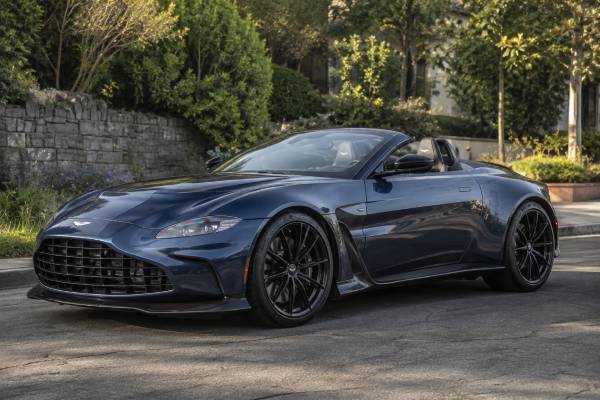
The 2023 Aston Martin V12 Vantage Roadster is a 249-car farewell built around a simple but extraordinary idea: expose the sound and force of Aston Martin’s 690 hp twin-turbo V12 in the compact AM6 Vantage without reducing it to a showpiece. It keeps the coupe’s wide body, carbon-ceramic brakes, rear transaxle, mechanical limited-slip differential, and 200 mph claim, then adds a fabric roof that can disappear in 6.7 seconds.
That combination makes the Roadster rarer than the 333-unit coupe and mechanically more demanding than a normal V8 convertible. Its roof, extra bracing, model-specific damper tune, carbon bodywork, enormous ceramic brakes, and heat-loaded V12 all deserve careful inspection. The factory rear wing was optional rather than standard, which also means two correct cars can look very different. This guide separates the Roadster from the coupe, explains the exact specifications, and gives owners and buyers a practical method for preserving one of Aston Martin’s most unusual open cars.
Table of Contents
- The meaning of the 249-car Roadster
- V12 Roadster specifications and technical data
- Roof packaging and structural engineering
- Open-air performance, aerodynamics, and braking
- A sensible ownership routine
- Roadster-specific inspection priorities
- Buying, provenance, and long-term value
What makes the 249-car Roadster distinct
The Roadster is a separate limited-production model, not a coupe allocation converted after the fact. Aston Martin announced 249 examples and described it as the final V12 Vantage Roadster of this bloodline, with first deliveries scheduled for late 2022 and most cars identified as 2023 models.
Its rarity is only the beginning. The fabric roof removes the upper structure that helps a coupe resist twisting. The Roadster also carries the heaviest and most powerful AM6 Vantage engine, wide tires, major aerodynamic loads, and brakes capable of repeated high-energy stops. The engineering task was therefore to maintain steering precision and body control while preserving the ease and theater expected from a convertible.
Aston Martin retained the 5.2-liter twin-turbo V12, eight-speed rear transaxle, and mechanical limited-slip differential used by the coupe. It also kept the 40 mm-wider body, carbon-rich exterior, central twin exhausts, and 21-inch wheel package. The Roadster received a bespoke adaptive-damper tune to account for its body structure and weight distribution.
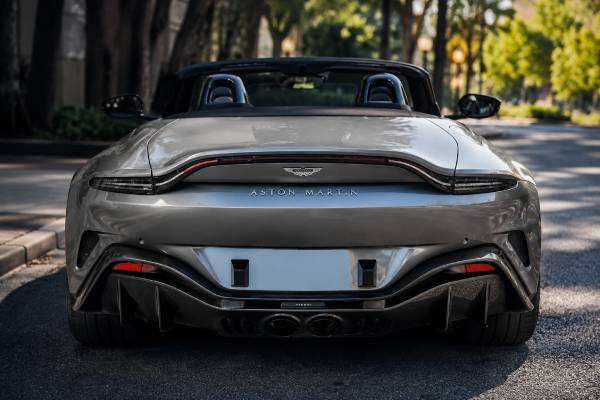
The visual difference at the rear is important. The coupe normally carried a large fixed wing, with deletion available by request. On the Roadster, the prominent wing was optional. The standard open car relied on its front splitter, flat-floor treatment, rear diffuser, and body shape, while the optional aero package raised claimed downforce to 216 kg at 200 mph. A wingless Roadster is therefore not incomplete. A winged example should have factory documentation, correct mounting, and evidence that the deck structure has not been altered carelessly.
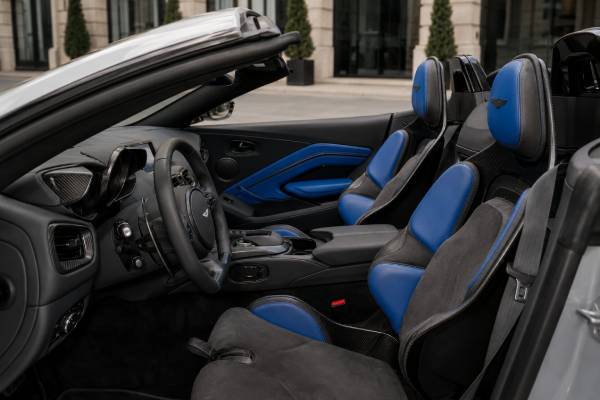
The cabin also carries model-specific identifiers, including sill plaques that refer to the 249-car production run and a V12 emblem near the start control. Standard Sports Plus seats could be replaced by carbon-fiber performance seats that saved about 7.3 kg. Trim, stitching, paint, exposed carbon, and Q by Aston Martin commissions create considerable variety, so authenticity is established through the VIN and original build record rather than by expecting every car to look alike.
The Roadster is often described as a collector car, but its systems benefit from use. Roof seals, hydraulic or electric mechanisms, tires, battery, brakes, fluids, and climate control all deteriorate when ignored. The best examples are not necessarily those with the fewest miles; they are the cars whose limited mileage is supported by regular servicing, controlled storage, complete records, and periodic full-temperature drives.
Specifications for the 690 hp open Vantage
This is an ICE-only, rear-wheel-drive convertible. The 5,204 cc V12 sits in a front-mid position, while the ZF eight-speed automatic and mechanical limited-slip differential are grouped at the rear. Aston Martin quotes 700 PS, equivalent to 690 bhp, 753 Nm in the launch material, 0–60 mph in 3.5 seconds, and a 200 mph maximum speed.
| Specification | Value | Notes |
|---|---|---|
| Engine family | AE31 twin-turbocharged V12 | Front-mid-mounted |
| Displacement | 5,204 cc (5.2 liters) | All-alloy, 48-valve, quad-cam |
| Bore × stroke | 89.0 × 69.7 mm | Official technical data |
| Compression ratio | 9.3:1 | Direct gasoline injection |
| Maximum power | 690 bhp (515 kW / 700 PS) at 6,500 rpm | Roadster output |
| Maximum torque | 753 Nm (555 lb-ft) | Launch specification |
| Fuel tank | 73 liters (19.3 US gal) | 98 RON premium fuel recommended |
| Specification | Value |
|---|---|
| Transmission | ZF eight-speed automatic transaxle |
| Drive type | Rear-wheel drive |
| Differential | Mechanical limited-slip differential |
| Final-drive ratio | 2.93:1 |
| Propeller shaft | Carbon-fiber shaft within an aluminum torque tube |
| Driver selection | Automatic modes and steering-wheel paddle control |
| Measure | Value | Manufacturer condition |
|---|---|---|
| 0–60 mph | 3.5 seconds | Launch claim |
| 0–100 km/h | 3.6 seconds | Technical-sheet value |
| Maximum speed | 322 km/h (200 mph) | Manufacturer claim |
| Power-to-weight ratio | 372 PS per metric ton | Manufacturer lightweight specification |
| Roof opening time | 6.7 seconds | Powered Z-fold roof |
| Roof operation speed | Up to 50 km/h (31 mph) | Start or continue only under approved conditions |
| Optional-aero downforce | 216 kg at maximum speed | With optional rear wing |
| Component | Specification |
|---|---|
| Front suspension | Unequal-length double wishbones, adaptive dampers, coil springs |
| Rear suspension | Multi-link layout, adaptive dampers, coil springs |
| Front brakes | 410 mm carbon-ceramic discs, six-piston calipers |
| Rear brakes | 360 mm carbon-ceramic discs, four-piston calipers |
| Front wheels and tires | 9.5J × 21 wheels; 275/35 ZR21 tires |
| Rear wheels and tires | 11.5J × 21 wheels; 315/30 ZR21 tires |
| Standard cold pressure | 2.2 bar (32 psi) |
| Steering | 13:1 ratio; 2.27 turns lock to lock |
| Specification | Value | Definition |
|---|---|---|
| Body type | Two-door, two-seat convertible | Bonded aluminum base structure |
| Track and body width change | 40 mm wider than the standard V8 Vantage | Model-specific front and rear package |
| Kerb weight | 1,855 kg (4,090 lb) | Official technical-sheet figure |
| Gross vehicle weight | 2,140 kg (4,718 lb) | Maximum permitted mass |
| Luggage volume | 200 liters (7.1 cu ft) | Includes visible rear-tower brace |
| Turning circle | 12.0 m (39.4 ft) | Kerb-to-kerb reference |
| Item | Specification | Ownership significance |
|---|---|---|
| Engine oil | SAE 0W-20 | Use only the current VIN-approved product |
| Oil and filter quantity | 10.79 liters (11.4 US qt) | Official service reference; final level requires the prescribed procedure |
| Coolant reference | 29.7 liters (31.4 US qt) | Multi-circuit system requires correct filling and bleeding |
| 12-volt battery | 70 Ah, 760 A | Smart maintenance charging is valuable in storage |
| Fuel compatibility | Maximum E10 ethanol content | Minimum 95 RON; 98 RON recommended |
How the roof and body work together
The Z-fold fabric roof is fast, shallow, and space-efficient, but its surrounding structure is what allows the V12 Roadster to remain a serious performance car. The roof stack sits behind the seats, while additional bracing manages loads that a coupe would pass through its fixed upper body.
Aston Martin added shear panels at the front and rear, reinforced the fuel-tank area, and installed a brace between the rear suspension towers. That brace is visible across the luggage compartment and leaves a 200-liter boot beneath and around it. It is not decorative and should not be removed, drilled, painted carelessly, or used as an attachment point for luggage.
The Roadster’s official kerb figure is 1,855 kg, 60 kg above the coupe’s corresponding technical-sheet value. That difference includes the powered roof mechanism and structural additions. It also changes the power-to-weight ratio from the coupe’s quoted 390 PS per ton to 372 PS per ton in the Roadster’s lightweight specification. On the road, however, the engine’s broad torque makes the difference less obvious than the numbers suggest.
Roof operation should look effortless. The front latch must release and engage cleanly, the fabric should fold symmetrically, the side windows should drop and reseal in the intended sequence, and the system should complete its cycle without hesitation or warning messages. The mechanism is designed to operate while the car is moving slowly, but using it on a steep incline, in extreme cold, with an obstructed storage area, or during unstable battery voltage adds unnecessary risk.
The fabric itself deserves inspection under both daylight and interior lighting. Look for abrasion at fold points, disturbed stitching, edge damage, fading, contamination, and areas that remain damp. The rear glass should be secure and clear. Seals need to be supple, correctly seated, and free of trapped debris. Water staining behind seats, beneath carpets, in the luggage area, or around electronic modules is more serious than a slightly noisy seal.
Window indexing is part of roof sealing. Each door glass lowers slightly when the door opens and rises into the seal after closing. Slow or uneven movement can come from voltage, calibration, regulator, or mechanical issues. Do not accept repeated slamming, manual pushing, or a claim that all convertibles leak. A correctly adjusted car should close cleanly and remain dry in normal weather.
Because the roof is central to the Roadster’s identity, repairs should be documented. A replacement fabric cover, adjusted frame, new motor, seal replacement, or water-ingress repair is not automatically negative when completed correctly. Unexplained dismantling, mismatched fasteners, damaged trim, or improvised waterproofing is a warning that diagnosis may have been incomplete.
Performance with the sky exposed
The V12 Roadster remains extremely fast, but its distinctive value is sensory rather than numerical. With the roof down, the engine’s smooth firing character, turbocharger breath, transmission shifts, and thin-wall exhaust become part of every acceleration event.
The 3.5-second 0–60 mph claim is only one tenth slower than the coupe’s launch figure. Maximum speed remains 200 mph. Those numbers depend on suitable conditions, correct tires, a healthy car, and manufacturer test procedures; they are not a promise that any road surface or ambient temperature can support repeated launches.
The adaptive dampers use Roadster-specific tuning. Their job is not to hide all movement, but to control the body without turning structural inputs into harshness. The wide front tires and quick steering produce a decisive response, while the mechanical differential helps the rear axle deploy torque progressively. A driver who applies full power before the rear tires are loaded can still overwhelm them, especially when rubber is cold, aged, damp, or contaminated.
The lack of a roof changes how speed is perceived. Wind, exhaust, and surrounding traffic make moderate speeds feel more vivid, which is one reason the Roadster can be enjoyable without approaching its limits. At motorway pace, raising the side windows and fitting the wind deflector correctly reduces cabin turbulence. The roof-up car is usable for distance, although it cannot equal a fixed coupe’s acoustic isolation.
Aerodynamic configuration needs careful interpretation. With the optional rear wing, the complete package can create 216 kg of downforce at top speed, 12 kg more than the coupe’s quoted maximum. That does not mean the Roadster always generates more useful grip in ordinary driving, because aero load grows rapidly with speed and the wing works as part of a complete front-to-rear balance. Removing a factory wing or adding a replica without matching hardware can upset that balance and damage the deck lid.
Carbon-ceramic brakes give the car the thermal capacity expected at this performance level. Their 410 mm front discs are the largest fitted to a production Vantage of this generation, and the system saves about 23 kg of unsprung mass compared with an equivalent steel arrangement. On a public road, the main ownership benefit is strong reserve and reduced mass, not repeated emergency-style stops.
Ceramic brakes need temperature-aware use. After washing or driving in heavy rain, gentle brake application can dry the surfaces. After a demanding drive, allow the car to cool through normal airflow rather than parking immediately with extreme heat concentrated at one point. Avoid holding a very hot pad against the same rotor area longer than necessary, and never let a wheel strike a ceramic disc during removal.
Track use is possible, but a limited Roadster is expensive equipment with no roll cage, racing harness, or competition warranty merely because it has Track mode. Follow circuit rules, obtain instruction, confirm insurance, and inspect tires, brakes, fluids, wheel fasteners, and underbody hardware before and after each event. A transparent track history supported by maintenance is preferable to hidden use.
A routine that keeps the Roadster healthy
Regular, fully warmed drives and time-based maintenance are better for this car than repeated short starts or static display. The routine should protect the V12, roof system, battery, brakes, tires, seals, and carbon exterior as one connected package.
Before a drive, walk around the car. Check for fluid beneath the engine and rear transaxle, tire damage, low pressure, objects near the roof path, and anything resting against the visible luggage-compartment brace. Confirm that the bonnet, doors, and deck lid are closed correctly. A quick visual habit can catch a soft tire or leaking fluid before speed magnifies the problem.
Start the engine without immediately raising its speed. Warning lamps should complete their normal check, and the idle should settle without smoke or persistent mechanical noise. Drive gently while engine oil, gearbox fluid, differential, tires, and brakes gain temperature. Coolant temperature alone does not prove that every system is ready for full load.
The official schedule varies with VIN and market, but a yearly inspection is sensible even for very low mileage. The service should include an all-module diagnostic scan, open-campaign check, oil service when due, coolant and leak inspection, battery test, roof operation, drain and seal inspection, tire measurement, ceramic-brake assessment, alignment check, and review of software levels.
The V12’s 0W-20 oil requirement must not be confused with the early V8 Roadster’s 0W-40 specification. Likewise, its 10.79-liter service reference should be used only within the official procedure. Oil quantity depends on proper draining, filter replacement, temperature, and final level confirmation. Overfilling is not extra protection.
Battery maintenance is especially relevant because roof operation depends on stable voltage. Use an approved smart charger during storage and connect it at the points specified by Aston Martin. If the roof slows, windows mis-index, or several unrelated warnings appear, test the battery and charging system before replacing unrelated modules. Repeatedly clearing low-voltage faults without fixing the cause wastes time and can interrupt a roof cycle.
Clean the roof with products intended for automotive fabric. Harsh household detergents, stiff brushes, and close-range pressure washing can weaken waterproofing or damage stitching. Let the top dry fully before leaving it folded for an extended period. Keep drains clear, but do not force wire or compressed air through channels without understanding their route.
The paint and carbon surfaces need similarly restrained care. Protect vulnerable edges, splitter undersides, mirror caps, and rear aero elements. Inspect paint-protection film as it ages, especially around vents and carbon edges. Retain removed factory parts, original covers, battery conditioner, keys, manuals, and accessory items in labeled storage.
Roadster-specific inspection priorities
A professional pre-purchase inspection should test the car as a convertible first and a limited-edition supercar second. A perfect engine report does not offset water ingress, damaged roof geometry, or poorly repaired carbon bodywork.
Begin with the roof from cold and with a fully charged battery. Cycle it more than once. Observe the front latch, frame movement, fabric stacking, cover closure, warning messages, and window indexing. Repeat the check after the road test because heat and vibration can expose an intermittent sensor or adjustment issue. Spray testing should follow an approved method rather than directing high-pressure water at seals.
Check hidden areas for moisture. Lift removable luggage trim where permitted, feel carpets, inspect behind seats, and look for water marks, odor, corrosion at connectors, fogged lamps, or mineral deposits. A dry car on a sunny day can still have a history of leaks. Ask directly about roof adjustment, drain clearing, seal replacement, and water-related electronic repairs.
Next, verify the following systems and conditions:
- Ceramic brakes: Obtain measured rotor and pad condition, inspect edges for chips, and listen for vibration or grinding. Replacement cost justifies specialist assessment.
- Tires and wheels: Confirm matching approved tires, date codes, inner-shoulder wear, wheel repairs, and correct sizes. Inspect lightweight wheels carefully if fitted.
- Cooling system: Look through the large grille for radiator damage and debris, then inspect hoses, reservoirs, undertrays, and joints for residue.
- V12 and transaxle: Arrange a genuine cold start, check for leaks from above and below, and test smooth selection of Drive and Reverse. Shifts should be fast without repeated harsh engagement.
- Structure and carbon panels: Compare panel gaps and paint depth, inspect bonded mounting areas, and look for disturbed weave, cracked clear coat, or non-original fasteners.
- Electronics: Test cameras, parking sensors, climate control, infotainment, audio, seats, lights, keys, alarm, windows, and every drive-mode control.
- Alignment and suspension: Uneven tire wear, an off-center steering wheel, pulling, knocking, or nervous braking deserves measurement, not an explanation that sports cars are naturally difficult.
Inspect the rear wing configuration carefully. A wingless car should match its build record. A winged car should have correct factory hardware and documentation. Fresh holes, reinforcement plates of unknown origin, wiring changes, or cracked carbon around the mounting area suggest an aftermarket conversion that needs expert review.
Diagnostic scanning should include stored and pending faults across the complete vehicle network. A seller may clear warning lights shortly before viewing, so readiness status, fault frequency, voltage history, and a second scan after the road test can be revealing. Compare the scan with invoices rather than treating it as a standalone verdict.
Finally, check recalls and service campaigns by VIN. Public recall tools are useful for safety actions, but an Aston Martin retailer can confirm manufacturer campaigns, software updates, and recorded completion. Model name and year alone cannot establish whether a specific chassis was affected.
How to buy for enjoyment and value
The best purchase is the example that can explain its entire life. Specification may influence desirability, but provenance, originality, measured condition, and the quality of any repair are more important than an unusual color or extremely low odometer reading.
Ask for the original order or build sheet, dealer history, invoices, inspection reports, campaign printout, warranty work, tire receipts, battery replacements, alignment records, and details of paint-protection film. Confirm that both keys, books, covers, tools, charging equipment, and original removable parts are present. On a 249-unit model, small missing items can be difficult to replace correctly.
Special paint and Q commissions can add appeal when their documentation is complete. They can also make future repair more complex. A paint-to-sample finish may be hard to match, exposed carbon needs specialist work, and custom interior materials may not be stocked. Insurance should recognize the exact specification and realistic repair cost rather than treating the car as a standard Vantage Roadster.
Modifications require a conservative view. An aftermarket exhaust, suspension component, wheel, tune, or wing may improve one owner’s experience, but it can change legality, warranty coverage, thermal behavior, noise, calibration, and collectability. Original parts and reputable invoices reduce uncertainty. A car that cannot be returned to factory specification should be priced accordingly.
Mileage is not the enemy. A few thousand careful miles with annual service can prove that the roof, cooling system, gearbox, brakes, and electronics work under real conditions. A near-zero-mile car may still need tires, fluids, seals, battery, software, and extensive recommissioning. Compare age and condition, not odometer numbers in isolation.
Before committing, calculate the first two years of ownership rather than only the purchase price. Include insurance, annual servicing, tires, battery support, ceramic-brake reserve, paint or film correction, enclosed storage, tax, and transport to a qualified workshop. A contingency fund protects the car and prevents small issues from becoming deferred maintenance.
The V12 Vantage Roadster rewards that discipline with something few modern cars can reproduce: a compact, rear-driven Aston Martin whose twelve-cylinder engine is heard without a fixed roof between driver and sky. Its 249-unit rarity may support long-term interest, but the real value lies in finding a car that remains mechanically correct, watertight, documented, and ready to be driven.
References
- Introducing the new V12 Vantage Roadster: The ultimate expression of style, sound and speed | Aston Martin USA 2022
- V12 Roadster Aston Martin | Aston Martin 2022 (Brochure)
- V12 Vantage Vehicle Information Sheet 2022 (Technical Information)
- Service Policy Letter 2022 (Technical Bulletin)
- Owner’s Guides | Car Ownership | Aston Martin (UK) | Aston Martin UK 2026 (Owner’s Guides)
- Check for Recalls: Vehicle, Car Seat, Tire, Equipment | NHTSA 2026 (Recall Database)
Disclaimer
This guide is provided for general information and cannot replace professional diagnosis, maintenance, or repair. Specifications, tightening values, service intervals, roof procedures, and campaign applicability can change with VIN, market, build date, and fitted equipment; use the official documentation for the individual vehicle before carrying out work.
If this article made your V12 Roadster research clearer, please share it on Facebook, X/Twitter, or a suitable Aston Martin community to help support our editorial work.