

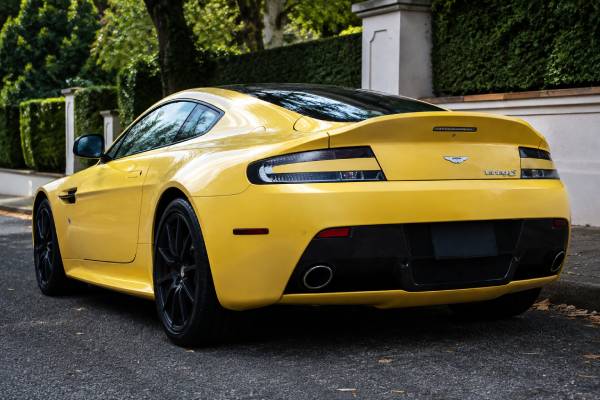
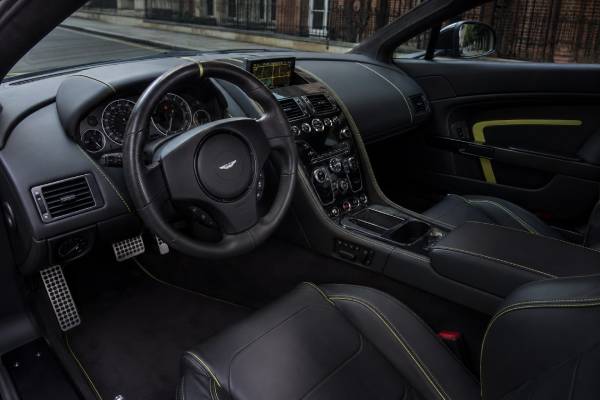
The Aston Martin V12 Vantage S was the fastest regular-production road car in the company’s range when it arrived, combining the compact VH Vantage body with the 565-hp AM28 V12 and a claimed 205-mph maximum speed. It replaced the original 510-hp V12 Vantage rather than merely supplementing it. The new car brought stronger torque, Bosch engine management, adaptive damping, revised steering, altered cooling, carbon-ceramic brakes, and initially a seven-speed Sportshift III automated manual. In 2016 Aston Martin added a seven-speed dogleg manual, creating one of the most unusual front-engine manual drivetrains of the modern era. Those two gearbox choices divide the market, but neither removes the larger ownership questions: carbon-ceramic brake condition, clutch life, V12 access costs, underbody corrosion, tyre age, damper health, and evidence of proper warm-up and servicing. Production lasted into 2018 and included numerous option and trim changes, so a build sheet is indispensable. This guide covers the 2013–2018 AM28-powered V12 Vantage S coupé as an engineering object, a driving machine, and a complex used-car purchase.
Table of Contents
- Why the S was a new V12 Vantage
- AM28 specification
- Two seven-speed transmissions
- Adaptive chassis and carbon-ceramic brakes
- V12 service realities
- How to audit a candidate car
- Ownership, value, and use
Why the S was a new V12 Vantage
The V12 Vantage S was a systematic redevelopment of the original V12 model. Its extra 55 hp received the headlines, but the engine controls, gearbox, steering, damping, exhaust, cooling, and body details changed the car’s operating character.
The AM28 engine retained the familiar 5,935 cc aluminium V12 architecture, often marketed as 6.0 litres, but adopted more advanced Bosch management and revised calibration. Output rose to 573 PS, equivalent to 565 bhp, while torque reached 620 Nm. The response remained naturally aspirated: torque built with engine speed, throttle input produced immediate combustion response, and the final third of the tachometer delivered the most intense acceleration and sound. Aston Martin claimed 205 mph, making the S—apart from the One-77—the company’s fastest road car at launch.
The transmission strategy was initially radical. Rather than keep the original car’s conventional six-speed manual, Aston Martin fitted the seven-speed Sportshift III automated manual derived from the transaxle used in other VH models. The lighter transmission and automated operation supported performance targets while retaining a single-clutch mechanical connection. Some enthusiasts objected to the absence of a clutch pedal, and Aston Martin answered in 2016 with a no-cost seven-speed manual option. Its dogleg first gear placed second through seventh in the main H pattern, prioritising the ratios used once moving.
The chassis became adjustable. Three-stage adaptive damping allowed the driver to choose Normal, Sport, or Track calibrations, while a quicker steering rack reduced hand movement. Carbon-ceramic brakes remained standard, and the exhaust used a lighter, freer-flowing design. Exterior revisions—including a more aggressive grille treatment, bonnet ventilation, carbon details, and a pronounced rear treatment—supported airflow and signalled that this was not the earlier V12 car with an S badge added.
Yet the S preserved the improbable formula that made the original compelling: the largest series-production Aston engine in the smallest body. Packaging that V12 creates heat, service access challenges, and substantial front-axle mass, but the rear transaxle and bonded-aluminium structure maintain useful balance. The result is not a delicate lightweight. It is a compact, muscular grand tourer with extraordinary speed and a surprisingly communicative chassis.
Later cars added equipment choices, graphics, carbon packages, updated infotainment, and regional editions. Some final examples overlap with AMR branding or special specifications and should be identified precisely. The title “V12 Vantage S” covers a meaningful production evolution; VIN-level documentation is the only reliable way to establish exactly what a particular car was built to be.
AM28 specification
The figures below describe the representative V12 Vantage S coupé. Published mass and acceleration data can differ according to transmission, market, options, test method, and whether a source uses dry, DIN, EU, or kerb conventions.
Engine
| Configuration | Front-mid-mounted 60-degree V12 |
|---|---|
| Displacement | 5,935 cc |
| Valvetrain | 48 valves, dual overhead camshafts per bank |
| Induction | Naturally aspirated |
| Maximum power | 573 PS / 565 bhp at approximately 6,750 rpm |
| Maximum torque | 620 Nm at approximately 5,750 rpm |
| Engine management | Bosch system specific to the AM28 generation |
Transmission and performance
| Drive | Rear-wheel drive |
|---|---|
| Initial transmission | Seven-speed Sportshift III automated manual transaxle |
| Later option | Seven-speed dogleg manual transaxle from 2016 |
| Differential | Mechanical limited-slip differential |
| 0–60 mph | Approximately 3.7 seconds for the quickest quoted configuration |
| 0–62 mph | Approximately 3.9 seconds |
| Maximum speed | 205 mph |
Chassis and steering
| Structure | Bonded and riveted aluminium VH platform |
|---|---|
| Suspension | Independent double wishbones front and rear |
| Dampers | Three-stage adaptive system with Normal, Sport, and Track modes |
| Steering | Hydraulically assisted rack and pinion with quicker ratio |
| Weight distribution concept | Front-mid engine and rear transaxle linked by torque tube |
| Stability control | Multi-mode DSC including reduced-intervention setting |
Brakes, wheels, and tyres
| Front brakes | 398 mm carbon-ceramic discs, six-piston calipers |
|---|---|
| Rear brakes | 360 mm carbon-ceramic discs, four-piston calipers |
| Wheel diameter | 19 inches |
| Front tyres | 255/35 ZR19 |
| Rear tyres | 295/30 ZR19 |
| Tyre note | Use factory-approved specification and current handbook pressures |
Dimensions and capacities
| Length | About 4,385 mm |
|---|---|
| Width excluding mirrors | About 1,865 mm |
| Height | About 1,250 mm |
| Wheelbase | 2,600 mm |
| Weight | Approximately 1,665 kg under a commonly quoted factory convention; option dependent |
| Fuel tank | Approximately 80 litres |
| Seating | Two |
The engine code, transmission, brake specification, tyre approval, emissions equipment, and software should be checked against the VIN. A V12 Vantage S may resemble another VH derivative from a distance while requiring different consumables and calibration.
Two seven-speed transmissions
Sportshift III and the dogleg manual share a rear transaxle location and seven forward ratios, but they are not the same ownership experience. Each demands a specific test procedure and driver technique.
Sportshift III is a single-clutch automated manual. Electro-hydraulic actuators operate the clutch and choose ratios while the driver commands shifts through paddles or lets the control unit decide. Because it lacks a torque converter, it must interrupt drive during every change. A driver can smooth the process by easing torque as the shift occurs, particularly at low and medium loads. Under strong acceleration, the system can deliver decisive changes that suit the V12’s escalating power.
Low-speed use exposes its compromises. Repeated creeping, parking on gradients, or holding the car with accelerator input makes the clutch slip and generates heat. The transmission should be assessed cold, warm, in reverse, during tight manoeuvres, in traffic, and at high load. Severe shudder, delayed engagement, unexplained neutral, hydraulic warnings, irregular bite, or a burning smell require diagnosis. Clutch wear figures from diagnostic equipment are helpful but should be interpreted alongside adaptations, actuator data, software level, and driving symptoms.
The manual version uses three pedals and a dogleg gate. First is positioned away from the main plane because it is needed primarily to launch; gears two through seven form the pattern used on flowing roads. The layout takes concentration until muscle memory develops. Selecting the wrong plane through haste can spoil the experience, whereas deliberate shifts make the unusual arrangement deeply engaging. AMSHIFT software can provide automated throttle blips and facilitate full-throttle upshifts when activated, but it does not eliminate the need for correct clutch use.
Test the manual for clutch slip at high torque, judder, release-bearing noise, hydraulic leaks, difficult reverse, baulking, and excessive driveline vibration. Confirm that the lever returns accurately to its expected planes. A worn or poorly adjusted linkage can make the dense seven-speed pattern harder to navigate. Ask whether a twin-plate clutch or other aftermarket parts have been installed, and obtain the exact invoice. Modifications may improve pedal weight and response while changing originality and future parts support.
Neither transmission makes the V12 inexpensive to service. The transaxle location, torque tube, clutch labour, and specialist procedures turn a consumable into a significant job. A recently completed clutch is valuable only when the work is documented, the associated components were inspected, and the result operates correctly.
For road use, the choice is personal. Sportshift III creates a dramatic, paddle-led rhythm and may suit drivers who want the V12 experience without a clutch pedal. The manual demands more effort but offers an exceptionally rare combination of naturally aspirated V12 and seven-speed dogleg control. Market preference can influence price, yet mechanical condition and history remain more important than transmission mythology.
Adaptive chassis and carbon-ceramic brakes
The S chassis gives the heavy V12 body composure without hiding its mass. Adaptive dampers widen the operating range, while hydraulic steering and carbon-ceramic brakes preserve direct feedback.
Normal mode should control the body while allowing enough compliance for ordinary roads. Sport and Track progressively increase damping force and reduce movement, but the car should not become uncontrolled or noisy in any setting. If the modes feel identical, if a warning appears, or if one corner continues to oscillate, inspect the dampers, wiring, sensors, mounts, and control system. Fluid misting, leakage, damaged connectors, and corrosion around fasteners are relevant. Replacement costs justify testing every setting during a pre-purchase drive.
The quicker steering makes the V12 S respond more immediately than the original V12 Vantage. Correct alignment is essential because broad tyres, worn bushings, mismatched compounds, or bent wheels can create tramlining and nervousness. The steering should build effort predictably, return toward centre, and remain free from hydraulic pump groan or assistance changes. Check the rack, pipes, reservoir, and underbody for leaks.
Carbon-ceramic brakes reduce unsprung mass and provide strong high-temperature capability, but they require inspection by measurement and condition rather than casual appearance. The discs may show a used surface without being defective; conversely, chips, deep scoring, oxidation, heat damage, or mass loss can make replacement necessary. Obtain disc weights or specialist readings where the manufacturer’s procedure calls for them. Inspect both faces, not just the visible outer surface.
Pads must be compatible with the discs. Ask for exact part numbers and invoices, particularly if the car has seen circuit use. A stone trapped between shield and disc can cause damage. Wheel cleaners, poor washing practice, and careless wheel removal can also harm expensive components. Brake judder may result from pad deposits, hub runout, suspension wear, or disc condition, so diagnosis should be systematic.
The 19-inch tyres are central to the car’s behaviour. Check manufacture dates, matching brand and specification, repairs, inner-edge wear, sidewall cracking, and flat spots. A low-mileage V12 S often wears old tyres because the owner sees abundant tread and postpones replacement. High torque and 205-mph capability make age as important as depth. Any proposed alternative size or compound should be evaluated for clearance, load, speed rating, stability-control compatibility, and insurance implications.
On the road, the V12 S is most convincing when inputs are progressive. Brake in a straight line, allow the front tyres to take a set, then use the engine’s linear torque to drive out. It can rotate and communicate, but it does not erase physics. Cold tyres, damp roads, abrupt throttle, and reduced stability control can overwhelm the rear axle quickly. Respect for temperature and surface conditions is part of correct operation, not an admission that the chassis is deficient.
V12 service realities
The AM28 is robust when maintained, but twelve cylinders, tight packaging, high heat output, and expensive peripheral components make neglect disproportionately costly. Preventive inspection is the economical strategy.
Start with service chronology. Engine oil and filter should be changed by time as well as distance, using the correct specification and level procedure. Coolant, brake fluid, gearbox oil, differential oil, filters, and spark plugs require documented intervals. “Recently serviced” is not enough; invoices should identify dates, mileage, fluids, and parts.
The ignition system has twelve plugs and multiple coils in confined spaces. A misfire can arise from plugs, coils, injectors, intake leaks, wiring, fuel quality, compression, or low system voltage. Scan all modules before clearing codes and record freeze-frame conditions. Replacing one visible component without diagnosis can leave the underlying fault and create a misleading clean dashboard for sale.
Cooling efficiency deserves special attention. Inspect radiator and condenser faces for debris, impact, and corrosion; verify fan operation; pressure-test unexplained losses; and examine tanks, caps, hoses, joints, and dried residue. The bonnet vents and underbody airflow must not be obstructed by incorrect parts. A car that remains stable in a short winter drive may reveal weakness only in traffic after a sustained high-load run.
Oil leaks or seepage should be traced from a clean engine and underside. The source, rate, and affected components determine urgency. Fluid on an exhaust, clutch, belt, or electrical connector presents different consequences from light staining. Remove enough underbody coverage to understand the leak path instead of accepting a freshly cleaned tray as proof of dryness.
The exhaust system and its valves can develop rattles, seized mechanisms, failed vacuum control, or leaks. Confirm that any permanently open-valve modification is deliberate and reversible. Excessive noise may create regulatory or insurance problems, while a replacement exhaust can change cabin resonance and value.
Electrical health begins with the battery. Low voltage causes slow cranking, false warnings, lost settings, alarm issues, and transmission complaints. Load-test the battery, verify charging output, inspect terminals, and use the correct conditioner during storage. Test both keys and every cabin function. Window indexing, door modules, seats, mirrors, climate control, infotainment, parking sensors, and instrument warnings should all be exercised.
Ageing VH cars also need underside attention despite aluminium body construction. Steel subframes, fasteners, brackets, brake pipes, suspension hardware, door parts, and mounting points can corrode. Inspect jacking locations, sills, wheel arches, front and rear structures, exhaust supports, and hidden moisture traps. Aluminium oxidation and galvanic reaction around dissimilar metals require appropriate repair methods.
Annual inspection by a V12-experienced specialist creates a useful condition record. Combining diagnostic data, brake measurements, tyre dates, clutch readings, alignment, photographs, and leak observations is more valuable than a stamp alone. It lets the owner plan expensive work before several systems mature into one overwhelming bill.
How to audit a candidate car
A credible V12 Vantage S should have a traceable identity, a coherent maintenance story, and condition that matches its mileage and use. Begin the audit before seeing the car.
Request the VIN, factory build sheet, registration history, service invoices, inspection reports, recall or campaign evidence, both keys, handbooks, and photographs of the underside. Confirm whether it is Sportshift III or the later manual and whether any special-edition designation is genuine. Identify carbon packages, lightweight seats, wheel type, audio, paint, trim, and market equipment.
Build a timeline. Note every annual service, mileage increase, owner change, long storage period, and major repair. Look for evidence of plugs, coils, coolant, brake fluid, transaxle and differential service, tyres, dampers, battery, clutch, brakes, air conditioning, exhaust work, and corrosion treatment. A five-year gap cannot be erased by an oil change immediately before sale.
Inspect the body in daylight. Compare paint colour and texture, panel alignment, fasteners, bonnet vents, front splitter, side sills, rear diffuser, lamp mounts, and wheel finishes. Stone chips are normal; cracks, displaced mounts, overspray, folded undertrays, or inconsistent hardware suggest repair. Paint-depth readings are useful on compatible panels but must be interpreted with aluminium and composite construction in mind.
Inside, compare wear with mileage. Examine seat bolsters, steering wheel, paddles or gear lever, pedal surfaces, dashboard leather, headlining, carpets, rear compartment, and seals. Dampness or a musty smell can indicate blocked drains or glazing leaks. Ensure warning lamps illuminate during the start-up check and extinguish correctly.
Insist on a cold start. Listen for prolonged abnormal noise, observe smoke and idle, and confirm that the engine was not pre-warmed. Drive until the oil, coolant, gearbox, brakes, tyres, and dampers are genuinely warm. Test all damper modes, steering over varied surfaces, straight-line braking, full engine response, and every gearbox function. Reinspect for smells, fluid, fan operation, and warnings after shutdown.
The specialist pre-purchase inspection should include a module scan, compression or further engine testing if symptoms justify it, undertray removal, clutch assessment, carbon-ceramic disc measurement, pad thickness, tyre age, wheel condition, suspension play, damper operation, geometry clues, cooling-system pressure test where appropriate, battery test, and a written estimate. Ask the inspector to divide findings into safety-critical, immediate mechanical, near-term maintenance, and cosmetic categories.
Use that report to calculate an entry cost, not merely negotiate. Purchase price plus clutch, brakes, tyres, annual service, tax, transport, and first-year contingency is the meaningful number. A higher-priced car with fresh, documented major work can be substantially cheaper than a superficially discounted example.
Ownership, value, and use
The V12 Vantage S is best understood as a high-performance analogue car with selective electronic assistance. It offers immense speed, but its enduring appeal comes from the naturally aspirated V12, hydraulic steering, compact body, and unusual transaxles.
The Sportshift car suits an owner willing to learn the gearbox and avoid prolonged clutch slip. The manual suits someone who enjoys deliberate control and accepts a demanding dogleg pattern. Both benefit from regular, fully warmed use. Very short starts, static idling, and long inactivity do not preserve the drivetrain. A proper drive exercises seals, brakes, air conditioning, differential, gearbox, exhaust valves, and electronics.
Storage should be dry, ventilated, secure, and supported by the correct battery conditioner. Monitor tyre pressures and contact patches, maintain fuel sensibly, and avoid washing the car immediately before sealing it into a damp garage. Keep recovery information available because low splitters and underbody aero require suitable loading angles.
Running costs are not proportional to current used prices. The car was engineered and priced as a flagship performance Aston, and parts remain in that category. Insurance should account for carbon trim, ceramic brakes, agreed value, limited specialist access, and any circuit use. A reserve fund prevents deferred maintenance when an expensive but predictable item arrives.
For buyers comparing generations, the original 510-hp V12 Vantage is simpler in concept and has a conventional six-speed manual, while the S is faster, more adjustable, and available with two distinctive seven-speed choices. The GT12 is rarer and more extreme but sacrifices subtlety and carries unique carbon and aero exposure. The later turbocharged Vantage is quicker in ordinary conditions and more modern, yet it does not reproduce the AM28’s response or sound.
Values will vary with geography, gearbox, colour, options, history, mileage, and market sentiment. Speculation should not dictate purchase. The strongest car is one that can be used without destroying originality and maintained without financial strain. Complete records, original equipment, unambiguous accident history, healthy ceramic brakes, and a recent specialist baseline are more durable value indicators than a low odometer alone.
A well-chosen V12 Vantage S delivers something few cars can: a large naturally aspirated twelve-cylinder engine in a genuinely compact two-seat body, connected to the rear axle through a transaxle and controlled through hydraulic steering. Preserve that system as a whole. Its engine, gearbox, chassis, and brakes are interdependent, and the quality of ownership comes from keeping all of them ready for the same drive.
References
- V12 VANTAGE S (Historic Models | 2013–2018)
- Aston Martin V12 Vantage | PH Used Buying Guide (2021)
- 2010 Aston Martin V12 Vantage – Review (2009)
- 2009 Aston Martin V12 Vantage First Drive (2009)
- Aston Martin Vantage buying guide: powertrain (2013)
- Aston Martin Vantage buying guide: rolling chassis (2013)
Disclaimer
Specifications, production details, service intervals, performance claims, and known issues vary by market, VIN, transmission, model year, optional equipment, software, and prior modification. This article is educational guidance rather than a workshop procedure, valuation, warranty, or substitute for the owner’s manual, official service information, diagnostic testing, and a specialist pre-purchase inspection. Confirm fluids, parts, brake assessment methods, wheel procedures, torque settings, lifting points, and safety-critical work with official Aston Martin documentation for the individual car.
Please share this guide on Facebook, X/Twitter, or an Aston Martin owners’ forum if it helps another buyer approach the V12 Vantage S with realistic information.