
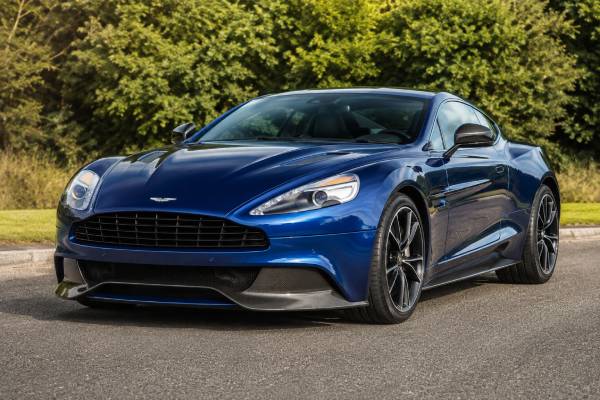
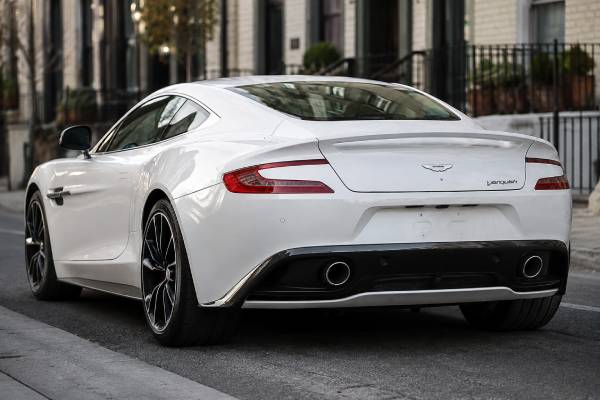
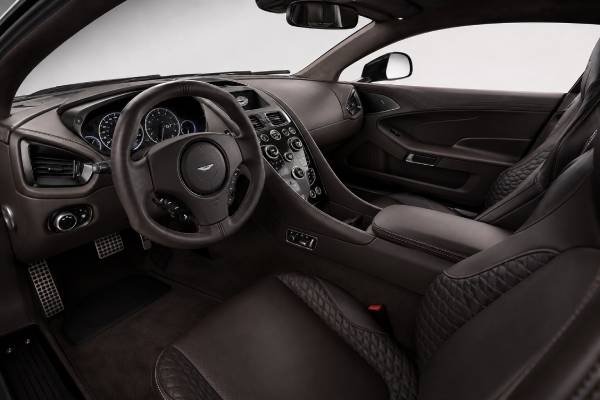
The 2014–2016 Aston Martin Vanquish with the AM29 V12 is the version that transformed the second-generation coupe from a rapid luxury GT into a genuine 200-mph flagship. Its output rose modestly to 568 hp, but the decisive change was the ZF eight-speed Touchtronic III rear transaxle. Shorter lower ratios, faster shifts, a revised final drive, and updated calibration cut the official 0–60 mph time to 3.6 seconds while improving cruising flexibility and rated efficiency. The carbon-fibre body, bonded aluminium structure, adaptive suspension, and carbon-ceramic brakes remained central to the car’s identity. For a buyer, the familiar shape can obscure the mechanical distinction between this car and the earlier six-speed model. It also remains a low-volume Aston Martin whose ceramic brakes, carbon panels, V12 ignition system, dampers, electronics, and bespoke trim demand specialist assessment. The best example is the one with verified AM29 specification, completed campaigns, consistent servicing, healthy chassis hardware, and no ambiguity about carbon or aluminium repairs.
Table of Contents
- The Eight-Speed Turning Point
- AM29 Coupe Specifications
- Why Three Extra Horsepower Made a Big Difference
- Chassis, Brakes, and Carbon-Body Condition
- Using the Vanquish as a Real Grand Tourer
- Maintenance, Campaigns, and Diagnostic Discipline
- Buying the Right 568 hp Coupe
The Eight-Speed Turning Point
The eight-speed update is the defining feature of the 568 hp Vanquish because it changed how often the V12 could operate in its strongest range. The three-horsepower increase alone cannot explain the jump from a 183 mph, 4.1-second early car to a 201 mph model capable of 0–60 mph in 3.6 seconds.
Aston Martin introduced the Touchtronic III transaxle as part of a broader powertrain revision. It retained the rear-mounted gearbox layout that helps balance the car, but added two ratios, quicker control, and a more performance-oriented final-drive relationship. Lower gears became more closely spaced, so the naturally aspirated engine did not fall as far down the rev range after each upshift. At motorway speed, the upper ratios allowed quieter, more relaxed cruising.
The result is a car that feels lighter than its actual mass. From rest, the torque converter and shorter gearing make the first metres decisive. On a winding road, the paddles can keep the V12 above the point where it becomes urgent. In traffic, the transmission behaves like a smooth automatic rather than demanding the clutch-management technique of the original AMV03 Vanquish.
The AM29 engine itself produced 568 bhp and approximately 630 Nm of torque. Its changes were evolutionary, preserving the linear response and high-rev character that make the naturally aspirated Aston V12 desirable. The drivetrain’s improved multiplication and shift strategy did more to the driver’s perception than the headline output increase.
This version can be confused with both neighbours in the range. A late-registered six-speed car may appear beside an early eight-speed car from the same calendar year, and the later Vanquish S uses the same basic eight-speed layout with more power and aerodynamic changes. Do not identify a car by registration date or wheel style. Confirm build specification, engine designation, number of gears, VIN, and factory record.
The change also affects the maintenance conversation. Touchtronic III does not share the early six-speed park-lock campaign described for certain 2014 cars, but it has its own fluid, software, cooling, electrical, and adaptation requirements. A fast shift in a test drive does not prove long-term health. Consistent behavior from cold to hot, clean diagnostic records, correct servicing, and absence of leaks matter more.
AM29 Coupe Specifications
The AM29 Vanquish is an ICE-only, front-mid-engine petrol coupe with a naturally aspirated 5,935 cc V12 driving the rear wheels through an eight-speed automatic transaxle. It retains the AM310’s carbon-fibre exterior and bonded aluminium VH structure, but its gearing and calibration deliver a substantially faster performance envelope. The tables describe the standard 568 bhp coupe rather than the later S.
| Specification | Value |
|---|---|
| Engine type | Naturally aspirated petrol V12 |
| Displacement | 5,935 cc (5.9 litres) |
| Maximum power | 568 bhp (576 PS) |
| Maximum torque | About 630 Nm (465 lb-ft) |
| Engine position | Front-mid mounted |
| Driven wheels | Rear |
| Measure | Published figure |
|---|---|
| Transmission | Eight-speed Touchtronic III automatic rear transaxle |
| 0–60 mph | 3.6 seconds |
| 0–62 mph (0–100 km/h) | About 3.8 seconds |
| Top speed | 201 mph (324 km/h) |
| Manual selection | Steering-column paddles |
| Final-drive concept | Revised ratio for stronger acceleration and higher maximum speed |
| Measurement | Value |
|---|---|
| Length | Approximately 4,728 mm (186.1 in) |
| Width excluding mirrors | Approximately 1,910 mm (75.2 in) |
| Height | Approximately 1,294 mm (50.9 in) |
| Wheelbase | 2,740 mm (107.9 in) |
| Published kerb mass | About 1,739 kg (3,834 lb) |
| Boot capacity | Up to 368 litres (13.0 cu ft) |
| System | Configuration |
|---|---|
| Platform | Bonded aluminium VH architecture |
| Outer panels | Carbon-fibre bodywork |
| Suspension | Double wishbones front and rear |
| Damping | Adaptive, driver-selectable |
| Brakes | Carbon Ceramic Matrix discs |
| Wheels | 20-inch alloy wheels |
| Item | Practical detail |
|---|---|
| Fuel | Premium unleaded gasoline |
| Fuel capacity | About 78 litres (20.5 US gal) |
| Seating layouts | 2+0 or 2+2 according to build |
| Primary role | High-performance two-door grand tourer |
| Stability systems | ABS, traction control, and electronic stability control |
Specifications can vary with market equipment and measurement standard. Verify tyres, pressures, fluids, brake criteria, and service data against the exact VIN rather than using a generic table as workshop instruction.
Why Three Extra Horsepower Made a Big Difference
The performance leap came from using the V12’s power more effectively, not from creating a substantially more powerful engine. The eight-speed gearbox narrowed the gaps between ratios, improved launch behavior, and kept the engine closer to its upper-range output during acceleration.
A naturally aspirated engine produces its strongest power at higher rpm than a modern turbocharged unit. With only six ratios, each shift can drop engine speed farther. Adding two ratios lets the control system choose a gear that better matches road speed and driver demand. The revised final drive further changes the torque delivered at the rear wheels.
In automatic operation, the gearbox can move from relaxed cruising to a lower ratio rapidly when the accelerator is pressed. In paddle mode, it gives the driver more choices without turning every shift into a large change in engine speed. This makes the car feel more immediate in ordinary overtaking as well as in instrumented acceleration.
The 201 mph top speed also depends on gearing, aerodynamic drag, tyre capability, cooling, and power available at the relevant road speed. It should not be interpreted as a recommendation to approach that figure outside controlled conditions. For ownership, it means every component involved in stability deserves respect: tyres must have correct ratings and age, wheels must be straight, alignment must be accurate, dampers must control the body, and underbody aerodynamic pieces must be present.
The engine should be judged by smoothness and progression. It should start cleanly, settle without persistent misfire, and pull evenly to high rpm after full warm-up. Hesitation may involve ignition coils, plugs, injectors, throttle bodies, air leaks, fuel pressure, sensors, or catalytic protection strategies. Because there are twelve cylinders, replacing one visible weak part without testing the system can lead to repeated visits.
Exhaust specification affects the experience. Factory sports exhaust options and later replacements can add volume, but verify legality, valve function, mounting quality, and whether calibration was altered. A loud car is not necessarily a healthy one; exhaust leaks, failed catalysts, or rattling valves can be mistaken for desirable aggression.
The rear transaxle layout contributes to balance, but it also extends the driveline. Mounts, torque-tube components, differential hardware, shafts, and joints can transmit vibration or clunks. A specialist road test should distinguish a normal low-speed driveline response from worn supports or backlash. Check under load, on lift-off, during tight turns, and after the transmission is fully hot.
Touchtronic III should shift firmly when commanded in sportier settings but remain coherent. Flare, delayed reverse, harsh engagement from park, shudder, or repeated hunting can involve software, fluid condition, temperature, adaptation, battery voltage, or mechanical wear. Diagnose first; do not assume a fluid change alone will cure every symptom.
Chassis, Brakes, and Carbon-Body Condition
The most financially important non-engine checks are carbon-fibre repair quality, ceramic-disc condition, damper function, and tyre age. These items can turn a superficially inexpensive Vanquish into a costly restoration before routine servicing begins.
The carbon body allows crisp, deep forms and saves mass, but it needs specialist damage assessment. Painted carbon can conceal cracks or delamination. Exposed carbon lacquer can yellow, cloud, chip, or show repairs. Inspect edges, mounting points, underbody pieces, splitter, diffuser, side strakes, bonnet, door skins, and rear quarters. Inconsistent weave is not always visible under paint, so repair documentation and inspection from behind panels are valuable.
The bonded aluminium VH structure carries loads beneath those panels. An impact can affect suspension pick-up points or adhesive joints even when the carbon panel was replaced. Aluminium repair requires controlled methods and isolation from incompatible materials. Ask where repair work was performed, whether factory procedures were used, and whether alignment records exist.
Carbon-ceramic discs require model-specific evaluation. Ordinary steel-disc assumptions do not apply. Specialists inspect for chips, cracks, surface condition, contamination, and wear according to approved criteria. A car may have little visible lip yet still need further assessment. Conversely, harmless appearance variations should not be used to justify unnecessary replacement.
Pads, calipers, fluid, hoses, and cooling also matter. A ceramic disc cannot compensate for seized hardware or old fluid. During the road test, the pedal should remain consistent and the car should stop straight. Repeated vibration, pulsing, grinding, or pulling requires investigation. Some low-speed sound can occur, particularly when cold or damp, but sellers should not use that fact to explain every noise.
Adaptive dampers should create a noticeable but sensible difference between settings. If the car bounces, floats, crashes, or shows no change, inspect for leakage, electrical faults, incorrect replacement components, worn bushes, or tyre problems. The broad wheels can be bent on potholes without obvious cosmetic damage, producing vibration at a narrow speed range.
Tyre date codes are as important as tread. A low-mileage car may still sit on old rubber, and 201-mph capability demands correct speed and load ratings. Mixed models between axles can alter balance, while mismatched tyres on one axle are unacceptable. Check inner edges for wear caused by geometry or worn joints.
The steering should be accurate, with some response to road camber but no persistent wander. An alignment printout is meaningful only if the workshop measured ride height, checked suspension condition, and used appropriate targets. Repeated alignments that never hold can indicate structural or component issues.
Using the Vanquish as a Real Grand Tourer
The AM29 coupe can function as a genuine touring car because its eight-speed gearbox, hatchback luggage access, adaptive ride, and stable high-speed behavior reduce fatigue. Its practicality remains conditional on planning around width, low clearance, fuel consumption, limited rear seating, and specialist support.
The 368-litre boot is useful for soft luggage. The 2+2 version adds occasional rear seating, but adults will usually prefer the rear area for bags. A 2+0 car may have a cleaner storage layout. Confirm the factory configuration, especially where later owners have retrimmed or converted the rear area.
Before a trip, check tyre pressures cold, fluid levels, battery state, warning messages, and the condition of the inflation or mobility equipment supplied. Plan premium-fuel stops because remote stations may not carry the recommended grade. The V12’s range varies sharply with speed, traffic, and short-trip use, so do not base an itinerary on a best-case display reading.
Long doors and a wide rear body make hotel and urban parking challenging. Use end spaces where possible, understand the camera and sensor coverage, and inspect the front splitter after unfamiliar ramps. The low bonnet edge can disappear from view, while carbon repair is far more expensive than touching up a steel bumper.
Cabin comfort should be tested personally. Seat shapes, steering-wheel reach, pedal relationship, and sight lines differ from modern cars. Verify memory, heating, ventilation where fitted, lumbar support, climate control, and window indexing. A small seat or window fault can become a major irritation over several hundred kilometres.
Infotainment belongs to its era. The system may be reliable but lacks the responsiveness and connectivity of a current car. Professionally installed smartphone integration can improve touring without replacing the original visual architecture. Avoid installations that cut factory wiring, block ventilation, or interfere with parking displays.
Noise should be assessed at several speeds. Tyre roar, wind whistle, exhaust drone, differential hum, and trim rattles have different causes. A seller may normalize them because the car is “sporty,” but the Vanquish was designed as a refined flagship. It should be dramatic under acceleration and calm enough to converse at a cruise.
Regular use can support reliability if the car reaches full operating temperature and is serviced correctly. Repeated very short drives are less helpful. After a long tour, clean insects and debris from the front carefully, inspect tyres and wheels, dry the brakes after washing, and note any fluid-use trend or new noise while it is fresh in memory.
Maintenance, Campaigns, and Diagnostic Discipline
The correct maintenance strategy is to preserve system health and resolve small symptoms before they trigger secondary damage. A stamped book is useful, but detailed invoices, diagnostic reports, campaign records, and measured brake and tyre condition tell a stronger story.
Service the engine by time and distance using the exact oil and filter specification. Inspect coils, plugs, belts, hoses, cooling fans, radiators, condensers, throttle operation, and signs of fluid seepage. Misfires can overheat catalysts, so investigate warning lights or roughness promptly rather than repeatedly clearing codes.
The eight-speed transaxle needs correct fluid, temperature, fill procedure, and diagnostic adaptation where specified. Generic transmission service can be harmful if the wrong product or level method is used. Check differential and torque-tube areas at the same visit.
Battery health is foundational. Low voltage can create body, restraint, transmission, roof, suspension, and infotainment warnings. Test the battery under load, confirm charging output, clean connections, and use a suitable maintainer during storage. Fault codes recorded during a voltage event should be interpreted, not automatically treated as failed modules.
Certain 2014–2016 Vanquish cars were included in a US recall concerning the double-locking function. In affected vehicles, an occupant might not be able to unlock a double-locked door from inside. The remedy disabled that feature through software. Campaign applicability is VIN-specific and market-specific, so obtain official confirmation rather than assuming a model year is complete.
Aston Martin also issued service action SA-18-0252 for certain V12 models, including Vanquish from 2013 model year onward. It addressed electrical connections at the starter solenoid, including a potentially unsuitable nut and wire routing that could contribute to poor connection, shorting, difficult starting, or failure to start. Ask a dealer or specialist to check completion by VIN.
Cooling-system cleaning should be careful. Debris between heat exchangers reduces performance, but aggressive pressure can bend fins or wet connectors. Watch temperature in traffic, verify fan stages, and investigate coolant loss. A car that stays cool only while moving is not healthy.
Keep ceramic-brake inspection records, tyre invoices with date codes, alignment printouts, battery-test results, and software-campaign evidence. This documentation helps the next technician avoid repeating work and supports resale value.
Buying the Right 568 hp Coupe
The right 568 hp coupe is identifiable, fully diagnosable, structurally transparent, and priced with its immediate needs disclosed. Mileage, colour, and optional carbon details should come after the mechanical and documentary evidence.
First, prove the version. Confirm AM29 output, eight forward ratios, build date, VIN, seating layout, market specification, and original options. A 2014 registration can belong to different mechanical specifications, so the transmission is a better identifier than the plate year.
Second, review history chronologically. Look for annual service, plugs and coils, cooling work, battery replacement, transmission service, differential care, ceramic-brake measurements, tyres, dampers, suspension joints, campaign completion, and repair invoices. Repeated no-start or electrical entries may point to unresolved voltage, starter, or connection problems.
Third, inspect independently. The workshop should scan all modules, road-test from cold to fully hot, lift the car correctly, evaluate carbon and aluminium, assess ceramic discs by the proper method, and price near-term work. A generic inspection that says “brakes look good” is not enough.
During the drive, verify smooth engagement of drive and reverse, clean kickdown, consistent paddle shifts, stable temperature, straight braking, and a meaningful difference between damper modes. Listen for torque-tube vibration, differential whine, wheel-bearing noise, suspension knocks, exhaust rattles, and wind leaks. Perform a hot restart.
Check every cabin function. Repairs to seat modules, audio, navigation screen, climate control, windows, parking aids, cameras, locks, and trim may be individually manageable but expensive in aggregate. Confirm both keys and any special accessories.
Compare the car with the early six-speed and Vanquish S on purpose rather than status. The six-speed has a calmer, more original AM310 feel and a lower 183 mph top speed. The S adds 595 hp, sharper aerodynamics, and a more focused calibration. The 568 hp car occupies an attractive middle ground: it has the transformative eight-speed performance without the S premium.
Avoid paying extra for unsupported claims such as “one of one” colour combinations. Obtain a factory build record where rarity matters. Modified exhausts, infotainment, wheels, or suspension should have invoices, correct geometry, and original parts where possible.
The final budget should include purchase, inspection, registration, insurance, transport, immediate baseline service, tyres if aged, battery support, and a repair reserve. A strong car may still need expensive maintenance because low-volume components do not become cheaper with age.
When properly sorted, this Vanquish gives the owner the essential second-generation experience in its most broadly capable form. It is fast enough to feel contemporary, naturally aspirated enough to feel special, and practical enough to tour. The eight-speed did not erase the car’s character; it unlocked more of it.
References
- VANQUISH (Manufacturer Historic Model Archive)
- Q2 2014 Results 2014 (Manufacturer Technical Update)
- Vanquish at 25 – three generations of flagship performance and engineering excellence 2026 (Manufacturer History)
- Part 573 Safety Recall Report 15V-846 2015 (Safety Recall)
- Service Action 2016 (Starter Solenoid Service Action)
- Owner’s Guides | Aston Martin (Manufacturer Owner Resources)
Disclaimer
This article is for informational purposes and is not a replacement for professional diagnosis, repair, or a specialist vehicle inspection. Specifications, torque values, fluids, maintenance intervals, recalls, service actions, and procedures can vary by VIN, market, build date, and equipment; verify them against official documentation for the exact car. Please share this guide on Facebook, X/Twitter, or an enthusiast forum if it supported your research.