
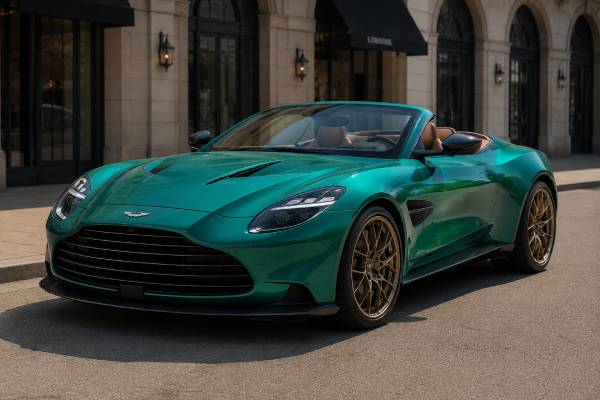
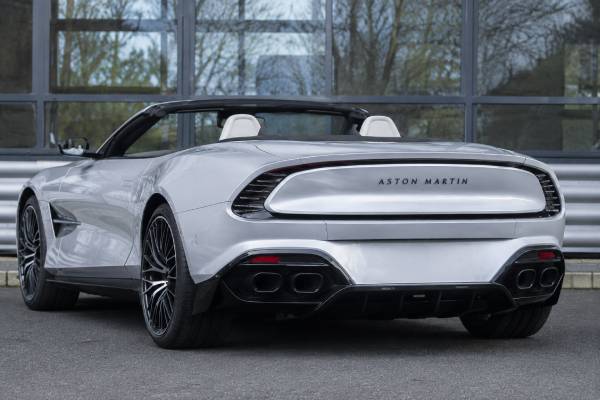
The Aston Martin Vanquish Volante is the open-roof form of the AM370 flagship, but its engineering brief goes beyond cutting the top from the coupe. Introduced in 2025, it combines the same 824 hp twin-turbo V12 and 214 mph maximum speed with a compact K-fold fabric roof, additional structural reinforcement, dedicated damper tuning, and a mass increase of only 95 kg. The roof opens in 14 seconds, can operate at urban speeds, and exposes the cabin to a V12 that delivers 1,000 Nm across a broad rev range. Those achievements also create distinct ownership priorities. Roof alignment, drains, seals, fabric care, cabin water management, tire condition, brake inspection, and software health all deserve close attention. A buyer should also understand that the Volante is a two-seat, ultra-high-performance touring car with limited luggage capacity, not simply a sunny-day accessory. This guide covers its exact specifications, roof system, dynamic behavior, touring practicality, maintenance needs, and a disciplined buying process.
Table of Contents
- Why the Volante Is a Separate Engineering Program
- Roof Operation, Packaging, and Weather Protection
- Vanquish Volante Specifications and Technical Data
- Performance With the Sky Open
- Touring Comfort, Cabin, and Digital Systems
- Volante-Specific Maintenance and Storage
- Inspection, Configuration, and Buying Decisions
Why the Volante Is a Separate Engineering Program
The AM370 Volante was developed alongside the coupe so its structure, roof package, suspension tuning, and exterior proportions could be solved together. That matters because an open car must recover stiffness without excessive reinforcement, keep the roof stack out of the luggage area, manage wind and water, and still preserve the high-speed stability expected of a 214 mph flagship.
Aston Martin launched the Volante in March 2025, with first deliveries planned for the third quarter. It shares the coupe’s 5.2-liter twin-turbo V12, rear-mounted eight-speed ZF transmission, carbon-fiber propeller shaft, electronic differential, carbon-ceramic brakes, and core bonded-aluminum architecture. The factory quoted the same maximum speed and only a tenth of a second difference in the 0–62 mph claim. That closeness is unusual for a convertible and explains why body stiffness, roof condition, tires, and alignment should be judged to flagship standards rather than excused as normal open-car compromises.
The model is a two-seater in its standard published form. Behind the occupants, the roof, structural bracing, and luggage area compete for a finite package. The very low 260 mm roof stack preserves the rear silhouette and helps keep usable space, but buyers should trial-pack real luggage. A weekend bag set that fits neatly may be more practical than rigid cases whose dimensions look acceptable on paper.
The exterior uses carbon-fiber body panels over the aluminum structure. The bonnet’s heat-extraction louvres, enlarged grille, brake-cooling paths, Kamm tail, rear shield, and diffuser all serve the same high-output car as the coupe. The roof changes airflow and the occupants’ sensory experience, but it does not reduce the need for cooling or aerodynamic stability. Any modification to splitters, undertrays, diffuser surfaces, wheel fitment, or ride height can therefore affect more than appearance.
With production of coupe and Volante combined under an announced ceiling of fewer than 1,000 Vanquish examples per year, specification matters. Q paint, roof color, carbon packages, wheel finish, brake-caliper color, interior material, and titanium exhaust can make two cars feel very different. Rarity alone does not make an unconventional combination desirable, though. A coherent commission with documented factory content is usually easier to value than a car whose appearance has been changed after delivery.
Roof Operation, Packaging, and Weather Protection
The K-fold roof is the Volante’s most distinctive mechanism and should work smoothly, quietly, and consistently. It opens in 14 seconds, closes in 16 seconds, can be operated at up to 31 mph or 50 km/h, and can be controlled remotely from close range where market settings permit.
A K-fold design avoids a bulky hardtop and allows the fabric to disappear beneath the tonneau without a separate visible cover. When retracted, the stack is only 260 mm high. That preserves the low rear deck and flowing profile rather than creating a raised storage hump. The fabric is acoustically enhanced, and Aston Martin claimed thermal insulation comparable with the coupe. In practice, cabin noise and temperature still depend on speed, wind direction, roof adjustment, seal cleanliness, interior color, and climate-control performance.
Operate the roof several times during inspection: once from fully cold, once after the car has warmed in the sun if possible, and once using the in-cabin switch. Watch the sequence from outside. Both sides should move symmetrically; the tonneau should clear painted and trimmed surfaces; latches should engage without repeated attempts; windows should drop and return correctly; and the final header seal should sit evenly. A slow or interrupted cycle can arise from low battery voltage, a position sensor, hydraulic or electric actuation, misalignment, obstruction, or software. Do not keep forcing the mechanism until a small fault becomes bent hardware or damaged fabric.
The ability to operate at 31 mph is a convenience limit, not a target. Roof movement creates changing aerodynamic load, and a pothole or sudden stop can add stress while the mechanism is unsupported. Use it on a smooth, straight road only when necessary, and preferably complete the cycle while stationary. Remote operation requires a clear view of the car so people, bags, clothing, branches, or garage fixtures cannot enter the mechanism.
Water management depends on more than the visible outer fabric. Header, side, rear, window, and tonneau seals must meet correctly; drainage routes must remain clear; and body apertures must release water where designed. Look for damp carpet, staining, musty odor, water lines, corrosion at fasteners, distorted leather, cloudy electronics, or condensation in lamps. Lift only trim that can be inspected without damage. A dry cabin on a sunny sales day does not prove the car is watertight.
Clean the roof with products approved for its material. Stiff brushes, household detergent, automatic-car-wash rollers, and aggressive pressure washing can harm fibers, water repellency, stitching, or seals. Remove bird contamination promptly without scrubbing it into the weave. Keep rubber seals clean and use only the treatment specified by the manufacturer; an unsuitable silicone product can attract dirt, smear glass, or interfere with sealing.
Vanquish Volante Specifications and Technical Data
The Vanquish Volante is a gasoline ICE vehicle without hybrid propulsion. Its V12 drives the rear wheels through a rear-mounted automatic transmission and electronic differential, while model-specific reinforcement and damping compensate for the missing fixed roof. The following values apply to the AM370 Volante announced for 2025 onward; market homologation and fitted options can alter mass or equipment.
| Specification | AM370 Vanquish Volante |
|---|---|
| Engine | 5.2-liter, quad-cam, 48-valve twin-turbo V12 |
| Engine position | Front-mid-mounted, longitudinal |
| Maximum power | 835 PS / 824 bhp at 6,500 rpm |
| Maximum torque | 1,000 Nm / 738 lb-ft from 2,500–5,000 rpm |
| 0–62 mph / 0–100 km/h | 3.4 seconds |
| Maximum speed | 214 mph / 345 km/h |
| Power-to-weight ratio | 416 hp per metric tonne, factory quoted |
| Component | Specification |
|---|---|
| Drive type | Rear-wheel drive |
| Transmission | Rear-mounted ZF eight-speed automatic |
| Propeller shaft | Carbon fiber within an alloy torque tube |
| Differential | Electronic rear differential; open to fully locked in 135 milliseconds |
| Front suspension | Double wishbones with adaptive Bilstein DTX dampers |
| Rear suspension | Multi-link with adaptive Bilstein DTX dampers |
| Stability settings | On, Track, Off, and Wet |
| Specification | Value |
|---|---|
| Front brakes | 410 mm carbon-ceramic discs with six-piston monoblock calipers |
| Rear brakes | 360 mm carbon-ceramic discs with four-piston monoblock calipers |
| Wheels | 21-inch forged alloy |
| Front tires | 275/35 ZR21 |
| Rear tires | 325/30 ZR21 |
| Summer specification | Bespoke Pirelli P Zero PZ4 with acoustic treatment |
| Winter specification | Bespoke Pirelli P Zero Winter 2 |
| Item | Factory figure or layout |
|---|---|
| Body style | Two-door, two-seat convertible |
| Primary structure | Bonded aluminum with Volante-specific reinforcement |
| Outer body | Carbon-fiber panels |
| Roof type | Acoustically enhanced fabric K-fold roof |
| Opening time | 14 seconds |
| Closing time | 16 seconds |
| Maximum operating speed | 31 mph / 50 km/h |
| Retracted stack height | 260 mm |
| Measure | Vanquish coupe | Vanquish Volante |
|---|---|---|
| Power | 824 bhp | 824 bhp |
| Torque | 1,000 Nm | 1,000 Nm |
| 0–62 mph | 3.3 seconds | 3.4 seconds |
| Maximum speed | 214 mph | 214 mph |
| Published weight relationship | Reference model | 95 kg heavier |
| Roof experience | Fixed panoramic glass | Powered folding fabric |
The identical top-speed claims do not mean the cars feel identical. Roof position changes sound, air movement, body sensation, and the driver’s perception of speed. Factory figures also assume a correctly maintained car on suitable tires under controlled conditions. Local registration documents and market specifications should take priority when a published value differs.
Performance With the Sky Open
The Volante preserves the coupe’s central performance character: immediate low-rev torque, rear-driven balance, rapid electronic differential control, and high-temperature braking capacity. The added mass and open structure are managed through reinforcement and a dedicated chassis tune rather than hidden by lower output.
Maximum torque arrives at 2,500 rpm and remains at 1,000 Nm through 5,000 rpm. This wide plateau makes the car exceptionally strong in normal overtaking ranges. The Boost Reserve strategy can pre-load intake pressure during partial-throttle operation, then release it when more power is requested. With the roof down, turbo induction, exhaust frequencies, and reflected sound become more prominent, so the same acceleration can feel more intense than in the coupe.
The eight-speed transmission sits at the rear axle. Its calibration works with the electronic differential and stability system to manage the huge torque delivery. The differential can lock fully in 135 milliseconds, helping traction on corner exit, rotation in slower bends, and stability during faster changes of direction. Smooth operation depends on correct tires and accurate wheel-speed data; mismatched tire diameter is a poor economy on a car whose controls continuously compare axle behavior.
Volante-specific Bilstein DTX calibration accounts for its structure and weight. A good car should show a clear difference between GT, Sport, and Sport+ without becoming loose in the softest mode or brittle in every mode. Roof-down body shake over broken surfaces should not be automatically labeled “normal.” Repeated steering-column tremor, unexplained creaks, uneven tire wear, or inconsistent alignment may point to wheel damage, chassis setup, loose trim, or previous impact.
The carbon-ceramic brakes remove a quoted 27 kg compared with iron hardware in the core system and resist fade at high temperature. On the road, they should provide predictable deceleration once condition and temperature are appropriate. Some low-speed noise can occur, but vibration, pulling, deep scoring, edge damage, or a warning requires investigation. A specialist should measure disc and pad condition; replacement exposure is too large for visual reassurance alone.
Roof-down driving changes fatigue. Wind, sun, dehydration, and sustained sound can make a long day more demanding even when the ride is comfortable. Use the wind-management equipment correctly, protect hearing during extended high-speed use where appropriate, and apply sunscreen. Keep loose objects secured. A light item lifted from the cabin at motorway speed can injure an occupant or another road user.
The 214 mph capability magnifies tire and aerodynamic concerns. Only use approved speed-rated tires in matched condition, maintain cold pressures for the current load, and inspect inner shoulders. Never explore maximum performance on public roads. High-speed testing belongs in a professionally managed environment that has the space, surface, safety support, and technical inspection required.
Touring Comfort, Cabin, and Digital Systems
The Volante is most convincing as a two-person touring car that can deliver open-air theater without abandoning climate control, connectivity, or physical switchgear. Its usefulness depends on the occupants’ seating comfort, wind tolerance, luggage plan, and confidence in the digital systems.
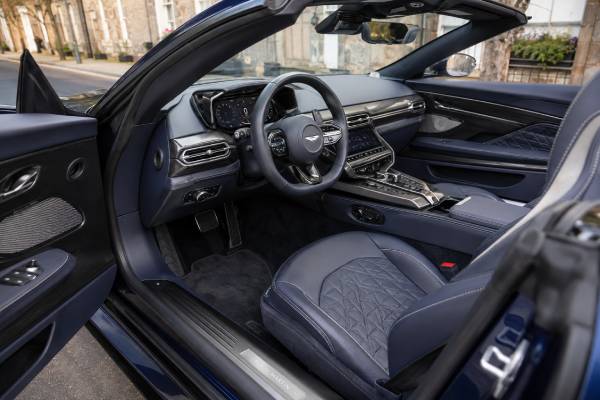
The driver faces a 10.25-inch digital instrument display, while a second 10.25-inch touchscreen handles infotainment, navigation, climate settings, and vehicle functions. Physical controls remain for drive mode, transmission, chassis, exhaust, ventilation, parking assistance, and other frequent tasks. This mixed interface is easier to use while moving than a screen-only layout, but every switch and display should be tested because one fault can involve software, a local control, a network module, or low voltage.
Wireless Apple CarPlay, online navigation, live routing, and the Aston Martin mobile app support modern touring. Connected functions use an embedded cellular system and may depend on market coverage, subscription status, account transfer, and privacy settings. When buying used, confirm that the previous owner’s account has been removed, the vehicle can be assigned to the new owner, and any included service period is transferable. Do not assume that a feature shown in a launch brochure remains free indefinitely.
Sports Plus seats were the regular launch choice, with carbon-fiber Performance Seats available for a firmer hold. The correct seat is the one that remains comfortable after an hour, supports the shoulder blades, and allows full control without pressure points. Roof-down wind can exaggerate neck fatigue, so test at realistic speeds. Check seat heating, ventilation where fitted, memory, lumbar support, and easy access to the belt.
Climate performance matters in both roof positions. With the roof down, the system must manage direct sun and moving air; with it raised, it should demist the large glass area and maintain stable temperature without odor. A musty smell can indicate a normal cabin filter issue, retained moisture, or water ingress. Inspect footwells and areas behind the seats rather than masking the symptom with fragrance.
The Volante’s luggage space is shaped by the roof package. Tailored soft bags usually make better use of irregular areas than hard cases. Before a long tour, practice loading with the roof both raised and folded and confirm that nothing can interfere with the mechanism. Keep emergency equipment, charging cable, documents, and rainwear accessible instead of burying them under the main luggage.
Volante-Specific Maintenance and Storage
Volante ownership adds roof and water-management care to the coupe’s V12, brake, tire, software, and battery requirements. Preventive attention is far cheaper than repairing stained trim, damaged control modules, a misaligned mechanism, or a carbon-ceramic brake system neglected because the car covered little mileage.
Follow the official time-and-mileage service schedule for the exact VIN and market. Use only the specified engine oil, filters, coolant, brake fluid, and other service materials. The V12’s high output and turbocharger heat make correct oil quality and warm-up practice especially important. Low annual mileage does not suspend fluid aging, moisture absorption, seal inspection, or software campaigns.
A roof-care schedule should include:
- Gentle cleaning with fabric-approved products and complete drying before folding for storage.
- Inspection of seams, outer fabric, headliner, seals, header rail, tonneau edges, and window contact.
- Clearing drainage paths using the approved method rather than wire or compressed air that can dislodge a hose.
- Operating the roof periodically in a safe environment to keep the mechanism exercised.
- Recording slow movement, unusual noise, asymmetry, warning messages, or water traces immediately.
Do not store the car for months with the roof folded. The fabric can develop persistent creases, dirt can be compressed into the stack, and dampness can remain trapped. Store it raised, clean, dry, and correctly latched unless the owner’s documentation says otherwise. Use a breathable indoor cover only on a clean car; a dirty or wind-blown cover can abrade paint and roof material.
Battery support is crucial. Roof motors, latches, windows, pumps or actuators, and control modules need stable voltage. Connect an approved maintainer at the designated points before extended storage. If roof operation becomes slow or stops, do not repeatedly cycle it on a weak battery. Stabilize voltage, read the warning, and follow the official recovery procedure. Improvised manual movement can damage synchronized components.
Check the cabin after heavy rain and washing. Touch carpets in several places, inspect behind seats, smell for dampness, and look for fogging that persists after normal ventilation. Deal with the entry path before drying the symptom. Water can travel along trim or wiring and appear far from the failed seal, so diagnosis may need controlled testing and partial trim removal by a specialist.
Tires age while parked. Maintain pressure, avoid prolonged loading on one spot, and inspect for flat spotting, sidewall cracking, punctures, and inner-shoulder wear. The bespoke acoustic construction and very high speed rating make casual substitutes inappropriate. If a puncture occurs, confirm whether repair is permitted for the exact location and internal foam arrangement.
Carbon-ceramic brakes should be kept clean of wheel chemicals and protected during tire work. Ask the workshop to use wheel supports and handling practices that prevent a wheel striking a disc. After washing or wet storage, drive carefully to dry the brakes when conditions permit. A parking brake left applied during a long damp lay-up can create avoidable problems.
Inspection, Configuration, and Buying Decisions
A Vanquish Volante should be chosen first for roof and structural integrity, complete history, correct tires and brakes, and a specification that works for two-person travel. Paint rarity and decorative carbon matter only after the expensive fundamentals have been verified.
When commissioning a new car, choose the roof color together with body paint, upper and lower carbon treatment, wheels, calipers, and cabin rather than as separate decisions. View physical samples outdoors and under artificial light. Strong contrast can emphasize the folded roof and rear deck; a tonal combination can make the car appear longer and calmer. Consider how pale leather, dark metal, and glossy carbon will behave in direct sun, not only in a studio configurator.
For a used or nearly new example, insist on a cold start and a dry, bright inspection followed by a water-management test if the seller permits. The checklist should cover:
- VIN, build sheet, registration, service invoices, warranty, campaigns, and key count.
- Roof fabric, stitching, headliner, latches, seals, drains, tonneau, and repeated operation.
- Cabin carpets, leather edges, electronics, lamps, and connectors for any sign of moisture.
- Carbon panels, bonded structure, panel gaps, paint, glass, underbody, and lifting points.
- Wheels, approved tires, alignment evidence, ceramic-disc measurements, and pad condition.
- Full diagnostic scan, software level, app transfer, cameras, sensors, displays, and audio.
- Road test from cold through operating temperature with the roof both raised and lowered.
During the drive, listen for wind whistle near the header, side-window flutter, body or trim creaks, wheel vibration, brake judder, driveline clunk, or inconsistent damper response. Some additional wind sound is inherent to a fabric-roof car, but a localized whistle or water path often has a correctable cause. Compare left and right sides and inspect seal contact afterward.
Previous paintwork is not automatically disqualifying, especially on a low nose exposed to stone chips. Quality, scope, reason, and documentation are what matter. Repairs to carbon fiber or the aluminum structure require more scrutiny than routine bumper refinishing. Use a specialist who can identify composite repair, assess bonded joints, examine geometry, and determine whether cameras or driver-assistance systems were recalibrated.
Secure storage should be planned before purchase. Measure the garage opening with mirrors, allow space for long doors, check overhead clearance during roof movement, and assess floor ramps. Avoid operating the top under a low opener rail or storage shelf. Confirm that the maintainer lead can be routed without crushing it and that the storage area is dry, ventilated, and protected from rodents.
The right example should feel resolved in both identities. With the roof raised it must be a quiet, dry, solid flagship; with the roof lowered it should deliver clean mechanism operation, controlled airflow, precise chassis behavior, and the full V12 experience without warning lights, vibration, or evidence that appearance was prioritized over maintenance.
References
- Aston Martin Vanquish Volante: The world’s fastest, most powerful front-engine convertible 2025 (Technical Release)
- Vanquish: Super GT V12 Sports Car | Aston Martin 2026 (Official Specifications)
- Vanquish at 25 – three generations of flagship performance and engineering excellence 2026 (Manufacturer History)
- Q by Aston Martin celebrates 60 years of Volante with exclusive anniversary editions 2025 (Manufacturer Release)
- Owner’s Guides | Aston Martin 2026 (Owner Documentation)
- Aston Martin Ownership | Luxury Car Servicing | Aston Martin 2026 (Official Ownership Information)
Disclaimer
This article is for informational purposes and does not replace professional diagnosis, repair, inspection, or purchasing advice. Specifications, torque values, intervals, roof procedures, software, and equipment can vary by VIN, market, and production date; confirm all work against the vehicle’s official service documentation and current Aston Martin guidance. Please share this article on Facebook, X/Twitter, or another platform if it was useful and you would like to support our work.