

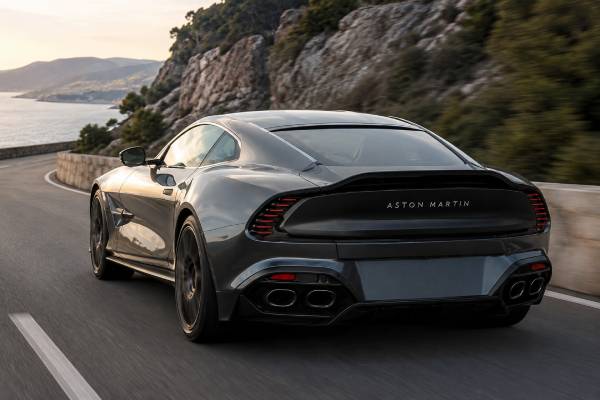
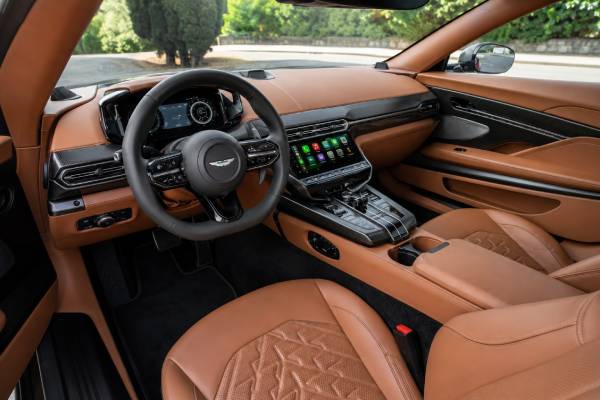
The third-generation Aston Martin Vanquish is a front-engine, rear-drive Super GT built around a 5.2-liter twin-turbo V12 that produces 824 hp and 1,000 Nm of torque. Introduced in 2024, it is not an update of the earlier carbon-bodied Vanquish; it uses a newer bonded-aluminum platform, carbon-fiber exterior panels, a rear-mounted eight-speed automatic, an electronic differential, carbon-ceramic brakes, and Aston Martin’s in-house infotainment architecture. Its 214 mph maximum speed makes it the fastest regular-production Aston Martin announced at launch, yet the car is intended to cross countries in comfort rather than behave like a stripped track special. That broad mission shapes every buying and ownership decision. Tire specification, suspension calibration, software condition, charging habits, and dealer support matter alongside color and trim. This guide explains what the AM370 Vanquish is, how its major systems work, which specifications deserve attention, and how to assess, configure, maintain, or buy one intelligently.
Table of Contents
- What Makes the AM370 Vanquish Different
- Vanquish Technical Specifications and Data
- How the New V12 Delivers Its Performance
- Chassis, Brakes, and High-Speed Control
- Cabin Technology and Grand-Touring Use
- Maintenance, Care, and Early Ownership
- How to Configure, Inspect, and Buy One
What Makes the AM370 Vanquish Different
The AM370 Vanquish is a new-generation flagship rather than a continuation of the 2012–2018 car. Its defining combination is a heavily reworked twin-turbo V12, a transaxle layout, active rear differential control, carbon-fiber bodywork, and a modern two-screen cabin, all tuned for very high speed without abandoning long-distance refinement.
Aston Martin revived the Vanquish name after a six-year gap and placed it above the DB12 and Vantage. Production was announced as fewer than 1,000 examples per year, which gives the car exclusivity without making it a one-off engineering project. First deliveries were scheduled for the fourth quarter of 2024. The practical consequence for shoppers is that early cars are still young: condition, correct software, warranty status, and evidence of careful running-in are generally more useful than conventional high-mileage wear analysis.
The engine sits behind the front axle line, while the ZF eight-speed automatic is positioned at the rear. A carbon-fiber propeller shaft runs through an alloy torque tube between them. This front-mid-engine transaxle arrangement helps approach an even front-to-rear mass distribution and places driveline weight where it can support traction. It also means the Vanquish is mechanically more integrated than a simple front-engine car with a gearbox bolted directly behind the engine. Diagnosis of vibration, shift behavior, differential noise, or driveline alignment should therefore be entrusted to technicians familiar with the complete system.
The body combines an extruded, bonded-aluminum structure with a full carbon-fiber outer skin. The long bonnet, 80 mm wheelbase extension ahead of the cabin, abrupt Kamm tail, and seven-blade rear lamps are visually dramatic, but each also reflects cooling, stability, packaging, or aerodynamic priorities. The standard panoramic glass roof admits only a small amount of light and uses a low-emissivity coating, avoiding a conventional blind. Buyers in very hot climates should still sit in a demonstrator parked in direct sun, because personal heat sensitivity and interior color can matter more than a specification-sheet claim.
Launch cars were presented as two-seaters with luggage space behind the occupants. By 2026 Aston Martin’s current model material also described a 2+2 arrangement, and the Vanquish 25 special edition was offered in either 2+0 or 2+2 form. Treat seating configuration as a build-specific fact, not an assumption based on model year alone. A rear-seat option may improve occasional usefulness, but it changes the cabin’s visual character and the way luggage is carried. Verify the factory build sheet before valuing one configuration over another.
Vanquish Technical Specifications and Data
The AM370 is an ICE vehicle: propulsion comes solely from a gasoline twin-turbo V12, with no traction hybrid system or externally chargeable battery. It uses rear-wheel drive, a rear-mounted automatic transmission, and an electronically controlled differential. The figures below apply to the current-generation coupe; federal-market length and equipment can differ from rest-of-world specification.
| Specification | AM370 Vanquish coupe |
|---|---|
| Engine type | All-alloy, quad-cam, 48-valve twin-turbo V12 |
| Displacement | 5.2 liters |
| Installation | Front-mid-mounted, longitudinal |
| Maximum power | 835 PS / 824 bhp at 6,500 rpm |
| Maximum torque | 1,000 Nm / 738 lb-ft from 2,500–5,000 rpm |
| Compression ratio | 9.3:1 |
| Induction and cooling | Twin turbochargers with water-to-air charge cooling |
| Specification | Value |
|---|---|
| Drive type | Rear-wheel drive |
| Transmission | ZF eight-speed automatic, rear mounted |
| Differential | Electronic rear differential |
| Final-drive ratio | 2.93:1 |
| 0–62 mph / 0–100 km/h | 3.3 seconds |
| Maximum speed | 214 mph / 345 km/h |
| Steering | Electric power assistance, 2.27 turns lock-to-lock |
| Area | Factory specification |
|---|---|
| Body structure | Extruded bonded aluminum |
| Exterior panels | Carbon fiber, including door outers and body sides |
| Front suspension | Independent double wishbones, coil springs, anti-roll bar, adaptive dampers |
| Rear suspension | Multi-link, coil springs, anti-roll bar, adaptive dampers |
| Dampers | Bilstein DTX adaptive system |
| Front brakes | 410 mm carbon-ceramic discs, six-piston monoblock calipers |
| Rear brakes | 360 mm carbon-ceramic discs, four-piston monoblock calipers |
| Measurement | Value |
|---|---|
| Length | 4,855 mm rest of world / 4,895 mm federal |
| Width | 2,044 mm mirrors folded / 2,120 mm including mirrors |
| Height | 1,290 mm |
| Wheelbase | 2,885 mm |
| Ground clearance | 120 mm |
| Turning circle, curb to curb | 12.7 m |
| EU certified unladen mass | 1,910 kg |
| Fuel tank | 82 liters |
| Boot volume | 248 liters |
| Specification | Value |
|---|---|
| Wheels | 21-inch forged alloy |
| Front tires | 275/35 ZR21 on 9.5J wheels |
| Rear tires | 325/30 ZR21 on 11.5J wheels |
| Summer tire | Bespoke Pirelli P Zero PZ4 with noise-cancelling system |
| Winter tire | Bespoke Pirelli P Zero Winter 2 |
| WLTP combined consumption | 13.7 L/100 km / 20.7 imperial mpg |
| WLTP combined CO2 | 312 g/km |
Published acceleration, consumption, and emissions values come from controlled procedures and do not predict every car in every setting. Temperature, fuel, tire condition, altitude, options, load, road surface, and local certification rules affect results. The 214 mph figure is a capability statement, not a suitable target for public roads; it also makes correct speed-rated tires and professional wheel inspection non-negotiable.
How the New V12 Delivers Its Performance
The Vanquish produces its extraordinary pace through broad, managed torque rather than only a dramatic peak-power number. Its 1,000 Nm plateau begins at 2,500 rpm and continues to 5,000 rpm, so overtaking performance arrives without waiting for repeated downshifts or very high engine speed.
Although the 5.2-liter capacity is familiar from other modern Aston Martin V12s, the flagship engine was substantially reworked. The cylinder block and connecting rods were strengthened; cylinder heads, cam profiles, intake ports, and exhaust ports were revised; spark plugs were repositioned; and higher-flow injectors were fitted. Reduced-inertia turbochargers can operate at a higher maximum speed. These changes support 160 PS per liter while meeting current emissions requirements, but they also increase the importance of correct oil, warm-up discipline, cooling-system health, and calibrated software.
Boost Reserve is a key part of the response strategy. Under partial throttle, the engine management system can build more intake pressure than the driver’s immediate torque request requires. It balances throttle position and turbo wastegate control so that stored boost is ready when the accelerator is pressed further. The driver experiences a cleaner, faster step into full torque. It is not a separate power mode or temporary overboost figure, and it should not be confused with launch control.
The transmission’s location and calibration shape how the engine feels. In GT mode, torque delivery is softened enough for wet roads, traffic, and relaxed touring. Sport and Sport+ sharpen the response, hold ratios differently, and bring more exhaust presence. Manual selection is available through the paddles. Owners should judge low-speed smoothness only after the driveline is fully warm and should compare behavior with another known-good car if shifts feel abrupt, delayed, or inconsistent. Adaptation, software, battery voltage, and genuine mechanical faults can create similar symptoms, so guesswork is expensive.
A 2.93:1 final drive helps the car achieve its high maximum speed. The result is not a frantic, short-geared character; instead, the V12’s torque fills the ratios. That is appropriate for a flagship GT, but it puts a large energy load through the rear tires whenever full throttle is used. Cold rubber, standing water, mismatched tire models, or old compounds can overwhelm the available grip even when tread depth appears legal.
Chassis, Brakes, and High-Speed Control
The Vanquish’s chassis is designed to make 824 hp usable, not merely impressive on paper. Its most important tools are a stiffened bonded-aluminum structure, wide-band adaptive dampers, predictive stability control, an electronic rear differential, and standard carbon-ceramic brakes.
Aston Martin quoted a 75 percent increase in lateral stiffness over the DBS 770 Ultimate. Additional underbody reinforcement, revised crossmembers, a stiffer engine brace, and strengthened rear damper mounting areas give the suspension a more stable platform. That allows softer compliance in GT mode without letting the body move inaccurately when loads rise. It also means crash repair quality is critical. Bonded aluminum and carbon-fiber panels require model-appropriate measuring, joining, curing, finishing, and calibration procedures. A glossy cosmetic repair proves little about structural accuracy.
Bilstein DTX dampers offer a wide separation between modes. GT should remain controlled but absorb imperfect roads; Sport and Sport+ progressively tighten vertical and body-motion control. A harsh ride in every setting can point to tire pressure, tire construction, wheel damage, alignment, a fault in the damping system, or unsuitable aftermarket parts. Conversely, float, repeated bouncing, or inconsistent behavior from side to side warrants diagnosis rather than being dismissed as the price of a comfortable GT.
The electronic differential can move from open to fully locked in 135 milliseconds. Its job changes with speed, steering angle, accelerator input, stability setting, and available grip. In a tight corner it can help the long car rotate; during fast direction changes it can support stability; on a variable surface it can manage rear-axle slip more precisely than a fixed mechanical differential. Because it works with the stability system, wheel-speed data and matching tire circumference are important. One incorrectly sized or heavily worn tire can disturb systems that compare wheel behavior continuously.
Carbon-ceramic discs measure 410 mm at the front and 360 mm at the rear. Compared with equivalent iron brakes, the system reduces unsprung mass by a quoted 27 kg and resists fade at very high temperatures. The ownership trade-off is cost and inspection sensitivity. Chips, impact marks, surface condition, remaining wear allowance, pad thickness, caliper condition, and correct wheel-removal technique all matter. Ceramic discs can last a long time in normal road use, but damage or track heat cycles can change the picture. Obtain measured condition rather than accepting “lifetime brakes” as a sales claim.
The bespoke Pirelli setup is part of the chassis calibration. Front and rear sizes differ, so rotation is not available in the usual sense. Replace tires in axle pairs at minimum, preserve the approved specification, and assess age as well as tread. The acoustic foam used to reduce cabin noise can complicate some puncture repairs and sealant use; follow tire-maker and Aston Martin guidance. Examine the inner shoulders because wide, low-profile rear tires can hide wear from a casual outer-edge glance.
Cabin Technology and Grand-Touring Use
The AM370 cabin is far more digitally capable than earlier Vanquish generations, but it retains physical controls for frequent driving functions. Buyers should evaluate the displays, connected services, audio, seating layout, and climate behavior as carefully as the leather and carbon trim.
A 10.25-inch digital driver display works with a separate 10.25-inch central touchscreen. Navigation can use online search, live traffic, three-dimensional mapping, and satellite imagery, while wireless Apple CarPlay provides an alternative interface. The car also communicates with Aston Martin’s mobile application through an embedded cellular connection. At launch, connected subscription packages were described as complimentary for three years, so a used buyer should establish the remaining term, market availability, transfer process, and which features require an active account.
Software condition is part of vehicle condition. Test cold start, user-profile loading, cameras, parking sensors, navigation, audio sources, Bluetooth, phone projection, app pairing, over-the-air or dealer-update status, and every steering-wheel or console shortcut. A reboot that solves a temporary fault once is different from a system that repeatedly freezes. Record software complaints before warranty expiry and keep dealer job cards even when no hardware is replaced.
The standard panoramic roof is tinted to roughly six percent light transmission and uses UV and low-emissivity treatment. It gives the coupe a more open feeling but cannot be covered by a conventional sliding blind. Pale upholstery may reduce perceived heat, while dark trim can emphasize glare or temperature for some occupants. Inspect the glass for chips, edge damage, seal disturbance, optical distortion, and signs of previous removal. Confirm insurance glass coverage because a large, model-specific panel is not comparable with an ordinary windscreen claim.
Seat choice affects both comfort and access. Sports Plus seats were standard at launch, while carbon-fiber Performance Seats were optional. A firmer, more supportive shell can be ideal for an athletic driver yet tiring for another owner on a six-hour journey. Test the actual seat, not a similarly named seat in another Aston Martin. Check all electric movement, memory, heating or ventilation where fitted, and make sure the driving position leaves enough clearance for knees and paddle operation.
The launch cabin is purposefully two-seat, with a rear cross-brace and shaped luggage areas. Later material introduced a 2+2 alternative. Neither is automatically better. The two-seat layout gives a focused flagship atmosphere and useful in-cabin storage for tailored bags. The 2+2 adds occasional passenger capacity, but prospective users should inspect access and space rather than assuming “rear seats” means adult grand-touring accommodation. The published 248-liter boot remains modest for a car this long, so trial-pack the luggage required for actual trips.
Maintenance, Care, and Early Ownership
A new Vanquish should be maintained by time, condition, and official schedule, not by low mileage alone. The most effective ownership strategy is to keep the battery supported, use the correct fluids and tires, document software updates, inspect carbon-ceramic brakes properly, and resolve small faults while warranty coverage is active.
Follow the service interval shown in the market-specific owner’s and service documentation. Specifications and procedures may change by VIN, and the hand-built V12 deserves the exact approved oil rather than a generic viscosity chosen from an internet discussion. Retain invoices that identify the oil, filter, parts, software operations, and inspection results. A stamped booklet without detail is less useful when a future buyer or warranty assessor asks what was actually done.
Running-in instructions should be followed from delivery or after major component replacement. Avoid sustained maximum load, repeated launch starts, and long periods at one engine speed until the official distance and conditions are satisfied. Warm-up means allowing oil, transmission fluid, differential, tires, and brakes to reach useful temperature—not merely waiting for coolant to move off its stop. After hard use, give the car a calm final period rather than switching off immediately at peak thermal load.
Low-use cars need deliberate battery management. The Vanquish carries numerous always-on control modules and connected functions. Use the Aston Martin-approved maintainer and correct connection points, keep the car within keyless-entry recommendations, and do not assume a modern battery can tolerate repeated deep discharge. Low voltage can produce multiple unrelated warnings, failed updates, lost settings, or difficult diagnosis. If the battery has gone flat, record why and have its condition tested rather than simply clearing codes.
Create a simple ownership routine:
- Check tire pressures cold and inspect both inner and outer surfaces before long trips.
- Look under the car for fluid, impact, or diffuser damage after unfamiliar ramps or roads.
- Confirm oil, coolant, brake, and warning status through the approved checks.
- Operate climate control, cameras, seats, and other systems regularly so faults appear before a critical journey.
- Keep the fuel fresh and the tank at a sensible level during storage.
- Arrange annual professional inspection even when mileage is minimal.
Carbon-fiber paintwork benefits from careful washing rather than aggressive correction. Examine exposed edges, lower aero parts, door areas, bonnet vents, and the rear shield for chips or lifting film. If paint-protection film is fitted, document the installer and installation date. Poor removal technique can damage clearcoat or reveal a color difference. Matte, special, or Q finishes may need product-specific care.
The forged wheels are vulnerable to pothole impact and cosmetic damage from unsuitable tire equipment. Request a road-force balance or runout check if vibration appears. Never allow a shop to lift the car, remove wheels, or handle carbon-ceramic brakes without the correct points, tools, and torque procedure. Incorrect wheel-bolt torque or dropped wheels can create expensive consequences.
Warranty terms depend on market, registration date, and coverage product. Before expiry, ask for a complete diagnostic scan and document intermittent faults with video, time, temperature, and operating conditions. Extended coverage may be valuable, but read exclusions for wear, carbon-ceramic components, tires, trim, glass, battery, modifications, and track use. The headline term matters less than what the contract will actually pay for.
How to Configure, Inspect, and Buy One
The best Vanquish is the car whose specification suits its intended use and whose history is transparent. Whether ordering new or buying an early used example, prioritize seating layout, seat comfort, climate suitability, tire and brake condition, warranty, software status, and repair evidence before highly personal decorative choices.
For a new commission, start with use rather than color. A touring owner may favor Sports Plus seats, a restrained cabin, durable exterior finish, winter-tire availability, and practical luggage. A collector may value a rare Q color, titanium exhaust, exposed carbon, or a historically informed combination. Highly unusual choices can be rewarding, but they narrow the resale audience. Obtain written confirmation of every option, especially items that are difficult to identify after delivery.
For an existing car, use a methodical pre-purchase process:
- Match the VIN, registration, build specification, invoices, and warranty records.
- Confirm ownership of keys, charging equipment, books, accessories, and any tailored luggage.
- Inspect paint depth, carbon-fiber surfaces, glass, underbody, wheels, tires, and brake discs under strong light.
- Scan all control modules and verify completed software updates or campaigns.
- Test every cabin, driver-assistance, connected, and parking function.
- Drive from cold through full operating temperature on varied roads.
- Obtain a written estimate for every defect before agreeing value.
A cold inspection is essential. Listen for abnormal mechanical noise, watch the start sequence, and confirm that warning lamps perform their check and extinguish appropriately. During the drive, assess steering straightness, brake feel, shift quality, differential behavior, ride-mode separation, vibration, and heat-related warnings. The car should feel coherent, not merely fast. A seller who warms it before arrival removes useful evidence.
Accident and transport damage can be subtle. Inspect low front edges, undertrays, jacking zones, wheel barrels, diffuser surfaces, bonnet and door gaps, glass dates, and paint transitions. Carbon panels can be cosmetically repaired, so use a specialist who understands both composite and bonded-aluminum structures. Ask where work was performed and whether calibrations and alignment records exist.
The strongest purchase is often neither the cheapest nor the most optioned. It is the Vanquish that starts cleanly from cold, carries complete factory and service records, shows no questionable repair or modification, has matching fresh tires and healthy brakes, operates every digital function, and is supported by a seller willing to permit a thorough independent inspection.
References
- Vanquish: Super GT V12 Sports Car | Aston Martin 2026 (Official Specifications)
- Aston Martin Vanquish – An icon returns to reign supreme 2024 (Technical Release)
- Vanquish at 25 – three generations of flagship performance and engineering excellence 2026 (Manufacturer History)
- Aston Martin Vanquish unveiled with stunning world premiere in Venice 2024 (Launch Release)
- Owner’s Guides | Aston Martin 2026 (Owner Documentation)
- Aston Martin Ownership | Luxury Car Servicing | Aston Martin 2026 (Official Ownership Information)
Disclaimer
This article is for informational purposes and is not a substitute for professional diagnosis, repair, inspection, or purchasing advice. Specifications, torque values, service intervals, software, and procedures can vary by VIN, market, production date, and equipment; verify every requirement against the vehicle’s official service documentation and current Aston Martin information. Please share this guide on Facebook, X/Twitter, or another platform if it helped you support our work.