
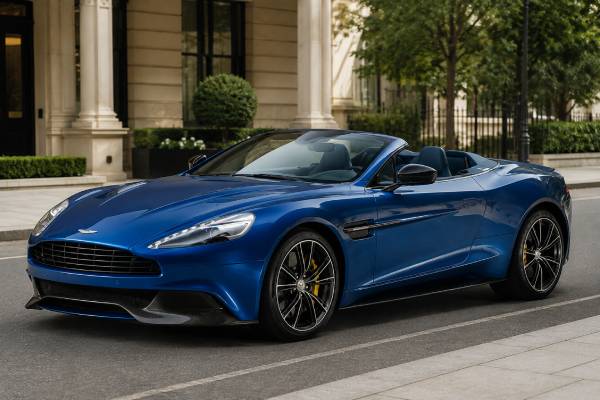
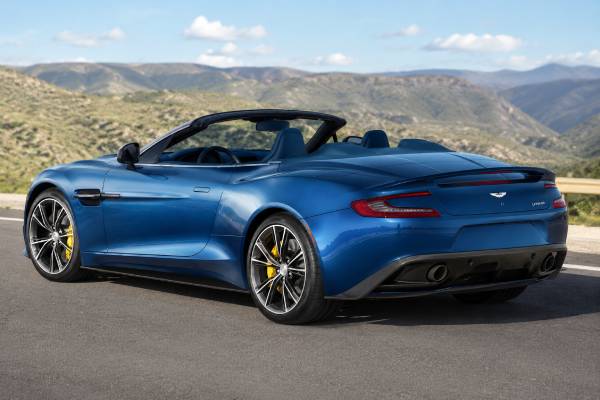
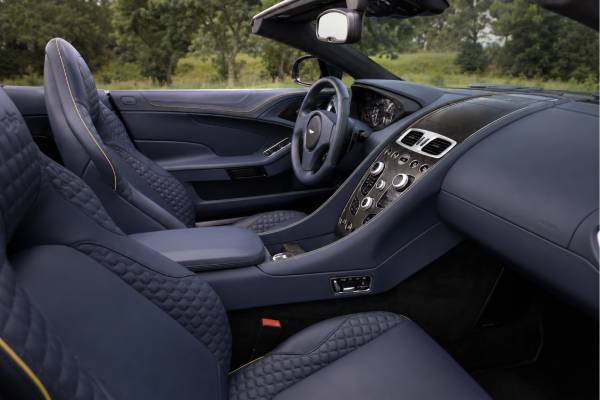
The 2014–2017 Aston Martin Vanquish Volante with the AM29 V12 is the mature, eight-speed version of the second-generation convertible. Its 568 hp output appears only slightly higher than the earlier car’s 565 hp, yet Touchtronic III gearing helps it reach 201 mph and approximately 62 mph in 3.8 seconds. That makes it unusually close to the coupe in outright pace while preserving the fabric roof, 2+2 cabin, carbon-fibre body, adaptive suspension, and carbon-ceramic brakes that define the open flagship. Buying one requires two parallel inspections: a super-GT assessment of engine, transaxle, brakes, dampers, tyres, and structure, and a convertible assessment of hood hydraulics, sensors, drains, seals, glass alignment, and hidden moisture. Software campaigns and V12 starter-solenoid service actions may also be VIN-specific. A properly maintained example can cross countries with the roof down and deliver one of Aston Martin’s richest naturally aspirated soundtracks. A neglected one can accumulate several expensive systems at once, so documentation and roof integrity outrank low mileage.
Table of Contents
- The Mature AM310 Volante
- Eight-Speed Volante Data
- How the Roof and Structure Shape the Car
- Touring Performance with Touchtronic III
- Weatherproofing, Interior, and Storage Care
- V12, Roof, and Chassis Maintenance
- A Volante-Specific Buying Process
The Mature AM310 Volante
The AM29 Volante is the version that combines the second-generation convertible’s developed chassis with the quicker eight-speed drivetrain. It is neither simply an early Volante with three more horsepower nor a Vanquish S without the badge; its identity is the broadest blend of open-air comfort and 201-mph performance in the regular AM310 range.
The original 565 bhp Volante already matched the coupe’s 183 mph top speed, but its six-speed gearbox created wider gaps between ratios. The 568 bhp update added Touchtronic III, which made better use of the naturally aspirated engine’s upper-rev power and transformed response from low and medium speed. More ratios also allow a calmer cruising gear, useful in a car intended for long journeys.
The design remained one of the model’s main attractions. Carbon-fibre exterior panels form the deeply sculpted body, while the fabric hood preserves a clean roofline when raised and a low rear profile when folded. The bonded aluminium VH platform carries the primary loads, with convertible-specific reinforcement compensating for the absence of a fixed roof.
That construction gives the buyer several layers to evaluate. Cosmetic carbon damage may be expensive but localized. Damage to the aluminium structure or suspension mounting points is more serious. Roof-frame misalignment may be mechanical, body-related, or the result of previous repair. A specialist must determine which layer is responsible rather than adjusting windows and seals to disguise a deeper problem.
The date range can create confusion. Cars registered in late 2014 or described generically as “2014 Vanquish Volante” may have different drivetrains depending on production and market timing. Count the ratios through documentation and diagnostics, identify the AM29 specification, and confirm 568 bhp factory output. The 2017 model year also overlaps the arrival of the more powerful Vanquish S Volante, which has different exterior and chassis details.
For many buyers, the regular 568 hp Volante is the sweet spot. It offers the quicker gearbox and full 201-mph capability without the sharper styling or price premium of the S. Its suspension and exhaust are still dramatic enough for enthusiastic driving, while the visual treatment can appear more elegant and less aggressive.
Eight-Speed Volante Data
Its propulsion classification is petrol ICE: a naturally aspirated V12 powers the rear wheels through a rear-mounted eight-speed automatic transaxle. It keeps the AM310’s carbon-fibre body and adaptive double-wishbone chassis while adding the weight and packaging of a power-operated fabric hood. The data apply to the 568 bhp AM29 version, not the earlier six-speed or later S.
| Item | Value |
|---|---|
| Engine | Naturally aspirated petrol V12 |
| Capacity | 5,935 cc (5.9 litres) |
| Maximum power | 568 bhp (576 PS) |
| Maximum torque | About 630 Nm (465 lb-ft) |
| Engine location | Front-mid mounted |
| Driven axle | Rear |
| Measure | Published result |
|---|---|
| Transmission | Eight-speed Touchtronic III automatic rear transaxle |
| 0–62 mph (0–100 km/h) | Approximately 3.8 seconds |
| Maximum speed | 201 mph (324 km/h) |
| Shift interface | Automatic modes and fixed column paddles |
| Drive modes | Powertrain and adaptive-chassis settings according to specification |
| Measurement | Value |
|---|---|
| Length | About 4,728 mm (186.1 in) |
| Width excluding mirrors | About 1,910 mm (75.2 in) |
| Wheelbase | 2,740 mm (107.9 in) |
| Published kerb mass | About 1,844 kg (4,065 lb) |
| Boot capacity | About 279 litres (9.9 cu ft) |
| Seating | 2+2 |
| Area | Configuration |
|---|---|
| Main structure | Bonded aluminium VH platform with convertible reinforcement |
| Body panels | Carbon fibre |
| Roof | Power-operated fabric folding hood |
| Suspension | Double wishbones front and rear |
| Dampers | Adaptive, electronically controlled |
| Brakes | Carbon Ceramic Matrix discs |
| Item | Detail |
|---|---|
| Wheel diameter | 20 inches |
| Fuel | Premium unleaded gasoline |
| Fuel capacity | Approximately 78 litres (20.5 US gal) |
| Roof-down luggage approach | Soft bags kept clear of roof partitions and mechanisms |
| Electronic safety | ABS, traction control, and stability control |
The exact mass, tyre specification, options, and homologated consumption vary by market. Use VIN-specific documents for service and loading decisions.
How the Roof and Structure Shape the Car
The roof system affects rigidity, noise, luggage space, water management, and long-term value, so it is a core part of the car rather than an accessory. A fully functional hood should move evenly, latch without strain, align with every window, and leave the interior dry after controlled water testing.
The fabric hood uses a powered frame, hydraulic or electrohydraulic actuation, position sensing, latches, and coordinated window movement. Each component must agree before the cycle completes. Low voltage, a sensor out of position, a binding joint, hydraulic leakage, or incorrect glass adjustment can interrupt operation.
Operate the roof multiple times from a healthy battery. Watch left and right frame movement, the tonneau area, window sequence, and final latch. A pump that sounds strained, runs unusually long, or leaves residue should be investigated. Repeatedly cycling a faulty roof can turn an adjustment problem into damaged hardware.
Inspect the fabric at fold lines and edges. The material should not have severe abrasion, tears, loose seams, detached rear-window bonding, or hardened areas. A replacement hood is not automatically negative; a recent, professionally fitted top may be preferable to original fabric that has shrunk. The invoice should identify materials and installer.
Water follows designed channels around the hood well and body. Leaves, dust, wax, or degraded seals can redirect it into trim cavities. Check drains gently and inspect beneath visible carpet. Moisture may hide in underlay, seatbelt areas, behind rear side trim, or around modules. Corroded connectors can produce faults long after the surface dries.
The bonded aluminium structure must resist loads without the benefit of a fixed roof panel. Aston Martin reinforced the Volante, but added mass and different torsional behavior remain. A healthy car may show a little more movement than the coupe on a diagonal bump; repeated steering-column shake, changing door gaps, rattling latches, or roof-header movement are not automatically normal.
Carbon panels can crack from impact or incorrect jacking. The low splitter and rear diffuser are vulnerable, while long doors can suffer edge damage in tight spaces. Inspect mounts and underside surfaces, not only paint. A repair should address the cause and structure, not just refinish the visible carbon.
Door hinges, latches, and window regulators carry extra importance because the glass is part of the weather seal. Check that the window drops on opening, rises to the correct height, and meets the hood consistently. A door should not sag or need force. Adjustment should follow body-alignment confirmation.
Touring Performance with Touchtronic III
Touchtronic III makes the Volante feel significantly more responsive without sacrificing its relaxed nature. The gearbox’s eight ratios help the V12 stay near its strongest engine speed during acceleration and then settle into a tall cruising gear when the road opens.
The engine’s response is progressive. At modest throttle it is smooth and easy to place; at higher revs it becomes urgent and sonorous. Roof-down driving makes that transition the centre of the experience. It also makes mechanical noises easier to hear, which is useful during inspection: exhaust leaks, mount thumps, wheel-bearing hum, and driveline vibration are less masked.
Automatic mode should move between ratios coherently. Paddle mode is useful for overtaking, descents, and flowing roads. The fixed paddles remain easy to locate while steering, although a driver accustomed to wheel-mounted paddles may need time to adapt. Healthy shifts may be firm in aggressive modes but should not flare, shudder, or produce warnings.
The rear transaxle and torque tube contribute to weight distribution, yet they create several possible vibration paths. Test steady throttle, acceleration, lift-off, and light reapplication at different speeds. A specialist should distinguish tyre imbalance from wheel damage, propshaft or torque-tube issues, mounts, differential noise, or internal gearbox behavior.
At 201 mph maximum capability, tyre quality is fundamental even when the car is used only at legal speeds. Correct speed and load ratings, matching construction, current date codes, and proper pressures support stability. A hardened tyre can make the car skittish in rain and can exaggerate convertible shake over sharp impacts.
Adaptive damping should control the extra mass without making the ride brittle. Try every mode on the same road. The softest setting should permit more movement but retain control; firmer modes should reduce roll and pitch. No change, warning messages, leakage, or repeated bouncing points to faults.
The carbon-ceramic brakes offer strong heat capacity and reduced unsprung weight. Their cold, wet, or low-speed sound can differ from steel brakes, but the pedal should be consistent and braking straight. Disc condition needs approved inspection because replacement is expensive. Do not let a general workshop judge them by the lip used on an iron disc.
Roof-up refinement is part of performance. A 201-mph convertible was engineered to cruise securely, so excessive wind whistle, hood drumming, or header movement deserves correction. Roof-down, test the wind deflector if supplied and verify that windows can be positioned without binding.
Weatherproofing, Interior, and Storage Care
Dry, ventilated storage and disciplined roof care prevent more problems than cosmetic products. The hood should be stored raised and clean for long periods, while the battery remains supported and drains stay clear.
Never fold the roof while it is wet or contaminated with grit. Moisture trapped in folds encourages staining and odor; grit abrades fabric. After washing or rain, raise the hood in a ventilated area until fully dry. Use a soft brush and manufacturer-compatible cleaner rather than household detergent or aggressive pressure.
Avoid leaving the car under a non-breathable cover while damp. Condensation can affect leather, electronics, aluminium fasteners, and roof hardware. A tailored breathable cover in a dry garage is preferable. Outdoor storage increases UV exposure, drain load, seal aging, and the chance of debris entering the roof well.
Leather and upper trim receive more sunlight than in the coupe. Inspect dashboard coverings, door caps, seat shoulders, stitching, steering-wheel surfaces, and carbon lacquer. Conditioning cannot reverse shrinkage or failed adhesive. A specialist trimmer should preserve original patterns and colour where restoration is needed.
The boot is useful for a convertible but smaller than the coupe’s. Keep luggage below the specified divider and away from moving parts. Soft bags reduce the chance of forcing a rigid case into trim. Confirm that the powered boot lid, latch, emergency release, and water seals work.
Climate control must be evaluated with the hood up. Strong cooling, stable fan speeds, correct distribution, and clear demisting are essential. Persistent fogging or a musty smell may reveal moisture. Check the evaporator drain and cabin filter as part of diagnosis.
The infotainment system is dated but integrated. Test audio, navigation, Bluetooth, parking aids, cameras, media inputs, and steering controls. A modern interface upgrade is most successful when reversible and electrically isolated from original circuits. Poorly fitted units can create battery drain or interfere with trim and roof controls.
Keep a travel kit suited to the vehicle: tyre-inflation equipment specified by Aston Martin, soft cleaning cloths, a roof emergency reference, battery information, roadside-assistance details, and contacts for a specialist. Do not carry unrestrained hard objects in the rear seats because open-top turbulence and hard braking can move them.
V12, Roof, and Chassis Maintenance
Maintenance should be coordinated across systems because a weak battery can stop the roof, a damp connector can trigger chassis warnings, and old tyres can make healthy dampers feel poor. A workshop that understands only the engine may miss the most expensive convertible risks.
Service the V12 by time and mileage using correct oil, filters, plugs, and coolant. Inspect coils, throttle bodies, belts, hoses, heat exchangers, fans, and evidence of catalyst stress. A misfire warning needs prompt diagnosis because unburned fuel can damage catalytic converters.
Check the starter-solenoid service action by VIN. Aston Martin’s SA-18-0252 addressed electrical connection details on certain V12 cars, including Vanquish. Poor contact or unsuitable wire routing could contribute to difficult starting, no-start conditions, or electrical short risk. Completion should be documented rather than inferred from a recent battery.
Some 2014–2016 US-market Vanquish vehicles were included in the double-locking recall. The concern was that a double-locked car might not allow an occupant to unlock a door from inside. Software disabled the function. A 2017 registration does not eliminate the need to check if the car was built within an affected range or imported from another market.
The eight-speed transaxle requires correct fluid and level procedures. Inspect for leaks and review adaptation or software history. A battery event can produce transmission faults, so voltage and charging tests should accompany diagnosis.
Roof maintenance includes fabric cleaning, seal conditioning with approved products, hinge and linkage inspection, hydraulic leak checks, sensor calibration, drain clearing, and window alignment. Do not lubricate every visible joint indiscriminately; the wrong product can attract dirt or damage seals.
Ceramic discs, tyres, wheels, and dampers should be inspected together. Record ceramic measurements, pad life, tyre dates, wheel runout, alignment, and damper condition. A car that vibrates may have several small contributors rather than one dramatic fault.
Review underbody fasteners and dissimilar-metal interfaces for corrosion or poor prior repair. Lift only at approved points. Incorrect jacking can damage carbon panels or the aluminium structure and may leave marks that are easy to miss from above.
A Volante-Specific Buying Process
A Volante-specific purchase begins with a dry roof test and ends with a fully hot mechanical test; reversing that order risks spending hours on the V12 before discovering a wet, misaligned body. Arrange inspection when the seller can leave the car cold and unwashed.
Verify identity first. Confirm AM29 engine specification, eight-speed gearbox, build date, VIN, market, original colour and hood, interior trim, 2+2 layout, and options. Ask for a factory build record when a rare specification affects price.
Inspect the roof before starting the engine. Look at fabric tension, seams, fold marks, seals, glass contact, latches, drain entrances, and the roof well. Smell the cabin and boot. Lift accessible carpet and use a moisture meter. A freshly detailed interior can still be wet underneath.
Test the battery, then cycle the roof. Any hesitation, asymmetry, warning, leak, or incomplete latch should be recorded on video for diagnosis. Repeat after the road test because heat can change hydraulic and sensor behavior.
The mechanical inspection should include:
- Cold start, hot restart, engine scan, and misfire history.
- Eight-speed engagement, all modes, paddle shifts, leaks, and adaptation data.
- Carbon body, aluminium structure, undertrays, and repair quality.
- Ceramic discs and pads assessed with Aston-appropriate criteria.
- Dampers, bushes, joints, wheels, tyres, bearings, and alignment evidence.
- Roof modules, body electronics, windows, climate, locks, and infotainment.
- Recall and service-action completion verified by VIN.
Drive roof-up over rough surfaces, then roof-down over the same route. This separates hood noise from suspension and structure. Test braking, full-temperature cooling in traffic, steering at motorway speed, and low-speed manoeuvring. Recheck the boot and cabin for water after a controlled hose test if the owner permits.
Read invoices for patterns. Repeated roof adjustments without seal or structure diagnosis, recurring low-voltage faults, multiple alignment visits, unexplained ceramic-brake comments, or frequent no-start incidents deserve further work. Large recent expenditure can be reassuring when it addressed root causes.
Price immediate needs before choosing between cars. A set of tyres, ceramic work, dampers, roof hydraulics, leather restoration, and carbon repair can exceed the premium for a better example. Low mileage does not protect seals, batteries, fabric, hydraulic components, or tyres from age.
Confirm that the emergency roof procedure, tools, tonneau components, wind deflector, battery conditioner, and both keys remain with the car. Missing model-specific accessories can be inconvenient to replace and may reveal careless storage or incomplete transfer between owners.
Choose this Vanquish when the priority is a naturally aspirated V12 convertible that can also tour seriously. The coupe is lighter and has more luggage room; the S Volante is sharper and more collectible to some buyers. The 568 hp Volante offers the balanced middle: smooth eight-speed usability, full 201-mph performance, and a less aggressive visual character. Its pleasures are large, but only a dry, documented, structurally sound car delivers them without constant distraction.
References
- VANQUISH VOLANTE (Manufacturer Historic Model Archive)
- Q2 2014 Results 2014 (Manufacturer Technical Update)
- Vanquish at 25 – three generations of flagship performance and engineering excellence 2026 (Manufacturer History)
- Part 573 Safety Recall Report 15V-846 2015 (Safety Recall)
- Service Action 2016 (Starter Solenoid Service Action)
- Owner’s Guides | Aston Martin (Manufacturer Owner Resources)
Disclaimer
This guide is for informational purposes and cannot replace professional diagnosis, repair, convertible-roof service, or an independent inspection. Specifications, torque values, fluids, intervals, recall coverage, and procedures differ by VIN, market, production date, and equipment; verify all technical work with official documentation for the exact car. Please share the article on Facebook, X/Twitter, or a relevant owner group if it was useful.