


The 2018–2023 Aston Martin Vantage replaced the long-running VH model with a wider, stiffer, turbocharged sports car built around a new bonded-aluminium architecture. Its Aston-calibrated 4.0-litre M177 V8 produces 503 hp and 685 Nm, driving the rear wheels through an eight-speed ZF automatic transaxle and Aston Martin’s first production electronic rear differential. The result is far quicker and more torque-rich than the naturally aspirated V8 it replaced, yet still uses front-mid engine placement, rear transaxle packaging, and two-seat hatchback practicality to preserve the Vantage formula. Across six model years, the core output remained stable while software, equipment, trim, option packages, and special derivatives evolved. Used-car quality now varies more with maintenance, battery health, tyres, brakes, cooling-system condition, electronic diagnostics, and accident repair than with headline mileage. Early infotainment also dates the cabin more quickly than the chassis. This guide focuses on the standard 503-hp automatic coupé from 2018 through 2023, excluding the limited AMR manual and later high-output facelift, and explains how the car works, what ownership requires, and how to inspect one intelligently.
Table of Contents
- The second-generation reset
- Core specifications
- Aston-calibrated M177 powertrain
- Electronic differential and chassis modes
- Model years, options, and derivatives
- Maintenance and diagnostic baseline
- The used-buying decision
The second-generation reset
The 2018 Vantage was a clean-sheet change in behaviour and presentation, not a mild continuation of the 2005 design. Turbocharged torque, an electronic differential, adaptive damping, and a much wider body made it a more forceful and configurable sports car.
Aston Martin retained principles that had served the previous generation well. The engine sits low and behind the front axle line, the gearbox is mounted at the rear, and a torque tube links them. This layout helps achieve near-even weight distribution while leaving useful luggage space beneath the rear hatch. The bonded-aluminium structure shares engineering ideas with the DB11 but contains a high proportion of model-specific components and tuning.
The power source came from Mercedes-AMG, yet the installation was not a simple engine swap. Aston Martin specified intake, exhaust, lubrication, mounting, cooling, control, throttle, and sound characteristics for the Vantage. The 3,982 cc twin-turbo V8 developed 510 PS, equivalent to 503 bhp, and 685 Nm from low engine speed. Compared with the outgoing naturally aspirated car, it offered a much broader torque plateau and dramatically stronger in-gear acceleration.
An eight-speed ZF automatic transaxle was standard. Paddles gave the driver direct ratio control, while automatic logic changed with the selected mode. The electronic differential could move from open to fully locked rapidly, coordinating with stability control, braking, steering, and powertrain data. That integration allowed the Vantage to be stable on a wet road, agile on a dry one, or deliberately permissive in track-oriented settings.
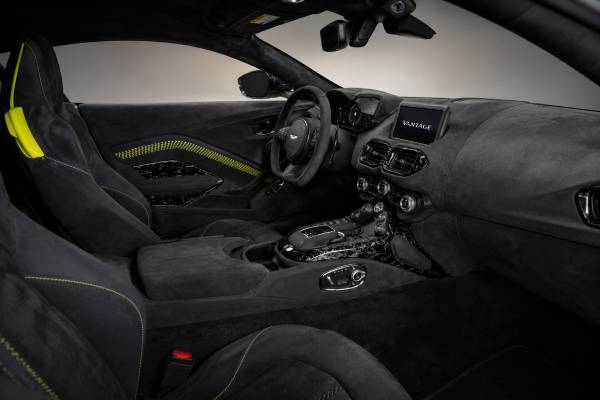
Styling announced the change as clearly as the engineering. The low nose, broad grille, side strake, continuous rear light graphic, rising diffuser, and pronounced rear haunches gave the car a more aggressive stance. Inside, the cabin mixed Aston leather and switchgear with a Mercedes-derived infotainment controller and display. The latter was functional but already behind touch-driven rivals and became the most visibly dated part of the car by 2023.
The standard coupé remained the range foundation while Roadster, AMR, F1 Edition, special colour themes, and regional packages appeared. These derivatives may share the 503-hp description but differ in gearbox, torque, aero, suspension, brakes, wheels, seats, mass, and production status. A used advertisement that says only “Vantage 4.0” does not provide enough information. The VIN, factory specification, and exact model year must lead every evaluation.
Core specifications
The following data describes the standard 2018–2023 503-hp automatic coupé in representative factory form. Options, homologation, tyres, emissions equipment, and measurement standards can alter published figures.
Engine
| Configuration | Front-mid-mounted 90-degree twin-turbocharged V8 |
|---|---|
| Displacement | 3,982 cc |
| Valvetrain | 32 valves, dual overhead camshafts |
| Maximum power | 510 PS / 503 bhp / 375 kW at 6,000 rpm |
| Maximum torque | 685 Nm from approximately 2,000–5,000 rpm |
| Induction | Twin turbochargers with charge-air cooling |
| Fuel | Premium unleaded to regional handbook specification |
Transmission and performance
| Transmission | Eight-speed ZF automatic rear transaxle |
|---|---|
| Drive | Rear-wheel drive |
| Differential | Electronically controlled rear differential |
| 0–60 mph | Approximately 3.5 seconds under the applicable factory convention |
| 0–62 mph | Approximately 3.6 seconds |
| Maximum speed | 195 mph |
| Shift control | Automatic modes and steering-column paddles |
Structure and chassis
| Body structure | Bonded aluminium with aluminium and composite exterior panels |
|---|---|
| Front suspension | Independent double wishbones |
| Rear suspension | Independent multi-link layout |
| Dampers | Adaptive system with mode-dependent calibration |
| Steering | Electric power-assisted rack and pinion |
| Weight distribution | Approximately 50:50 |
| Minimum dry weight | Approximately 1,530 kg |
Brakes, wheels, and tyres
| Front brakes | 400 mm ventilated steel discs with multi-piston calipers |
|---|---|
| Rear brakes | 360 mm ventilated steel discs |
| Standard wheel diameter | 20 inches |
| Front tyres | 255/40 ZR20 |
| Rear tyres | 295/35 ZR20 |
| Optional brake note | Carbon-ceramic systems appeared on selected specifications and derivatives |
Dimensions and practicality
| Length | 4,465 mm |
|---|---|
| Width excluding mirrors | 1,942 mm |
| Height | Approximately 1,273 mm |
| Wheelbase | 2,704 mm |
| Fuel capacity | Approximately 73 litres in launch specification |
| Luggage capacity | Approximately 350 litres |
| Seating | Two |
Fuel-tank figures and other data can differ among official documents and later market specifications. Do not mix Roadster, AMR, F1 Edition, or facelift numbers with a standard coupé simply because the engines share displacement.
Aston-calibrated M177 powertrain
The Vantage’s M177-based engine is defined by broad torque and thermal density. It produces effortless speed at modest rpm, but its turbochargers, cooling circuits, electronics, and exhaust demand a better maintenance record than a simple “Mercedes engine” label implies.
The turbochargers sit within the V of the engine, shortening the exhaust path and improving response. That hot-V arrangement concentrates heat near intake, coolant, oil, wiring, and control components. Aston Martin’s airflow paths, bonnet vents, cooling pack, fans, shields, and software manage the load. Missing undertrays, blocked radiators, damaged ducts, or non-standard tuning can upset the system even when the engine appears healthy on a brief drive.
A sound engine should start quickly, idle cleanly, build boost without hesitation, and pull consistently to the upper rev range. Persistent smoke, misfire, surging, unexplained oil consumption, coolant odour, boost faults, or abnormal turbo noise deserve diagnosis. These symptoms do not prove one specific failure: ignition, injectors, air leaks, sensors, charge pipes, fuel quality, software, turbo hardware, or low voltage can overlap.
Service evidence should identify oil specification and interval. Turbocharged engines expose oil to high local temperature, so low annual mileage is not a reason to ignore time-based changes. Inspect for seepage around covers, filter and cooler areas, turbo lines, hoses, and the underside. Recheck after the engine has been driven to full temperature because a freshly cleaned undertray can hide a small leak during a static viewing.
The cooling system should be assessed under load and in traffic. Examine radiator and condenser faces through the grille, looking for stone impact, bent fins, leaves, and corrosion. Confirm both fan operation and stable temperatures after a sustained drive. Check reservoirs, caps, hose junctions, charge-air circuits, and dried residue. A history of coolant top-ups needs a pressure test and an explanation.
Engine software matters. Aftermarket calibrations can raise boost and torque beyond the assumptions used for cooling, gearbox, differential, tyres, and emissions systems. Some modifications are professionally engineered; others are anonymous files installed for a sales claim. Scan control-unit identification, compare it with documentation, and confirm whether the car can be returned to an approved state. Insurance and local inspection consequences should be understood before purchase.
The exhaust system shapes the Vantage’s sound through valves and mode logic. Rattles may come from valves, mounts, shields, or contact rather than the engine. Inspect for cracks, poor welding, damaged catalysts, and non-standard sections. A louder system is not automatically better if it creates resonance, warning lights, excess heat, or legal problems.
The ZF transaxle is smooth and fast when healthy. It should engage drive and reverse without a long delay, shift cleanly at low load, respond promptly to paddles, and remain consistent when hot. Harshness may come from software adaptations, mounts, fluid condition, driveline joints, differential behaviour, or the gearbox itself. Verify the service approach for the exact car rather than accepting “sealed for life” as an inspection result. Documented fluid work must use the correct procedure and material.
Electronic differential and chassis modes
The electronic differential is what makes the second-generation Vantage behave differently from its mechanical-LSD predecessors. It can vary locking rapidly and coordinate with the car’s dynamic systems, but that capability depends on sensors, software, tyres, fluid, and battery voltage.
Sport, Sport Plus, and Track modes alter throttle response, shift strategy, exhaust, damping, steering weighting, differential control, and stability thresholds. Every mode should select without warnings and produce a perceptible change. A mode selector that works visually but leaves damper or differential faults stored in another module is not fully functional; a complete diagnostic scan is essential.
On the road, the standard car should feel stable and accurate rather than nervous. The steering is electrically assisted and less textured than the old hydraulic system, but it should remain consistent around centre and build effort smoothly. Pulling, tramlining, or an off-centre wheel may indicate tyre wear, pressure differences, poor alignment, bent wheels, or suspension damage. The broad tyres make small setup errors noticeable.
Adaptive dampers should control one body movement after a bump. Repeated bouncing, impact harshness on one corner, fluid leakage, or no difference between modes calls for inspection. Wiring and sensors can fail independently of the damper body. Look at mounts, arms, bushes, links, and fasteners as well as electronic fault codes.
The electronic differential needs four closely matched tyres. Significant differences in brand, model, circumference, wear, or pressure make the control system work around an avoidable inconsistency. Inspect all date codes and the inner tread. The rear tyres can wear rapidly under torque, while low-mileage examples may age and flat-spot. Replacement cost should be included in the purchase calculation if the set is mixed or old.
Standard steel brakes are large and effective but not inexpensive consumables. Measure disc thickness, inspect for cracking, scoring, corrosion, and pad deposits, and check caliper and hose condition. A car parked after washing can develop surface corrosion; one stored for months may have pads bind or leave uneven deposits. Brake vibration can also come from hub or suspension issues.
Cars with optional carbon-ceramic brakes require a different assessment. Disc condition may be judged by manufacturer-specific criteria including weight and visual inspection, not merely thickness. Confirm that the system is factory fitted, uses compatible pads, and has not suffered impact or unsuitable cleaning. Do not value a ceramic-equipped car without a specialist report on the remaining life.
The chassis can tolerate circuit work, and some cars will have been used as intended. Track history is acceptable when preparation and follow-up are documented. Look for overheated tyres, edge wear, wheel damage, brake cracking, gravel rash beneath the car, altered alignment, fluid changes, and aftermarket pads. A concealed excursion is more concerning than honest, properly maintained track use.
Model years, options, and derivatives
The 2018–2023 standard Vantage changed less in headline output than in detail. Equipment, option packaging, colour programmes, software, and related derivatives evolved, so year alone should not substitute for a build sheet.
Launch cars established the 503-hp automatic formula and often carry distinctive early colour and trim combinations. As production matured, software updates and running changes addressed calibration or functionality through normal factory processes. A later car is not automatically problem-free, and an early car with all campaigns, updates, and careful service may be preferable to a neglected late one.
The infotainment system came from an earlier Mercedes generation and uses a rotary controller rather than the integrated touch interface introduced on later Aston products. It provides navigation, media, Bluetooth, and vehicle functions but now feels dated. Test every function, screen pixel, controller input, USB connection, audio channel, camera, and parking sensor. Smartphone integration may depend on market, year, option, or retrofit; obtain documentation for non-factory upgrades.
Seat designs, leather treatments, carbon trim, wheels, exterior packs, audio, and convenience equipment can materially affect desirability. Lightweight seats may improve driving position and support but can reduce adjustment or comfort. Dark wheels may hide repairs, and carbon exterior parts can suffer low-speed damage. Factory protective film, if fitted, should be assessed for lifting, yellowing, trapped dirt, and removal risk.
The 2019 AMR is a separate 200-car manual model with reduced torque, mechanical differential, carbon-ceramic brakes, and lower mass. Later manual availability in some markets should also be identified separately from the standard eight-speed automatic covered here. Never use the presence of a clutch pedal alone to label a car AMR.
The F1 Edition introduced after Aston Martin’s return as a Formula 1 safety-car supplier added power, aero, chassis tuning, wheel and tyre changes, and its own visual specification. It is not a standard 503-hp car even when an advertisement places it in the same search results. Roadsters differ in structure, roof mechanism, luggage packaging, mass, and weather-sealing concerns.
Special Q by Aston Martin finishes and regional editions may be legitimate and valuable, but they increase the need for documentation. A rare-looking colour combination can also be a later wrap, repaint, or retrim. Confirm paint code, trim code, option list, production designation, and original invoice.
By 2023, the original interior and exterior generation was approaching replacement. The substantially revised high-output Vantage launched afterward should not be mixed into specifications or parts assumptions. The 2018–2023 car has its own appeal as the first turbocharged series Vantage and the final version with this Mercedes-derived cabin architecture.
Maintenance and diagnostic baseline
A used Vantage should be brought to a documented baseline immediately unless the records already prove one. Modern electronics do not reduce the need for physical inspection; they add another layer.
Battery and charging: Voltage stability is the first diagnostic check. A weak battery can trigger faults across engine, transmission, differential, dampers, security, and infotainment modules. Load-test it, verify charging output, inspect terminals and grounds, and ask how the car was stored. A conditioner should be correct for the fitted battery chemistry. Repeated jump-starting can create more questions than it answers.
Whole-car scan: Read every module before clearing anything. Save fault status, occurrence count, mileage where available, and freeze-frame information. A dashboard without warnings can still contain intermittent or recently erased faults. Confirm software campaigns and updates through an Aston-capable source.
Fluids and filters: Require dates and specifications for engine oil, coolant, brake fluid, transmission service where applicable, differential fluid, and filters. Service-book stamps rarely show enough detail. Time matters because moisture, corrosion inhibitors, and additive packages age while the car sits.
Cooling and air conditioning: Clean the cooling pack carefully, test fans, inspect hoses and reservoirs, and verify cabin cooling at idle and on the road. Condenser damage can affect air conditioning independently of engine cooling, but both share the vulnerable front opening. A warm cabin may be a refrigerant leak, compressor problem, control issue, or airflow fault rather than a simple recharge.
Body and water management: Bonded aluminium does not make the car corrosion-proof. Steel fasteners, brackets, subframes, brake lines, exhaust supports, and dissimilar-metal interfaces can deteriorate. Inspect the underside, wheel wells, jacking points, doors, hatch seals, scuttle drains, and carpets. Water in the cabin or luggage area can damage connectors and modules.
Tyres, wheels, and alignment: Examine all four inner shoulders, wheel barrels, rim edges, and date codes. Bent 20-inch wheels can balance acceptably yet create vibration or alignment symptoms. Check geometry after confirming that no joints are worn or bent. Retain a printout for future comparison.
Brakes and suspension: Measure rather than estimate. Record disc thickness or ceramic condition, pad depth, fluid date, caliper health, damper leakage, bush play, and wheel-bearing condition. Test the parking brake and all dynamic modes. A seller’s recent inspection may not include quantitative measurements.
Cabin and security: Operate both keys, alarm, windows, mirrors, seats, climate control, lighting, cameras, parking aids, infotainment, audio, and hatch release. Check leather shrinkage, stitching, headlining, trim rattles, and switch damage. Cosmetic parts can be surprisingly expensive and may be harder to source in a rare colour.
A good annual service produces a report that can be compared with the previous year. Trends—small coolant loss, increasing clutch adaptations on a manual derivative, worsening disc condition, a recurring voltage fault, or alignment drift—are more informative than isolated snapshots.
The used-buying decision
Choose a 2018–2023 Vantage by total condition and intended use, not by the lowest advertised price. Its performance is accessible enough for daily driving, but repair costs remain those of a low-volume luxury sports car.
Start remotely. Obtain the VIN, factory specification, service invoices, ownership history, accident and finance checks appropriate to the country, both keys, manuals, and records of campaigns or software. Ask directly about paintwork, protective film, wheels, tyres, brakes, coolant, oil leaks, warning messages, tuning, exhaust, track days, and storage. Specific answers can be verified; “perfect condition” cannot.
View the car dry and in daylight. Inspect paint consistency, panel gaps, grille and cooling openings, lamp mounts, splitter, sills, diffuser, undertrays, hatch, seals, wheel arches, and fasteners. The wide nose and low aero collect stone damage. Honest chips are preferable to fresh paint that hides an unexplained repair, but high-quality documented work is not automatically disqualifying.
Inside, compare wear with mileage and use. Check seat bolsters, steering wheel, paddles, pedals, controller, switchgear, carpets, hatch area, and headlining. Confirm that all warning lamps appear during self-test and then clear. Smell for dampness or coolant and look for evidence of rushed detailing around seams.
The engine must be cold for the first start. Observe idle, smoke, fan behaviour, messages, and noises. Drive long enough to heat every system. Test gentle automatic shifts, manual paddle commands, full-throttle response where safe, differential behaviour, all chassis modes, straight-line braking, steering on smooth and rough roads, climate control, and low-speed parking. Reinspect the underside and engine bay hot.
Commission a marque-specialist pre-purchase inspection. It should include a full scan, battery test, lift examination, cooling check, leak assessment, tyre and wheel report, brake measurement, suspension test, road test, software and campaign review, and photographs. Ask for costed priorities rather than a binary pass or fail.
Calculate the real first-year figure: purchase, tax, insurance, tyres, service, transport, storage, brake or cooling work, and contingency. A more expensive car with fresh matching tyres, measured brakes, clean diagnostics, and complete servicing can be the cheaper purchase. A very low-mileage example may need more recommissioning than a regularly exercised car.
The standard automatic Vantage is the broadest version of this generation. It can commute, tour, carry luggage, and deliver serious performance without the limited AMR’s dogleg learning curve or the F1 Edition’s more specialised setup. Its weakness is not a lack of speed but the temptation to buy one as a discounted luxury object. It should be maintained as a 195-mph car.
When the history, diagnostics, tyres, cooling, brakes, and body all agree, the 2018–2023 Vantage is a compelling modern Aston: compact enough to feel special on ordinary roads, practical enough for a journey, and powerful enough that performance never becomes routine. The best example is not necessarily the newest. It is the one whose condition can be demonstrated system by system.
References
- Introducing the new Vantage: the successor to a true sporting dynasty (2017)
- Vantage Hyper Red Press Kit (model press kit)
- Aston Martin Vantage | PH Used Buying Guide (2021)
- 2023 Aston Martin Vantage Review, Pricing, and Specs (2023)
- 2020 Aston Martin Vantage Review & Ratings (2020)
- Aston Martin Vantage review, prices and specs (model review)
Disclaimer
Specifications, options, software, service schedules, performance figures, and fault patterns can vary by country, model year, derivative, and VIN. This article is general educational information and does not replace the owner’s handbook, official workshop data, diagnostic testing, campaign checks, professional repair advice, or a specialist pre-purchase inspection. Confirm all fluids, parts, tyre approvals, brake procedures, torque values, lifting points, and safety-critical work with current Aston Martin information for the specific vehicle.
Please share this guide on Facebook, X/Twitter, or an Aston Martin owners’ group if it helps another driver assess the 2018–2023 Vantage carefully.