

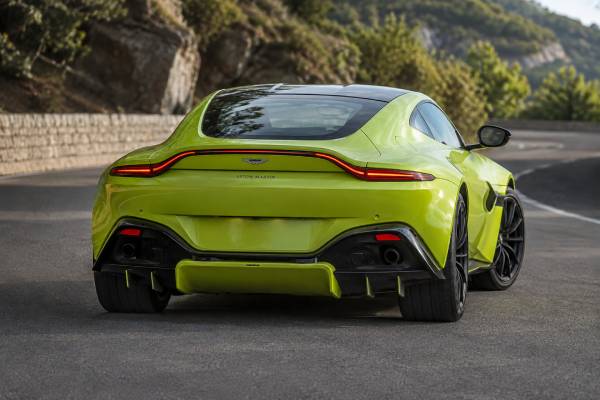
The 2024 Aston Martin Vantage was more than a facelift. Aston Martin raised the 4.0-liter twin-turbo V8 to 665 PS, or 656 bhp, widened the body, redesigned the cooling system, strengthened the bonded-aluminum structure, and replaced the aging cabin electronics with its own 10.25-inch touchscreen platform. The result kept the familiar AM6 architecture but changed nearly every part that shapes speed, steering, braking, comfort, and daily usability.
This guide focuses on the 656 hp launch specification introduced in 2024 and carried into subsequent markets before later output updates. That distinction matters because current brochures or configurators may show revised power figures for newer builds. Buyers should confirm the exact calibration by VIN and factory record rather than assuming every visually similar 2024–2026 coupe has identical output. Beyond the headline power, the car’s real advances lie in thermal capacity, Bilstein DTX dampers, electronic differential control, bespoke Michelin tires, and a much more modern cabin.
Table of Contents
- What changed for the 2024 reinvention
- 656 hp launch specifications and technical data
- Powertrain, gearbox, and thermal engineering
- Active chassis and driver-control systems
- Interior, infotainment, and everyday use
- Maintenance strategy and wear priorities
- Model-year verification and buying checks
What changed for the 2024 reinvention
The 2024 car kept the AM6’s front-engine, rear-transaxle foundation, but it was re-engineered deeply enough to feel like a new generation in use. Power increased by 155 PS and torque by 115 Nm over the outgoing standard V8, while the body, suspension mounts, cooling package, steering connection, brakes, tires, electronics, and interior all changed.
The familiar 3,982 cc V8 received modified cam profiles, an optimized compression ratio, larger turbochargers, and extensive calibration work. Output rose to 665 PS, equivalent to 656 bhp, with 800 Nm of torque. The eight-speed ZF transaxle gained a shorter 3.083 final-drive ratio and faster, mode-dependent shift logic. Aston Martin claimed 0–60 mph in 3.4 seconds and 202 mph at the top end.
The body became 30 mm wider, and the front was reshaped around a grille aperture 38 percent larger than before. The redesign was not only visual. Aston Martin said the new front arrangement increased mass airflow by 29 percent, while the thermal system sent 50 percent more cold air to the radiators. Larger turbochargers and higher cylinder output would be of limited value if intake temperature or oil temperature forced the engine to reduce power after repeated acceleration.
Structural changes were equally important. A repositioned front cross member improved suspension-mount stiffness, a lighter but stiffer engine-bay brace tied the front towers together, and rear-tower strengthening raised lateral stiffness under cornering load by 29 percent. Revised undertrays also contributed to lateral rigidity. These changes give the dampers and steering a more stable platform rather than asking software to compensate for body movement.
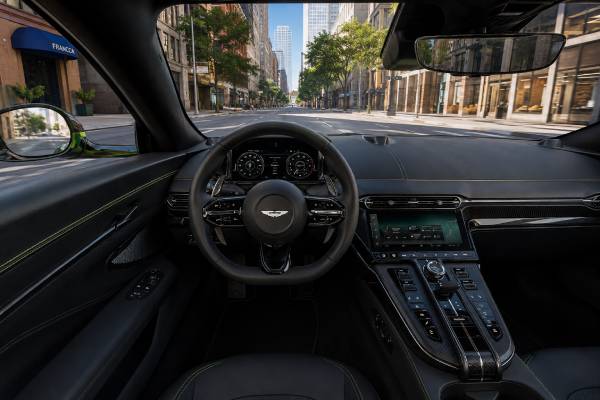
The interior addressed one of the early AM6’s clearest weaknesses. The previous Mercedes-derived interface gave way to an Aston Martin-developed system with a 10.25-inch capacitive touchscreen, digital displays, connected services, a companion app, and wireless smartphone functions in supported markets. Physical controls remain for gear selection, climate, chassis, exhaust, stability settings, lane assistance, and parking systems.
This model scope needs one clarification. The 656 hp figure identifies the original 665 PS launch calibration. Aston Martin’s current-market pages can show later 680 PS or 670 bhp data on visually similar base Vantage models. Production dates, market homologation, software, and model-year updates can therefore matter more than the registration year. This article does not combine those later outputs with the launch specification.
Technical data for the 656 hp launch car
The launch-version Vantage Coupe is a gasoline-only sports car with a front-mid-mounted V8, rear-mounted automatic transaxle, rear-wheel drive, and electronically controlled limited-slip differential. Its defining engineering figures are 665 PS, 800 Nm, a 3.083 final drive, 21-inch forged wheels, bespoke Michelin Pilot Sport S 5 tires, and a nominal 50:50 weight distribution.
| Specification | Value | Notes |
|---|---|---|
| Engine | 3,982 cc twin-turbocharged V8 | Hand-built, front-mid-mounted |
| Engine family | M177-based | Aston Martin hardware and calibration |
| Induction | Twin turbochargers with water-to-air charge cooling | Larger turbos than the outgoing 503 hp car |
| Maximum power | 656 bhp (489 kW / 665 PS) | 2024 launch calibration |
| Maximum torque | 800 Nm (590 lb-ft) | Manufacturer figure |
| Fuel tank | 73 liters (19.3 US gal) | Premium unleaded; follow market octane guidance |
| Specification | Value | Condition |
|---|---|---|
| Transmission | ZF eight-speed automatic transaxle | Mode-dependent shift calibration |
| Drive type | Rear-wheel drive | Electronic rear differential |
| Final-drive ratio | 3.083:1 | Shorter than the preceding standard Vantage |
| 0–60 mph | 3.4 seconds | Manufacturer claim with launch control |
| Maximum speed | 325 km/h (202 mph) | Manufacturer claim |
| E-diff response | Full lock in 135 ms; corrective response as fast as 60 ms | Manufacturer system description |
| Component | Specification |
|---|---|
| Front suspension | Unequal-length double wishbones, coil springs, Bilstein DTX adaptive dampers |
| Rear suspension | Multi-link axle, coil springs, Bilstein DTX adaptive dampers |
| Steering | Electric assistance, non-isolated column, constant 12.8:1 ratio |
| Steering travel | 2.27 turns lock to lock |
| Front wheels | 9.5J × 21 forged alloy |
| Rear wheels | 11.5J × 21 forged alloy |
| Front tires | 275/35 R21 Michelin Pilot Sport S 5, AML specification |
| Rear tires | 325/30 R21 Michelin Pilot Sport S 5, AML specification |
| System | Front | Rear |
|---|---|---|
| Standard steel brakes | 400 mm drilled cast-iron discs, six-piston calipers | 360 mm drilled cast-iron discs, four-piston calipers |
| Optional carbon-ceramic brakes | 410 mm carbon-ceramic discs | 360 mm carbon-ceramic discs |
| CCB mass benefit | 27 kg reduction in unsprung mass compared with the steel system | |
| Control support | Integrated Brake Slip Control and brake-based slip vectoring | |
| Specification | Value |
|---|---|
| Body type | Two-door, two-seat coupe |
| Length | 4,495 mm (177.0 in), including number-plate plinth |
| Width | 1,980 mm (78.0 in) excluding mirrors; 2,124 mm (83.6 in) including mirrors |
| Height | 1,275 mm (50.2 in) |
| Wheelbase | 2,705 mm (106.5 in) |
| Ground clearance | 94 mm (3.7 in) |
| Weight distribution | 50:50 front to rear |
| Turning circle | 12.0 m (39.4 ft) |
| Feature | Specification |
|---|---|
| Central display | 10.25-inch capacitive Pure Black touchscreen |
| Standard audio | 390 W, 11 speakers |
| Optional audio | Bowers & Wilkins, 1,170 W, 15 speakers |
| Connectivity | Embedded e-SIM, connected navigation, companion app, supported wireless smartphone integration |
| Driver controls | Physical switches retained for key climate, chassis, exhaust, ESP, and transmission functions |
| Traction adjustment | Eight-step Adjustable Traction Control when the relevant mode is selected |
Why the powertrain needed a new thermal system
The largest engineering challenge was sustaining 665 PS, not merely producing it for one acceleration run. Larger turbochargers and higher airflow increase heat in the intake charge, engine oil, coolant, exhaust, and under-bonnet environment, so Aston Martin redesigned the cooling package rather than relying on a more aggressive software tune alone.
An additional low-temperature radiator was added to the charge-cooler water circuit. Two auxiliary coolers joined the central main radiator, and the outboard engine-oil cooler gained roughly twice the face area of the previous component. The larger grille and revised airflow path increased the volume of cold air reaching the heat exchangers by 50 percent according to the launch material.
For owners, those details make radiator condition and unobstructed airflow important. Leaves, road debris, bent fins, careless paint-protection film, damaged undertrays, or aftermarket mesh can reduce cooling efficiency. A visual inspection through the grille is useful, but a workshop should also inspect hidden cooler faces and the space between stacked heat exchangers where dirt can accumulate.
The V8’s modified cam profiles, compression strategy, turbo hardware, and calibration produce a sharper response while retaining a broad 800 Nm plateau. The shorter final drive makes the car feel more urgent at ordinary speed and increases the frequency of gear changes compared with a taller ratio. Shift programming changes with drive mode, so a harsh Track-mode upshift does not necessarily indicate a fault; delayed engagement, flare, repeated clunks, or inconsistent behavior in normal mode does.
Launch Control coordinates the engine, gearbox, electronic differential, stability system, and wheel-slip target. Adjustable Traction Control lets an experienced driver alter permitted slip, but it is not a substitute for tire temperature, surface quality, or judgment. Repeated launches place high loads on rear tires, driveshafts, differential clutches, transmission fluid, and engine mounts. A used car’s launch history is rarely displayed as a simple number, so tire condition, diagnostic records, and driveline behavior provide more useful evidence.
The 2024 car remains a conventional ICE model without hybrid assistance. All acceleration energy comes from gasoline and the rear tires. That simplicity appeals to some enthusiasts, but fuel consumption and emissions reflect the output. Real-world range changes dramatically with traffic, temperature, drive mode, and throttle use. The 73-liter tank supports touring, though premium fuel availability should be planned on remote routes.
Owners should distinguish temperature from pressure and level. A normal coolant gauge does not prove that charge-air temperature or gearbox temperature is ideal for repeated full-power use. Warm the complete driveline progressively, and after a demanding run use an easy final section to restore airflow and reduce thermal concentration before shutdown.
How the active chassis creates usable speed
The new chassis systems are designed to make 800 Nm manageable, not to remove the driver. The Bilstein DTX dampers, electronic differential, 6D inertial sensor, brake controls, steering, and stability logic share information so the car can respond consistently across smooth tracks, broken roads, and wet surfaces.
The DTX dampers offer a 500 percent broader force-distribution bandwidth than the outgoing hardware. That does not mean the suspension is five times stiffer. It means the control system can choose from a much wider range of damping force and react more quickly. Soft settings can permit wheel movement over poor surfaces, while firmer settings control roll, pitch, and heave when grip and road quality support them.
A non-isolated steering column gives the rack a direct mechanical path to the driver’s hands. The 12.8:1 constant ratio is quick, but speed-sensitive assistance changes effort. Correct alignment, matched tires, and undamaged wheels are therefore critical. A car that tramlines excessively, pulls under braking, or has an off-center steering wheel may have tire or geometry problems rather than an inherent “race-car” character.
The electronic differential can move from open to fully locked in 135 milliseconds and can make faster corrective changes when used as a dynamic control device. In a tight corner it can help rotation; in a faster bend it can emphasize stability. Integrated traction and brake-slip systems coordinate engine torque, individual brake pressure, and differential locking so interventions are smoother than a simple brake-only strategy.
Adjustable Traction Control offers eight steps after yaw control is disabled in the relevant setting. Lower numbers provide more on-throttle restraint, while higher numbers allow greater slip. This is advanced functionality intended for controlled conditions. The safest public-road choice remains the full stability mode suited to weather and surface. A driver learning the system should do so at a professional venue, not on a narrow road with traffic and fixed obstacles.
The AML-coded Michelin Pilot Sport S 5 tires are part of the calibration. Their construction, compound, and breakaway behavior were developed with Aston Martin. Replacing them with a tire of identical size but different specification can change steering response, wet behavior, and electronic-control assumptions. Tire age, heat cycles, and inner-shoulder wear matter as much as central tread depth.
Standard steel brakes are a rational choice for frequent road use. They offer strong performance, a familiar cold response, and lower replacement cost than ceramics. Optional carbon-ceramic brakes remove 27 kg of unsprung mass and resist repeated high temperatures, but their rotors require specialist inspection and careful wheel handling. The correct choice depends on use, not on which option sounds more exotic.
A modern cabin with physical controls
The interior is one of the strongest reasons to choose the 2024 redesign over an earlier AM6. It replaces the previous interface with a cohesive Aston Martin system while keeping tactile switches for actions drivers use frequently.
The 10.25-inch touchscreen supports multi-finger gestures, online navigation, live traffic, satellite mapping, connected destination search, and companion-app functions where subscriptions and regional services permit. Wireless smartphone integration was part of the rollout, but availability can depend on software version, market, and device. A buyer should test the exact phone and account rather than relying on a brochure.
Physical transmission buttons remain on the center console, alongside climate controls and direct switches for chassis, exhaust, stability, lane assistance, and parking sensors. This arrangement reduces the need to navigate menus while driving. It also creates many individual controls that should be tested during a pre-purchase inspection; a beautifully trimmed cabin does not guarantee that every switch, display, camera, or connected service works.
The standard 390 W audio system uses 11 speakers. The optional Bowers & Wilkins system increases output to 1,170 W and 15 speakers. Audio preference is personal, but option cost should not outweigh seat fit, driving position, visibility, and the condition of high-touch surfaces. Carbon-shell seats can improve support and reduce mass, while powered comfort seats are easier for multiple drivers.
Connected services introduce ownership considerations absent from the earlier car. The app, e-SIM, account credentials, privacy settings, subscriptions, and remote functions must transfer correctly when the car changes hands. The seller should remove personal data, and the buyer should establish a new Aston Martin account through the approved process. A factory reset without proper account release can complicate activation.
The cabin is still a low two-seat sports-car environment. Door openings, sill height, limited storage, and rear visibility require adjustment. The 94 mm ground-clearance figure also makes steep entrances and speed humps a practical issue. Front-lift availability and configuration should be confirmed on the individual car rather than assumed.
Maintenance strategy and wear priorities
The right service strategy starts with the VIN-specific schedule and adds condition checks for a high-output, low-clearance sports car. Annual attention remains sensible even when mileage is low because oil, brake fluid, battery condition, tires, software, seals, and cooling components age with time.
A routine workshop visit should include a complete diagnostic scan, open-campaign check, engine-oil service when due, cooling-system inspection, battery test, brake measurement, tire and alignment review, underbody inspection, and confirmation that infotainment and driver-assistance software are current. Keep the report, not only the invoice total.
Radiator and oil-cooler cleanliness deserves special emphasis. The larger grille admits more air and more debris. Inspect the heat exchangers after long tours, autumn driving, or roadworks. Bent fins should be corrected with appropriate tools, and cleaning must avoid pushing dirt deeper between cooler layers. Any coolant odor, residue, warning, or unexplained level change needs prompt diagnosis.
The V8’s oil specification and quantity should come from current factory documentation for the exact build. Do not transfer values from the 2020–2023 503 hp car merely because both engines are M177-based. Turbo, calibration, sump, cooling, and service revisions can alter requirements. The electronic level procedure must be followed on level ground and at the prescribed temperature.
Tires may wear heavily at the inner shoulders, especially if alignment has shifted or the car sees frequent fast cornering. Record tread depth at several points, inspect date codes, and replace axle pairs with matching approved tires. A puncture repair may be technically possible in a limited tread area, but speed rating, manufacturer guidance, and intended use determine whether replacement is safer.
Brake checks differ by system. Steel discs should be measured for thickness, runout, cracking, and lip; pad condition must be assessed on both sides of each caliper. Carbon-ceramic discs require the factory method, which may include visual, dimensional, and condition criteria. Ceramic replacement cost should be reflected in any purchase decision.
A maintenance charger is useful for cars parked for weeks. Low voltage can create multiple network warnings, interrupt software operations, and cause confusing symptoms. Use the approved charging points and mode, and test a battery that repeatedly discharges rather than masking the problem with constant boosting.
Track use shortens inspection intervals. Check wheel fasteners, pressures, tread, brake fluid, pads, discs, leaks, undertrays, and suspension joints before and after each event. Heat cycles can reduce a tire’s grip before it reaches the legal tread limit. Document track preparation and post-event work; transparent evidence is better than a seller’s vague denial.
How to verify and buy the right model
The first buying task is to establish exactly which calibration and model-year specification the car has. The 656 hp launch version, later 680 PS base cars, and 680 PS Vantage S can appear closely related, so registration date and exterior appearance are not enough.
Request the factory build sheet and confirm VIN, production date, market, engine output, software level, wheel and brake package, seats, audio, exterior options, and any Q by Aston Martin content. If the seller describes a software power upgrade, obtain the invoice, approval, warranty position, and original calibration status. An undocumented tune should reduce confidence, not increase value.
Inspect the body for low-speed damage. The front splitter, undertrays, wheel rims, side sills, and rear diffuser sit close to the road. Scrapes are common, but broken mounting points, crushed underbody panels, or poor carbon repairs can be costly. Check paint depth and panel alignment, especially around the widened front end and clamshell bonnet.
A thorough road test should begin cold and include city speed, open-road acceleration, steady cruising, braking, tight turns, and rough surfaces. The engine should start cleanly, the gearbox should select Drive and Reverse promptly, steering should remain centered, and the dampers should make clear but controlled changes between settings. Investigate rattles, repeated warning messages, harsh driveline engagement, or cooling fans that behave abnormally.
Test every electronic function. Pair a phone, load navigation, use cameras and sensors, adjust seats and mirrors, check climate output, operate the app where possible, and verify both keys. Confirm that connected services can transfer to a new owner. A failed account handover can be less dramatic than an engine fault but still make an expensive modern car frustrating.
Use a specialist to scan all modules and compare faults with service records. Recently cleared codes can reappear after a drive cycle, so scanning before and after the road test is useful. Ask an authorized retailer to check campaigns and recalls by VIN, then compare the completion status with invoices and public recall databases.
Finally, price the actual condition. A desirable color, ceramic brakes, carbon seats, or premium audio may add appeal, but old tires, worn rotors, damaged film, overdue service, weak battery, or incomplete software work can consume that premium quickly. The best 656 hp Vantage is the one whose exact specification is proven and whose engineering upgrades have been maintained as carefully as its appearance.
References
- Introducing new Vantage: Engineered for real drivers 2024
- Vantage | V8 Performance Sportscar | Aston Martin USA 2026 (Model Overview)
- Vantage Quick Start Guide | Aston Martin USA 2026 (Quick Start Guide)
- Owner’s Guides | Car Ownership | Aston Martin (UK) | Aston Martin UK 2026 (Owner’s Guides)
- Aston Martin Luxury Car Servicing | Aston Martin (UK) | Aston Martin UK 2026 (Servicing)
- Check for Recalls: Vehicle, Car Seat, Tire, Equipment | NHTSA 2026 (Recall Database)
Disclaimer
This article offers general information, not professional diagnosis or repair instruction. Output, specifications, tightening values, service intervals, software, and procedures may differ by VIN, market, production date, and installed equipment, so confirm all critical details in the official service information for the specific Vantage.
Please share this guide on Facebook, X/Twitter, or a relevant owners’ group if it helped you understand the 656 hp Vantage and supports your research.